
ASHRAE 90.1 Office LED Retrofits: Why Wattage Sets the Budget
Office LED retrofit economics depend on adopted lighting power limits, verified input watts and controls—not fixture efficacy alone.

What Changed — and Why It Matters Now
At XHLWX (led-project-light.com), a Custom Indoor LED Lighting Manufacturer based in China, the engineering question behind an office LED retrofit is not simply how many lumens a replacement delivers. It is whether the complete lighting design fits the locally adopted lighting power allowance, maintains usable illumination and produces defensible operating savings. For US contractors and European specifiers supplying US projects, those are three separate checks.
The relevant change is the tightening of lighting power allowances across editions of ANSI/ASHRAE/IES Standard 90.1—not a single nationwide retrofit deadline. Under the Building Area Method, Table 9.5.1 lists an office lighting power density, or LPD, of 0.79 W/ft² in the 2016 edition and 0.64 W/ft² in the 2019 edition.
That is approximately a 19% reduction in the listed allowance. These values are edition-specific references, not universal limits for every office project.
The practical news angle is procurement: a replacement that looks efficient against an old fluorescent installation can still be unsuitable for the applicable power budget, control requirements or visual task. Conversely, an existing installation above a newer allowance does not automatically create a legal obligation to replace it. Alteration provisions, project scope and local adoption determine the requirements.
Before ordering, identify the jurisdiction, adopted code edition, local amendments and permitted compliance method. Use the DOE state energy-code adoption resource as a starting point, then confirm requirements with the authority having jurisdiction. A state summary alone may not resolve municipal amendments or an individual permit's treatment.
The Technical Detail Behind the Headline
LPD expresses lighting input power per unit floor area. For a simplified Building Area Method calculation, a 10,000 ft² office assessed at 0.64 W/ft² has a 6,400 W interior lighting allowance. The complete calculation must follow the adopted standard's definitions, exemptions and power-accounting rules; it is not merely a count of LED modules.
Standard 90.1 distinguishes the Building Area Method in Section 9.5 from the Space-by-Space Method in Section 9.6. The latter uses classifications for individual spaces and associated provisions. Do not take an office building-area allowance and present it as the limit for every private office, corridor or meeting room.
The following schedule is an illustrative retrofit procurement brief, not a tested XHLWX product specification. The visual targets are separate from the energy-code allowance.
| Parameter | Illustrative specification or design target | Standard or verification route | Buyer note |
|---|---|---|---|
| Luminaire input power | 44 W per luminaire, including driver | Adopted 90.1 power-accounting rules; electrical test data | Confirm maximum configured input, not LED-board watts |
| Illuminance | 500 lx maintained on selected office task areas | Applicable workplace brief; EN 12464-1 where specified | State task plane, maintenance factor and uniformity |
| CCT and color rendering | 4000 K; CRI Ra ≥80 | Product spectral report | Design targets, not general ASHRAE requirements |
| TM-30 color rendition | Rf ≥85; Rg 95–105 | ANSI/IES TM-30 report | Request results for the offered LED and CCT combination |
| Glare and distribution | UGR ≤19 target; approximately 90° distribution | Room-based calculation and photometry | Neither beam angle nor a catalog UGR label proves room performance |
| Controls | DALI-2, Casambi or 0–10 V architecture | Adopted control provisions and functional testing | Specify occupancy, daylight and scheduling sequences separately |
| Housing and dimensions | IP20; nominal 1,200 mm linear housing | IEC 60529; approved mechanical drawing | Verify ceiling fit; IP20 is not a wet-location specification |
| LED and driver options | Samsung or Bridgelux LEDs; Tridonic or Mean Well driver | Approved bill of materials and model-specific documentation | Named brands are possible specified options, not confirmed fitted components |
| EU market documentation | CE, RoHS and applicable ErP documentation | Applicable EU legislation and declarations | Confirm exact model and whether it is a light source or containing product |
| Factory quality system | ISO 9001 certificate, if required by tender | Certificate scope, validity and issuing-body verification | ISO 9001 concerns management systems, not luminaire energy-code compliance |
Require IES and LDT photometric files corresponding to the offered optic, output and configuration. Use DIALux, or another accepted calculation platform, to test spacing, task illuminance and glare. A low connected load is not a successful retrofit if it creates dark workstations or forces supplementary lighting that changes the power calculation.
For source checking, consult the relevant edition of ASHRAE Standard 90.1, particularly Sections 9.1, 9.4, 9.5 and 9.6. Adoption and amendments matter more than which edition appears on a supplier's brochure.
What This Means for Specifiers and Buyers
How Should a Contractor Calculate the Office Lighting Power Budget Before Selecting Fixtures?
Begin with a surveyed schedule: luminaire quantities, verified input watts, served areas, operating hours and control zones. Record emergency, decorative and supplementary lighting separately so the designer can apply the adopted edition's inclusion and exemption rules correctly. For existing fluorescent equipment, lamp nameplate watts alone may omit ballast losses.
Consider an illustrative 10,000 ft² office with 100 existing luminaires drawing 96 W each. Existing connected power is 9,600 W, equivalent to 0.96 W/ft². Replacing them with 100 luminaires drawing 44 W gives 4,400 W, or 0.44 W/ft².
Against the example 2019 Building Area Method allowance of 6,400 W, that leaves 2,000 W before accounting for any other included lighting. This is arithmetic headroom, not permission to add lighting without review. The design still needs the applicable controls, documentation and visual-performance checks.
Do not assume ordinary occupancy dimming reduces connected wattage for the LPD calculation. Annual energy consumption and installed lighting power are different quantities. Any claimed power adjustment or limited-output treatment needs explicit support in the adopted rules and an accepted implementation.
When Do Lighting Controls Improve LED Retrofit Payback Rather Than Just Satisfy Code?
Controls produce additional savings when they reduce operating time or average power beyond the LED-only baseline. Their value depends on occupancy, daylight availability, zoning and commissioning—not the communication protocol alone.
For the illustrative office, assume 3,000 equivalent full-load hours annually and electricity at $0.15/kWh. Ignore HVAC interactions, demand charges, maintenance savings, incentives and financing for this first-pass estimate.
| Annual energy or cost item | Calculation | Illustrative result |
|---|---|---|
| Existing lighting electricity | 9.6 kW × 3,000 hours | 28,800 kWh |
| LED-only electricity | 4.4 kW × 3,000 hours | 13,200 kWh |
| LED-only savings | 28,800 − 13,200 | 15,600 kWh; 54.2% |
| LED-only electricity-cost savings | 15,600 × $0.15 | $2,340/year |
| Additional control savings assumption | 20% × 13,200 | 2,640 kWh/year |
| Combined electricity savings | 15,600 + 2,640 | 18,240 kWh; 63.3% |
| Combined electricity-cost savings | 18,240 × $0.15 | $2,736/year |
At an assumed installed LED-only cost of $18,000, simple payback is approximately 7.7 years. If controls add $2,000 and deliver the assumed 20% reduction from the LED baseline, their incremental simple payback is approximately 5.1 years.
Combined project payback is approximately 7.3 years. These are scenario estimates, not quotations or measured results.
The LED-only case is an economic comparator, not necessarily a compliant construction option. Mandatory controls belong in the base compliance scope. For discretionary upgrades, request a zone-level savings estimate and a commissioning plan before accepting a generic percentage claim.
What Must European Suppliers Change When Quoting a US Office Retrofit?
Translate the European specification into the destination project's requirements rather than simply changing voltage. Confirm the supply, such as 120 V or 277 V, the driver input range, dimming behavior, grounding arrangement and required safety listing or approval. CE marking does not replace US electrical approval requirements; LED equipment may require evaluation under applicable standards such as UL 1598 and UL 8750.
Keep photometric and electrical schedules synchronized. A higher-output driver substitution can change input power, thermal loading and the submitted calculation. Require approval before substitutions involving the driver, optic, LED package or housing configuration.
Also define the controls sequence independently of the hardware. DALI-2, Casambi and 0–10 V describe different control approaches, but none alone establishes compliance with occupancy shutoff, daylight response or functional testing. Ask who supplies sensors, who commissions zones and who records acceptance results.
 ASHRAE 90.1 Office LED Retrofits: Why Wattage Sets the Budget: How should a contractor calculate the office lighting power budget before selecting fixtures?
Compliance Checklist (IES / LDT / DIALux / CE / RoHS / ErP)
Use a release-to-order checklist connecting calculations to the exact supplied configuration:
- Code basis: Record the adopted code, referenced 90.1 edition, amendments and alteration provisions. A newer published standard does not automatically govern an existing building.
- Power schedule: Record included floor area, compliance method, luminaire quantities and recognized input watts. Reconcile totals with drawings and the procurement schedule.
- Photometry: Obtain configuration-matched IES and LDT photometric files. Check that the reported output and power are consistent with the quotation and supporting report.
- Lighting model: Archive the DIALux calculation with room dimensions, reflectances, task planes, maintenance assumptions and glare evaluation. Treat 500 lx and UGR ≤19 as stated project targets, not ASHRAE-wide requirements.
- Controls and acceptance: Provide zoning, sequence of operation, compatible components and applicable functional-test records. Review Section 9.4 of the adopted edition rather than relying on a protocol logo.
- US electrical approval: Confirm listing or approval requirements with the authority having jurisdiction. Keep emergency-lighting provisions separate from ordinary energy-saving sequences.
- EU documentation for EU destinations: Request applicable declarations and technical documentation. RoHS Directive 2011/65/EU, Article 4(1), addresses restricted substances, subject to applicable exemptions. Commission Regulation (EU) 2019/2020, Article 3 and Annex II, sets applicable ecodesign requirements for light sources and separate control gear; check scope and exemptions.
- Quality and configuration control: Verify any requested ISO 9001 certificate and record approved component models. A brand name or factory certificate cannot replace configuration-specific evidence.
The EU texts can be checked directly through Directive 2011/65/EU and Regulation 2019/2020, including their amendments. European documentation is relevant to European supply, but it does not demonstrate compliance with a US lighting power allowance.
 ASHRAE 90.1 Office LED Retrofits: Why Wattage Sets the Budget: Compliance checklist (IES / LDT / DIALux / CE / RoHS / ErP)
Frequently Asked Questions
Q: Is 0.64 W/ft² the Mandatory Lighting Power Limit for Every US Office?
No. The 0.64 W/ft² figure is the office Building Area Method allowance in ASHRAE 90.1-2019, Table 9.5.1. A project's requirement depends on local adoption, amendments, compliance method and alteration scope. Confirm the governing documents before using that number for a permit calculation or purchasing decision.
Q: Can Occupancy Sensors Make an Over-budget Lighting Installation Compliant?
Do not assume so. A sensor may reduce annual kWh without changing the installed power used in the compliance calculation. A 4.4 kW installation remains a 4.4 kW connected-load example even if controls reduce operating energy by 20%. Any permitted adjustment or output limitation needs verification against the adopted code and approval process.
Q: What Payback Should a Buyer Expect from an Office LED Retrofit?
Calculate it from measured inputs rather than a universal industry claim. In this article's example, an $18,000 LED-only investment saves $2,340 annually at $0.15/kWh, giving approximately 7.7 years' simple payback. Actual results depend on operating hours, tariffs, installation costs, control performance, maintenance effects and incentives. Simple payback excludes financing and discounting.
Q: Which Documents Should Accompany a Low-wattage LED Quotation?
Request a configuration-specific input-power schedule, IES and LDT files, a lighting calculation and a controls sequence. For the illustrated office, verify that the 44 W luminaires meet the specified task-lighting targets. Also request destination-appropriate safety documentation and approved component models; EU deliveries need applicable CE, RoHS and ecodesign documentation rather than unsupported compliance labels.
Talk to Our Engineering Team
At XHLWX (led-project-light.com), a Custom Indoor LED Lighting Manufacturer based in China, an engineering review should begin with the adopted code edition, floor plan, existing wattage schedule, operating hours and destination-market requirements. Send those inputs with your target illuminance, control sequence and installation constraints. The next step is a configuration-specific proposal that separates the power-budget calculation, photometric evidence and estimated financial return—before fixture quantities and driver options are frozen.
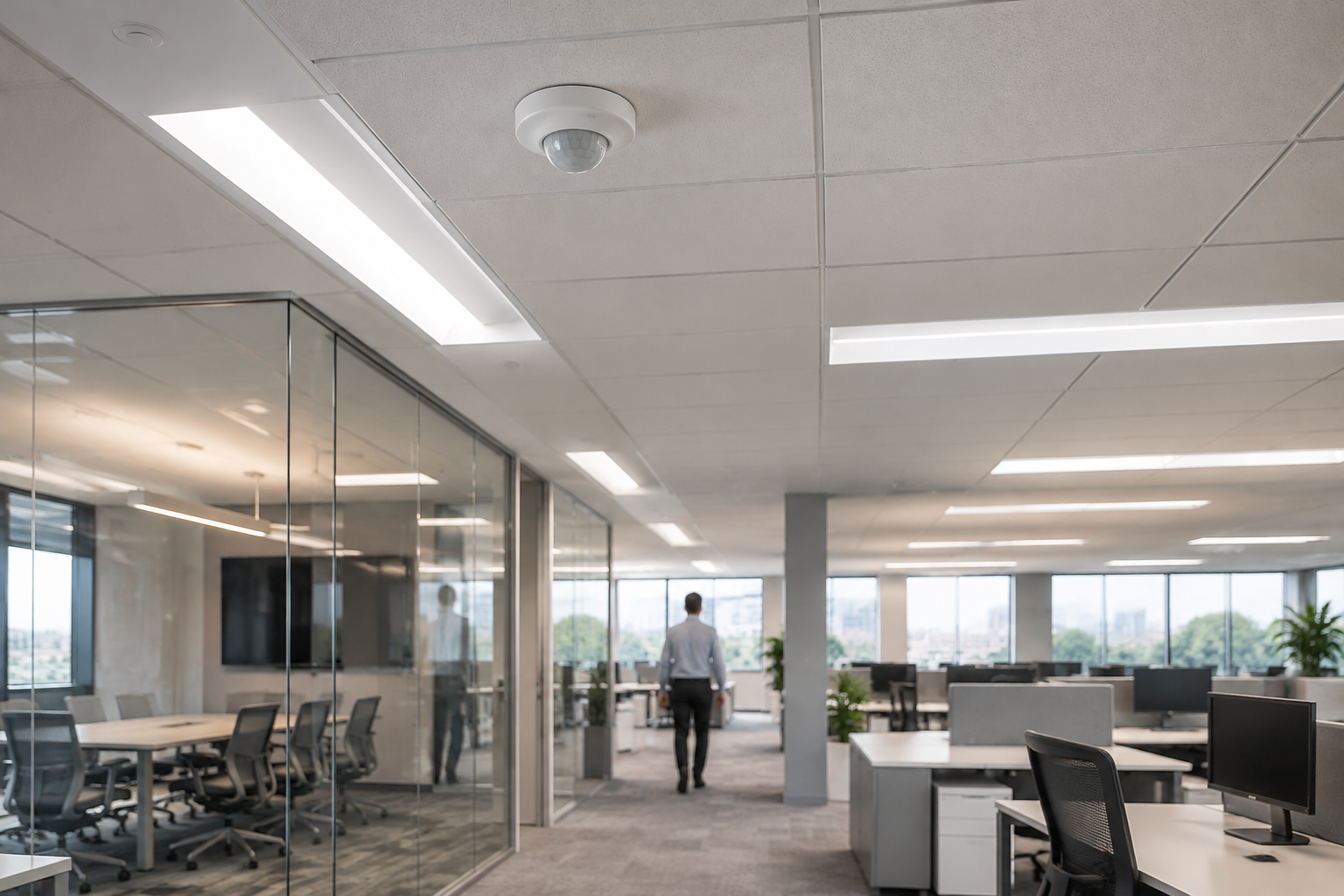 ASHRAE 90.1 Office LED Retrofits: Why Wattage Sets the Budget: Q: Can occupancy sensors make an over-budget lighting installation compliant?
Need a tailored lighting plan for your project?
Our senior lighting designers reply within 48 hours with a free design proposal & quotation.