
GCC Indoor LED Lighting Tenders: Closing the Evidence Gap
GCC lighting tenders need more than CE paperwork. Match local conformity, photometry and approved components before accepting substitutions.

What Changed — and Why It Matters Now
At XHLWX (led-project-light.com), a Custom Indoor LED Lighting Manufacturer based in China, the recommended starting point for GCC indoor LED lighting tenders is an evidence matrix connecting each offered luminaire to its destination-market requirements, tested configuration and installation conditions. For European and US consultants working on Middle East projects, the critical procurement question is not simply whether a fitting carries familiar marks, but whether its documentation covers the product actually being supplied.
This analysis does not report a newly announced GCC-wide lighting regulation. Its focus is a tender-stage risk: treating market-access documents, laboratory reports and project performance criteria as interchangeable.
They answer different questions. A conformity document concerns defined regulatory requirements; a photometric report describes a tested configuration; a room calculation predicts performance under stated assumptions.
The GCC comprises Bahrain, Kuwait, Oman, Qatar, Saudi Arabia and the United Arab Emirates. A Saudi project and a UAE project therefore need separate destination-market checks. Projects elsewhere in the Middle East require their own jurisdictional review; “Middle East compliant” is not a sufficiently defined acceptance criterion.
For a contractor comparing nominally equivalent 30 W downlights or linear luminaires, the practical consequence is significant: changing the driver, optic or LED board can make parts of the original evidence inapplicable. The strongest tender response is consequently a traceable offer, not the longest certificate list.
The Technical Detail Behind the Headline
A usable quality specification separates regulatory requirements, contractual design targets and supplier evidence. The following schedule is an illustrative office-project baseline, not a statement of XHLWX product capabilities or a universal GCC requirement. Final values should follow the consultant’s design brief and the applicable authority’s requirements.
| Parameter | Illustrative specification | Standard or verification route | Tender acceptance note |
|---|---|---|---|
| Task illumination | Maintained 500 lux; uniformity U₀ ≥0.60 | EN 12464-1 where contractually adopted; room calculation | Identify task plane, maintenance factor and calculation area |
| Color appearance | 3000 K or 4000 K; initial consistency ≤3 SDCM | Measured colorimetric report | Approve one CCT and binning requirement per scheduled zone |
| Color rendition | CRI Ra ≥90; TM-30 Rf ≥90 and Rg 95–105 | CIE colorimetry; specified IES TM-30 edition | These are example quality targets, not GCC-wide legal limits |
| Glare and beam | Calculated UGR ≤19; nominal 60° beam where suitable | CIE 117 methodology; goniophotometry | Evaluate actual room geometry; use the complete intensity distribution |
| Controls | DALI-2, Casambi or 0–10 V, as scheduled | Component documentation and functional mock-up | Do not accept an interface change as an automatic equivalent |
| Housing | IP20 for dry interiors; IP44 where the risk assessment requires it; 1200 mm nominal linear length | IEC 60529; approved dimensional drawing | State whether the IP claim covers the complete luminaire or exposed face |
| Operating conditions | Example 220–240 V, 50/60 Hz; project-defined ambient temperature | Nameplate and applicable IEC 60598 testing | Confirm actual supply and installation conditions before ordering |
| Named components | Samsung or Bridgelux LEDs; Tridonic or Mean Well driver, if specified | Exact part numbers and controlled bill of materials | Brand examples only; no partnership or approved configuration is implied |
| EU-market documentation | CE, RoHS and ErP evidence where applicable | Relevant EU legislation and product scope | These documents do not replace destination-country conformity checks |
| Quality management | ISO 9001:2015 certificate if contractually requested | Certificate scope, site and validity check | Management-system certification is not luminaire product approval |
The table becomes enforceable only when the tender identifies an evidence owner and an acceptance stage. For example, the supplier can submit the photometric report with the technical offer, while the consultant signs off the room calculation before purchase-order release.
Require IES and LDT photometric files for the offered optical configuration, with a report reference and identifiable test conditions. In DIALux, record room dimensions, surface reflectances, mounting height and maintenance factor. A result of 500 lux is not reproducible evidence if those inputs are missing.
Likewise, UGR is not a permanent property established by a catalogue badge. The installation geometry, observer position, background luminance and luminaire distribution influence the calculation. Beam angle alone cannot demonstrate compliance with a project glare target.
What This Means for Specifiers and Buyers
How Should a European or US Consultant Qualify a Saudi or UAE Lighting Bid?
Start with the destination jurisdiction and the importer’s responsibilities. For Saudi Arabia, ask the importer to identify applicable technical regulations, product classification and the required conformity route through the official SABER platform. Confirm the certificates and shipment documentation applicable to the actual product; do not assume every lighting item follows an identical route.
For the UAE, check applicable regulated-product requirements with the Ministry of Industry and Advanced Technology and the responsible conformity-assessment body. Record which applicant, manufacturer, brand and model the evidence covers. If a certificate uses a family designation, request confirmation that the offered variant falls within its scope.
A G-Mark requirement must also be checked against the relevant Gulf technical regulation and covered product categories. It should not be added indiscriminately to every indoor luminaire schedule. Similarly, CE documentation or a US safety listing should not be assumed to satisfy Saudi or UAE market-access obligations.
The next action is a two-column register: legal route confirmed by the importer and project performance accepted by the consultant. Both columns should be closed before shipment authorization.
How Can Contractors Prevent “approved Equivalent” Substitutions from Weakening Quality?
Define equivalence at configuration level. The approved schedule should identify the luminaire code, wattage, LED board, driver part number, optic, CCT, finish, control interface and accessories. Link this schedule to the submitted reports and a revision-controlled drawing.
A driver substitution may affect dimming, flicker, electromagnetic compatibility and thermal behavior. An optic substitution may change glare and spacing performance. A different LED board may change color rendition or lumen output even if the order description still says “4000 K, 30 W.”
Require a written deviation request before manufacture whenever a controlled component changes. The supplier should identify which evidence remains applicable and which tests or calculations require review. Relevant reports may include safety testing under IEC 60598-1 and the appropriate Part 2, plus applicable EMC evidence.
For controls, set a project-specific mock-up criterion. An example is stable operation at 100%, 50% and 10% output, followed by checks of minimum-level behavior, power restoration and scene recall.
Those percentages are proposed acceptance points, not universal performance guarantees. Sample approval should be recorded against the exact configuration intended for production.
How Should Buyers Compare Price When Two Bids Claim the Same Lux Level?
Compare installed outcomes under identical assumptions. If one bidder calculates initial illuminance and another calculates maintained illuminance, their headline lux values are not directly comparable. The same applies when mounting heights, calculation grids or reflectances differ.
Consider an illustrative scheme with 100 luminaires operating for 3,000 hours annually. At 30 W per luminaire, annual consumption is 9,000 kWh. At 24 W, it is 7,200 kWh: a calculated reduction of 1,800 kWh, or 20%, assuming the same operating hours and that stated wattage includes driver losses.
That saving is meaningful only if both proposals meet the same maintained illumination, uniformity, glare and color requirements. It excludes additional control savings and HVAC interactions. Financial savings require the project’s actual electricity tariff, not a generic GCC price.
Include commissioning, replacement access and spare-component availability in the comparison. A practical contractual target might require delivery of configuration files, a driver replacement procedure and a priced spare-parts schedule at handover. Any proposed spare quantity should be agreed from project scale and maintenance strategy rather than presented as an industry rule.
 GCC Indoor LED Lighting Tenders: Closing the Evidence Gap: How should a European or US consultant qualify a Saudi or UAE lighting bid?
Compliance Checklist (IES / LDT / DIALux / CE / RoHS / ErP)
Use the following checklist at technical approval and repeat the identity checks before dispatch:
- Destination-market classification: Confirm the country, product category, importer and applicable conformity route. Keep the official references and review date in the submittal register. Avoid relying solely on a distributor’s “GCC compliant” statement.
- Model and report identity: Match certificates, test reports, drawings, labels and purchase-order codes. Where a report covers a family, request the technical basis for including the offered size, power and driver combination.
- IES / LDT evidence: Check that the files represent the submitted optic and CCT configuration, with stated flux and test conditions. Resolve any difference between report wattage, file metadata and the commercial schedule.
- DIALux calculation package: Request the editable calculation file, not only screenshots. Record the maintenance factor, reflectances, working plane, luminaire positions and glare assumptions. Review the proposed 500 lux and UGR ≤19 targets in their actual application.
- Safety and EMC: Require evidence against applicable standards and editions, identifying the tested configuration. A 220–240 V driver rating alone does not establish complete-luminaire safety or electromagnetic compatibility.
- CE and RoHS: For products placed on the EU market, examine the applicable EU declaration of conformity. Article 6 of Directive 2014/35/EU sets manufacturer obligations under the Low Voltage Directive; Article 7 of Directive 2011/65/EU addresses manufacturer obligations under RoHS. Neither creates GCC approval.
- ErP scope: Regulation (EU) 2019/2020, generally applicable from 1 September 2021 and subsequently amended, concerns light sources and separate control gears. Check Article 1, Article 2 and the relevant annexes before requesting evidence; do not automatically treat every complete luminaire as a light source.
- ISO 9001 and handover: Verify the certificate’s manufacturing-site scope and validity separately from product approval. At handover, retain approved substitutions, control settings, maintenance instructions and the final installed equipment register.
For GCC-only deliveries, EU documentation can be a contractual requirement without being the governing local market-access route. Make that distinction explicit to prevent procurement delays and misleading approval statements.
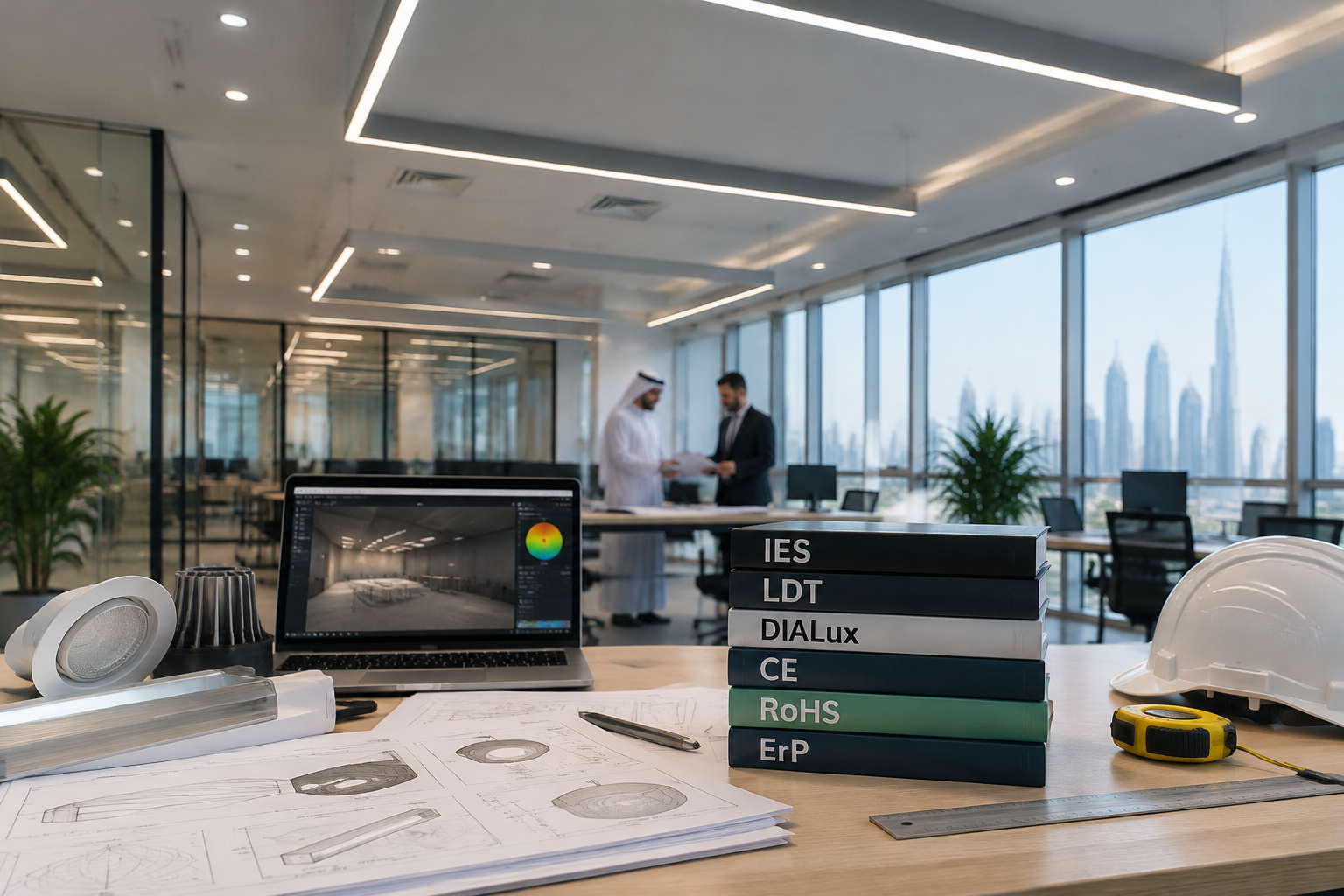 GCC Indoor LED Lighting Tenders: Closing the Evidence Gap: Compliance checklist (IES / LDT / DIALux / CE / RoHS / ErP)
Frequently Asked Questions
Q: Is CE Marking Enough for Indoor LED Lighting Supplied to GCC Projects?
No. CE marking addresses applicable EU legislation; it is not a blanket GCC market-access approval. A 230 V luminaire for Saudi Arabia or the UAE needs a destination-specific assessment of applicable regulations and conformity procedures. Ask the importer to confirm classification and documentation, then separately verify that the offered model satisfies the consultant’s performance specification.
Q: Should Every GCC Office Lighting Tender Require UGR Below 19?
UGR ≤19 can be a suitable design target for specified office tasks, but it is not a universal requirement for every GCC interior. Apply the project’s adopted lighting standard and room-use criteria. Verify glare through the actual layout, alongside maintained illuminance such as 500 lux and an agreed uniformity target, rather than accepting a catalogue claim alone.
Q: What Evidence Is Needed When a Supplier Changes the LED Driver?
Request the replacement’s exact part number, electrical ratings, dimming interface and relevant thermal information. Require an assessment of whether existing safety, EMC and photometric evidence remains applicable. A proposed mock-up can check operation at 100%, 50% and 10% output, but those checks do not replace required laboratory evidence or formal approval of the changed configuration.
Q: Can a Lower-wattage Offer Be Accepted Without a New Lighting Calculation?
Not safely on wattage alone. Reducing 100 luminaires from 30 W to 24 W gives a calculated 20% connected-load reduction, but it does not prove equal visual performance. Require matching photometric evidence and an updated calculation using the same maintenance factor, room inputs and acceptance criteria. Approve the saving only after maintained illuminance, uniformity and glare remain acceptable.
Talk to Our Engineering Team
At XHLWX (led-project-light.com), a Custom Indoor LED Lighting Manufacturer based in China, the proposed engineering review starts with your destination country, luminaire schedule, reflected ceiling plan and tender acceptance criteria. Include supply voltage, CCT, control protocol, operating conditions and required conformity documents. Request a configuration-specific evidence matrix before approving samples or substitutions, so the commercial offer, calculation model and delivered equipment can be checked against the same specification.
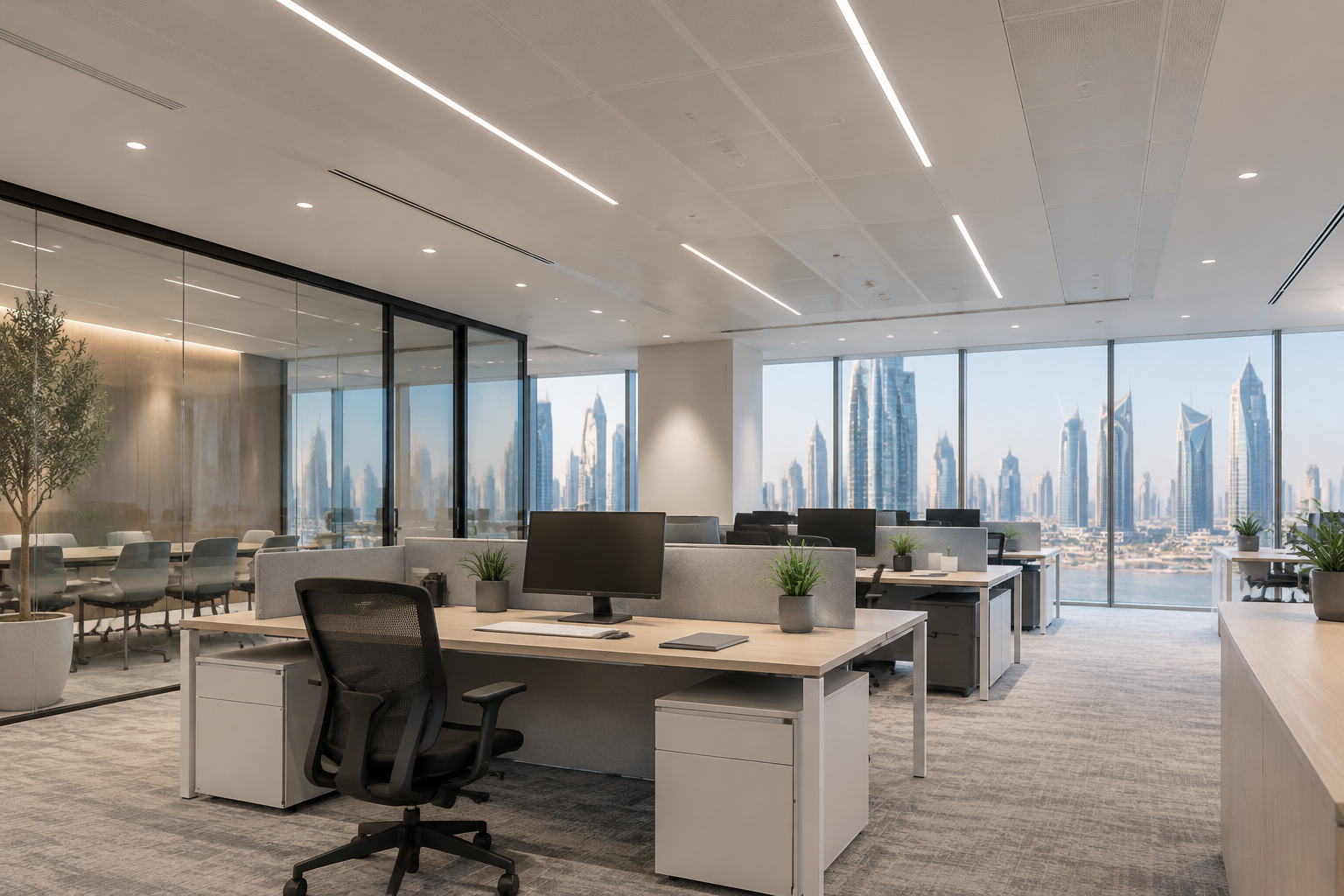 GCC Indoor LED Lighting Tenders: Closing the Evidence Gap: Q: Should every GCC office lighting tender require UGR below 19?
Need a tailored lighting plan for your project?
Our senior lighting designers reply within 48 hours with a free design proposal & quotation.