
Linear LED Batten Modules Above 200 lm/W: What Buyers Must Verify
A 200 lm/W LED module is not a 200 lm/W batten. Buyers need system-level evidence before comparing energy savings, optics and compliance.
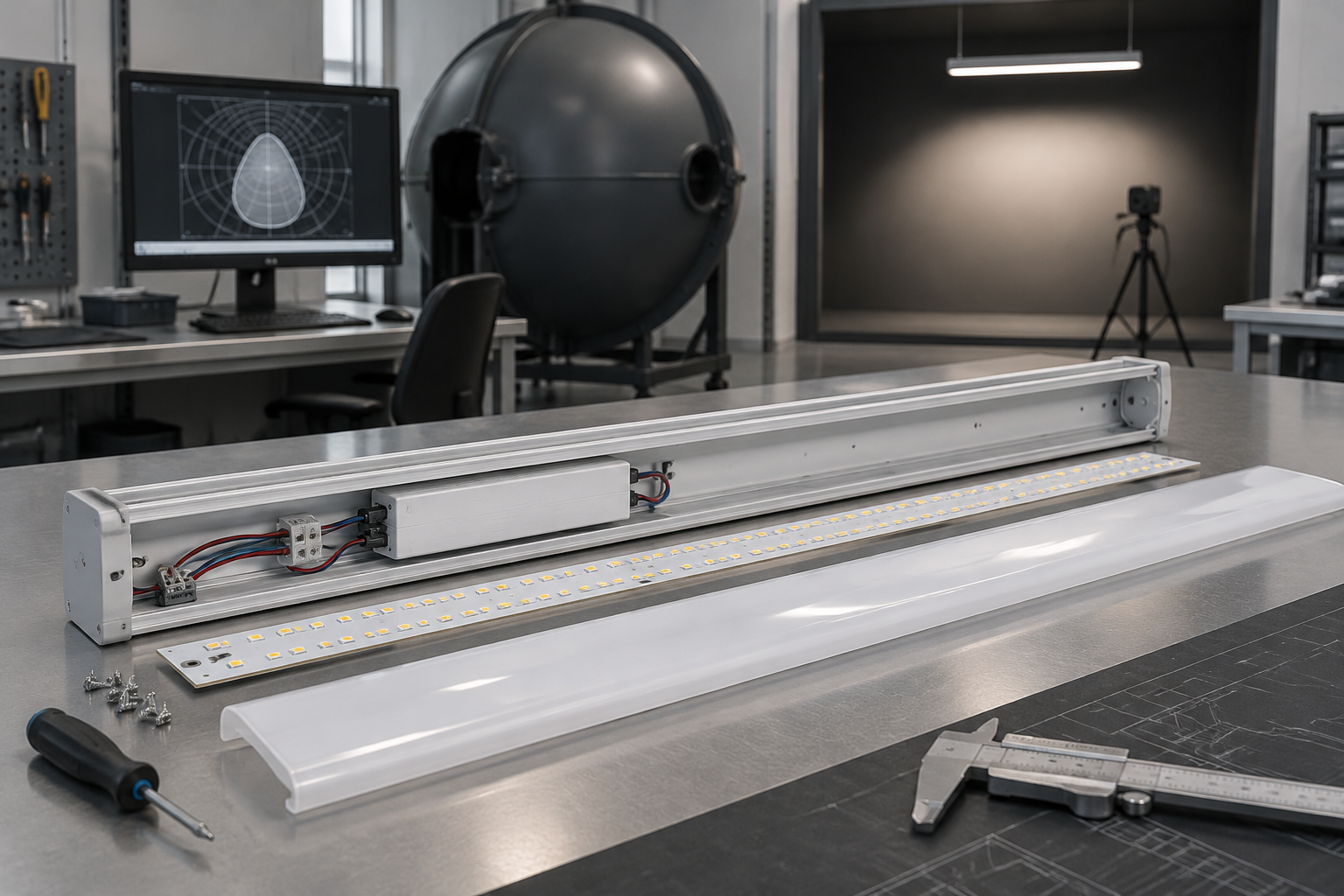
What Changed — and Why It Matters Now
At XHLWX (led-project-light.com), a Custom Indoor LED Lighting Manufacturer based in China, the practical question behind linear LED batten modules targeting more than 200 lm/W is where that efficacy is measured. An LED package, a populated module and a complete mains-powered batten have different measurement boundaries. European and US buyers should establish which boundary a quotation uses before treating its headline number as an energy-performance commitment.
The engineering significance of crossing 200 lm/W at module level is the opportunity to reduce electrical input for a given light output. It is not, by itself, evidence that an installed batten delivers 200 lumens for every watt purchased from the electricity supplier. Driver losses, operating temperature and optical transmission still affect the result.
This analysis treats above-200 lm/W performance as a procurement scenario, not a verified product announcement or market-wide benchmark. The buyer-facing implication is straightforward: a higher module rating should trigger a more detailed system specification, rather than replace one.
For a contractor comparing offers, the relevant questions are whether the complete luminaire maintains the required illuminance, whether its distribution suits the installation, and whether the quoted wattage includes all operating electronics. A cheaper module-level lumen can become an expensive installed lumen if additional fittings are needed to meet uniformity or glare requirements.
The Technical Detail Behind the Headline
Luminous efficacy is luminous flux divided by electrical power. The numerator and denominator must refer to the same product boundary and operating condition. Module efficacy normally excludes an external driver's losses; complete-luminaire efficacy should use light leaving the finished fitting and electrical power entering it.
A simplified engineering estimate illustrates the distinction:
Complete-luminaire efficacy ≈ module efficacy × driver efficiency × optical transmission × thermal correction.
Assume a module produces 220 lm/W under its stated reference conditions. With a 95% efficient driver, 90% optical transmission and a 0.94 thermal correction relative to those reference conditions, the estimated finished result is 176.8 lm/W, not 220 lm/W.
These are illustrative assumptions, not measured XHLWX results. If the module rating already represents its actual stabilized operating temperature, applying another thermal correction would double-count that effect. Likewise, integrated optics already included in a measurement must not be deducted twice.
Under those same assumptions, achieving 200 lm/W at the luminaire boundary would require approximately 249 lm/W at the module reference boundary. Alternatively, the design would need lower driver, optical or thermal losses.
The following schedule is an example tender framework, not a released product specification. Targets should be adjusted to the project and confirmed by the selected configuration's evidence.
| Parameter | Example specification or target | Verification reference | Buyer note |
|---|---|---|---|
| Module and luminaire efficacy | Module above 200 lm/W; finished-luminaire target stated separately | Module data plus complete-luminaire photometric report | Record temperature, current and AC input power |
| CCT and color rendering | 4000 K; CRI Ra ≥80; Rf ≥80 and Rg 95–105 as project targets | CIE colorimetry and IES TM-30 report | Do not substitute a different CCT or CRI variant's efficacy |
| Glare and distribution | UGR ≤19 where the task requires it; nominal 110° beam as an example | EN 12464-1 assessment and intensity distribution | Verify glare in the actual room, not from a beam-angle label |
| Control interface | DALI-2, Casambi or 0–10 V as separately quoted options | Relevant IEC 62386 parts for DALI; interface documentation | Measure input power for the actual driver and control assembly |
| Housing and dimensions | 1200 mm nominal length; IP20 for suitable dry interiors or IP65 where specified | Dimensional drawing; IEC 60529 | Check connectors, seals and installed configuration |
| LED and driver identification | Named Samsung, Osram or Bridgelux LED option; Tridonic or Mean Well driver option | Exact manufacturer part numbers and datasheets | Examples only; brand names do not prove assembly performance |
| EU conformity | Applicable CE legislation, RoHS and ErP requirements | Declaration of conformity and supporting technical file | Confirm the product's classification and applicable provisions |
| Quality management | ISO 9001 certification if required by the tender | Current certificate, scope and issuing body | Management-system certification is not a luminaire test |
| Project photometry | IES and LDT photometric files for the quoted variant | Report-to-file cross-check and DIALux model | Match optics, output, length and electrical configuration |
Higher efficacy must also be assessed alongside color quality. A supplier should not use a lower-CRI, cooler-CCT module figure to substantiate a warmer, higher-CRI finished product without configuration-specific evidence.
What This Means for Specifiers and Buyers
How Should a Contractor Compare a 200 lm/W Module with a Complete Batten Quotation?
Request two distinct entries: module efficacy under defined conditions and complete-luminaire efficacy at stabilized operation. The second entry should identify mains voltage, input watts, total lumens, ambient temperature, CCT, CRI and the installed diffuser or lens.
Ask for a whole-product measurement using an applicable method, such as ANSI/IES LM-79 for solid-state lighting products or EN 13032-4 for LED lamps, modules and luminaires. The report must identify the tested sample and configuration. Neither method turns a single test automatically into a product certification.
Require an exact bill-of-materials reference for the quoted build. A replacement driver can change input power, dimming behavior and thermal conditions; an alternative diffuser can change output and intensity distribution. Contractually define which substitutions need engineering approval and renewed evidence.
For US projects, establish whether the authority having jurisdiction requires an NRTL-listed luminaire to the applicable safety standard, commonly UL 1598 for this product category. CE documentation is not a substitute for that evaluation. Confirm voltage compatibility separately, including 120–277 V operation where required.
How Much Energy Could a Higher-efficacy Linear Batten Save at Equal Light Output?
Consider an illustrative installation needing 6,000 lumens per fitting. At a measured complete-luminaire efficacy of 160 lm/W, each fitting draws 37.5 W. At a verified 200 lm/W, it draws 30 W: a 20% reduction in operating power at equal initial luminous flux.
For 100 fittings operating 3,000 hours annually, consumption falls from 11,250 kWh to 9,000 kWh. The estimated saving is 2,250 kWh per year, before controls, standby consumption or differences in operating schedules. At an assumed electricity price of €0.20/kWh, that represents €450 annually.
However, substituting the earlier estimated 176.8 lm/W system result yields approximately 33.9 W per fitting and only about a 9.5% power reduction against the 160 lm/W baseline. Mistaking a 220 lm/W module rating for finished-product performance would materially overstate the saving.
Equal initial lumens are only a first comparison. Final energy calculations should use layouts that meet the same maintained illuminance and uniformity, with explicit maintenance factors. Different distributions can require different quantities of fittings.
When Can Glare Control and Thermal Design Outweigh the Highest Efficacy Number?
For an illustrative office writing and reading task, EN 12464-1:2021 specifies 500 lx maintained illuminance, a limiting UGR of 19 and Ra of at least 80. These values are task-specific, not universal requirements for every batten installation.
A high-output linear source still needs a suitable luminous area and intensity distribution. A diffuser or louver may reduce total transmitted lumens while improving visual comfort.
Conversely, removing optical material to raise efficacy can invalidate the intended lighting design. UGR depends on the installation, including observer position, room geometry and background luminance; it is not simply an intrinsic label on a fitting.
Thermal assessment is equally important. Specify the intended ambient range, mounting orientation and enclosure conditions.
Request the module's designated temperature-point limit and the driver's case-temperature limit, then verify them in the assembled product. Do not assume a 25°C ambient photometric result establishes performance in a hotter ceiling void or enclosed installation.
 Linear LED Batten Modules Above 200 lm/W: What Buyers Must Verify: How should a contractor compare a 200 lm/W module with a complete batten quotation?
Compliance Checklist (IES / LDT / DIALux / CE / RoHS / ErP)
Before issuing a purchase order, European and US project teams should close the following evidence gaps:
- Photometry: Obtain IES and LDT photometric files linked to the quoted build. Cross-check total lumens, input watts and intensity distribution against the report. File availability alone does not validate the data.
- Lighting calculation: Run DIALux with project geometry, mounting height, reflectances and a justified maintenance factor. Report maintained lux, uniformity and applicable glare results. Preserve the model alongside the approved luminaire schedule.
- EU electrical and EMC conformity: For an ordinary mains-powered batten, assess applicability of the Low Voltage Directive 2014/35/EU and EMC Directive 2014/30/EU. Wireless equipment can bring the Radio Equipment Directive 2014/53/EU into the assessment. CE marking is not a universal third-party certificate.
- RoHS: Request evidence addressing Directive 2011/65/EU, particularly Article 4 and Annex II restrictions, as amended. Component declarations should support the finished equipment's technical documentation rather than replace its conformity assessment.
- ErP classification: Regulation (EU) 2019/2020, applicable from 1 September 2021 with subsequent amendments, addresses light sources and separate control gears. Establish whether the batten is a containing product or itself a light source under the definitions. Article 4 addresses removal and replacement obligations, while Annex II contains the relevant ecodesign requirements. There is no blanket rule that every batten must achieve 200 lm/W.
- Energy-label claims: Under Regulation (EU) 2019/2015, light-source class A starts at corrected efficacy ηTM ≥210 lm/W; class B covers 185 to below 210 lm/W. These are corrected regulatory values, not automatically interchangeable with a module datasheet number. Determine labeling and EPREL obligations for the actual product classification.
- US acceptance: Confirm applicable electrical safety, local code and any specified rebate-program requirements before ordering. If a program requires a qualified-product listing, verify the exact model rather than accepting a family-level assertion.
Keep these records version-controlled. An approved optical assembly paired with an undocumented driver substitution is no longer the same evidence package.
 Linear LED Batten Modules Above 200 lm/W: What Buyers Must Verify: Compliance checklist (IES / LDT / DIALux / CE / RoHS / ErP)
Frequently Asked Questions
Q: Does a 200 lm/W LED Module Guarantee a 200 lm/W Batten?
No. A module rating can exclude driver and optical losses and may use different thermal conditions. For illustration, 220 lm/W multiplied by 95% driver efficiency, 90% optical transmission and a 0.94 thermal factor gives about 176.8 lm/W. Compare complete-luminaire lumens with complete-luminaire AC input watts under documented conditions.
Q: What Evidence Should Support an above-200 lm/W Claim?
Ask which measurement boundary the claim uses, then obtain a report identifying the sample, CCT, CRI, drive conditions and temperature. For a finished batten, request stabilized whole-product lumens and mains input power. A 4000 K, Ra 80 report should not automatically substantiate a 3000 K, Ra 90 configuration with different optics.
Q: Can a 200 lm/W Batten Automatically Qualify for EU Energy Class A?
No. Regulation (EU) 2019/2015 uses corrected efficacy ηTM, with class A beginning at 210 lm/W. Classification also depends on identifying the regulated light source and applying the relevant calculation factors. A raw module value or complete-luminaire efficacy alone does not establish the appropriate energy class or whether a containing product needs that label.
Q: Should Buyers Choose Maximum Efficacy or Better Glare Control?
Specify the visual task first, then optimize energy use within that requirement. An office task needing 500 lx and UGR no higher than 19 may justify an optic that reduces total output but improves the installation. Compare compliant layouts at equal maintained illuminance, not just isolated lm/W figures, and document the chosen maintenance factor.
Talk to Our Engineering Team
For the next quotation round, submit the room layout, mounting height, operating hours, target lux, glare limit, voltage and control requirements. Ask bidders to separate module data from complete-luminaire commitments and identify every assumption behind projected savings.
At XHLWX (led-project-light.com), a Custom Indoor LED Lighting Manufacturer based in China, the engineering discussion should begin with a testable specification: the intended CCT and color quality, actual housing and optics, named component part numbers, configuration-matched photometry and market-specific conformity evidence. Treat above-200 lm/W module performance as a design opportunity—not a substitute for verified installed performance.
 Linear LED Batten Modules Above 200 lm/W: What Buyers Must Verify: Q: What evidence should support an above-200 lm/W claim?
Need a tailored lighting plan for your project?
Our senior lighting designers reply within 48 hours with a free design proposal & quotation.