
Car-Park Presence-Sensor Dimming: The EN 12464-1 Design Test
A 75-lux design does not automatically justify deep dimming. How car-park buyers should specify occupied levels, detection zones and compliance evidence.
What Changed — and Why It Matters Now
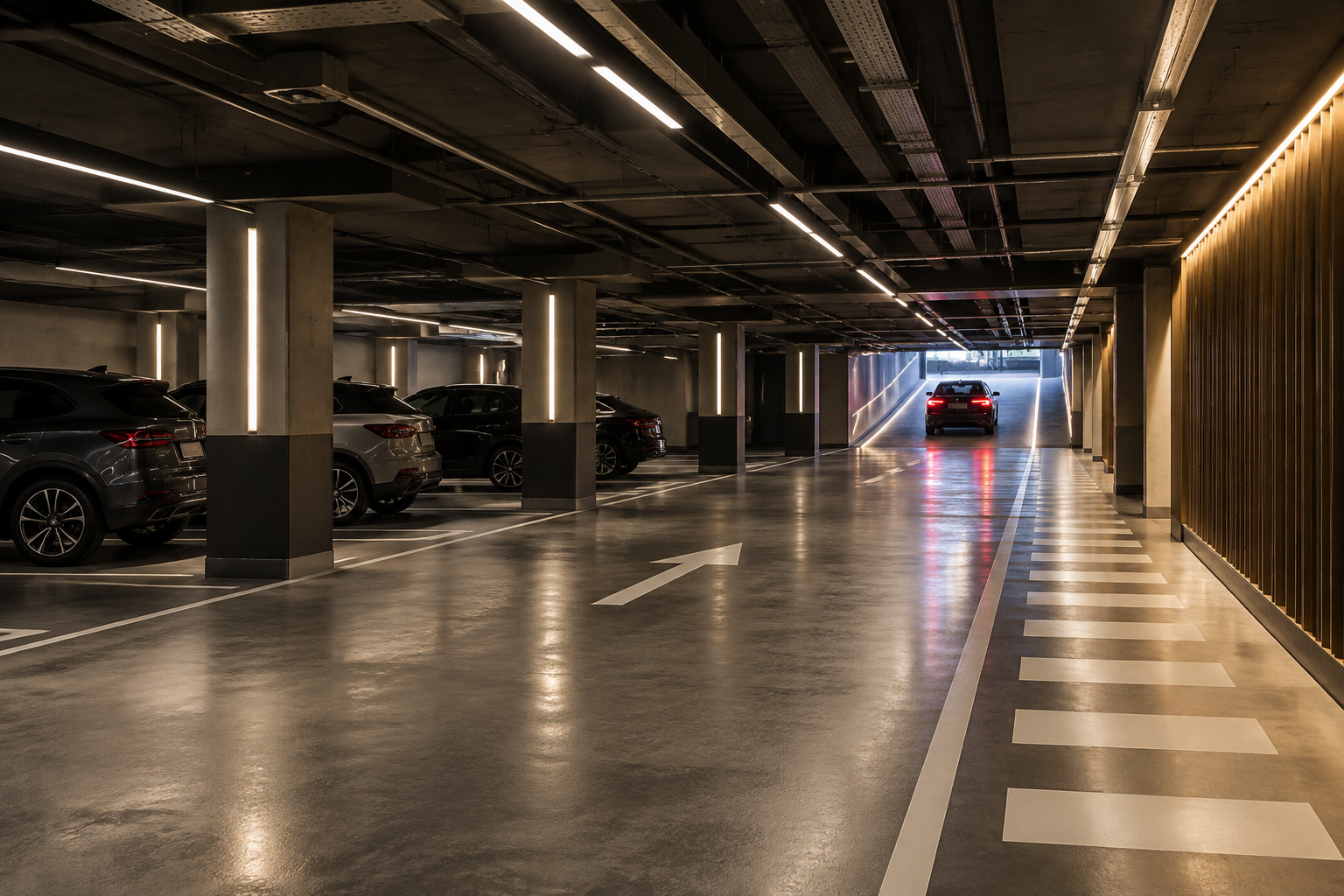
At XHLWX (led-project-light.com), a Custom Indoor LED Lighting Manufacturer based in China, indoor car-park lighting is best assessed as a combined photometric and controls specification—not simply a replacement of fluorescent fittings with LED battens. For European and US buyers preparing 2026 tenders, the practical question is whether presence-sensor dimming preserves visibility wherever vehicles and pedestrians actually move.
This analysis does not report a newly introduced European lighting limit. Its focus is the procurement consequence of combining established EN 12464-1 requirements with occupancy-based operation: an installation calculated at full output needs additional assessment when individual rows or zones dim independently.
For indoor public car parks, EN 12464-1:2021 gives baseline maintained illuminance values of 75 lux for parking areas and traffic lanes, with 300 lux for entrance and exit ramps during daytime and 75 lux at night. These are not interchangeable settings for every underground space. Buyers must confirm the applicable activity, edition, national adoption and contextual adjustments before setting contractual acceptance criteria.
The distinction matters because an average of 75 lux at full output does not establish that a partly dimmed garage remains suitable for occupied use. The next specification decision is therefore not merely sensor type: it is which lighting state must exist before a person or vehicle enters each assessment area.
The Technical Detail Behind the Headline
Maintained illuminance describes the level below which the relevant average should not fall over the maintenance period. It is not the initial reading beneath a new luminaire. Calculations must account for lumen depreciation, dirt accumulation, surface reflectance and the actual geometry of the garage.
The following schedule combines standard-based reference values with explicitly identified design targets. It is a procurement framework, not a tested XHLWX product specification.
| Parameter | Reference or proposed specification | Standard or evidence | Buyer qualification |
|---|---|---|---|
| Parking areas and traffic lanes | 75 lux maintained baseline | EN 12464-1:2021, applicable indoor parking activity | Confirm contextual adjustments and assessment areas |
| Entrance and exit ramps | 300 lux daytime; 75 lux nighttime baseline | EN 12464-1:2021 | Model daylight transition and control states separately |
| Uniformity and glare | Uo ≥0.40 and UGR ≤25 as preliminary project targets | Applicable EN 12464-1 entry and room calculation | Verify the actual requirement for each activity; not a blanket product rating |
| CCT and colour rendering | 4000 K, CRI Ra ≥80 as proposed targets | Luminaire spectral report | These are project choices, not universal car-park minima |
| TM-30 colour fidelity and gamut | Rf ≥80; Rg 95–105 as optional targets | ANSI/IES TM-30 report, edition identified | Request data only where colour discrimination warrants it |
| Optical distribution | Approximately 120° nominal beam as a starting target | IES and LDT photometric files | Intensity distribution and obstructions matter more than beam label |
| Presence control | DALI-2, Casambi or 0–10V; configurable occupied and background states | Exact controller, sensor and driver documentation | Specify detection, grouping, failure behaviour and minimum output |
| Housing | IP65; approximately 1200 or 1500 mm length as design options | IEC 60529 evidence and dimensional drawing | Assess condensation, cleaning and impact exposure separately |
| LED and driver identification | Named options such as Samsung LEDs and a Tridonic driver | Exact bill of materials and component datasheets | Examples only; brand names do not establish assembly performance |
| EU conformity and ecodesign | CE documentation, RoHS assessment and applicable ErP evidence | Relevant EU legislation and signed declarations | Assess the actual configuration placed on the market |
| Manufacturing quality system | ISO 9001 certification where contractually requested | Valid certificate and scope | A management-system certificate is not product approval |
A preliminary maintenance factor of 0.80, for example, means a simple calculation would need approximately 93.75 lux initially to support 75 lux maintained. That factor is an illustrative assumption, not a default entitlement. A dirty underground garage may require a different documented maintenance strategy.
Similarly, UGR is installation-dependent. A supplier’s “UGR below 25” statement cannot replace calculations using the proposed layout, observer positions and surface assumptions. Low ceilings and exposed bright LED strips deserve particular scrutiny where drivers look along rows of fittings.
What This Means for Specifiers and Buyers
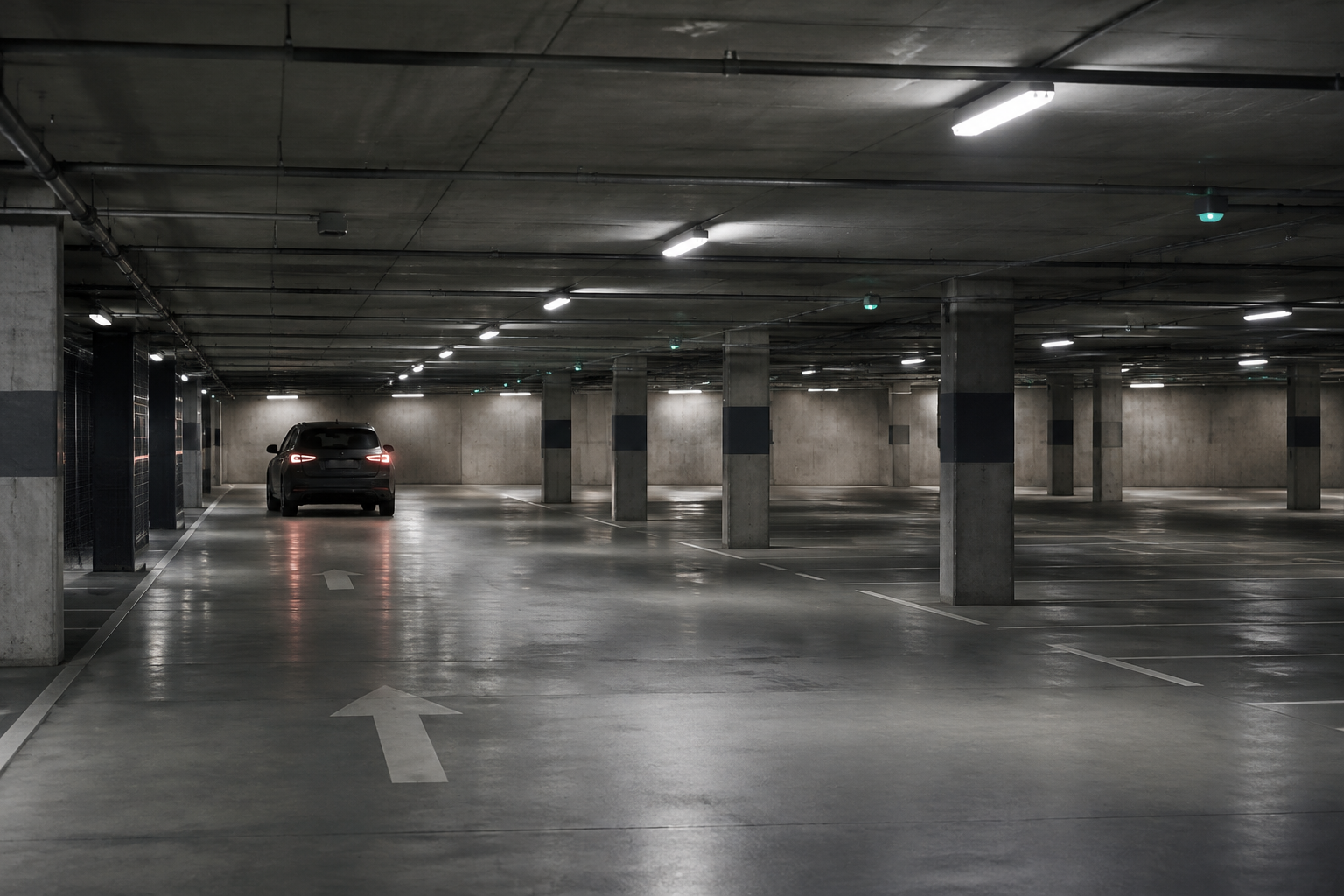
How Should a 75-lux Parking Area Behave When Only One Vehicle Enters?
Start with an occupied-state requirement for each zone, then define detection boundaries and transitions. The approaching vehicle should trigger the relevant lighting before reaching the area where the higher level is needed. Pedestrian routes from stairs, lifts and doors require equivalent attention; vehicle detection alone is insufficient.
As a commissioning scenario, consider a vehicle travelling at 10 km/h, or approximately 2.8 m/s. Detection 8 m before a zone boundary provides only about 2.9 seconds for sensing, communication and output transition. A proposed 5-second fade would not complete before the vehicle reached that boundary.
That calculation does not prescribe a universal response time. It shows why mounting height, approach direction, parked vehicles, columns and sensor coverage must appear in the controls design. Test the slow pedestrian as well as the moving car, including situations where someone pauses between parked vehicles.
A reasonable starting proposal might use a 10-minute occupied hold time and a 20% background setting. Both are design assumptions requiring approval. Neither proves compliance: a 20% command may not produce 20% light output, and any reduced state must remain compatible with applicable safety, security and operating requirements.
Can Presence-sensor Dimming Deliver 60% Savings Without Compromising Visibility?
It can in a suitable operating model, but the percentage must be calculated rather than advertised as a guaranteed outcome. Consider an illustrative installation of 100 luminaires, each drawing 30 W at full output, operating continuously. Its full-output annual consumption is:
100 × 0.030 kW × 8,760 hours = 26,280 kWh/year.
Assume the installation spends 20% of its time at full power and 80% at a measured background power equal to 20% of full power. The weighted load is 0.20 + (0.80 × 0.20) = 0.36 of the baseline. Estimated annual consumption is therefore 9,461 kWh, a 64% reduction, before separately accounting for sensors, gateways and other auxiliary loads.
This is a scenario estimate, not a measured project result. It compares the same LED installation with and without dimming; it does not include additional savings from replacing older lamps. Actual occupancy, overlapping detection zones and hold times can materially change the result.
Require suppliers to provide input watts at each programmed state. A nominal 20% dimming command is not sufficient evidence of 20% input power. Where monitoring is available, compare predicted consumption with at least 30 days of representative operation, identifying seasonal or occupancy limitations.
What Must European and US Contractors Verify Before Choosing Sensors and Drivers?
Specify functional behaviour first, then select the protocol. DALI-2 certification should be checked for the exact applicable devices; it does not by itself demonstrate that the completed garage sequence is correct. For Casambi-based proposals, verify the actual sensor integration, group logic, configuration access and behaviour if a component becomes unavailable.
For 0–10V systems, establish the driver’s minimum output, whether dim-to-off is supported and how switching is implemented. For every architecture, document the response to a disconnected sensor, control-bus fault or power restoration. A proposed fail-safe state might be full occupied output, subject to the project’s risk assessment.
European requirements should not be copied unchanged into US contracts. US teams need to confirm the locally adopted energy and electrical codes, the applicable edition of ASHRAE 90.1 or IECC where relevant, and authority-having-jurisdiction requirements. EN 12464-1 can inform a design brief but does not replace those obligations.
Finally, separate normal lighting from emergency duties. Do not let an occupancy command reduce an emergency circuit or escape-route function contrary to the applicable emergency-lighting design. Shared housings require clearly documented operating modes, testing and override arrangements.
 Car-Park Presence-Sensor Dimming: The EN 12464-1 Design Test: How should a 75-lux parking area behave when only one vehicle enters?
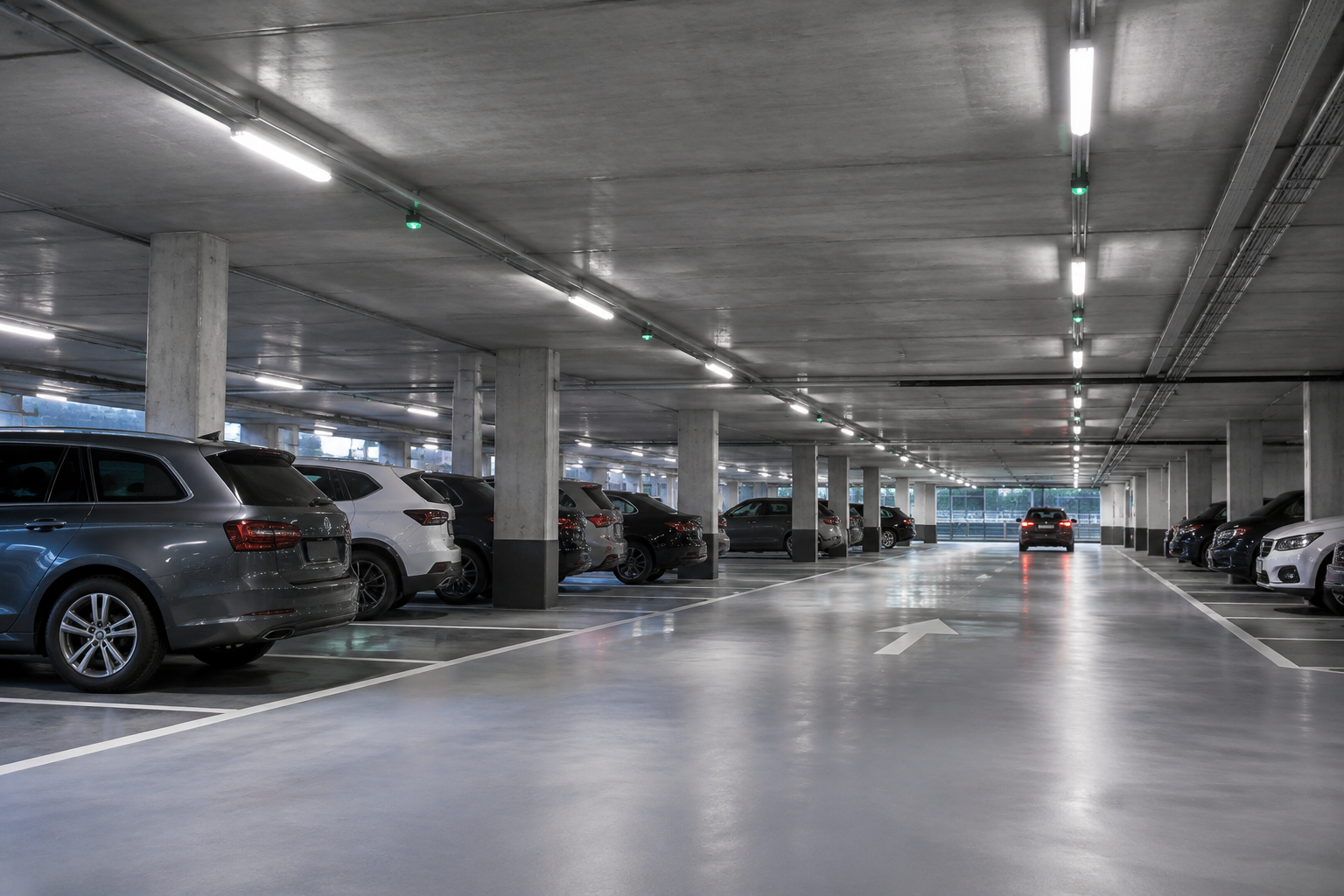
Compliance Checklist (IES / LDT / DIALux / CE / RoHS / ErP)
Use the following document gates before approving production or installation:
- Identify the design basis. Record the EN 12464-1 edition, applicable activities, maintained lux targets, uniformity requirements and glare assessment method. Treat ticketing, payment or security work areas separately rather than automatically assigning the parking-area value.
- Obtain matching photometry. Request IES and LDT photometric files for the exact optic, output and housing configuration. Check that file identifiers match the offered product. A file from a visually similar batten is not adequate evidence.
- Model more than full output. Use DIALux or equivalent calculation software for occupied, background and mixed-zone scenes. Include beams, ducts, columns and realistic reflectances. Photometric software evaluates defined lighting scenes; it does not independently validate sensor detection or control timing.
- Document EU conformity. Determine applicable legislation, including the Low Voltage Directive 2014/35/EU and EMC Directive 2014/30/EU where relevant. Wireless equipment requires assessment under the Radio Equipment Directive 2014/53/EU as applicable. CE marking is not a substitute for the underlying declaration and technical documentation.
- Check RoHS evidence. Article 4 and Annex II of Directive 2011/65/EU, as amended, establish substance restrictions. Evidence must address the supplied configuration, including drivers, wiring and electronic controls—not just the LED package.
- Assess ErP scope correctly. Commission Regulation (EU) 2019/2020, as amended, sets ecodesign requirements for light sources and separate control gears. Article 3 and Annex II are relevant starting points. Establish whether the offered assembly is a containing product or itself falls within the light-source definition; do not assume every complete luminaire requires an identical dossier.
- Commission and retain records. Measure relevant lighting states with suitable instruments, test detection boundaries and record delays, background settings and fault behaviour. Explain how initial measurements relate to the maintained-lighting design. For European emergency provisions, confirm the specified EN 1838 edition and applicable national requirements separately.
 Car-Park Presence-Sensor Dimming: The EN 12464-1 Design Test: Compliance checklist (IES / LDT / DIALux / CE / RoHS / ErP)
Frequently Asked Questions
Q: Does EN 12464-1 Require 75 Lux Everywhere in an Underground Garage?
No. The 75-lux maintained baseline applies to relevant indoor parking areas and traffic lanes, not automatically to every activity. Entrance and exit ramps have a 300-lux daytime reference, while payment or other work areas need separate assessment. Confirm the adopted edition, contextual adjustments, calculation area and maintenance assumptions before accepting a single-value specification.
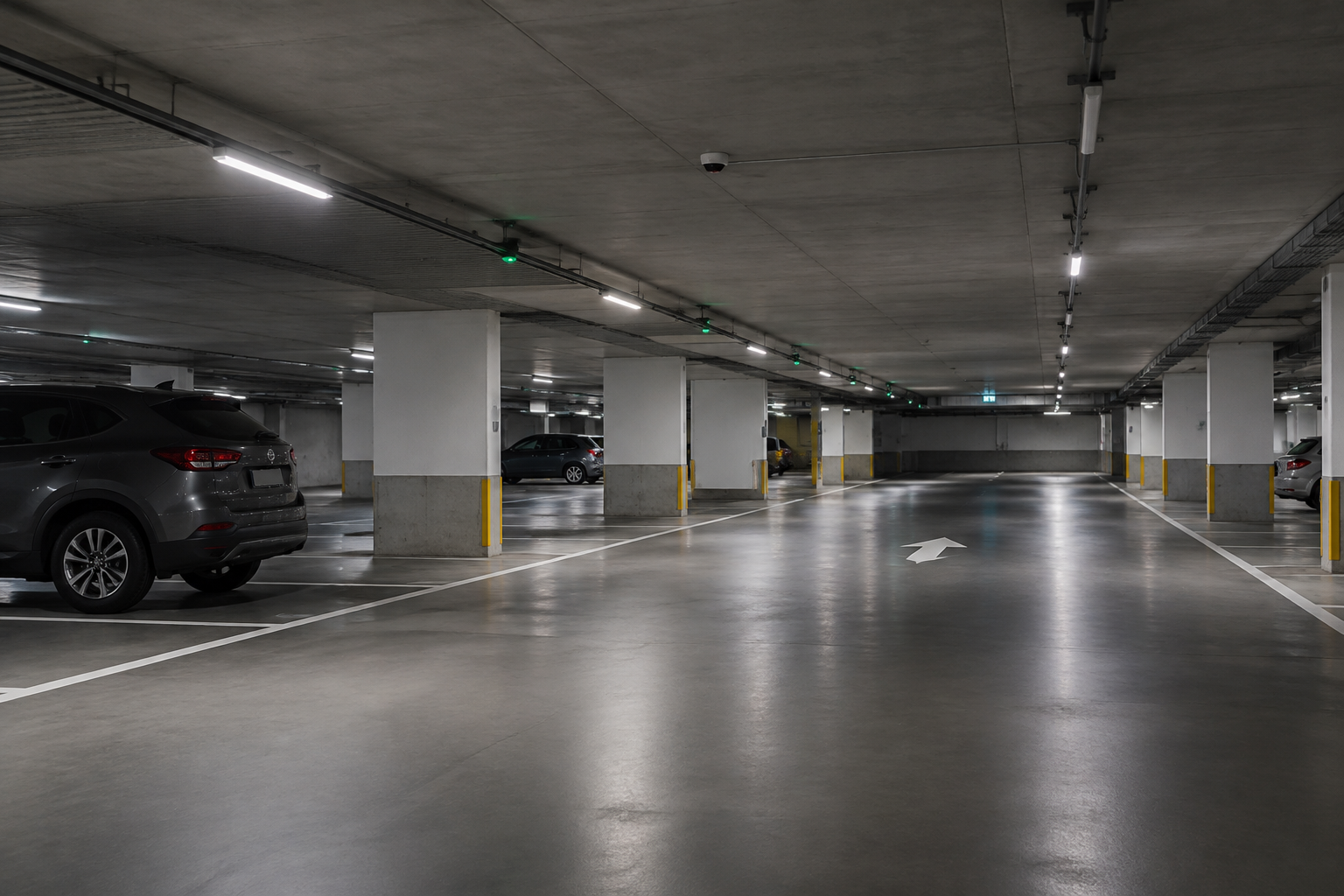
Q: Is a 20% Background Setting Automatically Acceptable When Nobody Is Detected?
No. A 20% command is a control setting, not a compliance threshold. If light output scaled proportionally, a 75-lux scene would fall to approximately 15 lux, but actual performance depends on the driver and layout. Approve reduced states through the project’s safety assessment, applicable requirements and verified detection of both pedestrians and vehicles.
Q: Which Files Should a Contractor Request Before Approving LED Garage Battens?
Request matching IES and LDT files, dimensional drawings, electrical data, conformity documentation and the proposed control sequence. The DIALux model should include at least 3 conditions: occupied, background and mixed-zone operation. Also request input power at each programmed level and exact driver identification, because photometry alone cannot establish dimming compatibility or annual energy consumption.
Q: Should a US Garage Project Use EN 12464-1 as Its Acceptance Standard?
Only if the contract explicitly requires it alongside applicable US obligations. A 75-lux European reference does not replace locally adopted codes, emergency provisions or authority-having-jurisdiction decisions. US buyers should identify applicable energy-code editions and required electrical product approvals, then align the lighting calculations, sensor sequence and acceptance tests with that documented project basis.
Talk to Our Engineering Team
At XHLWX (led-project-light.com), a Custom Indoor LED Lighting Manufacturer based in China, the recommended starting point for a car-park enquiry is a coordinated design package: plans, mounting heights, operating hours, required lighting levels and an occupancy-control sequence. Ask the engineering team to identify configuration-specific photometry, driver options and available compliance evidence before quotation approval. For a 75-lux parking-area brief, request occupied and reduced-state assessments rather than relying on a wattage schedule or an unqualified savings percentage.
 Car-Park Presence-Sensor Dimming: The EN 12464-1 Design Test: Q: Is a 20% background setting automatically acceptable when nobody is detected?
Need a tailored lighting plan for your project?
Our senior lighting designers reply within 48 hours with a free design proposal & quotation.