
ISO Class 7/8 Cleanroom Lighting: Why IP65 Is Not Enough
IP65 does not establish cleanroom suitability. ISO Class 7/8 buyers need evidence for ceiling seals, cleaning compatibility and installed performance.

What Changed — and Why It Matters Now
At XHLWX (led-project-light.com), a Custom Indoor LED Lighting Manufacturer based in China, cleanroom lighting specifications should begin with a distinction: ISO 14644 Class 7/8 describes airborne particle cleanliness, while IP65 describes enclosure protection. Neither designation, by itself, establishes whether a luminaire is suitable for a particular controlled environment. For European and US buyers, the procurement question is how the installed lighting assembly supports cleaning, ceiling integrity and room qualification.
The regulatory anchor is the revised EU GMP Annex 1 for sterile medicinal products, published on 25 August 2022. It became applicable on 25 August 2023, except paragraph 8.123, which followed on 25 August 2024. These are pharmaceutical manufacturing requirements—not a new lighting regulation or a universal requirement for every ISO-classified room.
Nevertheless, Annex 1 makes the lighting interface relevant to facility design. Paragraphs 4.5–4.8 address exposed surfaces, difficult-to-clean recesses, ceiling sealing and utilities arranged to avoid uncleanable recesses.
A recessed fixture can therefore require scrutiny beyond its electrical and ingress-protection test reports. The text is available through the European Commission’s EudraLex Volume 4 resources.
The practical consequence is that an IP65 purchase specification needs an installation and qualification specification beside it. This is particularly important when replacing luminaires within an existing classified ceiling, where removing one fixture can disturb seals and change the conditions under which the room was qualified.
The Technical Detail Behind the Headline
ISO 14644-1:2015 classifies air cleanliness by particle concentration. At the 0.5 μm threshold, the maximum concentrations are 352,000 particles/m³ for ISO Class 7 and 3,520,000 particles/m³ for ISO Class 8.
Classification also requires the relevant occupancy state to be specified: as-built, at-rest or operational. Those figures do not define a luminaire’s construction, illuminance or cleaning resistance.
Under IEC 60529, IP65 combines a dust-tight enclosure designation with protection against water jets under specified test conditions. It does not establish an air-leakage rate across a pressurized ceiling, resistance to disinfectants or suitability for repeated decontamination cycles. Nor does it establish the cleanability of screw recesses, frame joints or the surrounding ceiling interface.
The following schedule is an illustrative procurement brief, not a tested XHLWX product specification. Confirm each target against the room process, ceiling system and destination market.
| Parameter | Illustrative specification or evidence | Standard or reference | Buyer verification |
|---|---|---|---|
| Illuminance and glare | 500 lx maintained at the defined task plane; UGR ≤19 design target | EN 12464-1 where applicable | Calculate the actual room; neither value follows from ISO Class 7/8 |
| CCT and color rendering | 4000 K; CRI Ra ≥90; TM-30 Rf ≥85 and Rg 95–105 | CIE colorimetry; IES TM-30 | Obtain spectral data for the selected LED and diffuser combination |
| Optical distribution | Nominal 100–120° beam design target | IES/LDT photometry | Check high-angle luminance and shadows around equipment |
| Control interface | DALI-2, Casambi or 0-10V as project-selected alternatives | IEC 62386 for DALI; interface documentation | Verify driver, controller, minimum output and power-restoration behavior |
| Housing and dimensions | IP65 target; nominal 600 × 600 mm or 1200 × 300 mm format | IEC 60529; ceiling shop drawings | Confirm actual cutout, gasket compression and which surfaces carry the IP rating |
| Cleaning and sealing | Smooth room-side face; documented gasket and lens compatibility | Site cleaning protocol; GMP Annex 1 where applicable | Review actual chemicals, concentrations, contact times and service access |
| Named components | Samsung or Bridgelux LEDs; Tridonic or Mean Well driver, if selected | Exact component datasheets | Require model numbers and approve substitutions before production |
| EU conformity | Applicable CE documentation, RoHS evidence and ErP assessment | 2014/35/EU; 2014/30/EU; 2011/65/EU; 2019/2020 | Match documents to the delivered configuration and legal product scope |
| Quality management | ISO 9001 certificate, if claimed | ISO 9001:2015 | Check issuer, validity, manufacturing address and certification scope |
A UGR value is not an unconditional property of a panel. Room geometry, viewing direction, luminaire arrangement and surface reflectance affect the calculated result. Likewise, nominal ceiling-module dimensions are not installation dimensions: frame overlap, structural support and gasket seating require dimensioned drawings.
What This Means for Specifiers and Buyers
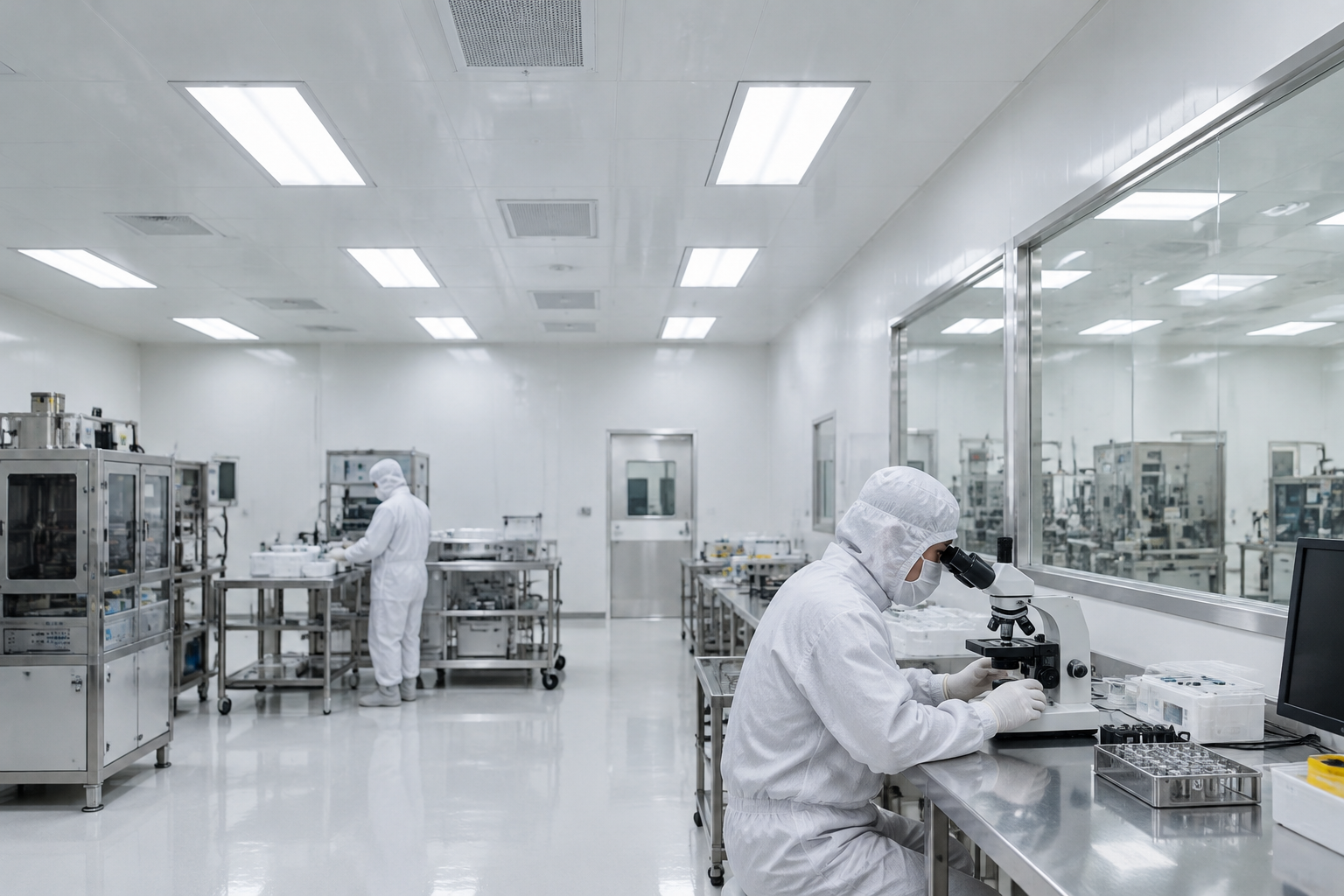
How Should an ISO Class 7/8 Specification Separate Room Classification from Luminaire Acceptance?
Create separate acceptance schedules. The room schedule should state ISO class, particle sizes, occupancy state and qualification procedure.
The luminaire schedule should state electrical safety, photometry, enclosure protection, materials, sealing interfaces and maintenance method. Avoid describing a fixture as “ISO Class 7 certified” unless supporting documentation explains precisely what was assessed and under which conditions.
For pharmaceutical projects, do not substitute an ISO class for an EU GMP grade. Annex 1 includes additional requirements concerning process protection, contamination control and microbiological monitoring. A particle-classification label alone does not establish compliance with those requirements.
Ask the cleanroom designer who owns the ceiling-to-luminaire seal: the lighting supplier, ceiling supplier or installer. Record the gasket, fastener spacing, compression method and inspection procedure. If pressure-boundary performance matters, agree a leakage criterion and test method; IP65 is not that criterion.
Which Construction Details Should Buyers Check Before Approving a Sealed Ceiling Luminaire?
Review a section drawing rather than relying on a front-view photograph. It should show the room-side lens, frame, gasket, cable entry, ceiling interface and driver location. A nominally flush luminaire can still contain exposed ledges or recesses that the cleaning team must assess.
Request compatibility evidence for the actual cleaning regime. Alcohol, chlorine-based agents and hydrogen peroxide processes should not be treated as interchangeable exposures.
Concentration, temperature, dwell time and repetition matter. A generic “chemical-resistant” description is insufficient without identifying the materials, test conditions and acceptance criteria.
Compare room-side and technical-void maintenance. Above-ceiling access may reduce disturbance to the occupied room, but only if the design permits servicing without compromising the room-side seal.
Room-side access may require controlled cleaning and a qualification-impact assessment afterward. Specify the service sequence, replacement-gasket policy and post-maintenance inspection before ordering.
How Can Contractors Reduce Lighting Energy Without Undermining Validated Operations?
Start with maintained illuminance and operating schedules, not a promised percentage saving. As an illustrative calculation, 100 luminaires drawing 40 W each for 6,000 hours annually consume 24,000 kWh. If scheduling reduces their average electrical demand by 20%, lighting consumption becomes 19,200 kWh: a calculated saving of 4,800 kWh, excluding controls standby power and HVAC interactions.
That estimate is not a cleanroom performance guarantee. Presence detection can miss stationary operators, equipment can obstruct sensors, and some activities require continuous illumination.
Obtain operations approval for dimming zones, timeout settings, minimum levels and recovery behavior. Emergency lighting must remain subject to its separate design requirements.
For US projects, identify the actual supply voltage, such as 120 V or 277 V, before driver selection. For either market, confirm control compatibility in a mock-up. A shared “0-10V” label does not settle dim-to-off behavior, while DALI-2 certification should be checked for the exact component rather than inferred from a protocol description.
 ISO Class 7/8 Cleanroom Lighting: Why IP65 Is Not Enough: How should an ISO Class 7/8 specification separate room classification from luminaire acceptance?
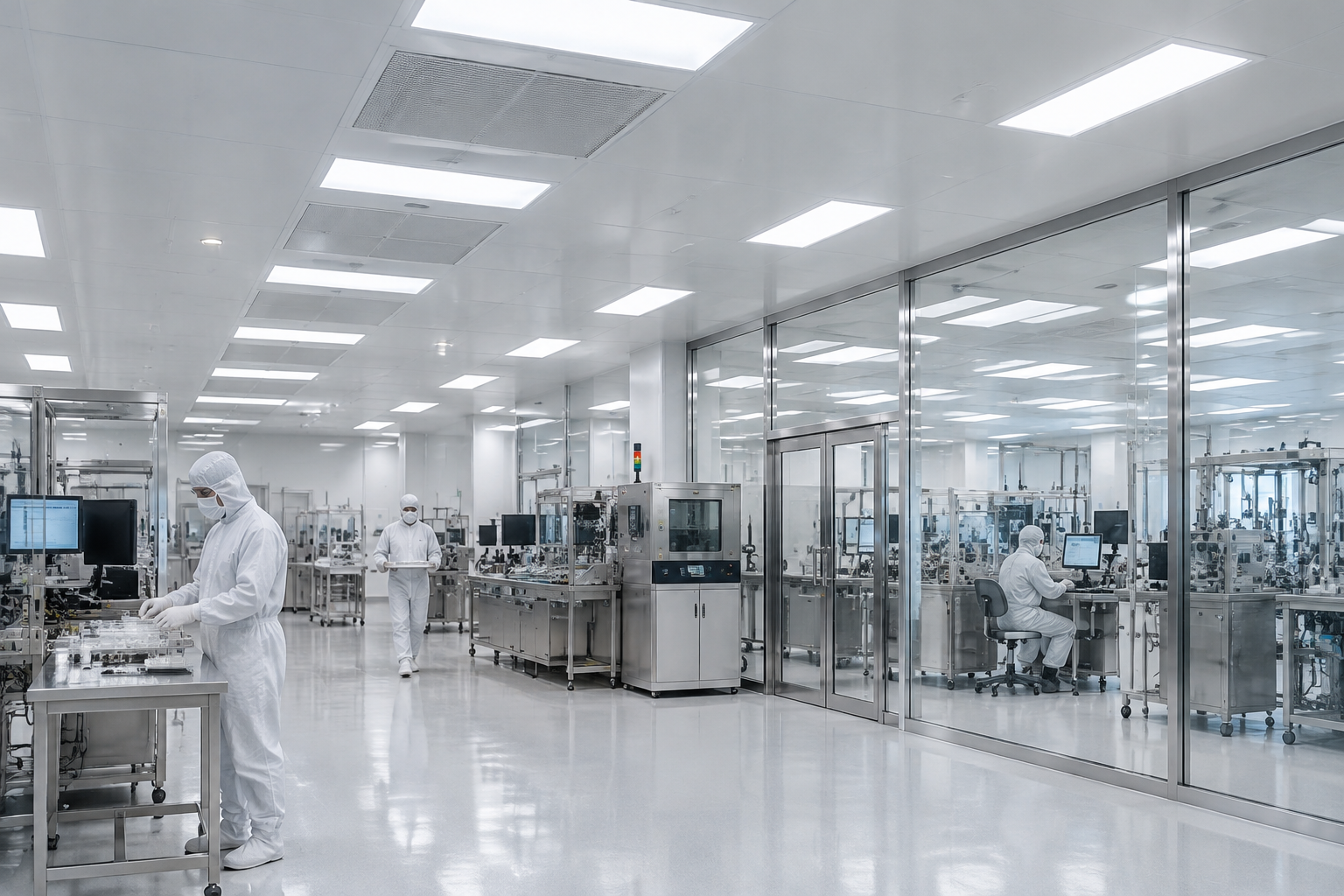
Compliance Checklist (IES / LDT / DIALux / CE / RoHS / ErP)
Use the following checks before technical approval and repeat the configuration check before shipment.
-
Obtain configuration-matched photometry. Request IES and LDT photometric files for the selected wattage, diffuser and optical assembly. Confirm the reported output and test conditions. A file from a visually similar panel does not establish the performance of a sealed cleanroom version.
-
Model the installation. Use DIALux to calculate maintained illuminance, uniformity and applicable glare criteria. Define working-plane height, maintenance factor, surface reflectance and major equipment obstructions. A 500 lx design target must be checked where work occurs, not only on an unobstructed floor grid.
-
Verify the IP claim’s boundary. Obtain the relevant IEC 60529 report and installation instructions. Establish whether IP65 applies to the complete enclosure or only the room-facing side when installed. Review cable glands, connectors and any conditions imposed on mounting orientation.
-
Check EU conformity at configuration level. CE marking is not a cleanroom certificate. Under the Low Voltage Directive 2014/35/EU, Article 6 sets manufacturer obligations, including technical documentation and conformity procedures. Review the EU declaration of conformity and applicable EMC evidence; wireless configurations may bring the Radio Equipment Directive into scope.
-
Separate RoHS from ErP. RoHS Directive 2011/65/EU, Article 7 addresses manufacturer obligations. Regulation (EU) 2019/2020 establishes ecodesign requirements for light sources and separate control gears; Articles 3–4 and the annexes govern applicable requirements and conformity assessment. Determine whether the supplied assembly is a containing product or a light source under its definitions before assigning obligations. Use the consolidated legal text and amendments.
-
Close destination-market and quality checks. For US installations, agree acceptable electrical-safety certification with the authority having jurisdiction; UL 1598 is a relevant luminaire safety standard, not an ISO cleanliness approval. ISO 9001 concerns the supplier’s management system, not product IP performance. Keep those evidence categories separate.
Finally, make substitutions subject to written approval. Changing a driver, lens, gasket or LED board can affect the evidence package even when the housing dimensions remain unchanged. The handover file should preserve the approved bill of materials, drawings, test references and maintenance instructions.
 ISO Class 7/8 Cleanroom Lighting: Why IP65 Is Not Enough: Compliance checklist (IES / LDT / DIALux / CE / RoHS / ErP)
Frequently Asked Questions
Q: Does an IP65 Luminaire Automatically Qualify for an ISO Class 7 Cleanroom?
No. IP65 addresses dust and water ingress under IEC 60529, while ISO 14644-1 classifies room air cleanliness. ISO Class 7 permits up to 352,000 particles/m³ at the 0.5 μm threshold under the specified classification conditions. Buyers must separately assess cleanability, materials, ceiling seals and the installed room’s qualification requirements.
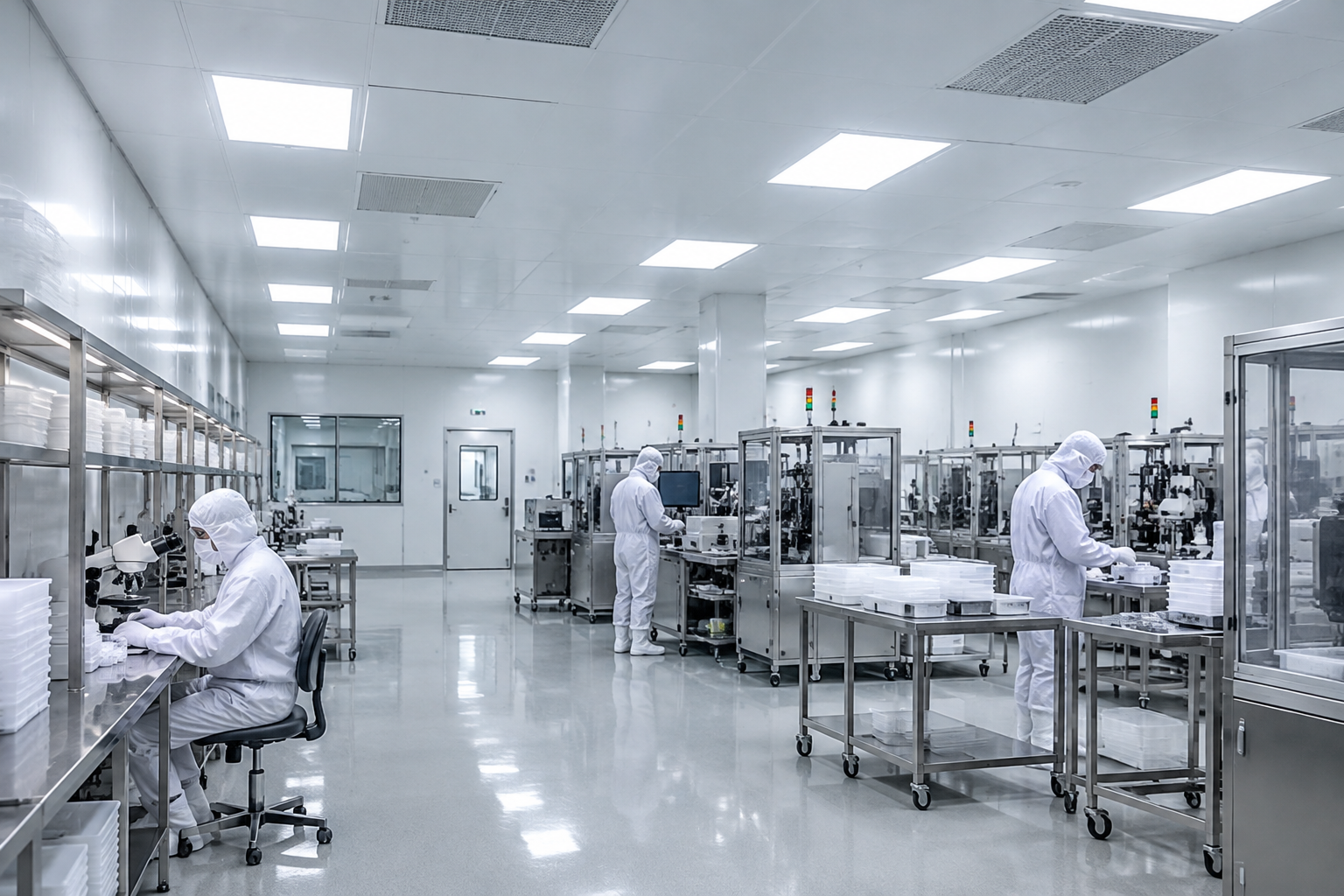
Q: What Illuminance Should Buyers Specify for ISO Class 7/8 Lighting?
ISO Class 7/8 does not prescribe illuminance. Select lighting levels from the visual task and applicable workplace requirements. A maintained 500 lx target can be a starting design assumption for some general tasks, but inspection work may need different lighting. Calculate uniformity, glare and equipment shadows before accepting the layout.
Q: Is IP65 Enough for Hydrogen Peroxide Decontamination?
IP65 alone does not demonstrate compatibility with hydrogen peroxide. Obtain material-specific evidence covering the planned concentration, exposure duration, temperature and number of cycles. Review the lens, gasket, coating and exposed adhesives individually. A water-jet test cannot establish chemical durability, and an ISO Class 8 room designation supplies no missing compatibility evidence.
Q: Which Documents Should Contractors Request Before Ordering Cleanroom Luminaires?
Request dimensioned installation drawings, the exact component schedule, IES/LDT files, applicable safety and IP reports, cleaning-compatibility evidence and destination-market conformity documents. Include the control configuration, such as DALI-2 or 0-10V, and maintenance instructions. For EU projects, check CE, RoHS and applicable ErP obligations; for US projects, confirm certification expectations with the local authority.
Talk to Our Engineering Team
At XHLWX (led-project-light.com), a Custom Indoor LED Lighting Manufacturer based in China, the engineering discussion should start with your ISO Class 7/8 room brief, ceiling drawings, cleaning protocol and destination-market requirements. Provide the target lux, CCT, supply voltage, control interface and maintenance-access strategy. Request a configuration-specific proposal and evidence schedule before approval, so lighting procurement supports—not substitutes for—the facility’s cleanroom qualification process.
 ISO Class 7/8 Cleanroom Lighting: Why IP65 Is Not Enough: Q: What illuminance should buyers specify for ISO Class 7/8 lighting?
Need a tailored lighting plan for your project?
Our senior lighting designers reply within 48 hours with a free design proposal & quotation.