
Warehouse LED High Bay Retrofits: Aisle Lux Before Energy Claims
Warehouse retrofit savings need an aisle-level lighting check. Learn how to specify maintained lux, rack illumination, controls and compliance evidence.

What Changed — and Why It Matters Now
At XHLWX (led-project-light.com), a Custom Indoor LED Lighting Manufacturer based in China, this analysis examines warehouse LED high bay retrofits through a practical procurement question: will the proposed energy reduction still deliver adequate lighting between fully loaded racks? For European and US buyers, the useful comparison is not simply old watts against new watts. It is verified task lighting against measured electrical consumption.
The reference point for European indoor workplace lighting is EN 12464-1:2021, subject to the applicable national adoption and project requirements. This article does not report a newly announced warehouse lighting rule. Instead, it addresses a specification gap: an open-floor illuminance calculation does not establish lighting performance after racks, pallets and working positions enter the model.
There is no single warehouse aisle lux figure suitable for every activity. Storage, circulation, picking, packing and inspection require different assessments. Buyers should identify the applicable activity entry in the standard and distinguish its requirements from additional project targets.
For preliminary budgeting, a designer might investigate 150 lx maintained horizontal illuminance in an access aisle and 300 lx at a picking or packing task. Those are illustrative design targets here, not a quotation of universal EN 12464-1 requirements. Reading small, low-contrast labels may justify a different target or supplementary lighting.
The procurement implication is straightforward: fix the task, calculation plane and acceptance criteria before comparing luminaire quantities or savings percentages. Otherwise, a lower-energy quotation may simply describe a less adequately lit warehouse.
The Technical Detail Behind the Headline
EN 12464-1 addresses more than average illuminance. Relevant assessment parameters include maintained illuminance, uniformity, discomfort glare and colour rendering. The selected activity and visual conditions determine which requirements apply; a generic claim of “EN-compliant high bay” cannot establish compliance for an installed layout.
The following schedule is an illustrative tender starting point, not an XHLWX product specification or a set of certified results. Replace its targets with the requirements established for the actual site.
| Parameter | Illustrative specification or target | Reference or verification route | Buyer notes |
|---|---|---|---|
| Horizontal aisle lighting | 150 lx maintained; U₀ ≥0.40 as an initial design target | Applicable EN 12464-1 activity entry; calculation and site measurements | Confirm whether the aisle is circulation, storage access or a working area |
| Picking and label reading | 300 lx on the defined task plane as a starting target | Task assessment and EN 12464-1 selection | Calculate vertical rack-face lighting separately where labels are read |
| CCT and colour rendering | 4000 K; CRI Ra ≥80 as project targets | Photometric and spectral test documentation | Select requirements for the goods and visual tasks involved |
| TM-30 colour fidelity and gamut | Rf ≥80; Rg 95–105 if specified | ANSI/IES TM-30 report | Optional project targets, not universal warehouse requirements |
| Glare and beam distribution | UGR ≤25 as an initial aisle target; compare 60°, 90° and asymmetric optics | Installation-specific glare assessment and photometry | Confirm the applicable glare limit; beam angle alone cannot predict aisle performance |
| Lighting control | DALI-2, Casambi or 0–10V, selected for the project | Component documentation and functional commissioning | Check dimming range, failure state and sensor coverage |
| Housing and dimensions | IP65 and approximately 1200 mm length for an illustrative linear option | IEC 60529 evidence and mechanical drawing | Neither IP65 nor this length is mandatory for every warehouse |
| LED and driver identification | Named options such as Samsung LEDs and a Tridonic or Mean Well driver | Exact bill of materials and component datasheets | Brand names alone do not establish luminaire performance |
| EU market documentation | CE declaration; RoHS evidence; applicable ErP documentation | Applicable EU legislation and technical file | Scope must match the supplied model and configuration |
| Manufacturing quality system | ISO 9001 certificate, if required by the buyer | Certificate scope, validity and issuing body | A quality-system certificate is not product approval |
Maintained illuminance is not initial illuminance. With an assumed maintenance factor of 0.80, a 150 lx maintained target requires approximately 187.5 lx initially in the calculation. This is an engineering example, not a recommended maintenance factor for every warehouse. Document the cleaning interval, environment and lumen-maintenance assumptions supporting the chosen value.
Require IES and LDT photometric files matching the offered luminaire, optic and output. Use them in DIALux, with racks and representative obstructions included. Model rack faces as well as floor or task planes; sufficient horizontal lux does not prove that a vertical label is readable.
What This Means for Specifiers and Buyers
How Should a Warehouse Aisle Lux Target Be Selected Under EN 12464-1?
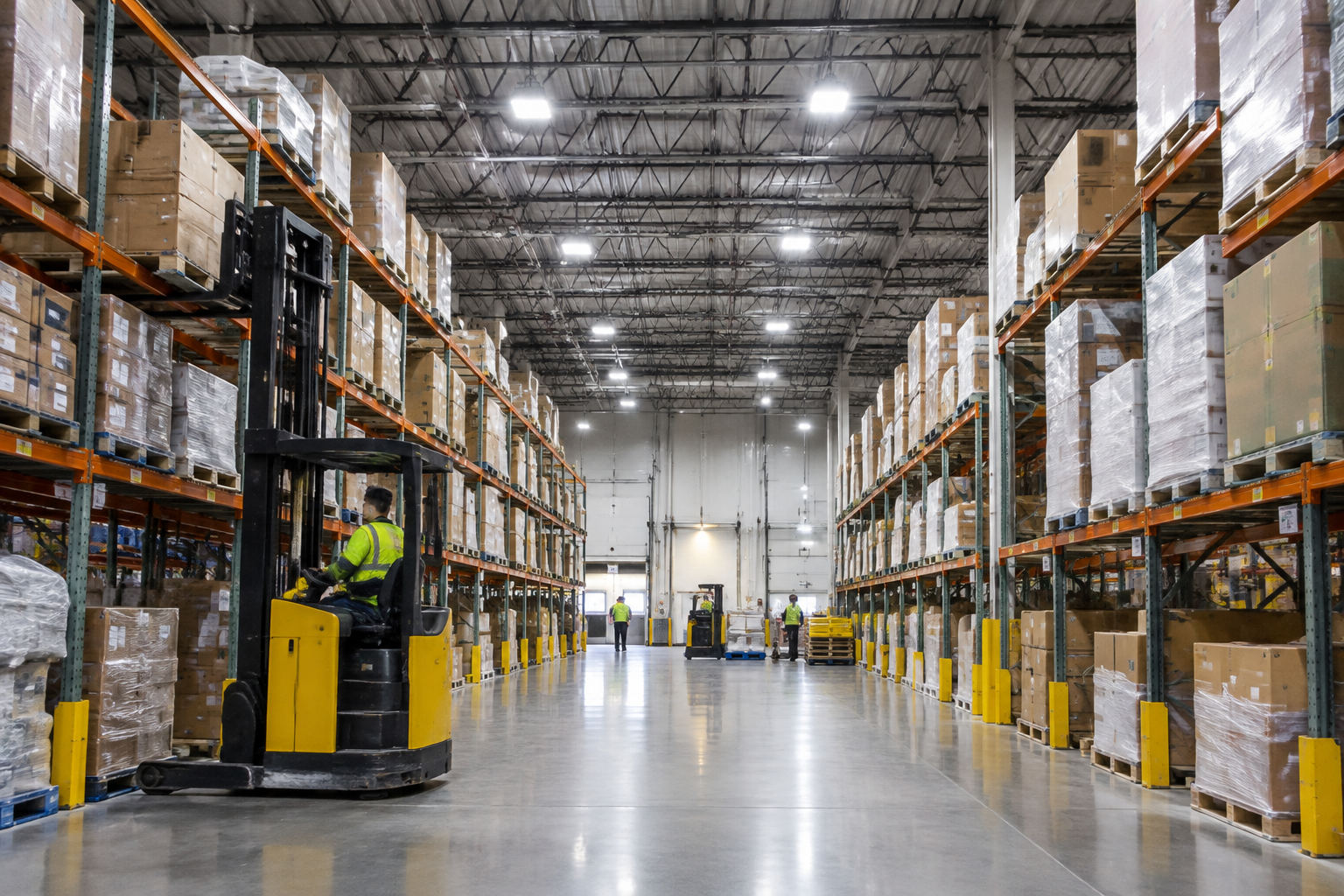
Begin with a task map rather than a fixture schedule. Identify pedestrian routes, forklift routes, rack access, manual picking, packing and inspection. Record where operators look, the height of labels and the contrast of the material being read. One aisle can contain several distinct visual tasks.
The European specifier should then check the relevant entries and contextual provisions in the adopted EN 12464-1 edition. Record required values separately from enhanced project targets. Do not describe a convenient 150 lx or 300 lx allowance as a mandatory standard value without identifying the applicable activity.
For US projects, EN 12464-1 can serve as an owner-selected design reference, but it does not replace applicable US requirements. Confirm the locally adopted electrical and energy codes, the authority having jurisdiction’s expectations and the relevant IES recommendations.
Finally, define calculation grids and measurement planes in the tender. A floor-level grid, a horizontal picking surface and a vertical rack face answer different questions. The contractor should price a clearly defined acceptance test rather than an undefined promise of “bright aisles.”
How Much Energy Can a High Bay Retrofit Save Without Reducing Useful Light?
Consider an illustrative warehouse with 100 existing luminaires drawing 400 W each, including control gear, operating for 4,000 hours annually. Its estimated lighting consumption is:
100 × 0.400 kW × 4,000 h = 160,000 kWh/year.
Replacing them with 100 luminaires drawing 150 W would consume 60,000 kWh/year, a 62.5% reduction, provided the new design satisfies the agreed lighting criteria. This is an arithmetic scenario, not a verified retrofit result or a recommended one-for-one replacement ratio.
Now assume the replacements operate at full input power for 60% of scheduled hours and at 30% of full input power for the remaining 40%. The weighted input factor is 0.72, giving 43,200 kWh/year and a 73% reduction against the original baseline.
At an illustrative electricity rate of €0.18/kWh, that second scenario saves approximately €21,024 annually in energy charges. It excludes installation, maintenance, demand charges and separately powered control equipment. A dimming command of 30% must not automatically be treated as 30% electrical input; confirm the driver’s measured behaviour.
Ask bidders to provide both a full-output comparison and a controlled-operation estimate. Keep occupancy and daylight assumptions visible so operational differences do not disappear inside a headline savings percentage.
Which Controls and Optics Work When Racks Block Light and Sensors?
An asymmetric or aisle-oriented distribution is a candidate where light must reach down narrow corridors and onto rack faces. A wider distribution may suit open handling areas. Neither is inherently superior: compare calculated uniformity, glare and useful task illuminance at the actual mounting height.
Model representative rack loading. Empty shelving may allow light paths that disappear when pallets are stored. Changing aisle width or rotating a linear luminaire can also change the result, so obtain an updated calculation after significant layout changes.
For controls, specify behaviour rather than protocol alone. DALI-2, Casambi and 0–10V can support different project architectures, but none guarantees appropriate occupancy detection. Check sensor mounting limits, obstructions and detection of pedestrians as well as vehicles.
A 10-minute hold time followed by a 30% standby setting could be a commissioning trial, not a universal recommendation. Confirm safe transition behaviour, response to approaching traffic and the maintained lighting needed while people remain present. Keep emergency lighting requirements separate from normal-lighting energy optimisation.
 Warehouse LED High Bay Retrofits: Aisle Lux Before Energy Claims: How should a warehouse aisle lux target be selected under EN 12464-1?
Compliance Checklist (IES / LDT / DIALux / CE / RoHS / ErP)
Use the following document gate before purchase approval. European legislation is not interchangeable with US product acceptance, and a component certificate does not automatically cover the completed luminaire.
- Photometric identity: Match IES/LDT filenames, output, power, optic code and mounting orientation to the quotation. Require recalculation after substitutions that affect distribution or output.
- Calculation evidence: Obtain the DIALux model and report, including geometry, reflectances, maintenance factor, calculation planes, uniformity and relevant glare assessment. Record excluded obstructions or assumptions.
- CE documentation: Request the EU Declaration of Conformity for the supplied model. For equipment within scope, manufacturer obligations appear in Low Voltage Directive 2014/35/EU, Article 6, and EMC Directive 2014/30/EU, Article 7. Wireless equipment requires assessment of the applicable radio-equipment framework.
- RoHS evidence: Directive 2011/65/EU, Article 4 and Annex II establish restricted-substance requirements and limits. Check the applicable documentation and any claimed exemptions against the actual materials and components.
- ErP scope: Regulation (EU) 2019/2020, Article 3 and Annex II, as amended, set ecodesign requirements for in-scope light sources and separate control gear. Do not assume that an unsupported “ErP compliant” statement resolves the treatment of a containing luminaire.
- US acceptance: Agree the required product listing, electrical installation requirements and local energy-code provisions before ordering. CE marking does not substitute for a US listing where one is required.
- Site handover: Define lux measurements, control settings and electrical measurements in advance. Record ambient conditions, operational state and instrument details so later checks can be compared meaningfully.
For the lighting standard itself, consult EN 12464-1:2021, Light and lighting — Lighting of work places — Part 1: Indoor work places, through the relevant national standards body. The project specification should name the adopted edition rather than rely on an undated reference.
 Warehouse LED High Bay Retrofits: Aisle Lux Before Energy Claims: Compliance checklist (IES / LDT / DIALux / CE / RoHS / ErP)
Frequently Asked Questions
Q: Is 150 Lux Enough for Every Warehouse Aisle?
No. In this article, 150 lx is an illustrative maintained-illuminance target for preliminary aisle design, not a universal EN 12464-1 requirement. Select the applicable activity and assess the actual task. Picking, packing and low-contrast label reading may need different criteria. Specify the measurement plane and assess vertical rack-face lighting where workers read labels.
Q: Can a Warehouse LED Retrofit Realistically Save 70% Energy?
A reduction around 70% is mathematically possible under suitable assumptions, but it is not guaranteed. The example here reduces annual consumption from 160,000 to 43,200 kWh by combining lower connected load with dimming. Verify existing system power, operating hours, occupancy and the replacement design’s maintained lighting performance before using that estimate in a financial approval.
Q: Does a UGR Below 25 on a Datasheet Prove Aisle Compliance?
No. UGR depends on the installation, observer positions, background luminance and luminaire distribution; a datasheet value may represent a particular reference arrangement. A project target such as UGR ≤25 must be checked against the applicable task requirement and assessed for the relevant geometry. Obtain matching photometry and document the assessment method rather than accepting an isolated product label.
Q: What Should a Contractor Request Before Ordering Replacement High Bays?
Request the exact bill of materials, IES/LDT files, a layout calculation, electrical data and jurisdiction-specific compliance documentation. Agree maintained lux, uniformity and measurement planes before purchase. For a proposed 150 W replacement, verify system input power and dimming behaviour rather than relying on nominal LED-board wattage. Also confirm mounting compatibility, sensor coverage and responsibilities for commissioning.
Talk to Our Engineering Team
Prepare a layout showing rack heights, aisle widths, mounting positions and picking locations. Add existing measured system power, operating hours and the required acceptance criteria. These inputs allow quotations to be compared on useful lighting and transparent energy assumptions rather than wattage alone.
At XHLWX (led-project-light.com), a Custom Indoor LED Lighting Manufacturer based in China, the next engineering discussion should start with that task map and evidence schedule. Ask the team to identify which proposed configurations can be supported by matching photometry, control documentation and market-specific compliance evidence before approving a sample or production order.
 Warehouse LED High Bay Retrofits: Aisle Lux Before Energy Claims: Q: Can a warehouse LED retrofit realistically save 70% energy?
Need a tailored lighting plan for your project?
Our senior lighting designers reply within 48 hours with a free design proposal & quotation.