
LED Surge Protection and Warranty Terms: A Procurement Test
How LED buyers can connect EN 61000-4-5 surge evidence, site protection and warranty exclusions before awarding an indoor lighting contract.
What Changed — and Why It Matters Now
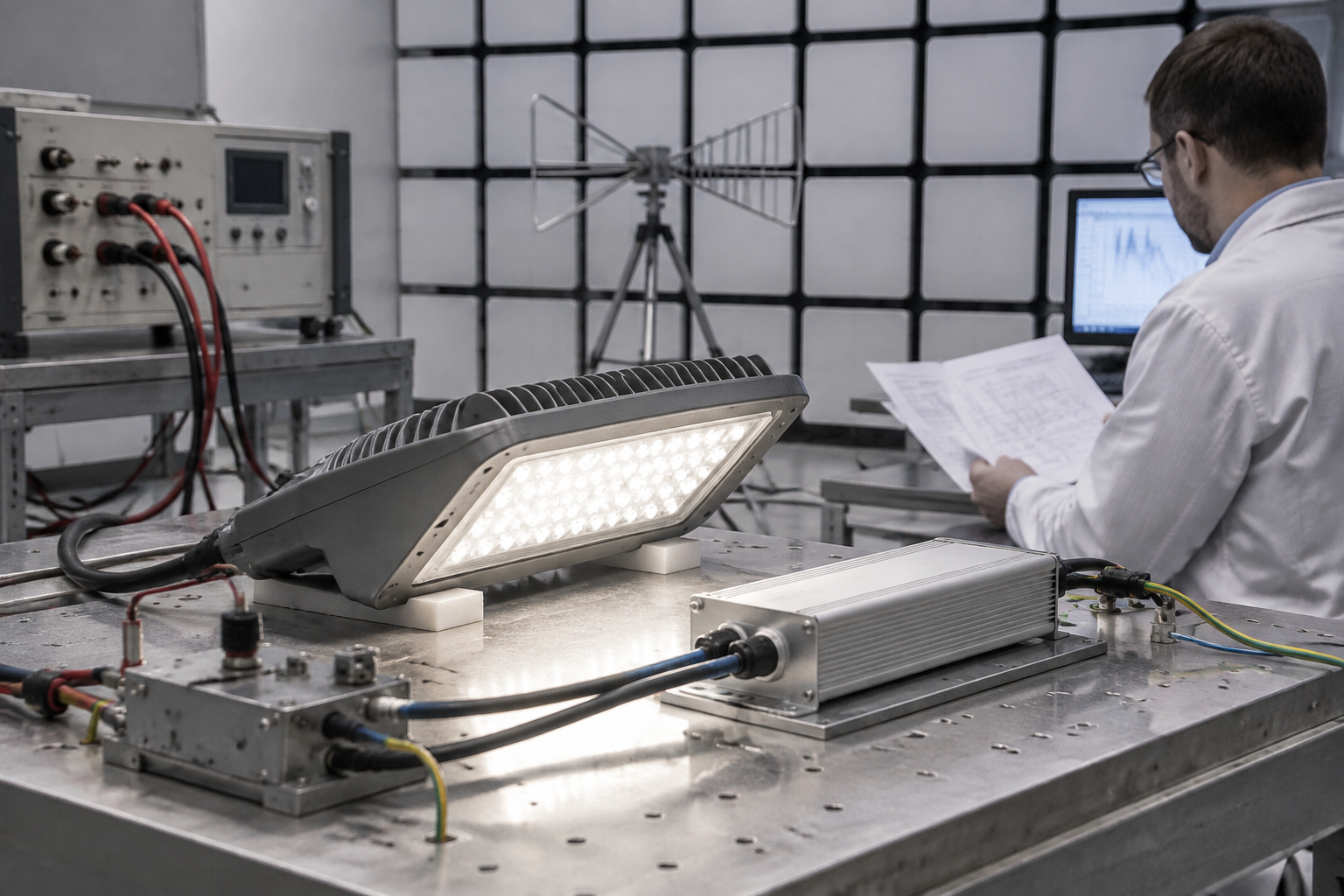
At XHLWX (led-project-light.com), a Custom Indoor LED Lighting Manufacturer based in China, surge protection and warranty terms should be reviewed as one procurement decision. For European and US indoor lighting projects, the central question is not simply whether a driver advertises “2 kV protection.” It is whether the supplied luminaire has relevant test evidence, whether the installation matches the tested conditions, and whether the warranty covers the failure costs the buyer expects.
This is a procurement analysis, not an announcement of a new surge mandate. EN 61000-4-5 describes a surge immunity test method; it does not independently set one universal protection level for every indoor LED luminaire.
Applicable product standards, project requirements and installation conditions determine which tests and acceptance criteria matter. A tender should identify the relevant standard editions rather than treating an undated compliance statement as sufficient.
The practical shift proposed here is from comparing isolated specifications to evaluating a documented allocation of risk. A five-year warranty excluding transient overvoltage can offer less protection against the particular risk under review than its headline suggests. Conversely, a higher tested surge level does not automatically include replacement labor, access equipment or consequential losses.
For a contractor, the buying decision therefore has three linked parts: verified immunity, coordinated installation protection and an enforceable remedy. None substitutes for the others.
The Technical Detail Behind the Headline
The IEC 61000-4-5 test framework, adopted in European EN standards, uses defined surge waveforms to evaluate immunity to switching and lightning-related transients. For the combination-wave generator relevant to many power-port tests, the nominal open-circuit voltage waveform is 1.2/50 μs and the nominal short-circuit current waveform is 8/20 μs. These describe different generator characteristics, not two interchangeable voltage ratings.
A meaningful report identifies the tested port, coupling arrangement, voltage level, polarity, operating condition and performance criterion. Differential-mode testing concerns a surge between conductors such as line and neutral.
Common-mode testing concerns coupling between conductors and earth or a reference arrangement. Protective-earth availability and equipment construction affect how the test is applied.
Consequently, “4 kV surge protection” is incomplete without the test mode and setup. It also does not mean that the luminaire withstands a direct lightning strike, sustained supply overvoltage or every transient that might occur on site.
The following schedule is an illustrative tender target, not a statement of XHLWX product performance, certification or warranty coverage. Final values require project engineering and documentary confirmation.
| Procurement item | Illustrative target or required disclosure | Standard or evidence route | Buyer’s verification note |
|---|---|---|---|
| Power-port surge immunity | Consider 1 kV line-to-neutral and 2 kV line-to-earth as project discussion values, not universal requirements | EN 61000-4-5 method; applicable EN IEC 61547 requirements | Specify edition, coupling, construction and acceptance criterion |
| Color and rendition | 3000 K or 4000 K; CRI ≥90; TM-30 Rf ≥85 and Rg 95–105 as design targets | Spectral measurement; identified IES TM-30 edition | Check the exact LED and optical configuration |
| Glare and distribution | Project UGR ≤19; nominal 60° or 90° beam options | Photometric report and room calculation | UGR is installation-dependent, not a universal product score |
| Controls | Select DALI-2, Casambi or 0–10 V; define dimming range | Exact driver documentation and system compatibility evidence | Verify control-port behavior after surge exposure |
| Housing and dimensions | IP20 for a suitable dry interior; illustrative 1200 mm linear housing | IEC/EN 60529; dimensional drawing | IP classification does not establish surge immunity |
| Chip and driver identification | Specify exact Samsung or Bridgelux LED and Tridonic or Mean Well driver model if selected | Bill of materials and component documentation | Brand names alone do not establish system performance |
| EU conformity and management | Applicable CE, RoHS and ErP documentation; ISO 9001 certificate if contractually required | EU declaration, technical documentation and certificate scope | ISO 9001 concerns quality management, not product surge approval |
| Warranty allocation | Illustrative five-year term with defined voltage, temperature and operating conditions | Signed supply agreement and warranty schedule | Identify exclusions, labor coverage and claim deadlines |
A driver report is useful component evidence, but the finished luminaire introduces wiring, terminals, insulation, housing and control interfaces. Procurement should require evidence covering the supplied assembly, or a documented technical justification explaining how component evidence supports that assembly. Undocumented driver substitutions should trigger approval before shipment.
What This Means for Specifiers and Buyers
How Should an Indoor LED Tender Distinguish Driver Ratings from Luminaire Immunity?
Start with the exact configuration that will be delivered: input voltage, protection class, driver model, control interface and emergency equipment where fitted. A report for a 230 V non-dimming driver does not, by itself, establish the performance of a 120 V controlled luminaire with different electronics.
Ask the supplier to map each offered variant to its evidence. The report should identify operating conditions, applied surge levels and observed behavior. Temporary disturbance, automatic recovery and permanent damage are materially different outcomes; the allowable response must follow the applicable standard and the buyer’s stated project requirements.
As an additional contractual design target, a buyer could require no permanent loss of lighting or control functions after the agreed test sequence. If light output is checked before and after testing, define the measurement procedure and tolerance rather than demanding an unexplained “zero change.”
For a commercial office, an illustrative brief might combine 500 lx maintained task illuminance, UGR ≤19 and 4000 K lighting. Surge verification cannot replace that lighting calculation: a robust driver inside an unsuitable optical system still fails the project brief.
When Should a Contractor Add Distribution-board Surge Protection?
Luminaire immunity and installation-level surge protective devices, or SPDs, address related but different parts of the risk. Device selection requires an electrical assessment considering the supply arrangement, earthing system, lightning protection, cable routes, local installation rules and equipment withstand characteristics.
For European work, the relevant national implementation of IEC/HD 60364 requirements should be checked, including provisions addressing transient overvoltages and SPD selection and erection. For US projects, the locally adopted National Electrical Code edition and applicable SPD requirements govern the installation. Neither market should be reduced to a blanket instruction to fit one SPD type everywhere.
Where an SPD is specified, record its voltage protection level, continuous operating voltage, installation location, backup protection and manufacturer’s connection requirements. Coordination and conductor routing matter; a distribution-board label alone does not demonstrate the residual stress at each luminaire.
If the warranty requires external surge protection, obtain that condition before pricing the job. Define commissioning evidence, inspection responsibility and replacement responsibility for a failed SPD. Otherwise, a supplier requirement can become an unpriced contractor obligation.
Which Warranty Clauses Determine the Actual Cost of a Surge-related Failure?
Require the warranty to distinguish transient surge damage from sustained overvoltage, incorrect wiring and operation outside declared supply limits. EN 61000-4-5 test evidence does not establish immunity to every abnormal supply condition. Equally, a supplier should not rely on an undefined “electrical event” exclusion without explaining how a claim will be assessed.
The contract should identify the start date, duration, operating-hour limits, ambient-temperature limits, remedy and claim process. Ask whether the remedy is a driver, a complete luminaire, repair or credit. Establish who pays for diagnosis, freight, duties, removal, reinstallation and access equipment.
Consider an explicitly hypothetical comparison: if replacing a driver requires €35 in parts and €120 in labor and access, a parts-only remedy leaves most of the intervention cost with the buyer. These figures are estimating assumptions, not market benchmarks. Their purpose is to reveal the cost categories hidden by the phrase “five-year warranty.”
Also agree what evidence supports a disputed failure: photographs, circuit identification, failed-part return, SPD condition and supply-monitoring records where available. A requirement for continuous transient recording should be disclosed in advance if it is a condition of coverage. Legal enforceability and statutory rights depend on jurisdiction and contract type.
 LED Surge Protection and Warranty Terms: A Procurement Test: How should an indoor LED tender distinguish driver ratings from luminaire immunity?
Compliance Checklist (IES / LDT / DIALux / CE / RoHS / ErP)
Use separate approval tracks for lighting quality, electrical immunity and contractual coverage. Combining them into a single “compliant” checkbox obscures missing evidence.
- Photometry: Obtain IES and LDT photometric files for the exact output, optic and configuration. Use DIALux to evaluate maintained illuminance, uniformity and installation-dependent glare. Record mounting height, reflectances and maintenance factor. Photometric files do not demonstrate surge immunity.
- Surge evidence: Request the report number, laboratory identity, tested sample configuration, standard edition, coupling modes, voltage levels and results. Check whether control and emergency interfaces are covered where applicable. Confirm how alternative drivers or production changes are controlled.
- EU electrical safety and EMC: Determine the applicable legislation, including Low Voltage Directive 2014/35/EU and EMC Directive 2014/30/EU where relevant. Article 6 of the Low Voltage Directive and Article 7 of the EMC Directive establish manufacturer obligations. CE marking is not a standalone laboratory certificate or a promise of surge-related warranty coverage.
- RoHS: Request supporting documentation under Directive 2011/65/EU, as amended. Article 7 sets out manufacturer obligations. Material restrictions and relevant exemptions are a separate compliance question from immunity to electrical transients.
- ErP: Check Commission Regulation (EU) 2019/2020, as amended, for in-scope light sources and separate control gears. Assess the applicable requirements and treatment of containing products. ErP documentation does not prescribe a universal five-year warranty or a universal luminaire surge rating.
- US acceptance: Confirm the relevant safety listing or certification and acceptance requirements with the authority having jurisdiction. CE documentation does not replace US requirements. Check the applicable luminaire category, installation environment and supply voltage.
- Commercial sign-off: Attach the approved configuration, test requirements, installation conditions and warranty schedule to the purchase order. Identify a claim contact and response timetable. Do not leave coverage dependent on an unsigned quotation footnote.
Energy savings belong in a separate, transparent calculation. For example, replacing 100 luminaires rated at 60 W with 40 W alternatives operating 3,000 hours annually would reduce calculated lighting consumption by 6,000 kWh per year, or approximately 33%, before control effects. That estimate assumes comparable delivered lighting performance; it says nothing about surge immunity or warranty liability.
 LED Surge Protection and Warranty Terms: A Procurement Test: Compliance checklist (IES / LDT / DIALux / CE / RoHS / ErP)
Frequently Asked Questions
Q: Does EN 61000-4-5 Require Every Indoor LED Luminaire to Withstand 4 kV?
No. EN 61000-4-5 provides a surge test method rather than one universal 4 kV requirement for indoor lighting. Applicable product standards and project conditions determine the relevant levels and acceptance criteria. Buyers should request the tested coupling mode, equipment configuration and standard edition, because a voltage figure without those details is incomplete.
Q: Is a Driver’s 2 kV Rating Enough to Approve a Complete Luminaire?
Not by itself. A 2 kV driver claim needs a defined test method, coupling arrangement and performance criterion. The complete luminaire can include additional wiring, controls and emergency electronics. Require evidence covering the delivered assembly, or a documented engineering justification linking the component evidence to that assembly and its intended installation.
Q: Does a Five-year LED Warranty Normally Include Surge Damage and Labor?
A five-year duration alone does not establish either coverage. The written terms must state whether electrical surges are included, which installation conditions apply and whether labor, access equipment and freight are reimbursed. Compare the remedy as well as the duration, and obtain agreement on how disputed electrical failures will be investigated before ordering.
Q: Can an External SPD Replace Luminaire Surge Testing?
No. An external SPD and a luminaire’s tested immunity serve different roles. A design using a Type 2 SPD still needs suitable equipment withstand characteristics and coordinated installation. The designer should assess residual voltage, connections and local rules, while the buyer verifies the luminaire’s evidence and any warranty condition requiring installation-level protection.
Talk to Our Engineering Team
At XHLWX (led-project-light.com), a Custom Indoor LED Lighting Manufacturer based in China, the engineering discussion should begin with the project’s supply voltage, earthing arrangement, control protocol, operating environment and requested warranty allocation. Submit the proposed surge test levels alongside the lighting brief, photometric requirements and installation protection plan.
Request written confirmation of the offered configuration and available evidence before approval. The procurement objective is not the largest kV number: it is a defensible match between tested performance, site conditions and responsibility when something fails.
 LED Surge Protection and Warranty Terms: A Procurement Test: Q: Is a driver’s 2 kV rating enough to approve a complete luminaire?
Need a tailored lighting plan for your project?
Our senior lighting designers reply within 48 hours with a free design proposal & quotation.