
Office Daylight Harvesting Savings: Why Metering Matters
Occupancy and daylight controls can cut office lighting energy, but buyers need circuit-level metering, a credible baseline and verified desk illuminance.

What Changed — and Why It Matters Now
At XHLWX (led-project-light.com), a Custom Indoor LED Lighting Manufacturer based in China, the practical question for office occupancy sensors and daylight harvesting is how buyers should verify savings without accepting darker desks or unreliable switching. This analysis examines the measurement requirements behind control-led lighting upgrades, rather than reporting a new product launch or an unverified installation result.
The evidence for controls is established, but its interpretation matters. A 2012 Lawrence Berkeley National Laboratory-associated meta-analysis, published in LEUKOS, reported average lighting-energy savings estimates of 24% for occupancy control, 28% for daylighting control and 38% for multiple control approaches. These are historical research findings across different installations and methods—not guaranteed savings for a contemporary LED office.
For a buyer comparing tenders, the important distinction is between a control command and measured electrical consumption. A dashboard showing “50% dimming” does not, by itself, establish a 50% reduction in circuit energy. Driver characteristics, operating hours, standby consumption and actual occupancy affect the result.
The procurement implication is straightforward: specify an energy-verification method alongside the luminaires. Keep control savings separate from savings attributable to replacing older light sources, reducing installed wattage or changing office attendance.
The Technical Detail Behind the Headline
A defensible design starts with visual requirements and then evaluates the power needed to maintain them. For office writing, typing, reading and data processing, EN 12464-1:2021 specifies 500 lx maintained illuminance, a limiting unified glare rating of 19 and minimum colour rendering index Ra 80.
The task-area uniformity requirement is 0.60. Other office activities and surrounding areas require separate checks.
The following schedule is an illustrative procurement brief, not a declaration of XHLWX product performance or certification. Values identified as targets must be confirmed against the selected luminaire and project conditions.
| Parameter | Illustrative specification | Verification reference | Buyer notes |
|---|---|---|---|
| Task lighting | 500 lx maintained; uniformity ≥0.60 | EN 12464-1:2021, relevant office task | Check desk locations and maintenance assumptions |
| CCT and colour | 4000 K; CRI Ra ≥80; optional Ra ≥90 | Supplier spectral report | Keep CCT fixed during comparative energy tests |
| TM-30 colour fidelity | Rf ≥85; Rg 95–105 as project targets | IES TM-30 report | These are proposed targets, not universal office limits |
| Glare and distribution | UGR ≤19; nominal 90° beam as a design option | Room calculation and photometry | Beam angle alone does not establish glare compliance |
| Control interface | DALI-2, Casambi or 0–10V | Device documentation and commissioning test | Verify dimming range, off-state behaviour and zoning |
| Housing | IP20; nominal 1200 mm linear body | IEC 60529 evidence and drawing | Illustrative choice for a dry indoor office |
| LED and driver | Samsung LED option; Tridonic or Mean Well driver option | Exact component codes and datasheets | Named brands are examples, not a confirmed bill of materials |
| EU conformity | CE documentation; RoHS; applicable ErP evidence | Relevant EU legislation | Match evidence to the exact supplied configuration |
| Quality management | ISO 9001:2015 certificate, if required | Valid certificate and manufacturing scope | Management-system certification is not product approval |
Request IES and LDT photometric files for the exact optical configuration. Use DIALux to evaluate illuminance, uniformity and glare under declared geometry, reflectances and maintenance factors. A static photometric calculation does not establish annual control savings: those require operating assumptions or measured time-series data.
Also request an input-power-versus-dimming curve. For example, a 10% digital command must not be treated as 10% electrical input unless supporting measurements demonstrate that relationship. Record the lowest stable light output, minimum input power and any separate switching needed for a true off state.
What This Means for Specifiers and Buyers
How Should an Office Contractor Measure Occupancy and Daylight Savings Separately?
Define the baseline before activating automatic controls. For a controls-only comparison, use the same luminaires, full-output settings, scheduled hours and task-lighting requirements in both conditions. Document attendance and blind positions so that changed working patterns are not mislabelled as control performance.
A practical pilot target is 4–8 weeks, using 1–5 minute power records and representative workplane illuminance measurements. This is a proposed protocol, not a universal minimum. One short winter or summer sample cannot establish annual daylight savings without adjustment for seasonal conditions.
Where operations allow, compare four states: fixed-output reference, occupancy control only, daylight control only and combined control. Alternate comparable test periods rather than assigning each state to a different season. Log overrides and changes to setpoints.
Meter the complete lighting circuit where possible, including drivers and relevant control equipment. If a gateway serves several systems, document its allocated energy.
DALI diagnostic data can supplement this record, but verify whether reported power is measured, calculated or estimated. Retain timestamped exports so the contractor and client can reproduce the calculation.
How Much Energy Could a Combined-control Office Design Save?
Consider an illustrative office with 100 luminaires drawing 30 W each at full output. With 2,500 scheduled operating hours and no baseline consumption outside that schedule, annual reference energy is:
100 × 30 W × 2,500 h ÷ 1,000 = 7,500 kWh.
Assume occupancy control removes 750 full-output-equivalent operating hours. During the remaining 1,750 hours, daylight harvesting reduces average luminaire input to 70% of full power. Active lighting consumption becomes:
3 kW × 1,750 h × 0.70 = 3,675 kWh.
Add an explicitly estimated 100 kWh annual allowance for incremental control and standby energy not already included. The resulting 3,775 kWh represents approximately 49.7% savings against the reference. This is a worked estimate, not a measured site result or a forecast for every office.
Notice that two assumed 30% reductions do not add to 60%. Applied sequentially, they yield 51% before the additional energy allowance. At an illustrative electricity price of €0.20/kWh, the 3,725 kWh reduction is worth approximately €745 annually, excluding maintenance and financing.
How Can Daylight Zones Avoid False Savings from Darker Desks?
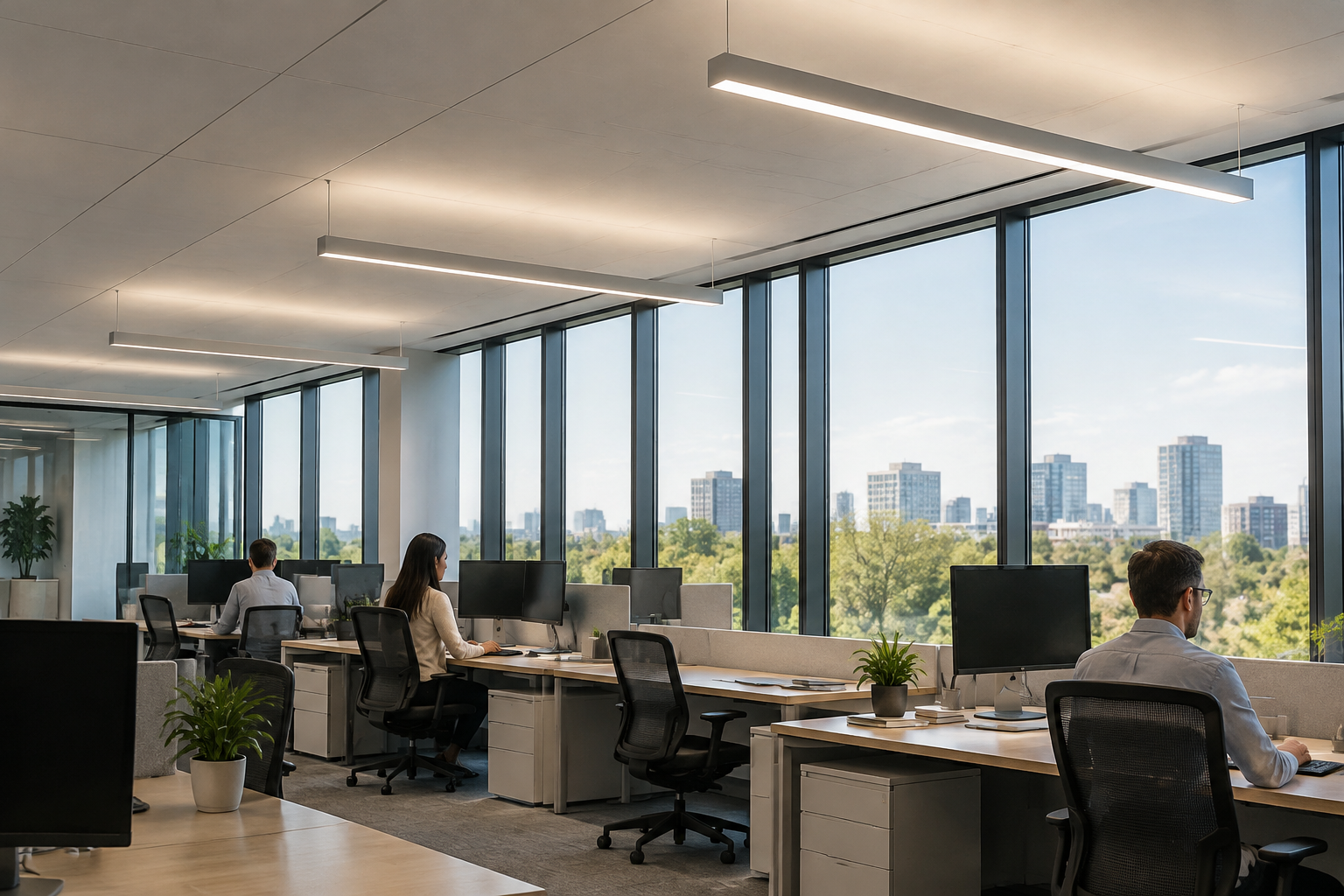
Separate perimeter and interior control zones. A sensor near a window can register adequate daylight while a desk deeper in the room remains below its target. Set zone boundaries using the façade, partitions, workstation layout and measured daylight distribution—not simply equal numbers of luminaires.
Commission daylight response with representative blind positions. Verify the darkest relevant occupied desks as well as locations directly beneath the sensor. A proposed 500 lx control setpoint is not proof that every task area achieves 500 lx maintained illuminance.
For occupancy control, a 10–20 minute timeout can be evaluated as an initial design setting, subject to local code and user needs. Test seated, low-motion activities before acceptance. A short timeout that repeatedly switches off during reading creates an operational defect, not a credible efficiency achievement.
Specify manual override behaviour, restoration after power loss and the response to sensor or network failure. Exclude emergency circuits from ordinary switching unless an appropriately designed emergency-lighting arrangement permits it. Preserve required escape-route operation independently of the office savings calculation.
 Office Daylight Harvesting Savings: Why Metering Matters: How should an office contractor measure occupancy and daylight savings separately?
Compliance Checklist (IES / LDT / DIALux / CE / RoHS / ErP)
Use a tender evidence schedule that separates visual performance, electrical conformity and energy verification. None substitutes for the others.
- Photometry: Obtain IES and LDT photometric files with a report identifying the luminaire, optics, luminous flux, input power and test conditions. Confirm that substitutions do not invalidate the design.
- Lighting calculation: Require the DIALux model, maintenance factor, calculation surfaces, reflectances and relevant observer positions. Evaluate glare for the actual arrangement; UGR is not an installation-independent product guarantee.
- CE: For EU supply, identify all applicable legislation. The Low Voltage Directive 2014/35/EU and EMC Directive 2014/30/EU are relevant to many mains-powered lighting products; radio-enabled configurations require assessment under the Radio Equipment Directive 2014/53/EU. Request the EU declaration of conformity and supporting documentation rather than a generic “CE certificate.”
- RoHS: Directive 2011/65/EU, Article 4 and Annex II establish substance restrictions, subject to applicable exemptions. Ask for evidence covering the delivered assembly and current component configuration.
- ErP: Commission Regulation (EU) 2019/2020, Article 3 and Annex II set ecodesign requirements for in-scope light sources and separate control gears, with requirements applying from 1 September 2021 and subsequent amendments. Establish the product classification and applicable requirements; a luminaire is not automatically assessed as a light source.
- US projects: Confirm the locally adopted energy-code edition and applicable occupancy, daylight-response and acceptance requirements. Agree the product listing or field-evaluation route required by the authority having jurisdiction. EU conformity documents do not replace US acceptance requirements.
- Handover: Require circuit-meter exports, sensor-zone drawings, timeout settings, dimming curves, override logs and desk-level lux readings. Include the uncertainty of the measuring equipment and the method used to annualise results.
The purchase order should identify who commissions the system, who approves the baseline and who resolves discrepancies. A proposed contract arrangement is to retain final acceptance until both lighting performance and control sequences pass witnessed tests. Avoid making a guaranteed annual percentage dependent on attendance or weather that neither supplier nor contractor controls.
 Office Daylight Harvesting Savings: Why Metering Matters: Compliance checklist (IES / LDT / DIALux / CE / RoHS / ErP)
Frequently Asked Questions
Q: What Percentage of Office Lighting Energy Can Occupancy and Daylight Controls Save?
There is no universally defensible percentage. The 2012 LEUKOS meta-analysis reported average savings estimates of 24% for occupancy control, 28% for daylighting and 38% for multiple approaches. Those findings are context, not a guarantee for an LED office. Establish a project baseline and measure combined operation because overlapping savings cannot simply be added.
Q: Does a 50% Dimming Setting Mean 50% Lower Electricity Consumption?
Not necessarily. A 50% command describes an interface setting, which may use a nonlinear curve, rather than a verified electrical reduction. Driver overhead, minimum operating power and standby loads affect the relationship. Request measured input power at several settings, such as 100%, 75%, 50%, 25% and minimum output, then check the complete circuit during commissioning.
Q: How Long Should an Office Lighting Savings Pilot Run?
A 4–8 week pilot is a useful proposed starting point for testing control sequences, occupancy detection and data quality. It does not automatically capture annual daylight conditions. Log power at 1–5 minute intervals where practical, record overrides and attendance, and use seasonal monitoring or a documented annualisation method before presenting an annual kWh claim.
Q: Can DALI-2 or Wireless Control Data Replace a Dedicated Energy Meter?
Only if the relevant devices provide suitably validated energy measurements and the reporting boundary includes the loads being assessed. An estimated wattage value is not equivalent to metered kWh. For acceptance, a project might specify a meter with ±1% stated energy accuracy under relevant operating conditions, while using control-system logs to explain switching and dimming events.
Talk to Our Engineering Team
Prepare a room plan, baseline circuit schedule, operating calendar and target illuminance before requesting a controls quotation. Ask for an itemised evidence package and an agreed pilot method, not just a predicted savings percentage.
At XHLWX (led-project-light.com), a Custom Indoor LED Lighting Manufacturer based in China, the engineering discussion should start with your European or US project's 500 lx task requirements, sensor zones, driver interfaces and measurement boundary. Request configuration-specific documentation and a commissioning plan so that any proposed energy reduction can be checked against both metered kWh and acceptable working conditions.
 Office Daylight Harvesting Savings: Why Metering Matters: Q: Does a 50% dimming setting mean 50% lower electricity consumption?
Need a tailored lighting plan for your project?
Our senior lighting designers reply within 48 hours with a free design proposal & quotation.