
EU ErP Compliance for LED Luminaires Turns on Module Access
EU ecodesign compliance depends on identifying, accessing and documenting the light source—not just checking a luminaire’s efficacy.
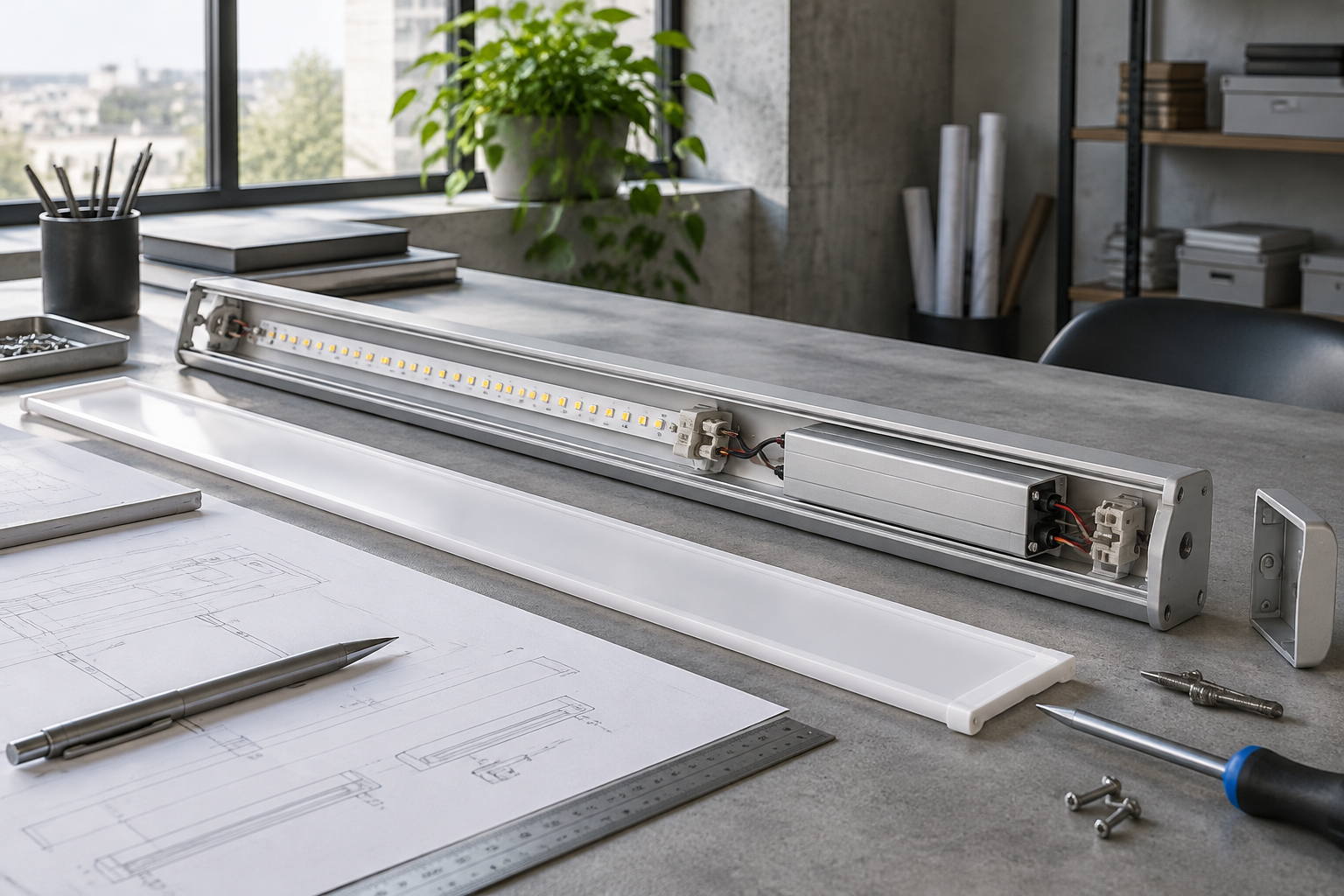
What Changed — and Why It Matters Now
At XHLWX (led-project-light.com), a Custom Indoor LED Lighting Manufacturer based in China, the practical procurement question is how to demonstrate EU ecodesign compliance when an LED module sits inside a finished luminaire. For European specifiers and contractors, the decisive evidence extends beyond an efficacy figure: buyers need to know what constitutes the regulated light source, how it can be accessed for verification, and whether its replacement is possible or technically justified as inappropriate.
Commission Regulation (EU) 2019/2020 has applied principally since 1 September 2021, with amendments including Regulation (EU) 2021/341. This is not a newly announced blanket requirement for every luminaire to achieve one efficacy threshold. It establishes ecodesign requirements for light sources and separate control gears, including those placed on the market inside a containing product.
The distinction matters when specifying sealed linear fittings, integrated downlights or proprietary LED assemblies. A luminaire that allows its contained light source to be separately verified can be treated as a containing product. If it cannot be disassembled for that verification, the entire product is considered a light source under the regulation’s definition.
The procurement consequence is straightforward: define the regulatory boundary before accepting the compliance dossier. A module report, driver declaration and finished-luminaire datasheet must describe a coherent assembly. A compliance statement for one component does not automatically establish compliance for every configuration built around it.
The Technical Detail Behind the Headline
Article 2 defines a containing product and establishes the disassembly distinction. Article 3 points to the ecodesign requirements in Annex II. Article 4 addresses removal, replacement and information obligations. These provisions should be read together rather than reduced to a request for an “ErP certificate.”
Three different questions need separate answers:
- Verification access: Can the light source be removed without permanently damaging it, so market-surveillance authorities can verify it separately?
- Replacement: Can the light source and separate control gear be replaced using commonly available tools without permanently damaging the containing product?
- End-of-life dismantling: Are instructions available for dismantling the relevant components when the product reaches disposal?
Article 4 allows a technical justification related to product functionality where replacement is not appropriate. That is not the same as an unrestricted exemption for sealed products. Nor does such a justification erase the separate question of whether the complete assembly must be classified as a light source.
The following table is an illustrative procurement schedule, not a tested XHLWX product specification. The project targets must be confirmed against the selected configuration.
| Parameter | Illustrative specification or evidence | Standard or regulatory reference | Buyer’s verification note |
|---|---|---|---|
| Source boundary and access | Identified LED module; documented removal sequence | Regulation (EU) 2019/2020, Articles 2 and 4 | Establish whether the regulated light source is the module or complete assembly |
| CCT and colour quality | 3000 K or 4000 K; CRI ≥80; optional TM-30 Rf ≥90 and Rg 95–105 | Annex II where applicable; IES TM-30 for additional colour evaluation | TM-30 values here are design targets, not ErP requirements |
| Glare and beam | UGR ≤19 as an office design target; 60° or 90° nominal beam | EN 12464-1 and project photometry | Verify glare in the actual room; a beam angle alone proves neither comfort nor compliance |
| Controls | DALI-2, Casambi or 0-10V, selected by project | IEC 62386 where applicable; relevant system documentation | Verify the exact driver, control interface and standby arrangement |
| Housing | 1200 mm nominal length; IP20 indoors or IP44 where specified | IEC/EN 60529 | Confirm that opening and reassembly preserve the required enclosure performance |
| LED and driver identification | Samsung LED package or Tridonic driver as example named components | Exact manufacturer datasheets and model references | Brand names are illustrative; record the actual part numbers and substitutions |
| EU conformity | Applicable CE documentation and RoHS evidence | Applicable EU legislation, including Directive 2011/65/EU | Obtain model-specific declarations and supporting technical documentation |
| Ecodesign evidence | Applicable source and control-gear calculations, tests and information | Regulation (EU) 2019/2020, Annex II | Do not substitute finished-luminaire lm/W for the required regulatory assessment |
| Quality-system evidence | ISO 9001 certificate, if claimed | ISO 9001 | Verify scope and validity; certification does not establish product conformity |
Annex II’s maximum permitted on-mode power calculation depends on the applicable source characteristics and correction factors. Therefore, a purchase specification stating only “minimum 120 lm/W” or “minimum 160 lm/W” cannot reproduce the regulatory assessment.
Keep component and system measurements separate. LED-module output, driver losses and optical losses affect different boundaries. The declared useful luminous flux and electrical input used for ecodesign must correspond to the regulated source and prescribed assessment conditions, not whichever catalogue figures look most favourable.
What This Means for Specifiers and Buyers
How Should a European Buyer Specify an Accessible LED Module Without Confusing It with a Retrofit Lamp?
Accessibility does not mean every luminaire needs an E27 lamp holder or a universal replacement module. A proprietary LED board can be assessed within a containing product, provided the relevant access, replacement and information requirements are addressed.
For tender purposes, request a drawing showing the module, connectors, driver, fixings and opening sequence. Ask which tools are required and whether the diffuser, thermal interface or seals need replacement during servicing. Where a supplier relies on a technical justification for non-replaceability, request that justification before approving the sample.
Also distinguish legal requirements from commercial preferences. Article 4 is not a promise that every LED board will remain commercially available for 10 years. If a project requires a defined spare-parts period, interchangeable mounting dimensions or a maximum replacement price, place those conditions in the purchase contract.
For a hotel corridor, an illustrative specification might require a 3000 K replacement module with matching drive current, dimensions and colour consistency. Those contractual requirements protect the installed appearance; the words “replaceable LED” alone do not.
What Should Contractors Do When an LED Board or Driver Changes After Tender Approval?
Treat substitutions as engineering changes, not merely purchasing changes. A different LED package can alter forward voltage, spectral output and thermal behaviour. A different driver can change efficiency, output current, dimming behaviour and the applicable control-gear evidence.
Require an updated bill of materials and an assessment of which declarations, tests and calculations remain applicable. If a replacement changes the regulated light-source model or its declared characteristics, check the associated ecodesign and energy-labelling documentation rather than assuming the original records cover it.
Use a project hold point: no substitution should enter production until the responsible technical reviewer accepts the revised evidence. This is particularly useful where one housing is offered with several CCTs, power settings and control options.
For a 500 lux office design target, a lower-output substitution may require changes to spacing or quantity. Recheck the lighting calculation where output or distribution changes; nominally matching wattage does not demonstrate equivalent delivered illumination.
How Should US Specifiers Handle a Luminaire Family Also Destined for Europe?
Separate the market-specific evidence from the shared mechanical design. EU ecodesign documentation does not establish compliance with US electrical safety requirements, local codes or project-specific listing requirements. Conversely, a US-market safety listing does not replace European conformity assessment.
A shared housing may use different drivers for a European 230 V supply and a US project using 120 V or 277 V. Record the actual voltage range, output settings and control interface for each ordered variant. Verify that the service instructions identify the correct replacement components for that market.
Energy comparisons should also use complete-system input. As an illustrative estimate, reducing a fitting from 40 W to 32 W over 3,000 annual operating hours reduces consumption from 120 kWh to 96 kWh: a 24 kWh, or 20%, reduction.
That estimate assumes unchanged hours and acceptable lighting performance. It is not an ErP test result or a measured project saving.
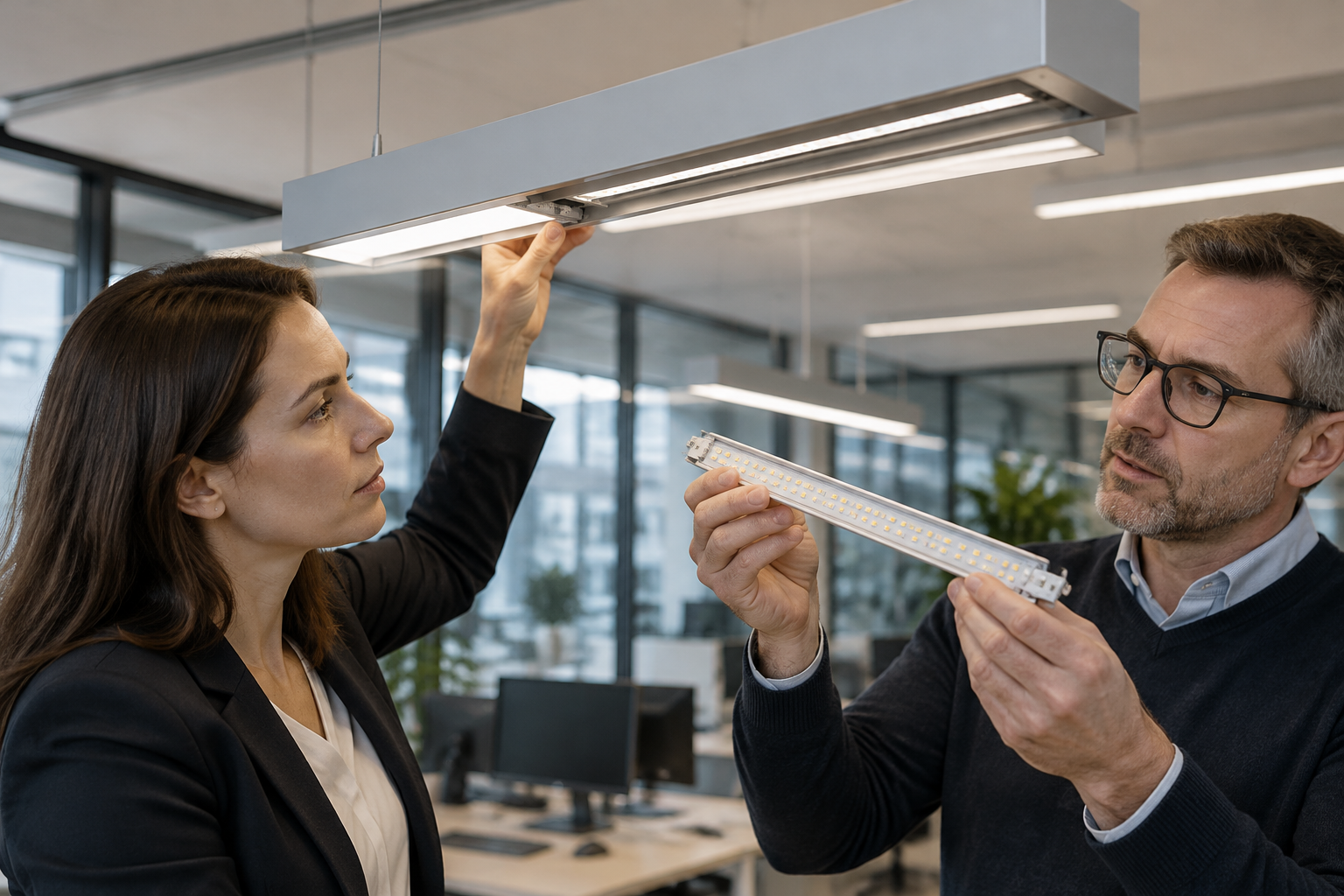 EU ErP Compliance for LED Luminaires Turns on Module Access: How should a European buyer specify an accessible LED module without confusing it with a retrofit la
Compliance Checklist (IES / LDT / DIALux / CE / RoHS / ErP)
Before issuing an order, assemble one configuration-specific evidence pack. The following sequence separates legal assessment from lighting-design acceptance.
-
Record the regulatory boundary. Identify the light source, any separate control gear and the containing product. Confirm whether the disassembly conditions permit separate source verification. Check the applicable scope and any Annex III exemption rather than assuming every specialised product follows identical requirements.
-
Obtain access and replacement information. Request the Article 4 removal instructions and the required information about replacement by end users or qualified persons. For products sold directly to end users, check the applicable packaging and user-instruction information. Obtain the freely accessible end-of-life dismantling instructions as well.
-
Match the ecodesign evidence to the ordered variant. Check applicable Annex II energy-efficiency, functional and information requirements. Record source identifiers, driver model, electrical settings and declared characteristics. Do not treat market-surveillance verification tolerances as extra design allowances.
-
Check energy labelling separately. Regulation (EU) 2019/2015 governs light-source energy labelling and associated product information. Confirm the applicable supplier and EPREL obligations for the identified source. A containing luminaire is not automatically a separately energy-labelled light source; classification must come first.
-
Request IES and LDT photometric files. These should represent the finished luminaire configuration used in the project. Use DIALux to verify maintained illuminance, distribution and glare against the relevant design brief. For an illustrative office target of 500 lux and UGR ≤19, document geometry, reflectances and maintenance assumptions. Simulation is not a substitute for ecodesign testing.
-
Review CE and RoHS documentation. Identify the applicable legislation and obtain the EU declaration of conformity and supporting evidence. Depending on the product, this may involve electrical safety, EMC and radio-equipment requirements. Neither a CE logo nor an ISO 9001 certificate alone proves compliance with Regulation (EU) 2019/2020.
-
Freeze the approved configuration. Attach the bill of materials, drawings, photometry and document revisions to the order. State how replacements and substitutions will be reviewed, including any need for renewed testing or calculations.
Primary legal references are Regulation (EU) 2019/2020, its amendment Regulation (EU) 2021/341, and Regulation (EU) 2019/2015. Consult the current consolidated texts and the provisions applicable when the product is placed on the market.
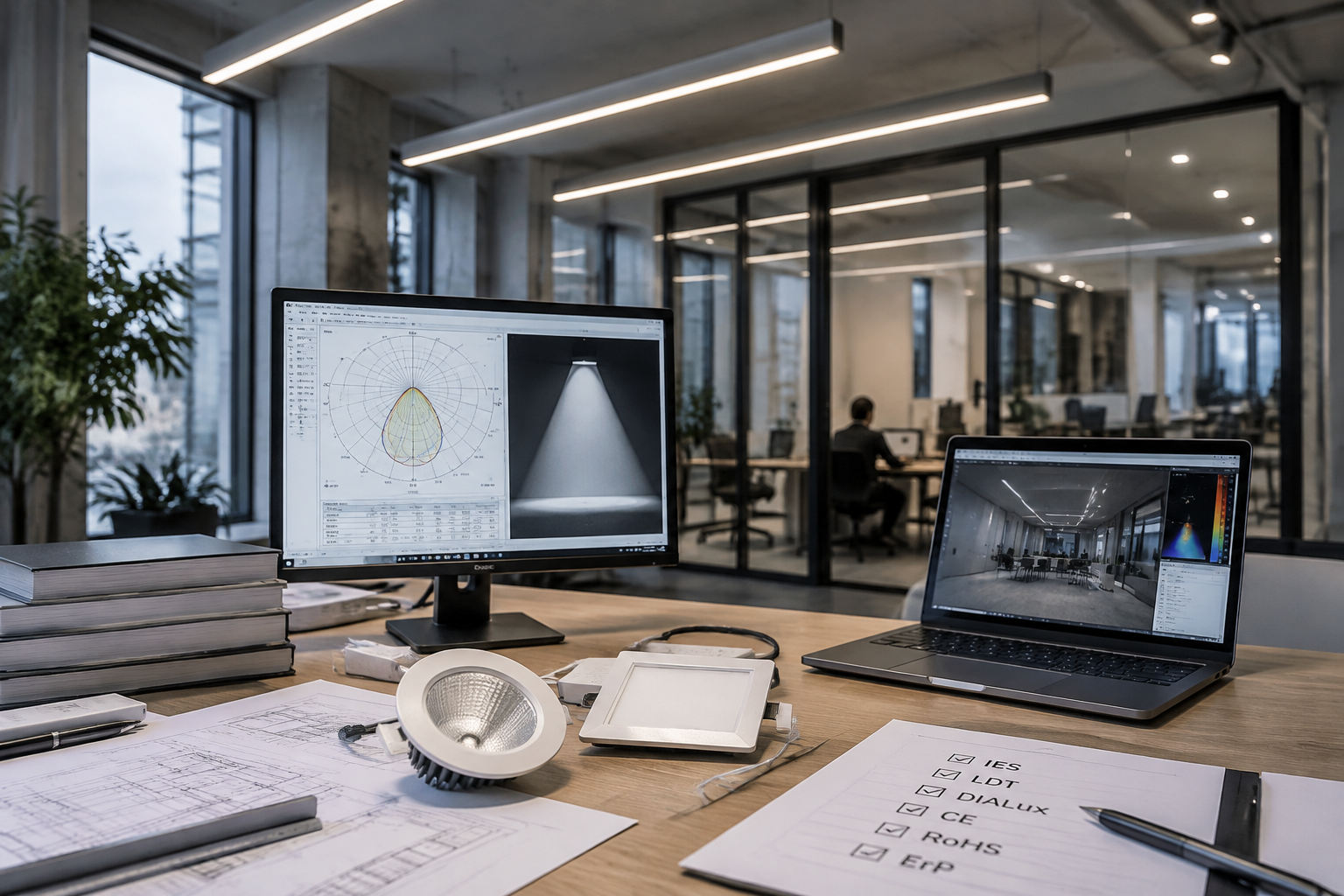 EU ErP Compliance for LED Luminaires Turns on Module Access: Compliance checklist (IES / LDT / DIALux / CE / RoHS / ErP)
Frequently Asked Questions
Q: Does Every LED Luminaire Need Its Own ErP Test as a Complete Light Source?
No. Under Article 2 of Regulation (EU) 2019/2020, classification depends on whether the containing product can be disassembled to allow separate verification of its light source. If it cannot, the entire product is considered a light source. Buyers should request the classification rationale and removal instructions before deciding which test reports are relevant.
Q: Does Article 4 Require Every LED Module to Be Replaceable by the Building User?
No. Article 4 distinguishes replacement information for end users and qualified persons. It also permits a functionality-related technical justification where replacement is inappropriate. The baseline requirement concerns replacement using commonly available tools without permanent damage to the containing product. Procurement documents should identify who can perform the work and request any justification relied upon.
Q: Can a 160 lm/W Luminaire Automatically Be Described as ErP Compliant?
No. A 160 lm/W catalogue figure does not establish the assessment boundary or demonstrate all applicable Annex II requirements. Ecodesign assessment uses the relevant source characteristics, calculations and functional information. Buyers should check the source and control-gear evidence, while using finished-luminaire efficacy separately to compare project options under consistent electrical and photometric conditions.
Q: Are IES Files and a DIALux Report Sufficient Evidence for EU Market Access?
No. IES and LDT files support lighting calculations, and DIALux can assess targets such as 500 lux or UGR ≤19 in a defined room. They do not establish electrical safety, RoHS compliance, ecodesign conformity or Article 4 replacement information. Keep the project lighting report and regulatory technical documentation as separate, cross-referenced deliverables.
Talk to Our Engineering Team
At XHLWX (led-project-light.com), a Custom Indoor LED Lighting Manufacturer based in China, the engineering discussion should begin with your destination market, luminaire drawings and required service strategy. Share the target CCT, illuminance, glare criteria, control protocol and enclosure rating, then request a configuration-specific review of source classification, module access and documentation. For European and US projects alike, agree on the evidence package and substitution rules before purchase—not after installation.
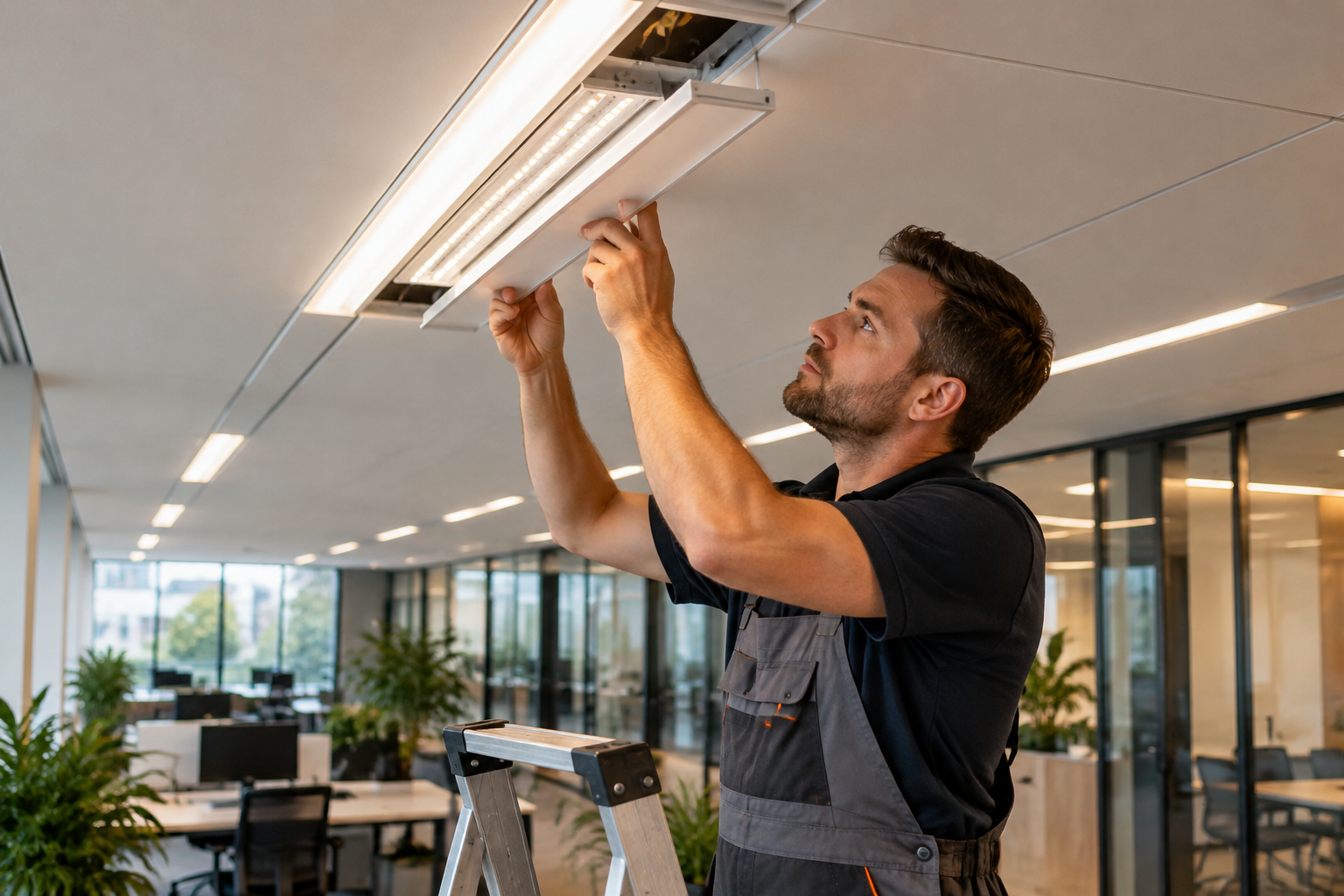 EU ErP Compliance for LED Luminaires Turns on Module Access: Q: Does Article 4 require every LED module to be replaceable by the building user?
Need a tailored lighting plan for your project?
Our senior lighting designers reply within 48 hours with a free design proposal & quotation.