
D4i Lighting Data Handover Becomes a Commercial Tender Test
DALI-2 and D4i certification sharpen procurement questions: who programs luminaire data, verifies energy readings and delivers usable asset records?

What Changed — and Why It Matters Now
At XHLWX (led-project-light.com), a Custom Indoor LED Lighting Manufacturer based in China, the practical question behind DALI-2 and D4i certification is what a buyer can verify at handover. For commercial projects, specifying a certified driver is only the beginning. The tender also needs to establish which luminaire data are populated, which operating values the control system exposes, and who maintains those records after replacement.
The underlying change is technical rather than a newly announced legal mandate. DALI-2 certification addresses interoperability through defined testing requirements, while D4i extends the framework with requirements for intelligent, connected luminaires, including standardized luminaire, energy and diagnostics data. The DALI Alliance’s D4i overview describes D4i as an extension of DALI-2 certification.
That distinction creates a procurement issue separate from choosing wired or wireless controls. A project can have working dimming yet still lack useful asset records. Conversely, a driver may support standardized data that the selected gateway or facilities-management interface never exposes.
For European and US specifiers, the actionable development is therefore the ability to write a more precise acceptance specification. Certification momentum should not be confused with a verified market-share statistic: this analysis makes no claim about shipment growth. Its focus is how existing certification requirements can support more accountable purchasing, commissioning and maintenance.
The Technical Detail Behind the Headline
DALI is based on the IEC 62386 series. DALI-2 certification covers defined product functionality and interoperability; D4i adds requirements particularly relevant to luminaire-level integration.
The DALI Alliance identifies Parts 251, 252 and 253 with luminaire data, energy data, and diagnostics and maintenance data respectively. These data functions are mandatory for D4i LED drivers, but ordinary DALI-2 certification alone does not establish equivalent coverage.
D4i also addresses power for luminaire-mounted control devices, including requirements relating to integrated DALI bus power supplies. This does not mean every sensor can be connected without checking electrical budgets. Designers must verify supply configuration, device consumption and the intended connection architecture against the selected manufacturers’ instructions.
The following schedule combines engineering targets with evidence requests. It is an example procurement framework, not a specification or certification claim for an existing XHLWX product.
| Procurement item | Example specification or target | Standard or evidence | Buyer verification |
|---|---|---|---|
| White-light optics | 3000 K or 4000 K; CRI ≥90 | Spectral test report for selected configuration | Match LED, current and optic to supplied version |
| Color rendition | TM-30 Rf ≥85; Rg 95–105 as design targets | ANSI/IES TM-30 report, edition identified | Check full report rather than CRI alone |
| Glare and distribution | UGR ≤19 as an office design target; 60° or 90° nominal beam | Room calculation and photometric report | Confirm observer positions, spacing and actual distribution |
| Controls | DALI-2 driver with D4i where asset data are required | DALI Alliance product database | Verify exact model, certification scope and listed versions |
| Alternative interfaces | Casambi or 0–10 V only where explicitly scheduled | Interface documentation and system test | Do not assume equivalent access to D4i data |
| Data functions | Parts 251, 252 and 253 | D4i documentation and commissioning readout | Identify populated fields and data exposed by the controller |
| Housing | IP20; 1200 mm nominal linear housing as example targets | IEC 60529 evidence and dimensional drawing | Specify IP44 or higher separately where conditions require |
| Driver and LED sourcing | Named Tridonic driver and Samsung LED option | Exact part numbers and manufacturer datasheets | Brand names alone do not establish certification or performance |
| EU market requirements | CE conformity; RoHS; applicable ErP requirements | EU Declaration of Conformity and technical documentation | Check product scope and current applicable requirements |
| Factory quality system | ISO 9001 certificate where required by tender | Valid certificate with site and scope | Treat as management-system evidence, not product approval |
The most important boundary is between capability and delivery. A standardized memory structure does not guarantee that every manufacturer-entered field contains useful project information.
Likewise, driver diagnostics cannot automatically identify every optical, wiring or environmental problem. Procurement should define expected fields, permitted unavailable values, units and interpretation.
Check the exact component in the DALI Alliance product database. A family brochure, compatibility statement or DALI logo is not a substitute for matching the ordered model to its certification record. A certified component also does not, by itself, establish certification or compliance of the complete luminaire or installed system.
What This Means for Specifiers and Buyers
How Should a Tender Define D4i Data Ownership Before Luminaires Are Ordered?
Begin with a data responsibility schedule. Identify which information the luminaire manufacturer programs, which identifiers the commissioning contractor assigns, and which records the operator receives. Keep the manufacturer’s identity, product identity and installation location distinct: replacing a fitting should not silently detach its operating history from the correct room or circuit.
Require the controls supplier to identify where data reside and how authorized users retrieve them. Standardized driver data do not guarantee an open building-management-system interface or a subscription-free export. Those are separate contractual questions involving gateway functionality, software licensing and access permissions.
A useful design target is one asset-register entry per independently maintained luminaire, with explicit handling of fittings containing 2 or more drivers. Ask for a sample export before purchase approval.
It should demonstrate readable units, timestamps where relevant, stable identifiers and a documented replacement workflow. Do not require installation metadata to reside in driver memory unless the implementation supports it.
How Can Contractors Prove D4i Energy and Diagnostic Data Are Usable?
Commissioning should include data retrieval, not just an on/off demonstration. An example acceptance test could use 10 representative luminaires across different circuits and control zones. That sample size is a proposed project target, not a DALI Alliance certification rule; larger or more complex installations may require broader testing.
Read identification data, command several output levels, and verify that available power and energy values behave consistently with the test conditions. Compare the declared measurement accuracy and update behavior with a suitable reference instrument. Establish the acceptance tolerance from documented capabilities rather than assuming every driver provides billing-grade measurement.
For context, a hypothetical 30 W luminaire operating at full input power for 3,000 hours consumes 90 kWh annually. One hundred such luminaires consume 9,000 kWh before accounting for standby loads or control effects. D4i certification does not guarantee any percentage reduction; savings require a defined baseline, operating profile and measurement boundary.
Diagnostic tests should be safe and manufacturer-approved. Verify the meaning of supported events, counters and unavailable values without deliberately damaging equipment. The handover record should distinguish a driver-reported condition from a fault inferred by the supervisory software.
What Must European and US Buyers Check When a Certified Driver Is Substituted?
Treat substitution as a controlled engineering change. A replacement bearing the same brand or DALI-2 designation may differ in output current, dimming behavior, supported data, physical dimensions or control functionality. Require a revised part-number schedule and a fresh check of the certification database before approving it.
For example, changing a nominal 700 mA driver to a 900 mA version is not a neutral procurement decision. Compatibility with the LED module, thermal design and declared photometry must be reassessed. A compatible electrical replacement may still require updated data programming and commissioning records.
For European projects, review whether the change affects conformity evidence for the supplied product. For US projects, confirm its acceptability within the luminaire’s safety listing or certification and the authority having jurisdiction’s requirements. Applicable evaluation may involve UL 1598 for luminaires and UL 8750 for LED equipment; DALI certification does not replace these safety considerations.
 D4i Lighting Data Handover Becomes a Commercial Tender Test: How should a tender define D4i data ownership before luminaires are ordered?
Compliance Checklist (IES / LDT / DIALux / CE / RoHS / ErP)
Use separate evidence tracks for lighting performance, control interoperability, electrical safety and regulatory conformity. Passing one does not establish the others.
- Photometry: Request IES and LDT photometric files for the actual LED, optic, diffuser and drive-current combination. Record file revision and tested configuration. Neither format establishes controls certification.
- Lighting calculation: Use DIALux to assess the specified room geometry, reflectances, maintenance factor and operating conditions. A 500 lux maintained task illuminance and UGR ≤19 can be appropriate office design targets, but the applicable task requirements must be checked against the selected EN 12464-1 edition. UGR is installation-dependent, not a universal luminaire score.
- Control evidence: Archive the exact DALI-2 or D4i database entry, component datasheet and system architecture. State which data functions the gateway exposes and how commissioning results are recorded.
- CE documentation: Request the EU Declaration of Conformity and supporting evidence for applicable legislation. Depending on the product, this may include the Low Voltage Directive 2014/35/EU, EMC Directive 2014/30/EU and Radio Equipment Directive 2014/53/EU. CE marking is not a generic third-party quality certificate.
- RoHS: Check Directive 2011/65/EU, Article 4, and applicable Annex II substance restrictions. Obtain documentation covering the delivered configuration, including substituted electronics.
- ErP: Assess scope under Commission Regulation (EU) 2019/2020, as amended. Its principal requirements applied from 1 September 2021; Annex II addresses light sources and separate control gears. D4i is not a general ErP requirement, and not every assembled luminaire is assessed identically.
- Quality management: Where ISO 9001 is requested, verify the certificate’s validity, manufacturing-site coverage and scope. It does not certify photometric performance, DALI interoperability or EU product conformity.
For primary regulatory wording, consult the EU ecodesign regulation and RoHS Directive, including their amendments. Contracts should identify the applicable versions rather than relying on a supplier’s undated compliance summary.
 D4i Lighting Data Handover Becomes a Commercial Tender Test: Compliance checklist (IES / LDT / DIALux / CE / RoHS / ErP)
Frequently Asked Questions
Q: Does a DALI-2 Driver Automatically Provide D4i Energy Data?
No. DALI-2 certification alone does not establish D4i functionality. D4i LED drivers must support the specified luminaire, energy, and diagnostics data requirements associated with Parts 251, 252 and 253. Buyers should verify the exact database entry and then confirm that the selected controller exposes the required values in a usable interface or export.
Q: Can D4i Readings Replace a Building’s Electricity Meter?
Not automatically. Driver-reported energy can support operational analysis, but its suitability depends on documented accuracy, measurement boundaries and data availability. A hypothetical 30 W fitting running for 1,000 hours consumes 30 kWh at constant input power. Compare readings with an appropriate reference and do not treat them as revenue-grade measurements without separate evidence.
Q: Is D4i Certification Mandatory for Commercial Lighting Sold in Europe?
No general EU requirement mandates D4i for all commercial lighting. It may be required by an individual tender. Applicable legal obligations instead depend on product scope and include measures such as Regulation (EU) 2019/2020 and RoHS Directive 2011/65/EU. Certification supports specified control functionality; it does not replace CE conformity assessment or relevant technical documentation.
Q: What Should a Contractor Deliver at D4i Project Handover?
Deliver the final component schedule, certification references, addressing records, available data-field descriptions, access instructions and acceptance-test results. Include an asset export and a documented replacement process. As a project design target, test at least 10 representative luminaires before wider sign-off, while adjusting the sample to installation complexity and the agreed commissioning plan.
Talk to Our Engineering Team
Before requesting a quotation, assemble the lighting schedule, target CCT and CRI, room calculations, proposed control architecture and required data outputs. Ask bidders to return exact driver part numbers, certification references and a responsibility matrix for programming, commissioning and replacement. This makes data delivery a priced contractual obligation rather than an assumption discovered after installation.
At XHLWX (led-project-light.com), a Custom Indoor LED Lighting Manufacturer based in China, the engineering discussion should begin with those project-specific requirements: optical performance, certified component selection, accessible operating data and documented conformity. For European and US buyers, the next step is a configuration review and sample data demonstration before approving production—not simply another checkbox marked DALI.
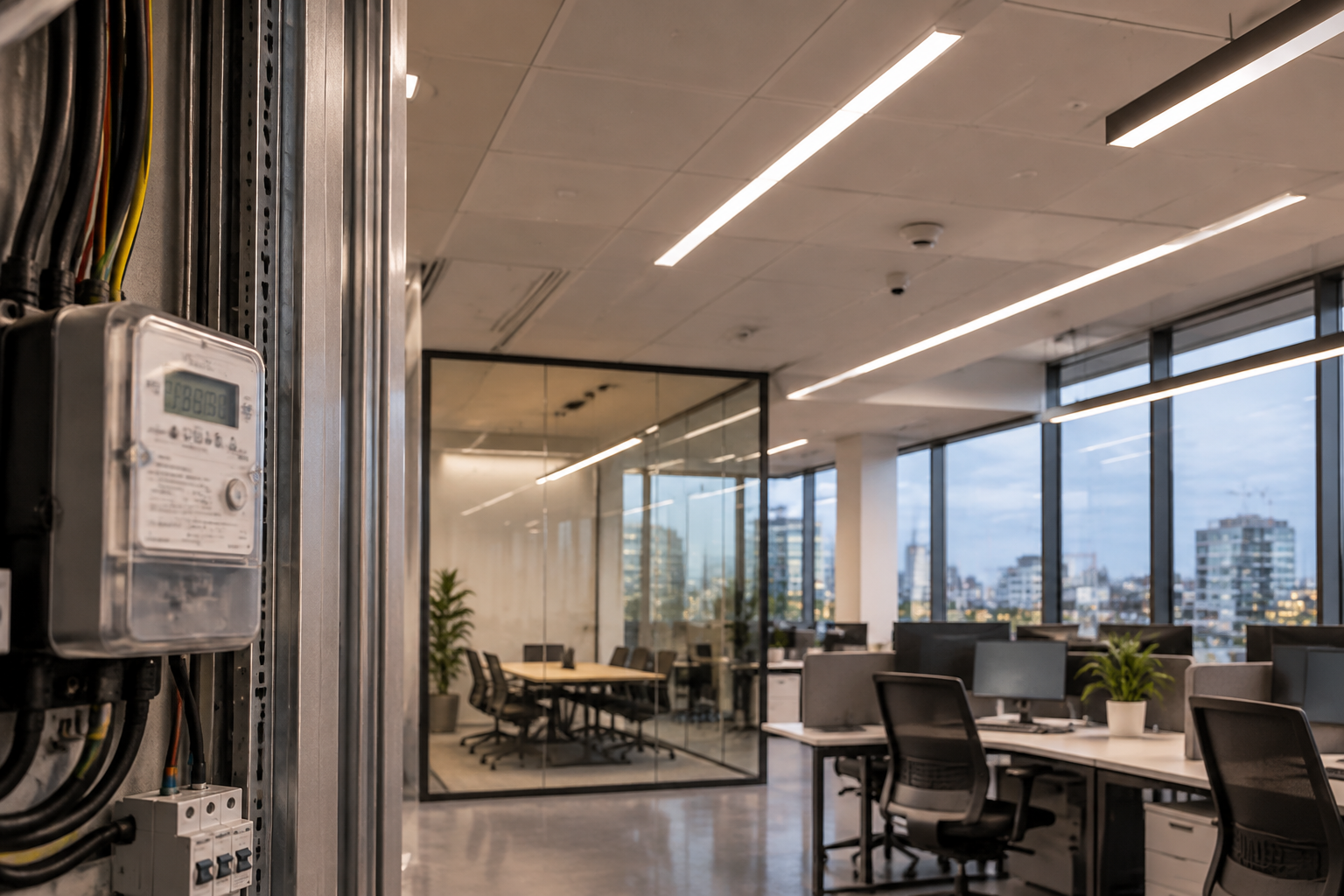 D4i Lighting Data Handover Becomes a Commercial Tender Test: Q: Can D4i readings replace a building’s electricity meter?
Need a tailored lighting plan for your project?
Our senior lighting designers reply within 48 hours with a free design proposal & quotation.