
RoHS Exemption Review Puts LED Luminaire Brass Parts in Focus
RoHS exemption reviews reach beyond LED drivers. Buyers must check brass connectors, alloy declarations and spare-part eligibility before substitution.
What Changed — and Why It Matters Now
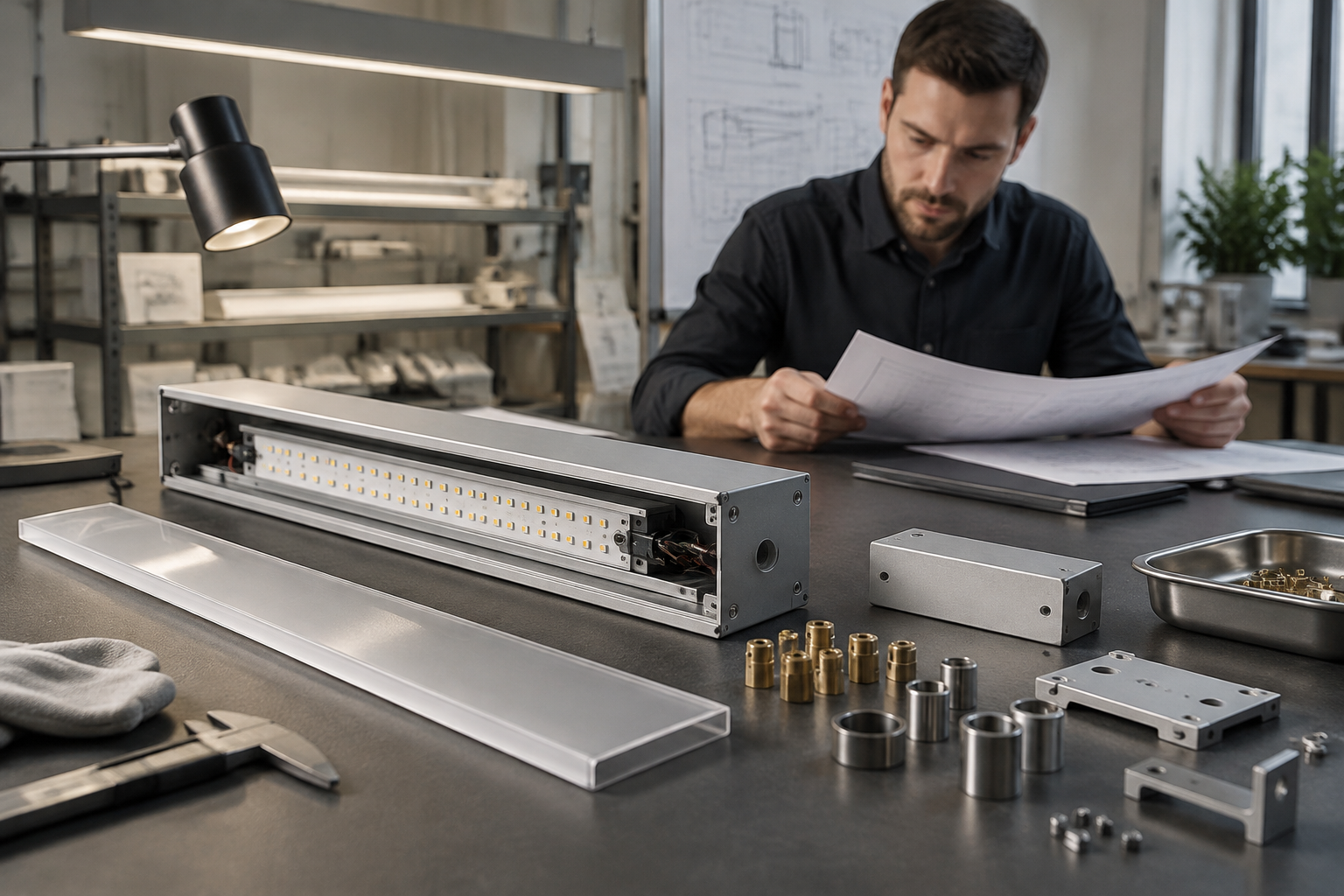
At XHLWX (led-project-light.com), a Custom Indoor LED Lighting Manufacturer based in China, the procurement issue raised by RoHS exemption reviews extends beyond LED drivers: brass terminals, machined fittings and other small metal parts also need application-specific material evidence. For European lighting buyers, the practical question is whether each restricted-substance exemption remains applicable to the component, equipment category and date of placing the product on the market.
The less obvious exposure is mechanical hardware. A luminaire can use a lead-free soldering process yet contain an alloy that relies on a separate lead exemption.
Reviewing only the LED board and power supply therefore leaves a gap in the bill of materials. This analysis focuses on that gap, particularly copper-alloy components and replacement-part planning, rather than repeating the driver-materials debate.
The legal anchor is Directive 2011/65/EU, commonly called RoHS. Article 4 restricts substances in electrical and electronic equipment; Annex II sets maximum concentrations by homogeneous material.
Annex III provides application-specific exemptions. Lighting equipment falls within category 5 of Annex I, although the classification of the particular product must still be checked.
An exemption review is not, by itself, a ban or a universal replacement deadline. Under Article 5(5), an existing exemption remains valid until a decision is taken on a renewal application submitted within the prescribed timeframe.
Buyers should distinguish an assessment or consultation from an adopted amendment and its applicable dates. This article does not assert a newly announced cutoff for all LED lighting alloys.
The Technical Detail Behind the Headline
For lead, the general Annex II limit is 0.1% by weight in a homogeneous material. Cadmium has a lower limit of 0.01%; the other listed restricted substances have 0.1% limits.
These are not percentages of the complete luminaire. A small brass insert cannot be made compliant simply by averaging its lead content across a much heavier aluminium housing.
The familiar Annex III entry 6(c) concerns copper alloys containing up to 4% lead by weight. It illustrates why an alloy certificate and an exemption reference must be read together.
Buyers must verify the applicable entry, any amended wording, equipment-category coverage and dates against the consolidated directive and subsequent amendments. A reference copied from an old supplier declaration is not sufficient evidence for a new delivery.
Material substitution also needs an engineering release. Changing an alloy can affect machining, thread performance and electrical-contact behaviour.
Those effects depend on geometry, processing and service conditions; they should be assessed rather than assumed. The following schedule combines material evidence with illustrative tender targets, not specifications or test results for an existing XHLWX product.
| Parameter or component | Illustrative requirement | Standard or evidence | Buyer qualification |
|---|---|---|---|
| Brass terminals and inserts | Identify alloy, lead content and any claimed exemption | RoHS Annexes II–III; material certificate | Match evidence to the exact part revision |
| White-light optics | 3000 K or 4000 K; CRI Ra ≥90 | Photometric and spectral report | Design targets; confirm delivered configuration |
| Colour fidelity and gamut | TM-30 Rf ≥85; Rg 95–105 | ANSI/IES TM-30 report | Proposed project limits, not RoHS requirements |
| Glare and beam | UGR ≤19 in the modelled office; nominal 60° beam | EN 12464-1 assessment; intensity distribution | UGR depends on room geometry and observer position |
| Lighting control | Specify DALI-2, Casambi or 0–10 V by circuit | Interface documentation; certification where applicable | Do not treat the three systems as interchangeable |
| Housing and dimensions | IP20 dry-interior option; nominal 1200 mm length | IEC 60529; dimensioned drawing | Verify joints, cable entries and mounting hardware |
| LED source and driver | Request exact Samsung LED and Tridonic driver references, or approved equivalents | Component datasheets and declarations | Brand names alone do not establish compliance |
| EU product obligations | CE documentation; RoHS evidence; applicable ErP assessment | EU declaration of conformity and technical file | Assess each legal instrument separately |
| Quality management | ISO 9001 certificate if contractually required | Certificate scope, site and validity | Management-system certification is not product approval |
If a replacement terminal changes the current path or a fitting changes heat transfer, the manufacturer should identify which safety and performance checks need repeating. A documentary alloy change does not automatically require new photometry; a change affecting LED temperature, optical alignment or output may justify it.
What This Means for Specifiers and Buyers
How Should a European Contractor Check Brass Parts Before Approving an LED Luminaire Order?
Start with a component-level declaration, not a one-line statement that the complete fitting is “RoHS compliant.” Ask the manufacturer to identify intentionally used lead-containing alloys and any restricted-substance applications relying on exemptions. The review should cover lamp caps where present, terminal components, mounting inserts, machined adaptors and relevant electronic components.
For every exemption-dependent item, record four fields: part number, material specification, exact exemption entry and legal applicability. Add the expected market-placement timing. Article 3 defines placing on the market as the first making available of equipment on the Union market; it is not simply the installation date or the purchase-order date.
Use IEC 63000 as the framework for technical documentation, including supplier evidence and risk-based evaluation. X-ray fluorescence screening can help identify suspect materials, but it does not independently establish legal exemption eligibility. Follow-up testing should suit the substance and material, using relevant IEC 62321 methods where appropriate.
When Can Replacement Parts Use a Different RoHS Route from New Luminaires?
Article 4(4)(f) addresses cables and spare parts for equipment that benefited from an exemption and was placed on the market before that exemption expired, insofar as the specific exemption is concerned. This is a narrow provision linked to the original equipment and application—not blanket permission to sell any old component indefinitely.
Contractors should distinguish replacement parts for identifiable installed equipment from components used to manufacture new luminaires. Retain the original model, relevant market-placement evidence, applicable exemption and replacement-part identity. Where eligibility is unclear, obtain a documented compliance assessment before approving supply.
For a proposed 10-year maintenance programme, specify both a technically compatible replacement route and the records needed to establish its legal basis. Avoid promising that one alloy or component will remain commercially available for the entire period. Compatibility, legal eligibility and availability are three separate procurement questions.
What Should US Specifiers Request When the Same Luminaire Platform Also Serves Europe?
An EU RoHS declaration does not establish US electrical-safety acceptance. US projects should separately specify applicable listing requirements, local code obligations and control compatibility. For dual-market purchasing, ask whether the EU and US versions share the same alloy parts, LED board and driver, or merely the same exterior housing.
A substitution clause should require written approval before changes to alloy, plating, terminal geometry or component revision. It should also identify which evidence must be refreshed. For a 0–10 V installation, for example, request the actual minimum dimming level and documented behaviour on control-wire interruption; the interface label alone does not answer either question.
Keep energy comparisons separate from material-compliance claims. As an illustrative calculation, replacing 100 luminaires rated at 40 W with 30 W units operating for 3,000 hours annually reduces nominal consumption from 12,000 to 9,000 kWh: 25%.
That estimate assumes equal operating hours and excludes additional control effects. Equivalent maintained illuminance must still be demonstrated.
 RoHS Exemption Review Puts LED Luminaire Brass Parts in Focus: How should a European contractor check brass parts before approving an LED luminaire order?
Compliance Checklist (IES / LDT / DIALux / CE / RoHS / ErP)
1. Establish the legal version before setting a deadline. Check the consolidated RoHS text, relevant amending directives and renewal status. Article 5(5) requires renewal applications no later than 18 months before expiry. Article 5(6) provides a 12–18 month period after a decision for exemptions that are revoked or whose renewal is rejected. Apply the specific adopted measure rather than inventing a universal transition date.
2. Build an exemption register around actual components. Link each restricted-substance application to a supplier, part revision, material declaration and legal reference. Separate unrestricted materials, below-threshold materials and exemption-dependent applications. “Lead-free” should be defined contractually; it is not a substitute for demonstrating compliance with every relevant RoHS restriction.
3. Separate photometric evidence from chemical evidence. Obtain IES and LDT photometric files for the exact proposed optical configuration and use DIALux to assess the installation. For an office writing, reading or data-processing task, a design assessment may use 500 lx maintained illuminance and UGR ≤19 under the relevant EN 12464-1 task requirements. Check the complete task criteria, maintenance assumptions and project edition; chemical compliance does not prove lighting quality.
4. Review CE documentation at product level. Article 7 sets manufacturer obligations, including technical documentation, conformity assessment and retention of relevant records for 10 years after equipment is placed on the market. Article 13 addresses the EU declaration of conformity. Where applicable, the assessment must also cover legislation such as the Low Voltage Directive, EMC Directive or Radio Equipment Directive. CE marking is not a standalone laboratory certificate.
5. Treat ErP as a separate assessment. Commission Regulation (EU) 2019/2020, as amended, establishes ecodesign requirements for light sources and separate control gears. Article 4 addresses removal and replacement obligations for containing products, subject to its conditions. A compliant brass alloy does not establish energy efficiency or replaceability, and an efficient light source does not establish RoHS compliance.
6. Make change control part of the contract. Require notification before material or supplier substitutions, with a documented assessment of affected compliance, safety and performance evidence. Include lot or revision identification so that approved documents can be matched to delivered goods. Check ISO 9001 certificate scope if requested, but do not use it to replace product-specific evidence.
 RoHS Exemption Review Puts LED Luminaire Brass Parts in Focus: Compliance checklist (IES / LDT / DIALux / CE / RoHS / ErP)
Frequently Asked Questions
Q: Does a RoHS Exemption Review Immediately Prohibit Brass in LED Luminaires?
No. A review does not itself prohibit brass or establish a universal deadline. The relevant issue is whether a restricted substance exceeds its homogeneous-material limit and, if so, whether an applicable exemption covers that use. Lead generally has a 0.1% limit. Verify the exemption wording, renewal status and adopted amendments before approving or rejecting a component.
Q: Is a Supplier Declaration Enough to Justify Lead-containing Copper-alloy Parts?
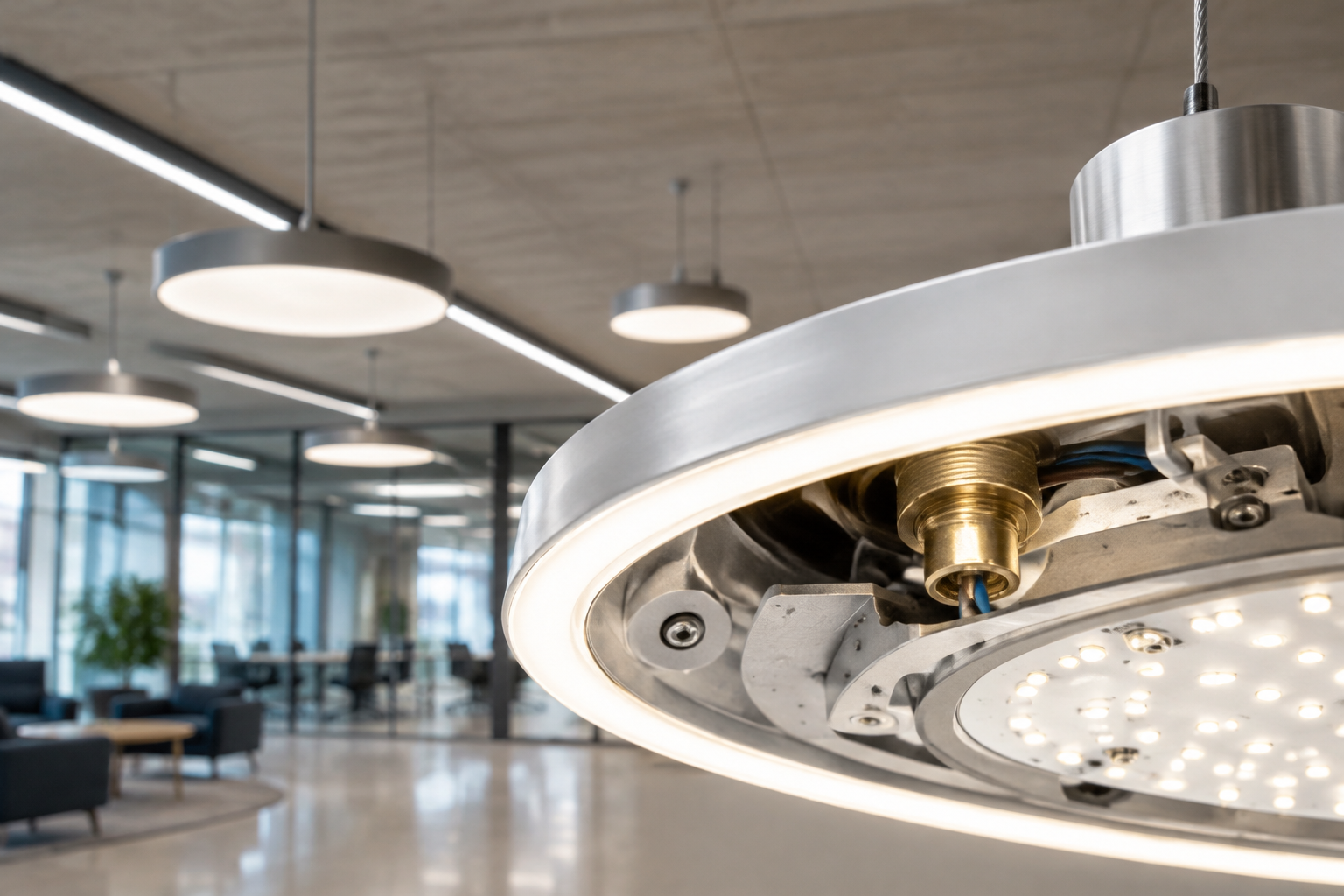
A declaration can support the technical file, but its adequacy depends on specificity and reliability. Request the part revision, alloy specification, lead concentration and applicable exemption. The familiar 6(c) entry concerns copper alloys containing up to 4% lead; the applicable legal wording and dates must still be checked. Use risk-based evidence evaluation rather than demanding identical laboratory testing for every part.
Q: Must Every Alloy Substitution Trigger New IES and LDT Files?
Not automatically. A change limited to an unrelated mounting insert may leave the measured optical distribution unchanged. However, a substitution affecting thermal conditions, LED position or optical geometry needs an engineering assessment. For a 4000 K fitting, check whether output, colour or intensity distribution could change before deciding whether new measurements and revised photometric files are necessary.
Q: Can Existing Installations Receive Replacement Parts After an Exemption Expires?
Potentially, subject to the specific legal conditions. Article 4(4)(f) addresses spare parts for equipment that benefited from an exemption and was placed on the market before expiry, concerning that exemption. Keep evidence connecting the replacement to eligible equipment. A proposed 10-year spare-parts commitment should distinguish this route from supplying components for newly manufactured luminaires.
Talk to Our Engineering Team
At XHLWX (led-project-light.com), a Custom Indoor LED Lighting Manufacturer based in China, the recommended starting point for a project review is the intended market, delivery schedule, luminaire configuration and maintenance requirement. Bring the proposed CCT, lux and glare targets alongside the alloy and exemption questions. Ask engineering to identify the evidence required before substitution approval, so procurement can evaluate material compliance, lighting performance and replacement-part planning together.
 RoHS Exemption Review Puts LED Luminaire Brass Parts in Focus: Q: Is a supplier declaration enough to justify lead-containing copper-alloy parts?
Need a tailored lighting plan for your project?
Our senior lighting designers reply within 48 hours with a free design proposal & quotation.