
EN 1838 Emergency Lighting: The Battery-End Output Test
Emergency lighting compliance depends on battery-mode photometry, rated duration and evidence for the complete luminaire—not normal-mode lumens alone.

What Changed — and Why It Matters Now
At XHLWX (led-project-light.com), a Custom Indoor LED Lighting Manufacturer based in China, the engineering question for emergency-lighting procurement is whether the proposed assembly can deliver the required illumination throughout its rated emergency duration. A normal-operation lumen figure, a battery capacity label and a CE mark do not, separately, establish that result.
For an LED retrofit, the important change is the complete emergency configuration: LED module, driver, battery, optics and enclosure. Replacing a fluorescent fitting or adding an emergency conversion kit changes the evidence needed to connect product safety with the building’s escape-lighting calculation. This is a procurement analysis, not an announcement of a new statutory lux limit.
EN 1838 addresses emergency-lighting performance in the space; EN 60598-2-22 addresses requirements for emergency luminaires. Meeting one does not automatically demonstrate the other. A safety-tested fitting can still be installed too far apart, while a convincing lighting calculation can rely on output that the specified battery system does not sustain.
The practical tender issue is therefore battery-end performance. European specifiers should require emergency-mode photometric evidence tied to the exact product configuration and rated duration. US buyers need a separate code and listing assessment rather than treating European documentation as a substitute.
The Technical Detail Behind the Headline
Emergency operation should be treated as a distinct operating condition, not simply a lower dimming setting. Depending on the architecture, the emergency driver may energize only part of an LED board, operate at a different current or supply a separate emergency light source. Each arrangement can affect the usable intensity distribution.
EN 60598-2-22, used with the relevant general luminaire requirements in EN 60598-1, provides the product-safety framework. The applicable edition and national adoption should appear in the procurement documents. Evidence must identify the complete assembly, its emergency classification, rated duration and relevant operating conditions—not merely a compliant driver inside an otherwise unassessed housing.
The following schedule contains illustrative tender targets, not specifications for an existing XHLWX product and not universal EN 1838 requirements.
| Parameter | Illustrative specification or evidence | Standard or assessment route | Buyer’s verification point |
|---|---|---|---|
| Emergency output | Declared emergency lumens, output factor where applicable, and duration profile | EN 1838; EN 60598-2-22 | Match the data to the supplied LED board, optic, driver and battery |
| Color quality | 4000 K CCT; CRI Ra ≥80; TM-30 Rf ≥80 and Rg 95–105 as normal-lighting targets | CIE colorimetry; IES TM-30 | These targets do not replace emergency-lighting criteria |
| Glare and beam | Normal-mode UGR ≤19 where appropriate; nominal 90° beam as a design option | EN 12464-1; EN 1838 | Assess emergency disability glare separately; beam angle alone is insufficient |
| Controls | DALI-2 emergency option; Casambi or 0–10 V for normal lighting if required | IEC 62386-202 where applicable; IEC 62034 for automatic testing | Verify device functions, certification scope and failure behavior |
| Housing | IP20 dry-interior or IP65 environmental target; 1200 mm body as a layout option | EN 60598-1; IEC 60529 | Confirm that the assessed enclosure includes emergency components |
| Duration and battery | 1 h or 3 h project-selected duration; declared battery type and temperature limits | EN 60598-2-22; local fire strategy | Check sustained output, recharge requirements and replacement instructions |
| Named components | Tridonic emergency controlgear or Samsung LEDs as nominated component options | Component documentation plus complete-luminaire assessment | Brand identification is traceability, not proof of assembly compliance |
| Market documentation | CE declaration, RoHS evidence, ErP applicability review; ISO 9001 certificate if requested | Applicable EU legislation; ISO 9001 | ISO 9001 is a management-system standard, not product approval |
A single emergency-output ratio is usable only when it represents the actual configuration. For example, suppose a normal-mode file represents 3000 lm and the documented emergency output is 300 lm with an unchanged distribution.
A 0.10 scaling factor may be appropriate. If emergency operation lights only selected LEDs or a separate optic, that shortcut needs separate validation.
Request IES and LDT photometric files identifying their operating mode. Use the applicable data in DIALux, documenting whether the file contains absolute emergency output or requires an emergency-lighting factor. Applying a 0.10 factor to a file already measured at emergency output would understate illumination tenfold; omitting a necessary factor could overstate it tenfold.
What This Means for Specifiers and Buyers
How Should a Contractor Verify Illumination at the End of a 3-hour Discharge?
Start with the required illumination and rated operating duration, then work backward to the luminaire evidence. Do not select a battery solely because its ampere-hour rating appears sufficient. Battery voltage, usable capacity, conversion efficiency, temperature, LED operating conditions and protective cutoffs all affect the result.
For illustration, consider an assessment point requiring 1.0 lx under the project’s applicable criteria. A calculation showing 1.2 lx initially offers no assurance if output falls to 70% before the end of the required duration.
With unchanged distribution, that point would receive approximately 0.84 lx. This is a proportional engineering example, not a declaration that 1.0 lx is the correct threshold everywhere.
EN 1838 distinguishes escape-route, open-area and high-risk-task applications. Its high-risk-task provisions include a minimum of 10% of the relevant normal illuminance, with a minimum of 15 lx.
Measurement areas, uniformity, response times, glare and other criteria must also be checked against the applicable requirements. A single favorable lux reading cannot establish overall compliance.
Ask for the emergency-output basis used in the calculation, evidence supporting the rated duration, and the manufacturer’s temperature and maintenance limitations. Where an emergency ballast lumen factor or emergency luminaire lumen factor is declared, establish exactly what it represents. Keep the luminaire’s discharge behavior separate from the project’s maintenance assumptions to avoid omitted or duplicated allowances.
What Evidence Should Accompany an Emergency Conversion Kit Before Installation?
A conversion kit is not automatically a compliant finished luminaire. Its installation can alter wiring separation, thermal conditions, enclosure integrity, battery access and the relationship between normal and emergency circuits. The party making the modification must establish responsibility for the resulting assembly and its conformity documentation.
Before approval, obtain a configuration-specific package: assembly drawing, component list, wiring diagram, battery designation, charging arrangement, emergency classification, rated duration, installation instructions and relevant assessment reports. A document describing a different battery, enclosure size or LED module should trigger a technical query rather than an assumption of equivalence.
Treat communications and emergency operation as separate verification tasks. IEC 62386-202 covers the DALI interface for self-contained emergency lighting controlgear.
A DALI-2 label on a normal driver does not establish that the complete fitting offers emergency testing or reporting. Similarly, a Casambi interface or 0–10 V dimming input does not by itself demonstrate an emergency function.
The control cause-and-effect schedule should describe what happens when the normal lighting supply fails and when communications are unavailable. Automatic testing assessed against IEC 62034 can support maintenance, but commissioning records, fault handling and corrective action remain necessary. Agree who receives a failed-duration-test alarm and who must resolve it.
How Should European and US Contractors Avoid Buying Incompatible Compliance Packages?
European buyers should separate building-design acceptance from product-market requirements. EN 1838 calculations address the installation; CE documentation addresses applicable EU product legislation. A CE declaration is not an approval of escape-route spacing, and a DIALux report does not establish electrical safety.
For electrical equipment within its scope, the Low Voltage Directive 2014/35/EU sets manufacturer obligations in Article 6 and the technical-documentation framework in Annex III. Relevant electromagnetic-compatibility obligations must also be assessed under Directive 2014/30/EU. The EU declaration of conformity should identify the supplied model and applicable legislation.
US projects require their own pathway. UL 924 addresses emergency lighting and power equipment, while installation and illumination requirements depend on the adopted building, fire and electrical codes, including applicable NFPA provisions.
Confirm the required listing and acceptance route with the authority having jurisdiction before ordering. A European 3-hour configuration is not automatically acceptable merely because its stated duration exceeds a US project’s specified operating time.
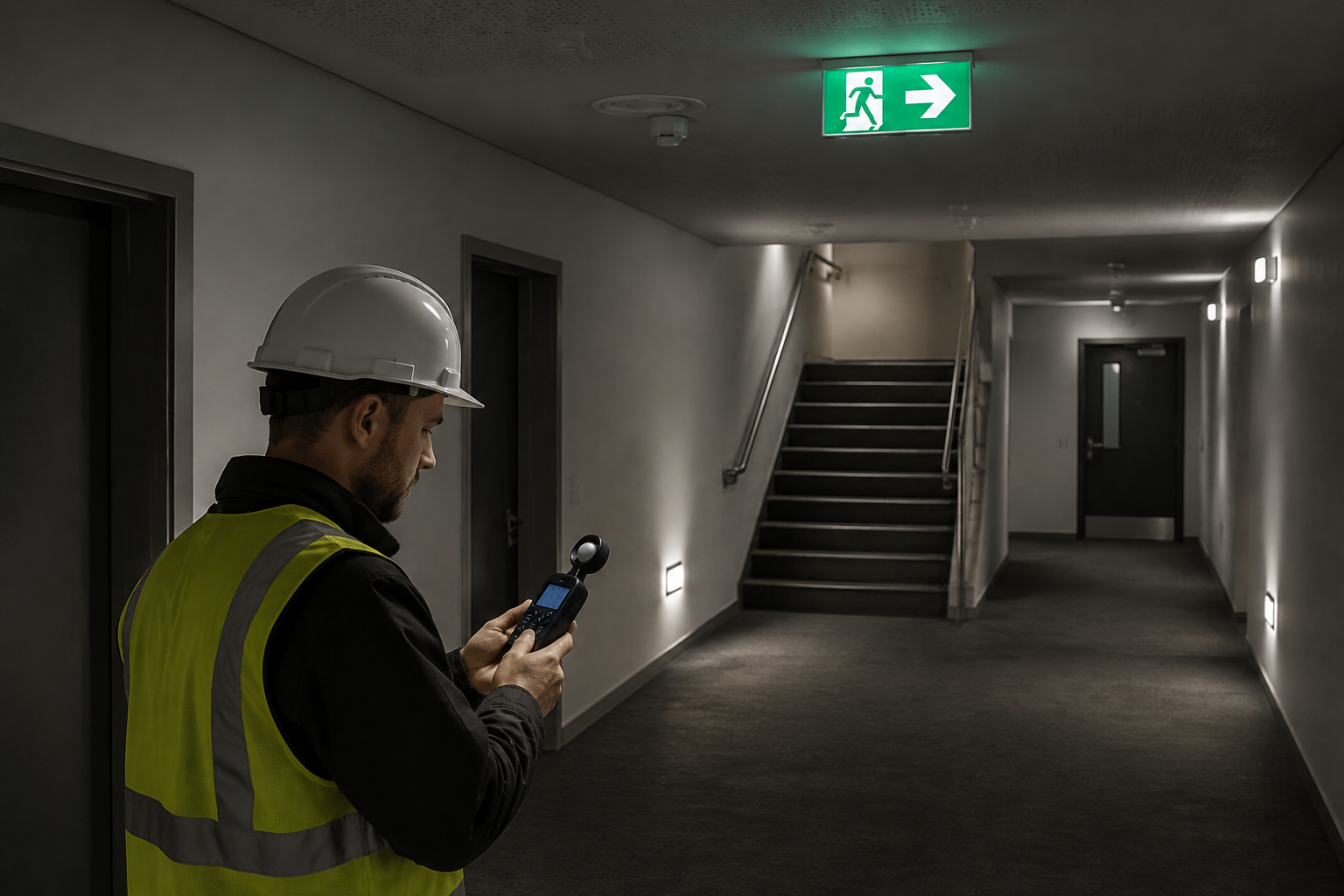 EN 1838 Emergency Lighting: The Battery-End Output Test: How should a contractor verify illumination at the end of a 3-hour discharge?
Compliance Checklist (IES / LDT / DIALux / CE / RoHS / ErP)
Use the following as a tender-return and technical-submittal checklist. Mark every item as supplied, not applicable with justification, or outstanding.
- Design basis: Record the fire strategy, applicable standards and national rules, rated duration, mounting heights, assessment areas and maintained or non-maintained operation. Identify any high-risk-task areas separately.
- Photometry: Obtain emergency-mode IES/LDT data or a justified conversion method. Record the tested configuration, output basis, orientation and applicable operating conditions. Do not accept a normal-mode brochure lumen figure as the sole input.
- Calculation: Archive the DIALux model, luminaire schedule, factors, calculation surfaces and results. Check minimum illumination and other required criteria, not just average lux. Explain how performance throughout the rated duration is represented.
- Luminaire safety: Request configuration-matched evidence against EN 60598-2-22 and the relevant EN 60598-1 requirements. Verify duration marking, battery information, installation instructions and declared ambient conditions.
- CE and RoHS: Check the declaration against the model supplied. RoHS Directive 2011/65/EU Article 7 sets manufacturer obligations; Annex II identifies restricted substances. Request supporting technical documentation rather than relying only on a generic “RoHS compliant” statement.
- ErP: Assess light-source and separate-controlgear obligations under Regulation (EU) 2019/2020. Review its Article 1 scope and Annex III exemptions against the actual equipment. An emergency function does not justify assuming that every component or normal-lighting function is exempt.
- Handover: Agree commissioning tests, recharge conditions, logbook format, maintenance responsibilities and replacement-component controls. Assess ongoing operation against applicable national rules and the relevant EN 50172 requirements.
Energy comparisons should include charging and standby consumption. As an illustrative estimate, 100 fittings averaging 1.2 W each continuously would consume about 1051 kWh per year: 100 × 1.2 × 8760 ÷ 1000. This is not a measured product result; replace it with declared or measured average consumption under a defined operating cycle.
For source verification, use the full standards through the relevant national standards body. The legal texts are available on EUR-Lex: 2014/35/EU, 2014/30/EU, 2011/65/EU and 2019/2020. Check applicable amendments and consolidated versions when preparing the submittal.
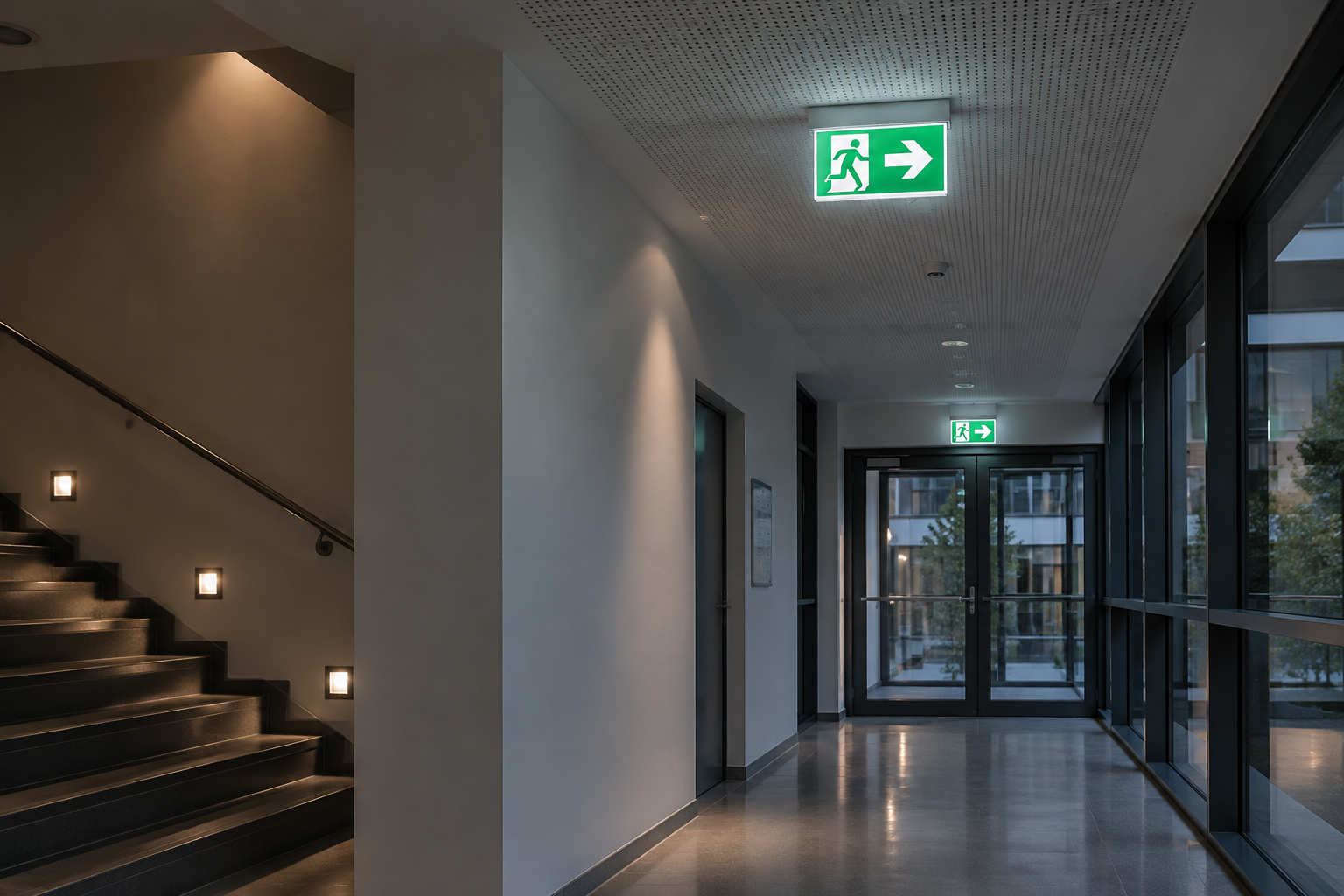 EN 1838 Emergency Lighting: The Battery-End Output Test: Compliance checklist (IES / LDT / DIALux / CE / RoHS / ErP)
Frequently Asked Questions
Q: Can Normal-mode Photometry Establish Emergency-lighting Compliance?
Only when a documented method reliably converts it to the actual emergency distribution and output. A 3000 lm normal-mode file scaled to 300 lm assumes the distribution remains unchanged. If only part of the LED array operates, request emergency-mode photometry. The calculation must also address output throughout the required duration, not merely immediately after mains failure.
Q: Does EN 60598-2-22 Compliance Prove That an Escape Route Meets EN 1838?
No. EN 60598-2-22 addresses the emergency luminaire, while EN 1838 addresses lighting performance in the space. Installation height, spacing, obstructions, duration and photometric distribution still matter. Even a product with a documented 3-hour rating needs a project calculation and commissioning checks; the duration marking alone does not establish adequate floor illumination.
Q: Is UGR Below 19 Enough to Demonstrate Acceptable Emergency Glare?
No. UGR ≤19 can be a useful normal-lighting design target for certain workplaces, but it is not a substitute for EN 1838 emergency disability-glare assessment. Review the relevant luminous-intensity limits and installation conditions using emergency-mode data. A fitting’s normal-mode UGR table does not demonstrate compliance for every mounting height or emergency configuration.
Q: Should Buyers Specify a 1-hour or 3-hour Emergency Battery?
Select the duration required by the applicable national rules, occupancy strategy and project specification. Neither 1 hour nor 3 hours is universally correct. Ask the supplier to demonstrate performance for the selected duration under declared conditions, and confirm recharge and maintenance requirements. A larger battery cannot compensate for unsuitable optics or an unverified complete-luminaire assembly.
Talk to Our Engineering Team
At XHLWX (led-project-light.com), a Custom Indoor LED Lighting Manufacturer based in China, the useful starting point for an engineering review is your floor plan, mounting heights, required emergency duration, ambient conditions and destination-market compliance route. Request a configuration-specific evidence schedule before approving samples or placing an order. The purchasing decision should connect the emergency driver, battery, photometry and installation calculation to the exact luminaire being supplied.
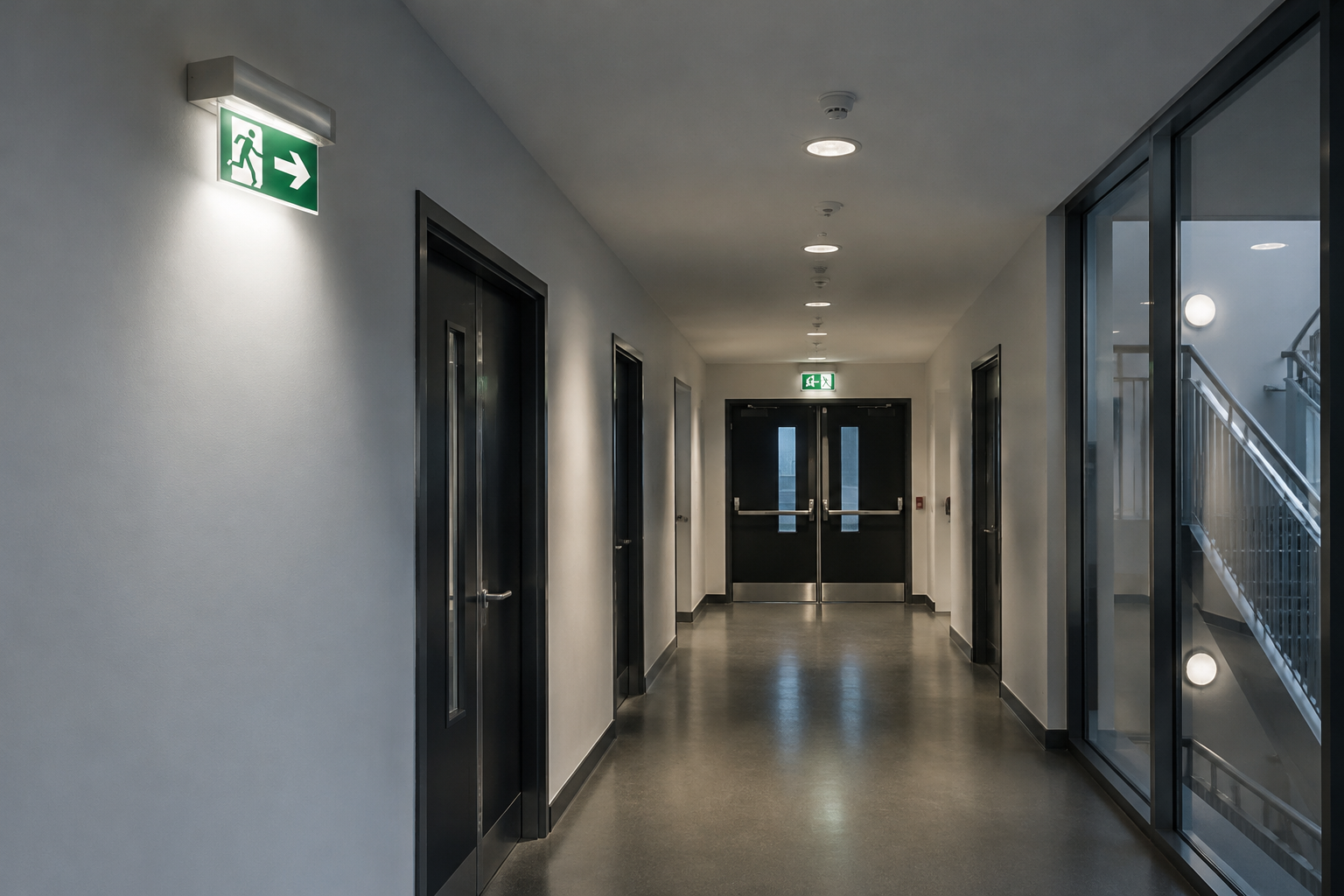 EN 1838 Emergency Lighting: The Battery-End Output Test: Q: Does EN 60598-2-22 compliance prove that an escape route meets EN 1838?
Need a tailored lighting plan for your project?
Our senior lighting designers reply within 48 hours with a free design proposal & quotation.