
DIALux Evo Tender Verification: Why IES/LDT Files Must Match
Making photometric files a tender gate requires more than a DIALux screenshot. Buyers need matched test evidence, reproducible models and substitution rules.

What Changed — and Why It Matters Now
At XHLWX (led-project-light.com), a Custom Indoor LED Lighting Manufacturer based in China, DIALux evo photometric verification should be treated as a procurement evidence question: can the offered luminaire reproduce the submitted lighting calculation? For European and US buyers considering a hard tender requirement, the decisive deliverable is not simply an IES or LDT attachment. It is a traceable connection between the tested configuration, the calculation model and the equipment ultimately delivered.
The change examined here is contractual, not a newly announced regulation. A tender that changes “photometric files available on request” to “matched files and a reproducible calculation required before technical acceptance” creates a pass/fail gate. Neither DIALux software nor an IES/LDT file independently establishes regulatory compliance, and there is no universal EU or US requirement to use DIALux specifically.
That distinction matters when bids contain similar wattages but different distributions. Two luminaires rated at 4,000 lm can produce different task-plane illuminance, wall brightness and glare because their angular intensity distributions differ. A buyer comparing only lumens per watt may therefore accept a substitution that fails the original lighting design.
A defensible requirement is straightforward: no technical acceptance without configuration-matched photometry, disclosed calculation assumptions and an independently reviewable model. This article proposes that requirement as a tender design, rather than reporting an unverified market-wide adoption trend.
The Technical Detail Behind the Headline
IES and LDT photometric files describe a luminaire’s luminous-intensity distribution and associated metadata. They are calculation inputs, not complete laboratory reports.
IES LM-63 defines a photometric data-transfer format; EULUMDAT is commonly associated with the .ldt extension. Neither filename proves who performed the measurement or whether the tested optic matches the bid.
The following schedule is an illustrative indoor-office tender baseline, not an XHLWX product specification or a claim of certified performance. Buyers should adapt it to the application and applicable standard edition.
| Parameter | Illustrative tender requirement | Evidence or reference | Acceptance note |
|---|---|---|---|
| Task illuminance | Maintained average 500 lx; uniformity U0 ≥0.60 | Project task schedule; applicable EN 12464-1 criteria | Define task area, grid and maintenance factor |
| CCT and CRI | 4,000 K; Ra ≥80 | Configuration-specific spectral test report | Do not infer color quality from photometry alone |
| TM-30 color rendition | Rf ≥85; Rg 95–105 as project targets | Report identifying the TM-30 edition | Additional buyer criteria, not universal legal limits |
| Glare | UGR ≤19 as an office design target | Calculation with stated observer positions | Not an unconditional luminaire rating |
| Beam distribution | Nominal 80° full-width half-maximum, where meaningful | IES/LDT data and intensity curves | For asymmetric optics, specify distributions in relevant planes |
| Controls | Select DALI-2, Casambi or 0–10V explicitly | Driver model, wiring and commissioning schedule | Protocol names do not establish interoperability by themselves |
| Housing | IP20; nominal 1,200 mm length | Drawing and IEC 60529 test evidence | Confirm exact dimensions and environmental suitability |
| LED and driver identity | For example, Samsung LED package and Tridonic driver | Exact component codes and controlled bill of materials | Illustrative brands, not a claim about supplied products |
| EU compliance | Applicable CE, RoHS and ErP requirements | EU Declaration of Conformity and supporting technical documentation | Identify legislation and scope for the actual configuration |
| Factory quality system | ISO 9001 certificate if contractually required | Current certificate, site scope and issuing body | Management-system evidence, not photometric certification |
| Photometric traceability | Exact offered optic, output setting and revision | Report referencing EN 13032-4 or IES LM-79, as applicable | Link exported files to the measured sample |
A successful file import establishes only that the software can read the data. Reviewers should also check luminous flux, input power, luminous dimensions, orientation and the relationship between absolute or relative photometry and any applied scaling. Scaling can be legitimate, but it must be declared and technically justified rather than used to conceal a mismatched configuration.
Glare needs particular care. A catalog statement such as “UGR<19” does not guarantee that every room arrangement meets that threshold.
Room geometry, background luminance, luminaire placement, viewing direction and luminous area affect the result. An incorrect luminous opening can therefore compromise glare assessment even when the task-plane lux values appear plausible.
What This Means for Specifiers and Buyers
How Should a Tender Turn IES/LDT Submission into a Pass/fail Gate?
Require an evidence package for each offered configuration before technical evaluation closes. It should contain the source photometric file, associated test-report reference, exact product code, optic, CCT, driver setting, declared wattage, drawing revision and a file revision or checksum. The report should identify the measurement method and laboratory; where accredited testing is required, verify the laboratory’s relevant accreditation scope.
A usable clause is: “Each offered luminaire configuration shall include traceable IES or LDT photometry and a reproducible DIALux evo calculation. Undeclared substitutions, missing configuration identification or failure to demonstrate the scheduled lighting criteria shall prevent technical acceptance pending resolution.”
Specify whether one format is sufficient or both are required. Requiring both IES and LDT does not provide two independent measurements if both exports originate from the same test. Set the review deadline, clarification process and responsible approver so that incomplete evidence is not silently accepted during purchasing.
Which DIALux Evo Assumptions Must Remain Fixed Between Competing Bids?
Issue a common calculation brief. For an illustrative office comparison, this could define a 20 m × 10 m room, a 0.80 m working plane, fixed mounting coordinates and ceiling/wall/floor reflectances of 70%/50%/20%. These are modeling assumptions, not universal office conditions; measured or architect-approved values should replace them when available.
State the maintenance factor and its basis. With an assumed maintenance factor of 0.80, a 500 lx maintained target corresponds to 625 lx initial average illuminance under the same model assumptions. A bidder using 1.00 instead of 0.80 can make an otherwise identical design appear stronger without improving the equipment.
Lock the task boundaries, calculation grid, daylight contribution, furniture assumptions and glare observer positions. Request the native project, PDF results and software version, plus confirmation that the reviewer can access the required software features. For a US project using another calculation platform, permit an equivalent reproducible workflow if the contract allows it; comparable assumptions matter more than software branding.
What Happens When a Contractor Proposes an Equal-and-approved Substitute?
Treat a substitute as a new calculation input, not merely a new catalog number. A changed lens, diffuser, luminous opening, LED board or driver current may affect distribution, flux, glare or power. The proposed replacement should be checked in the approved room model, with every change logged and the relevant acceptance criteria rerun.
Define the consequences before award. For example, a project may require renewed approval whenever the optic changes or declared output differs by more than an agreed 5% review trigger. That percentage is a contractual screening threshold, not a statutory tolerance or permission to miss the lighting criteria.
An illustrative energy comparison shows why power also belongs in the register: 100 luminaires operating at 30 W for 3,000 hours consume 9,000 kWh annually, excluding control-system and standby consumption. At 36 W, the same count and hours produce 10,800 kWh—a 20% increase. Equal lux alone therefore does not establish commercial equivalence.
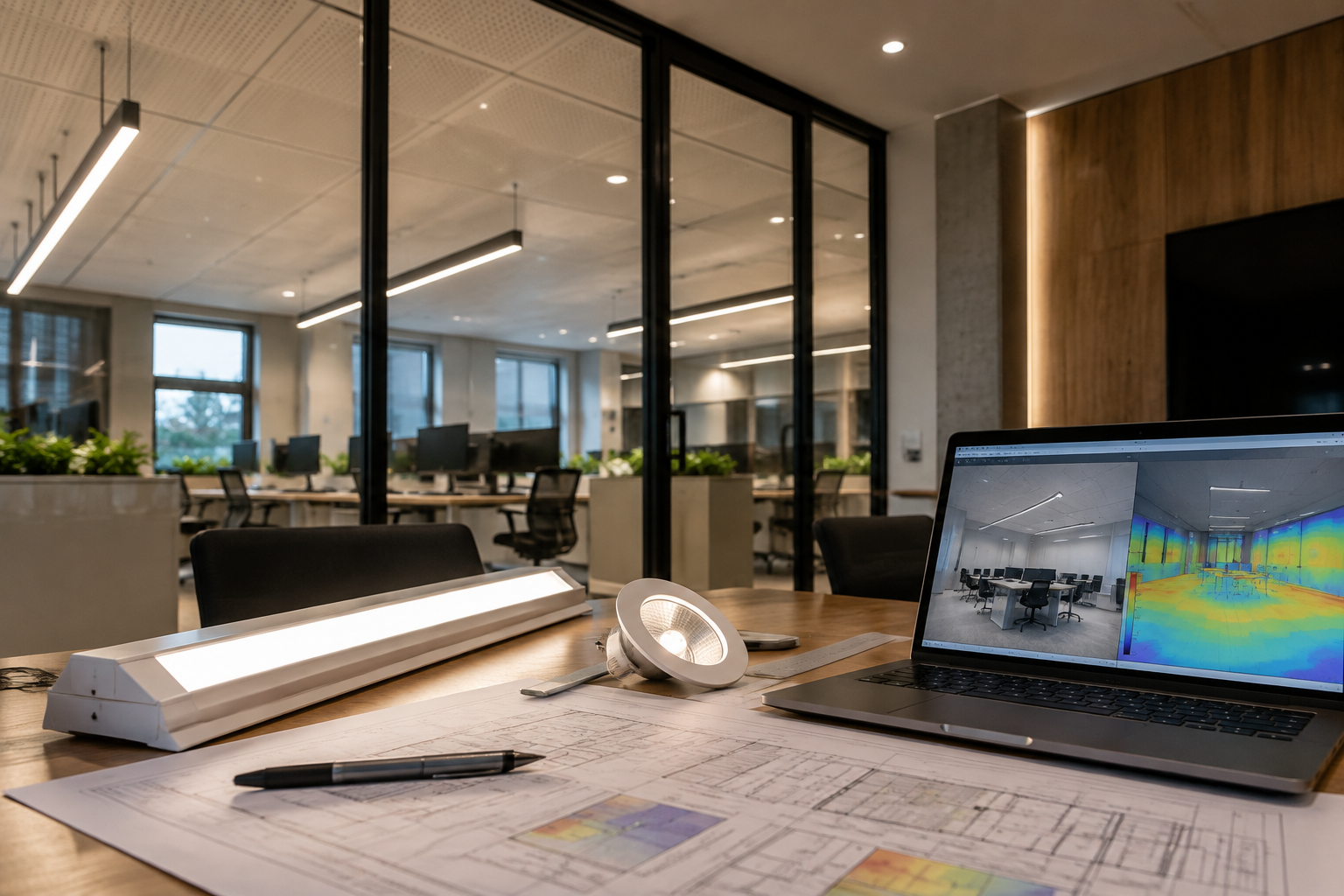 DIALux Evo Tender Verification: Why IES/LDT Files Must Match: How should a tender turn IES/LDT submission into a pass/fail gate?
Compliance Checklist (IES / LDT / DIALux / CE / RoHS / ErP)
Keep lighting-performance acceptance separate from legal market-access checks. A successful DIALux calculation cannot replace electrical safety, electromagnetic compatibility or hazardous-substance documentation. Conversely, CE marking does not demonstrate that a particular room achieves 500 lx or its specified glare limit.
- IES/LDT identity: Match the file to the report, optic, output setting and offered model. Record filenames and revisions. Investigate generic family files that cannot identify the tested configuration.
- DIALux reproducibility: Archive the native project, source photometry, software version and results. Record geometry, reflectances, grids, observers, maintenance assumptions and any flux multiplier.
- CE documentation: Obtain the EU Declaration of Conformity covering the supplied model. Article 6 of Directive 2014/35/EU sets manufacturer obligations for electrical equipment within its scope. Assess applicable EMC and, where relevant, radio-equipment legislation separately.
- RoHS scope: Article 4 and Annex II of Directive 2011/65/EU, as amended, govern restricted substances and concentration limits. Request supporting material-compliance evidence and identify any relied-upon exemptions rather than accepting an unexplained “RoHS compliant” statement.
- ErP classification: Commission Regulation (EU) 2019/2020, as amended, applies ecodesign requirements to light sources and separate control gears, including those within containing products. Its general application date was 1 September 2021. Article 3 and Annex II should be checked against the supplied product’s classification and applicable exceptions.
- ISO 9001 distinction: If required, verify that the certificate covers the manufacturing site and relevant activities. It does not substitute for product testing or prove that a photometric export is correct.
- US acceptance: Establish applicable electrical-code, listing and authority-having-jurisdiction requirements before procurement. Where UL 1598 evaluation is specified, CE documentation is not a substitute for that requirement.
Finally, schedule installation verification. A site lux survey should record operating settings, measurement positions, instrument status and daylight conditions. Compare measured initial illuminance with an appropriate initial calculation—not uncritically with maintained design values—and investigate discrepancies before changing the approved model merely to fit the measurements.
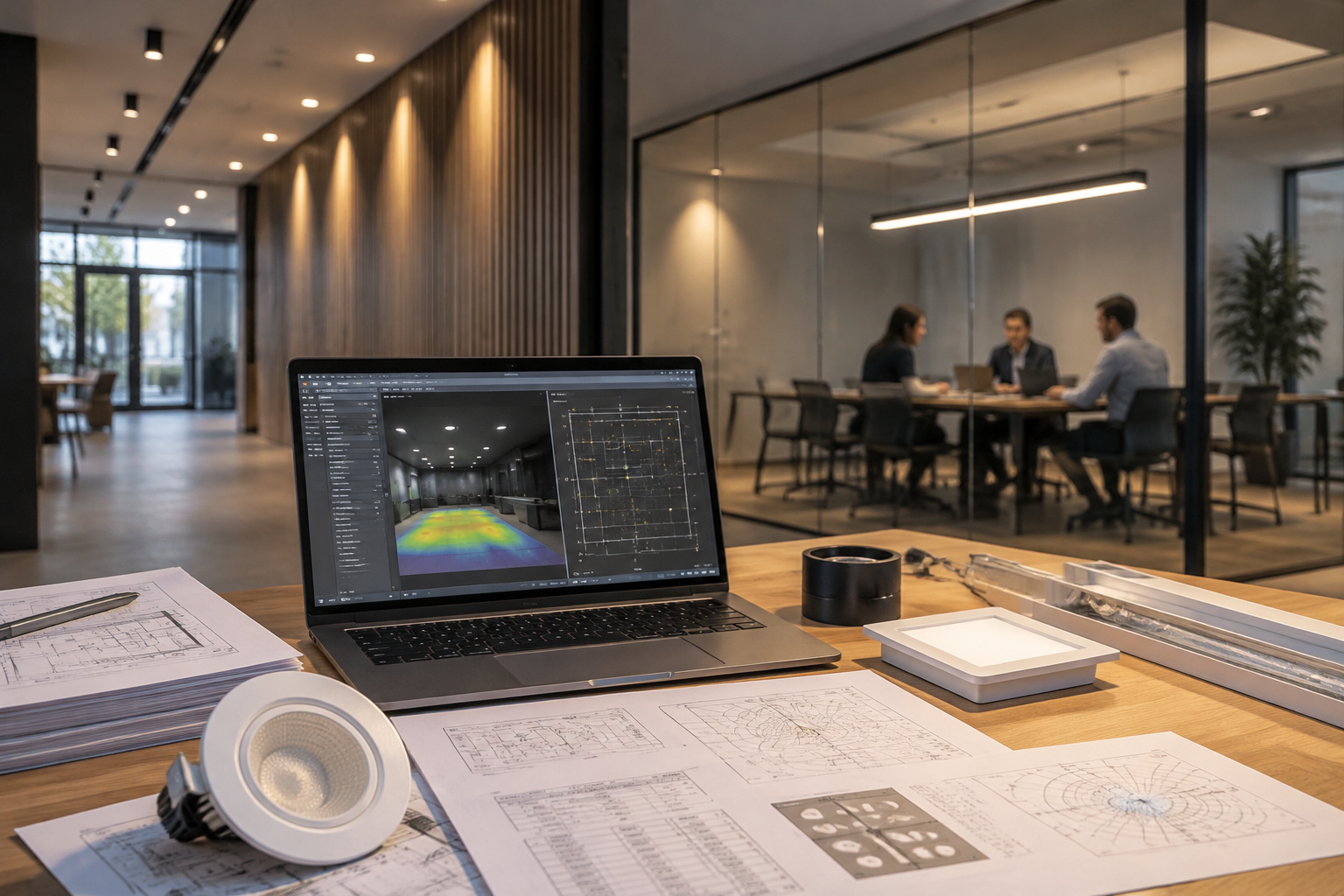 DIALux Evo Tender Verification: Why IES/LDT Files Must Match: Compliance checklist (IES / LDT / DIALux / CE / RoHS / ErP)
Frequently Asked Questions
Q: Does Importing an IES File into DIALux Evo Prove Tender Compliance?
No. Importing shows that the software can read the file, not that it represents the offered luminaire or meets the project criteria. A tender targeting 500 lx and UGR ≤19 still needs a configuration-matched report, correct room assumptions and reviewable results. CE, RoHS and applicable safety evidence require separate checks.
Q: Must Every Tender Require Both IES and LDT Files?
Not necessarily. A buyer can accept either format if the approved calculation workflow supports it and the data are traceable. Requiring 2 exports may help different project teams, but it does not create independent test evidence. If both are supplied, compare their distributions, flux interpretation and orientation to avoid inconsistent calculations.
Q: Can One Photometric File Cover Several CCT or Driver Options?
Sometimes, but the supplier must explain and substantiate its applicability. Changing from 3,000 K to 4,000 K or selecting a different driver current can change output and power. The tender should require configuration-specific data or a documented scaling method supported by relevant measurements. Changes to optics or luminous geometry require particular scrutiny.
Q: Should Site Lux Readings Equal the DIALux Maintained Illuminance Result?
Not automatically. Maintained illuminance includes an allowance for deterioration and maintenance conditions, while commissioning usually measures a new installation. With a 0.80 maintenance factor, a 500 lx maintained target corresponds to 625 lx initial average in the same model. Compare equivalent conditions, including daylight, control settings, measurement grid and actual room reflectances.
Talk to Our Engineering Team
Before requesting a quotation, assemble the room model, lighting criteria, control architecture, installation dimensions and submission deadline. Ask for a configuration-by-configuration evidence matrix rather than a general catalog. This gives the design reviewer a clear acceptance route and gives the contractor an explicit rule for substitutions.
At XHLWX (led-project-light.com), a Custom Indoor LED Lighting Manufacturer based in China, the engineering discussion should begin with that tender evidence matrix: exact optics, CCT, driver settings, photometric traceability and the assumptions behind the DIALux model. European and US buyers should request confirmation of available documents and configuration coverage before approval, with any evidence gaps resolved before the purchase order is released.
 DIALux Evo Tender Verification: Why IES/LDT Files Must Match: Q: Must every tender require both IES and LDT files?
Need a tailored lighting plan for your project?
Our senior lighting designers reply within 48 hours with a free design proposal & quotation.