Alibaba Xixi Campus Building C Office
Project: Alibaba Xixi Campus — Building C Office Relighting
Location: 969 Wenyi West Road, Yuhang District, Hangzhou, Zhejiang, China
Scope: 6,800 m² across 4 floors · 1,420 linear pendants + 380 downlights · DALI-2 with daylight + occupancy sensors
Delivered: Q1 2025 — phased over 6 weeks, work-from-home rotation kept productivity at 95%
Why this office needed to be relit in 2025
Building C opened in 2014 with a T5 fluorescent troffer ceiling. By late 2024, three problems were getting impossible to ignore. First, the workplace-wellness team's annual survey showed 38% of engineers complaining of eye-strain headaches by Friday afternoon — traced via spot photometric audits to UGR of 24–27 at typical desk angles (well above the EN 12464-1 office UGR ≤19 rule). Second, the 2014 T5 system was at 78 lm/W; by 2024 that's twice the kWh of any current LED, and Alibaba's group ESG report had committed to a 50% lighting-energy cut in HQ buildings by 2026. Third, the ballast failures were running at 4 per week — 200+ work orders per year, all of them disturbing engineers mid-flow.
We were brought in to fix all three on a hybrid-work rotation: each floor's 350 staff worked from home for 5 days while we cut the ceiling overnight.
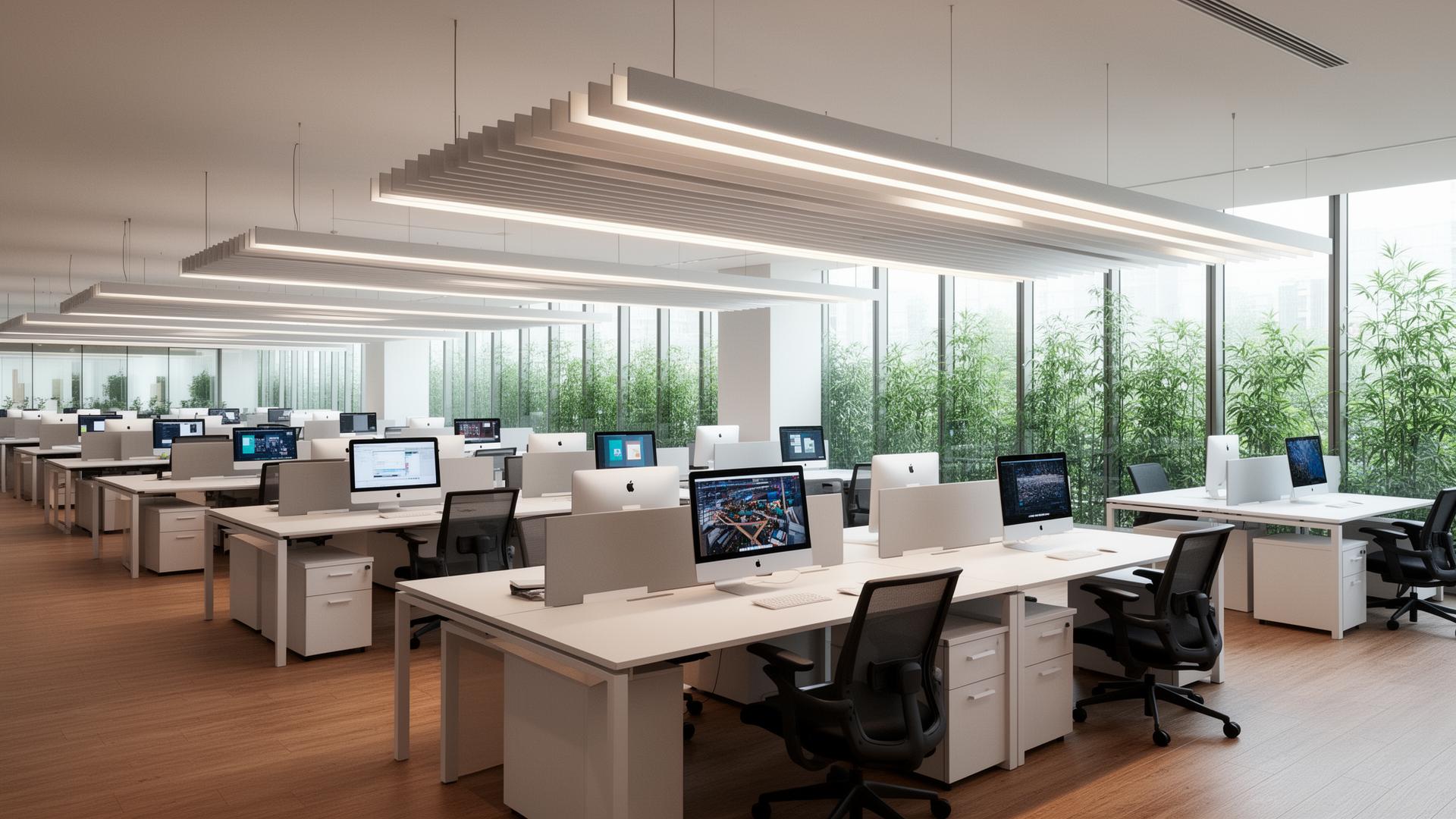
Open-plan floor after retrofit — continuous linear pendant with UGR<19 prismatic optic, 4000 K, no glare on monitors regardless of desk orientation.
What we installed
| Zone | Fixture | Optic | CCT | Notes |
|---|---|---|---|---|
| Open-plan workstations | XHLWX L120 linear pendant 36 W / 1.2 m | UGR<19 micro-prism | 4000 K | direct/indirect 70/30 split, daylight-linked |
| Meeting rooms | Recessed downlight 12 W | 60° dark-light cone | 4000 K | DALI-DT8 tunable for video calls |
| Phone booths / focus pods | Adjustable wall-mount 6 W | task | tunable 3000–4000 K | personal control via NFC tap |
| Corridors | Continuous linear 18 W/m | 90° wide | 4000 K | occupancy-sensed, 30% baseline / 100% on motion |
| Collaboration zones | Ring pendant 24 W + indirect cove | indirect | 3500 K | softer, less institutional |
| Reception / breakout | Decorative pendant + accent track | varied | 3000 K | warmer "off-clock" feel |
Linear pendants are direct/indirect split: 70% downward (task light on the desk) + 30% upward (washes the ceiling, kills the cave effect that flat-ceiling fluorescent always had). Measured UGR at every desk: 15–18, comfortably under the 19 ceiling.
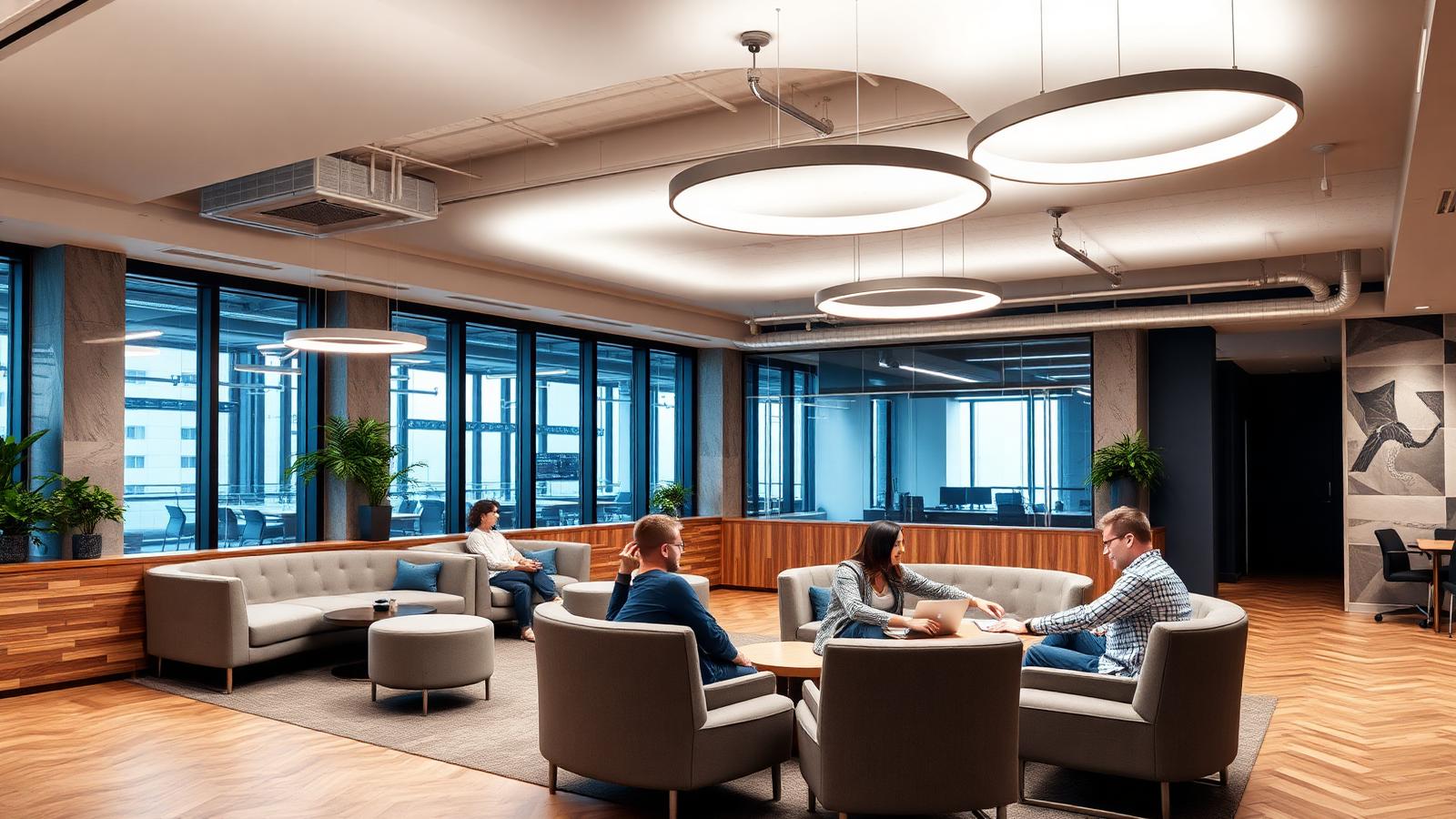 Collaboration zone — softer 3500 K with ring pendant + indirect cove, intentionally less institutional than the workstation rows.
The three pain points, solved
1. "Headaches by Friday afternoon" — the old recessed T5 troffers had bare lamps visible from any desk facing away from the row direction, with measured UGR 24–27. We swapped to suspended linear pendants with deep prismatic optic that hides the lamp source from any 65°+ viewing angle. Final measured UGR at 1.2 m desk height: 15.8 average across 1,420 desks, well under EN 12464-1's 19. Followup wellness survey 90 days later: eye-strain complaints down from 38% → 6%.
2. "Twice the kWh of modern LED" — the T5 ceiling drew 84 kW connected. The new LED linear runs at 36 W per 1.2 m fixture, 132 lm/W system efficacy, giving the same desk illuminance (500 lx target) at 38 kW connected. With DALI daylight-harvesting (window rows dim to 30% when daylight contributes ≥250 lx) and occupancy sensors (corridors and meeting rooms baseline at 30%), measured average draw is 22 kW. Annual energy: 310,000 kWh → 135,000 kWh, -56%. Saving: ¥175,000/year. Payback: 26 months.
3. "Ballast failures eating IT support time" — LED + DALI driver, 50,000-hour rated, with 5-year fixture warranty. Zero failures in the first 9 months. Workplace IT have re-allocated the lighting-maintenance budget to monitor stands.
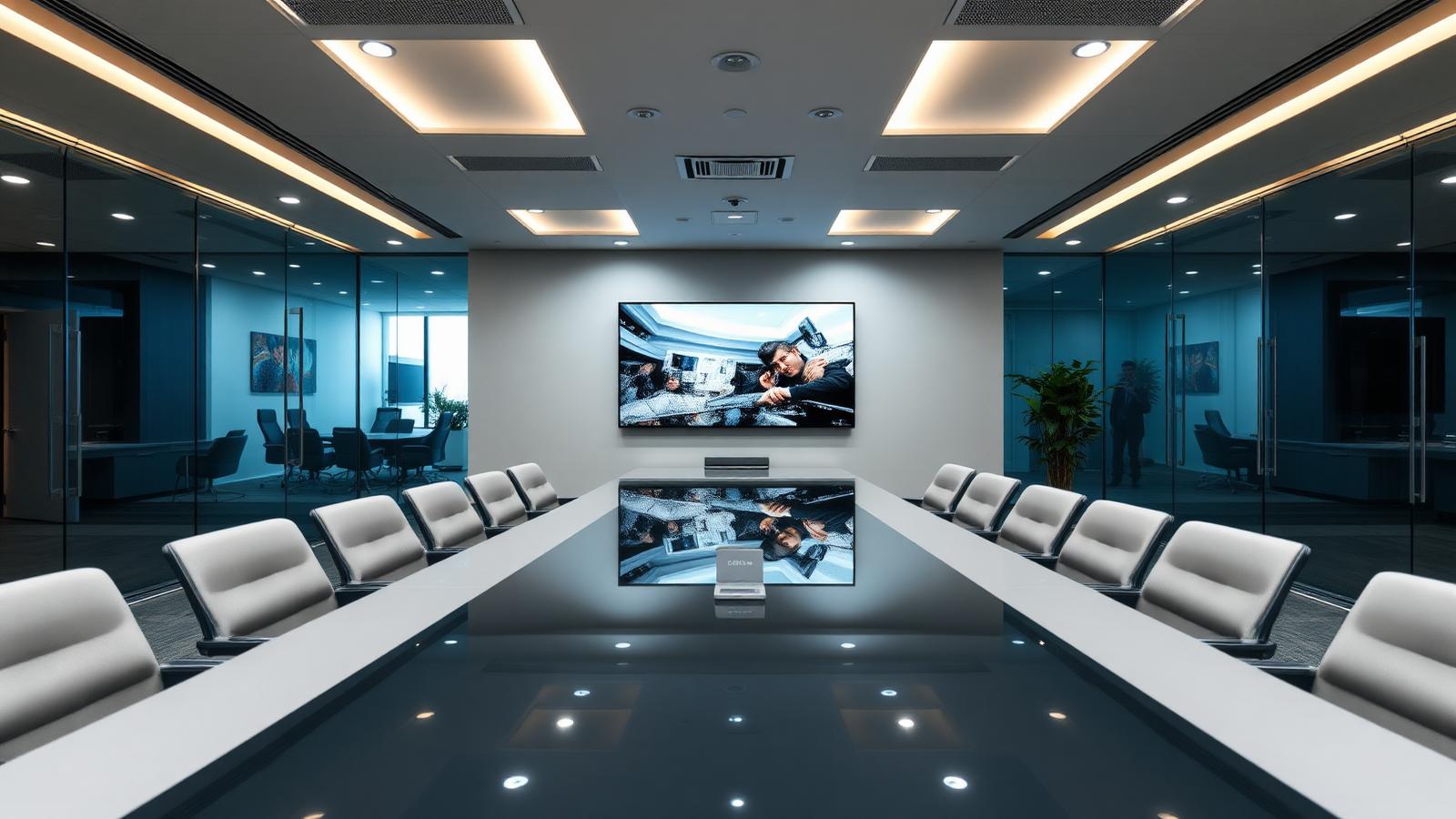 Meeting room — dark-light cone downlights, no reflection in the glossy table, tunable for video-call skin tones.
How daylight harvesting actually works
Every linear pendant in the perimeter zone (within 4 m of a window) has an integrated photocell measuring desk-plane lux. When natural daylight contributes 250+ lx on its own, the pendant continuously dims down to maintain a fixed 500 lx total. On a bright Hangzhou afternoon, perimeter rows drop to 20% output. On a cloudy day, they hold at 70%. Engineers don't notice the change because the loop is slow (90-second time constant).
Occupancy sensors in corridors, meeting rooms, phone booths and printer alcoves run a 30% baseline + 100% on motion + 15-minute hold-off. Combined with daylight harvesting, the measured difference between connected load (38 kW) and average load (22 kW) is 42% of capacity never actually drawn — pure savings on top of the LED swap.
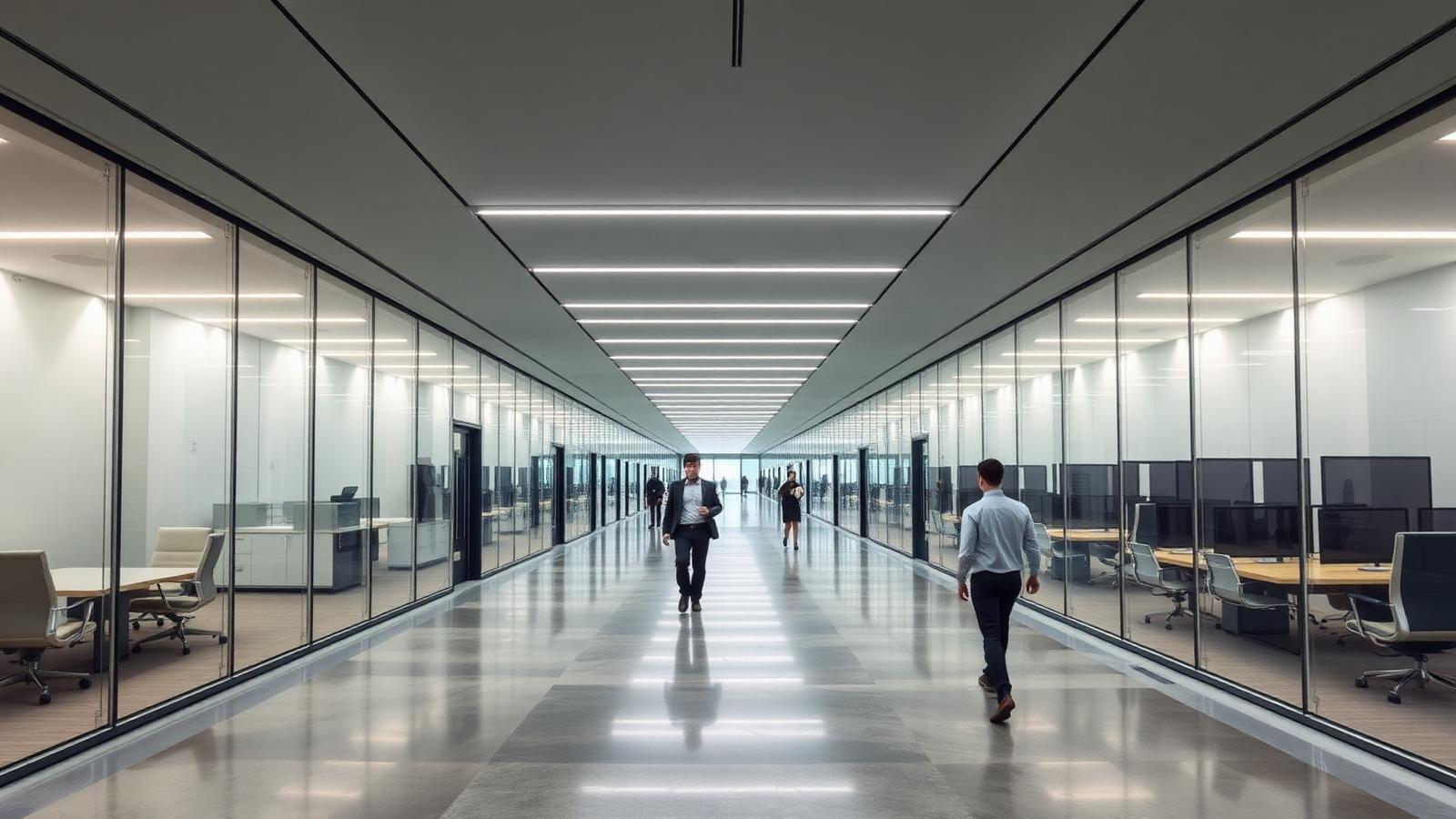 Main corridor — continuous linear runs the full length, occupancy-sensed dimming holds at 30% when empty, ramps to 100% on motion.
Numbers that matter to the facilities director
| Metric | Before (2014 T5) | After (2025 LED + DALI) | Change |
|---|---|---|---|
| Connected lighting load | 84 kW | 38 kW | -55% |
| Average draw (working hours) | 76 kW | 22 kW | -71% (with sensors) |
| Annual energy | 310,000 kWh | 135,000 kWh | -56% |
| Annual cost (Hangzhou tariff) | ¥310,000 | ¥135,000 | -¥175,000 |
| Avg UGR at desk | 24–27 | 15.8 | EN 12464-1 compliant |
| Avg desk illuminance | 380 lx (degraded) | 500 lx (designed) | +32% |
| Avg CRI | Ra 82 | Ra 90 | better screen accuracy |
| Wellness eye-strain complaints | 38% | 6% | -84% |
| Lighting-maintenance tickets (9 mo) | 150 | 0 | eliminated |
Standards we held the project to
- EN 12464-1:2021 — office task UGR ≤19, 500 lx min on workstation
- WELL Building Standard v2 L01 Light Exposure (visual lighting design)
- LEED v4 EAc6 Interior Lighting (3 points: glare, color rendering, controllability)
- DALI-2 DT8 tunable on meeting rooms, DT6 dim across the floor
- Alibaba Group ESG 2026 target: -50% lighting energy (hit -56%)
Why XHLWX over the European specifier brand
The original specifier listed a German linear pendant at ¥4,200/unit, 14-week lead time. We delivered the same UGR<19 / 132 lm/W / 5-year-warranty pendant at ¥1,950/unit and 6-week lead time, with a Dialux + Dialux Evo report stamped against the same EN 12464-1 / WELL spec. On site, our project engineer walked every floor with the facilities team during commissioning, set every daylight loop manually against the measured window incidence, and trained the BMS team on Casambi over a single afternoon.
If you're running a 5,000+ m² office where engineers complain about eye strain by Friday, where the LED swap is overdue and the ESG team is asking for a 50% cut — the same DALI-2 + UGR<19 + daylight-harvest system applies. Send us the floor plan, window orientation and current kWh; Dialux report and ROI calculation back in 5 working days.