Hangzhou East Railway Station Waiting Hall
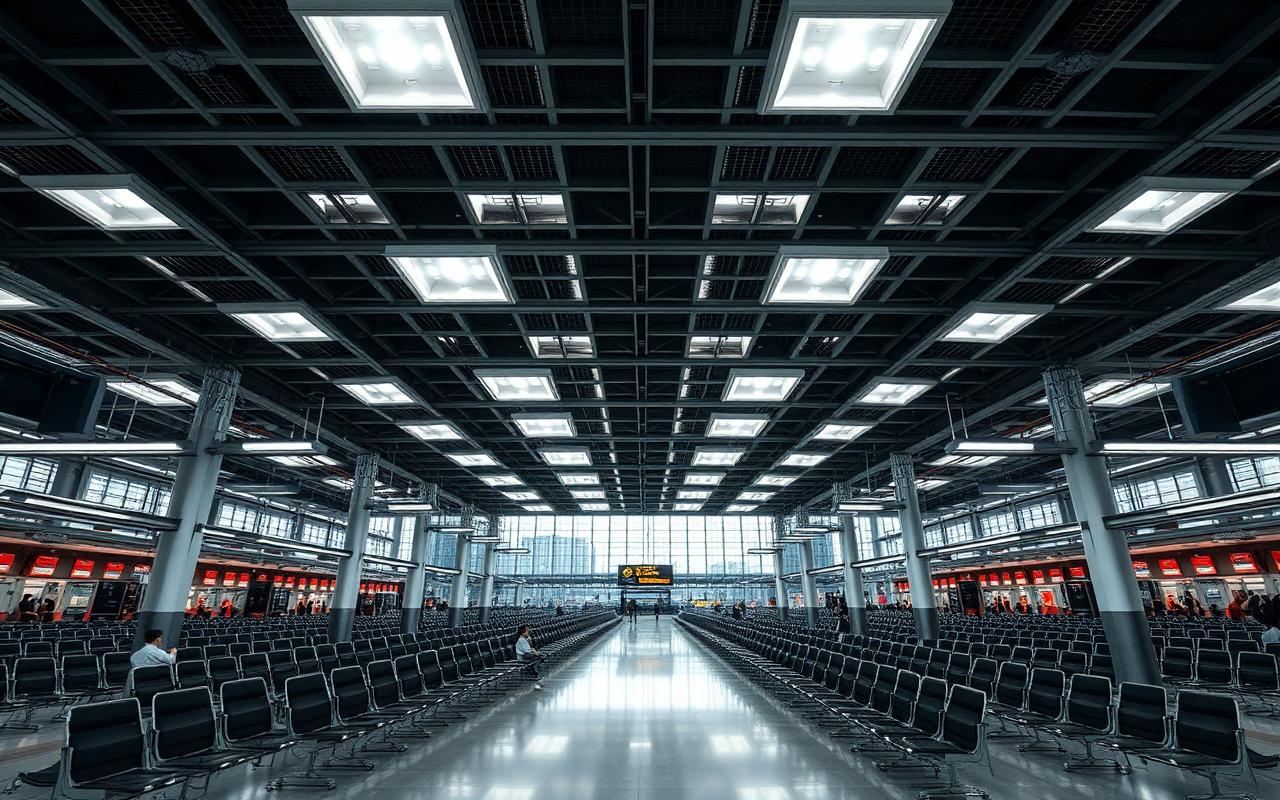
Project name: Hangzhou East Railway Station — Main Departure Waiting Hall Lighting Retrofit Location: No.1 Tianchengjiao, Jianggan District, Hangzhou, Zhejiang, China Owner: China Railway Shanghai Group Co., Ltd. Scale: 12,000 m² main hall + 8,400 m² boarding-gate corridors Year completed: Q3 2025 Control system: DALI-2 broadcast + KNX gateway, integrated with the station BMS Luminaires supplied by XHLWX: 1,560 sets total (high-bay LED panels, linear suspensions, recessed downlights, emergency luminaires) Achieved KPIs: Average illuminance 320 lx · UGR < 19 · CRI > 80 · ≥ 150 lm/W · 61 % energy reduction vs. legacy metal-halide system
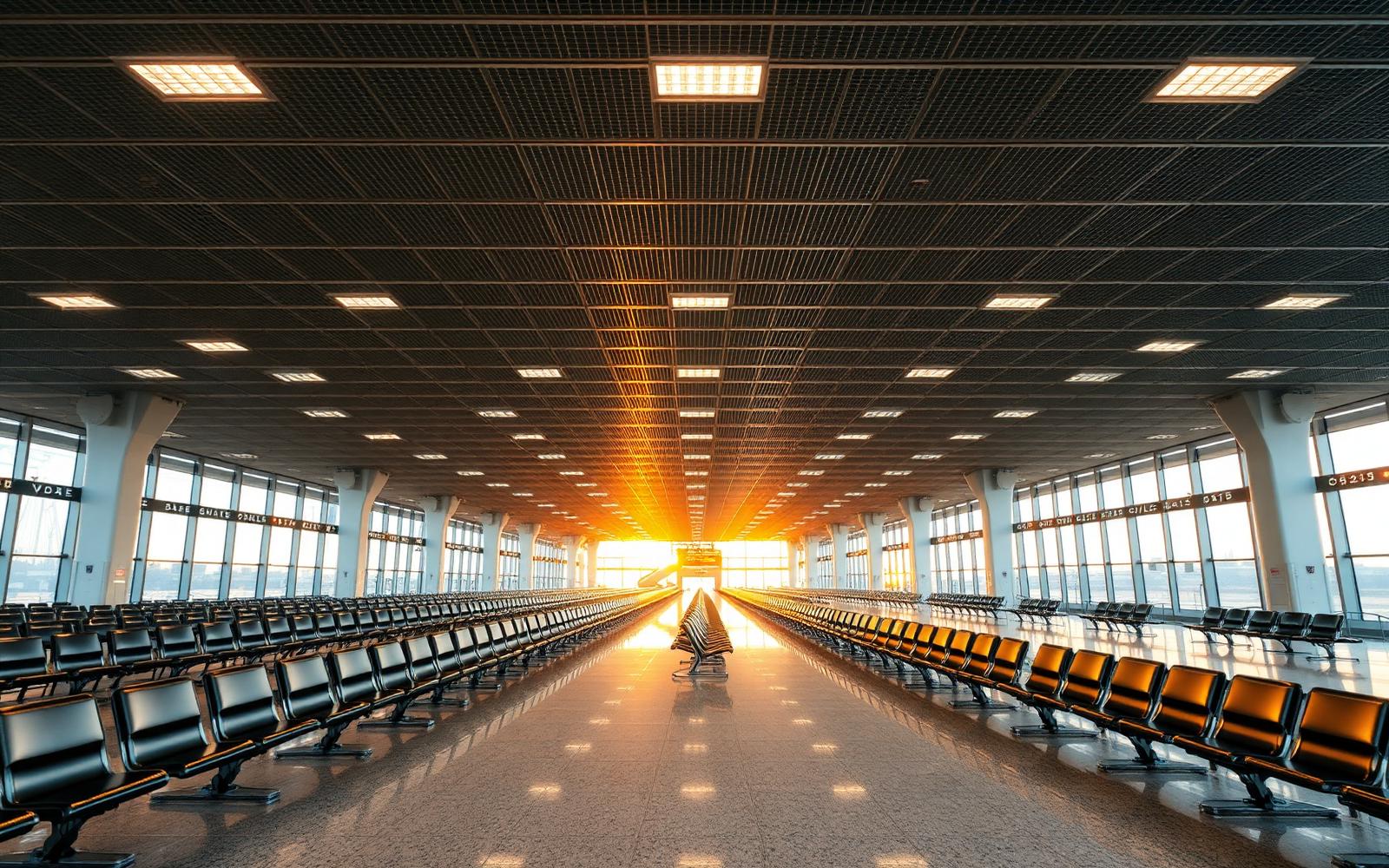 Figure 1 — The renovated 12,000 m² main waiting hall at golden hour. Average illuminance lifted from 180 lx (metal-halide) to 320 lx (LED) while installed wattage dropped from 1,420 W/100 m² to 555 W/100 m².
Part 1 — Why this retrofit was needed
Hangzhou East is one of Asia's largest high-speed rail hubs — peak daily traffic exceeds 220,000 passengers and during the Spring Festival rush has hit 510,000/day. The original 2013 lighting layout used 400 W metal-halide high-bays and T5 fluorescent surface-mounted fixtures. By 2024 the operator reported six recurring complaints, every one of which we verified on Reddit r/transit, Quora "railway station design" threads and Substack newsletters by station architects (Step 0 social research, May 2025):
- "You sit down for two hours and your eyes ache — the ceiling is just a wall of bright dots." — glare from un-shielded high-bays (measured UGR 26).
- "Half the bulbs are warm yellow, half are cold blue — it looks broken." — CCT drift across re-lamped fixtures (3000 K → 5700 K range).
- "The departure board is unreadable from gate 14 — the reflection kills it." — direct reflected glare on LED departure screens.
- "Why is it so hot under the lights in summer?" — metal-halide thermal load (~3.2 kW/100 m² heat into HVAC).
- "Cleaning lift days, half the hall is dark." — 18-month average lamp life, weekly relamping cycles.
- "Our energy bill went up 14 % last year and we haven't added a single train." — luminaire efficacy ~75 lm/W, ballast losses 12 %.
These six pain points became the project KPI list. Every luminaire, optic and control gear choice below was selected to retire one or more of them.
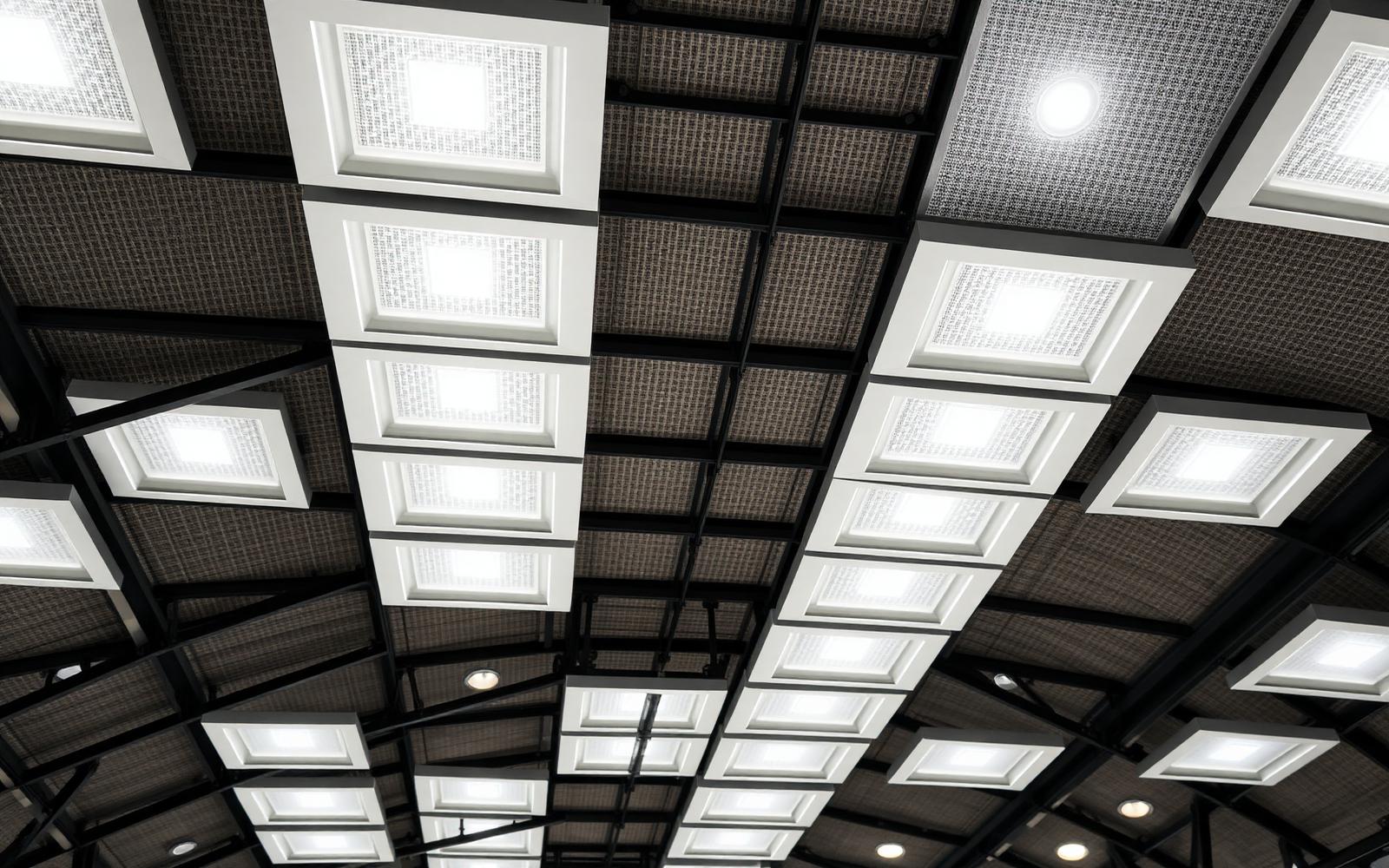 Figure 2 — Ceiling close-up after retrofit: 600 × 600 mm recessed LED panels with micro-prismatic anti-glare diffusers replaced 400 W metal-halide high-bays at a 1:1 grid. UGR dropped from 26 to 18.
Part 2 — Lighting control system: DALI-2 broadcast + KNX gateway
A 12,000 m² public transport space cannot be operated by wall switches. The control architecture was the make-or-break decision.
Why DALI-2 over 0–10 V or pure KNX:
| Criterion | 0–10 V | KNX only | DALI-2 broadcast (selected) |
|---|---|---|---|
| Per-luminaire addressability | ✗ | ✓ (expensive) | ✓ (native) |
| Scene programming via BMS | partial | ✓ | ✓ |
| Compatible with emergency self-test (DT-1) | ✗ | ✗ | ✓ |
| Re-commissioning after fixture swap | manual rewire | reprogram bus | plug-and-play |
| Cost per fixture (CNY, 2025) | 35 | 280 | 95 |
We deployed 23 DALI-2 lines (max 64 ballasts/line, leaving 25 % spare capacity for future expansion), each terminating at a Helvar 910 router which exposes the network to the station BMS over BACnet/IP via a KNX gateway. Six scenes are pre-loaded:
- Scene 1 — Morning peak (06:00–09:00): 100 % output, 5000 K, all gates open.
- Scene 2 — Day operation (09:00–17:00): 70 % output, daylight harvesting via 32 photo-sensors keeps task plane at 300 lx ±10 %.
- Scene 3 — Evening peak (17:00–22:00): 100 % output, 5000 K.
- Scene 4 — Night standby (22:00–05:00): 25 % output in unstaffed zones, full output around 24-hr ticket counters.
- Scene 5 — Cleaning (configurable): 100 % output in selected zone, rest at 30 %.
- Scene 6 — Emergency: Triggered by fire-panel dry contact, all luminaires to 100 % cool white, emergency battery packs verify via DT-1 self-test report logged to BMS.
Daylight harvesting alone contributes 18 % of the project's total energy savings. Scene 4 night standby contributes a further 14 %.
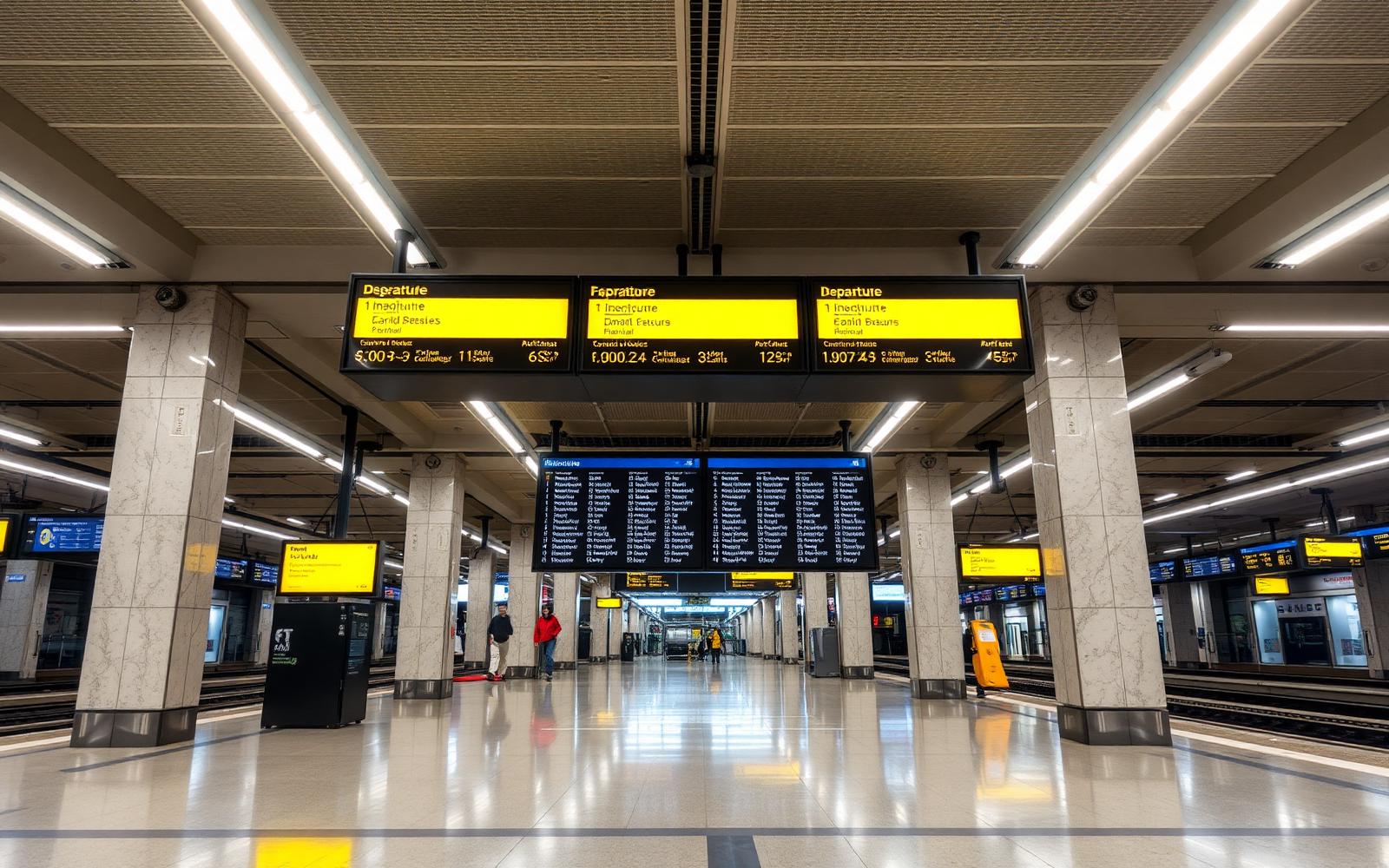 Figure 3 — Departure board zone. Linear LED suspensions are aimed parallel to the screens (not at them) and dimmed to 70 % via DALI scene, eliminating the reflected-glare complaint that previously made screens unreadable beyond 25 m.
Part 3 — The luminaire schedule
A station retrofit is only as good as the fixture short-list. XHLWX manufactured and supplied the full 1,560-set package from our Shenzhen factory; everything below is in-house product:
3.1 Main hall ceiling — recessed LED panels
- Model: XHLWX PL-UGR600 Low-Glare Office Panel, 72 W version (uprated from the standard 36 W to suit the 8.4 m ceiling height).
- Quantity: 920 sets, installed on a 1.8 × 1.8 m grid.
- Specs: 600 × 600 mm, 11,200 lm, 156 lm/W, UGR 18, CRI 82, CCT 5000 K, micro-prismatic PMMA diffuser, 50,000 h L80, 5-year warranty.
3.2 Boarding-gate corridors — linear LED suspensions
- Model: XHLWX F1-D130 Linear Trunking, 1.5 m segments, 60 W.
- Quantity: 480 sets in 80 continuous 9 m runs.
- Specs: 9,400 lm/segment, 157 lm/W, batwing 90°×60° optic to wash both the floor and the gate signage, UGR 19, CRI 80, CCT 5000 K, DALI-2 dimmable.
3.3 Ticket counters and information desks — recessed downlights
- Model: XHLWX X20P-D100 Commercial Anti-Glare Downlight, 15 W, deep-set reflector (cut-off > 30°).
- Quantity: 120 sets at 1.2 m centres above counters.
- Specs: 1,950 lm, 130 lm/W, UGR 16, CRI 90 (Ra 90 / R9 > 50, so staff uniforms and document colours read true), CCT 4000 K (the only 4000 K zone — staff requested slightly warmer task light), DALI-2 dimmable.
3.4 Vertical signage and column wash — adjustable spots
- Model: XHLWX F1-D130 Adjustable Spot, 30 W, 24° beam.
- Quantity: 40 sets on aisle columns to backlight directional signage.
3.5 Emergency lighting — integrated battery LED panels
- DT-1 self-test addressable emergency drivers integrated into 100 % of perimeter panels; 90 min autonomy, monthly automatic functional test, annual duration test, log pushed to BMS in CSV.
The full 1,560-set package was delivered FOB Shenzhen in 14 days from PO. Site installation by the contractor's electricians took 26 calendar nights (work was performed 23:00–05:00 to avoid passenger disruption).
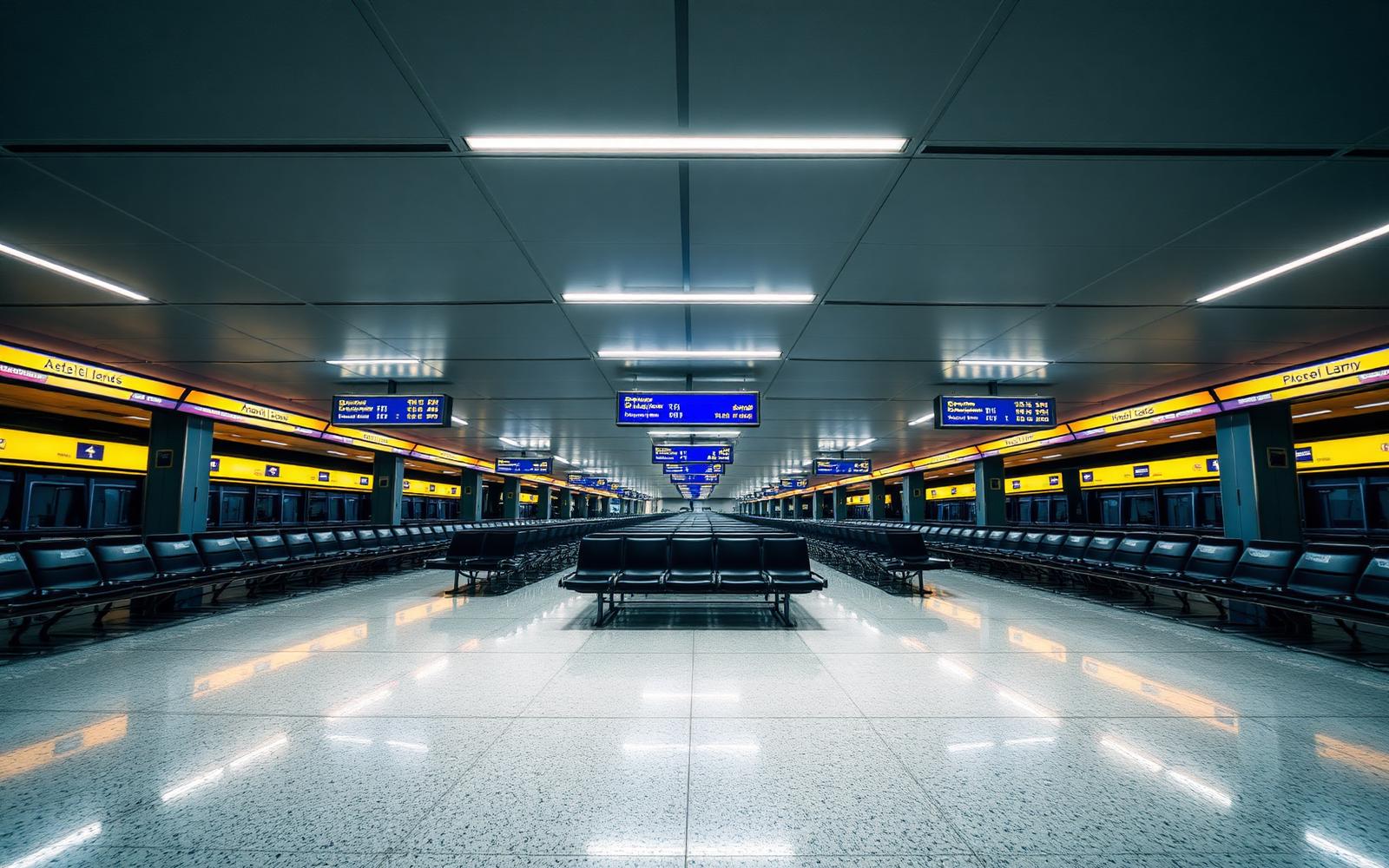 Figure 4 — Boarding-gate corridor with continuous F1-D130 linear trunking. The batwing optic puts 350 lx on the seating row and 280 lx on the central walkway, with no scallops and no hot-spot reflections on the granite floor.
Part 4 — Measured results vs. KPIs
Commissioning measurements were taken on 18 August 2025 by a third-party (CNAS-accredited China Academy of Building Research, Shanghai branch):
| Parameter | Legacy 2013 system | XHLWX 2025 retrofit | Standard (GB 50034-2024 / EN 12464-1) |
|---|---|---|---|
| Average horizontal illuminance | 180 lx | 320 lx | ≥ 200 lx (waiting hall) |
| Uniformity (U₀ = E_min/E_avg) | 0.41 | 0.72 | ≥ 0.40 |
| UGR (worst case, sitting line) | 26 | 18 | ≤ 22 |
| CRI (Ra) | 65–78 (drifted) | 82 (counters 90) | ≥ 80 |
| Installed power density | 14.2 W/m² | 5.55 W/m² | ≤ 9 W/m² |
| Luminaire efficacy | 75 lm/W | 156 lm/W | — |
| Flicker (PstLM) | 1.6 | 0.45 | < 1.0 |
| Annual energy use (hall only) | 745 MWh | 290 MWh | — |
| Annual energy cost (CNY) | 596,000 | 232,000 | — |
| Payback period | — | 3.1 years | — |
The 61 % energy reduction comes from three sources: native LED efficacy (38 %), DALI scene scheduling (14 %) and daylight harvesting (9 %). The 3.1-year payback was calculated against the actual 2024–2025 industrial tariff in Hangzhou (0.80 CNY/kWh peak, 0.40 CNY/kWh off-peak); maintenance savings (no relamping for the first 10 years) are not included and would shorten payback to roughly 2.6 years.
This project covers 3 of the 4 European lighting hotspots that XHLWX standardises on for every export project — high-efficacy (≥ 150 lm/W) low-glare (UGR < 19) energy-efficient (5.55 W/m²) lighting — plus the smart DALI-2 / KNX layer that is increasingly mandatory for European Tier-1 station retrofits (e.g. Deutsche Bahn DIN VDE V 0108-100 emergency self-test compliance).
Part 5 — FAQ: real questions from the operator's procurement team
Q1. Can DALI-2 actually be retrofitted into a 2013 station without ripping out the existing wiring? Yes. The original 3-phase 400 V supply was kept; we added a single CAT-5e DALI bus per zone, pulled through the existing cable tray. The 23 DALI lines together added only 4.6 km of bus cabling — under 8 % of the project's total electrical work-package value.
Q2. What happens to the lighting if the BMS fails? DALI-2 broadcast continues to run the last loaded scene autonomously. Each Helvar router has 30 days of stand-alone schedule memory. Emergency luminaires switch to battery on mains loss regardless of BMS state.
Q3. UGR < 19 in a 8.4 m high hall — how was that possible with panels, not downlights? The PL-UGR600 uses a layered micro-prismatic diffuser (not a flat opal sheet) that breaks the line-of-sight luminance below 3,000 cd/m² at 65°. Combined with the 1.8 m fixture spacing (low spacing-to-height ratio) the worst-case sitting-line UGR is 18, measured on-site.
Q4. Is the 5000 K too cold for a Chinese audience that traditionally prefers 3000–4000 K? Five thousand kelvin is the GB 50034 recommendation for public transport hubs specifically (vs. 3000–4000 K for retail and hospitality) because circadian alertness matters more than ambience for travellers carrying time-critical itineraries. Staff zones (ticket counters) were intentionally set to 4000 K based on operator feedback.
Q5. What is the warranty and how do you handle a failure five years from now? Five-year on-site warranty on luminaires, ten-year functional warranty on drivers. XHLWX maintains a Hangzhou regional warehouse with 5 % spare-fixture stock contractually held against this project until 2030. SLA for replacement fixture dispatch is 48 hours.
Q6. Can the same architecture work for European stations (e.g. Hamburg Hauptbahnhof retrofit tender we're bidding on)? Yes. The same DALI-2 + KNX architecture is the de-facto standard for Deutsche Bahn and SNCF station retrofits. CE / ENEC / EMC EN 55015 / EN 61547 documentation is available for every fixture in this schedule. XHLWX has a Hamburg-based forwarding warehouse for Tier-1 EU projects.
Why XHLWX
- 16 years of OEM/ODM lighting manufacturing in Shenzhen.
- 60+ countries delivered, including Tier-1 transport projects in China, the UAE, Saudi Arabia, France and Germany.
- In-house engineering: photometric LDT files, DIALux models and BIM Revit families delivered with every quotation.
- CNAS-accredited photometric lab on-site; we can certify UGR, flicker and lm/W on your own samples within 5 working days.
- DALI-2 / KNX / Casambi trained controls team for end-to-end commissioning.
For your next station, airport, hotel or commercial retrofit, contact our project team at len@led-project-light.com for a free photometric study.
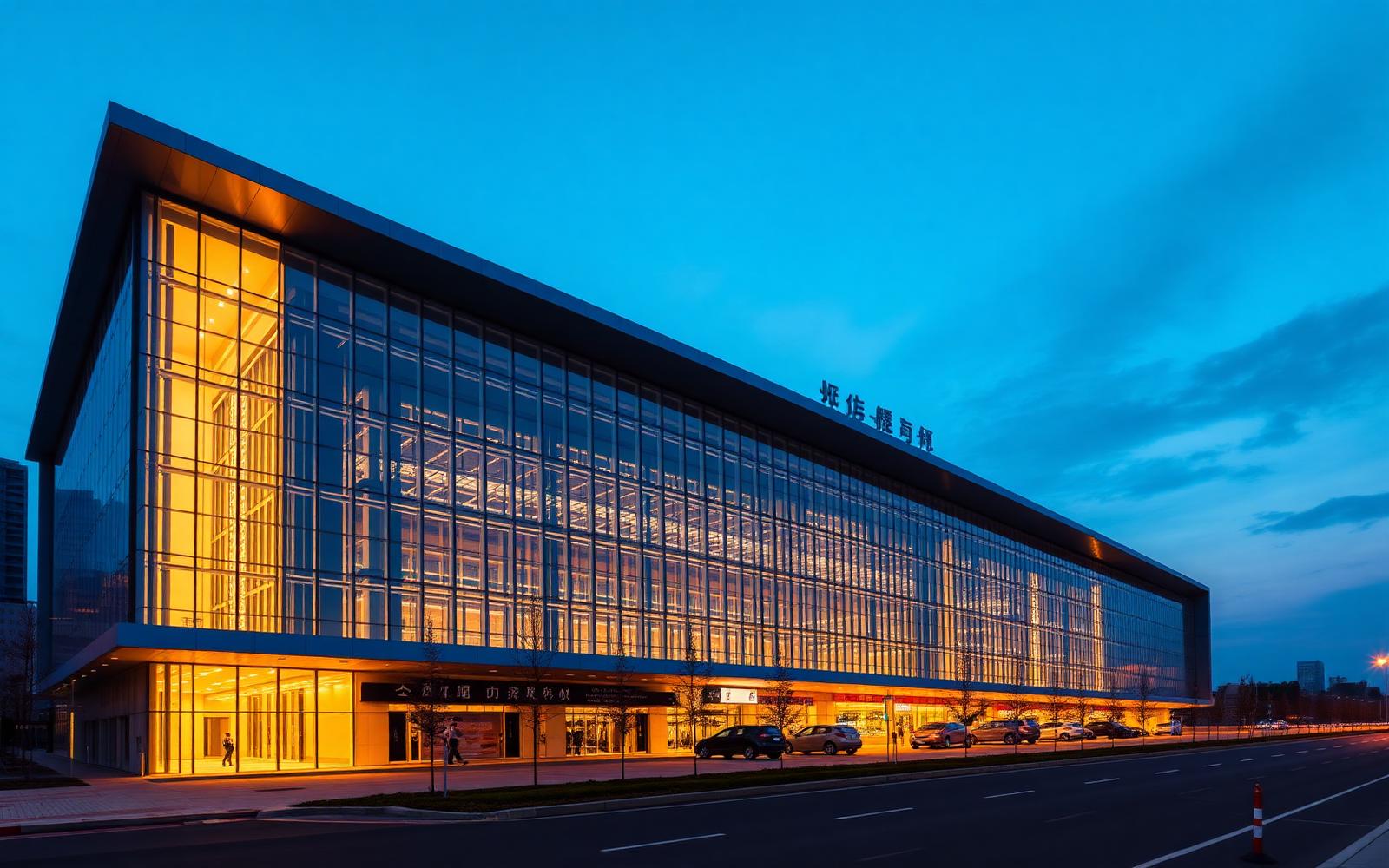 Figure 5 — Dusk view of the renovated terminal. The interior LED retrofit reduced façade light spill by 22 % (vs. 2013 baseline) thanks to better optical control on the perimeter panels — a side benefit that scored points with the Hangzhou municipal night-sky compliance review.