
Abu Dhabi Mosque Interior Lighting: 6,800 m² LED Retrofit
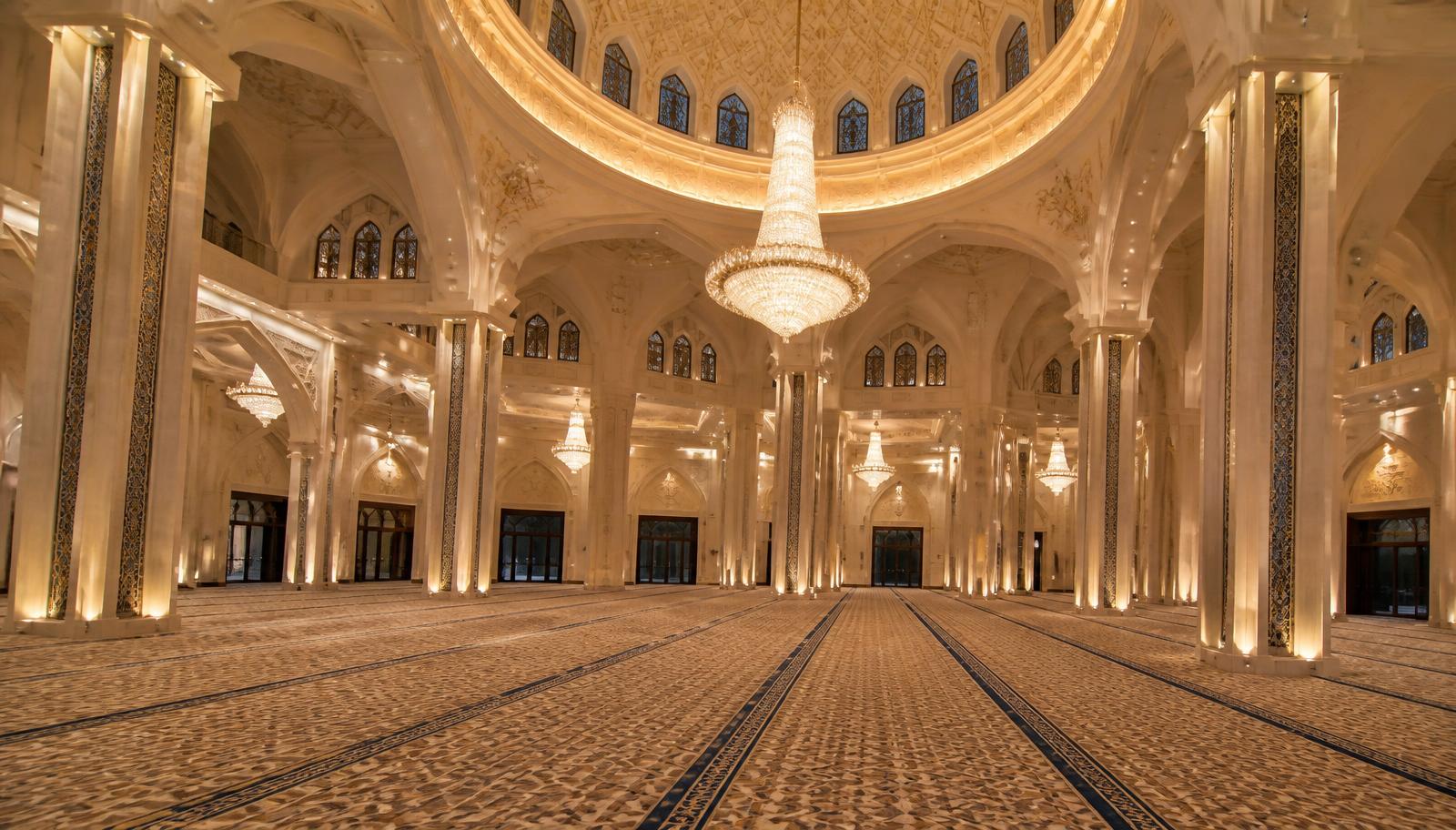
Project Background: an Interior-Only Retrofit for a 4,200-Worshipper Prayer Hall
The Abu Dhabi community mosque in this case study serves a congregation of about 4,200 at Friday prayer across a main prayer hall, a women's prayer hall, an ablution wing, and a linked circulation gallery — roughly 6,800 m² of enclosed floor area. The building opened in 2014 with metal-halide uplights in the dome, halogen accents at the mihrab, and CFL downlights in circulation.
By 2025 three problems had made a retrofit unavoidable.
The dome had gone grey and patchy. Metal-halide sources shift over life, and after a decade adjacent uplights in the same cove were reading anywhere from 2,900 K to 3,600 K. On a hand-painted gilded dome, a colour shift of that size does not look like a lighting fault to the congregation — it looks like the artwork has been damaged.
Relamping the dome was a two-day operation. The dome crown sits 21 m above the carpet. Every lamp change meant scaffolding inside a working place of worship, so maintenance was deferred, which made the patchiness worse.
Comfort in prostration was never considered in the original design. Worshippers spend a large part of the prayer looking up, or with the head lowered and the eye near carpet level. Bright unshielded sources in the ceiling plane that measure acceptably at desk height are severely uncomfortable at those two viewing angles. The mosque committee described the main hall as "bright but tiring".
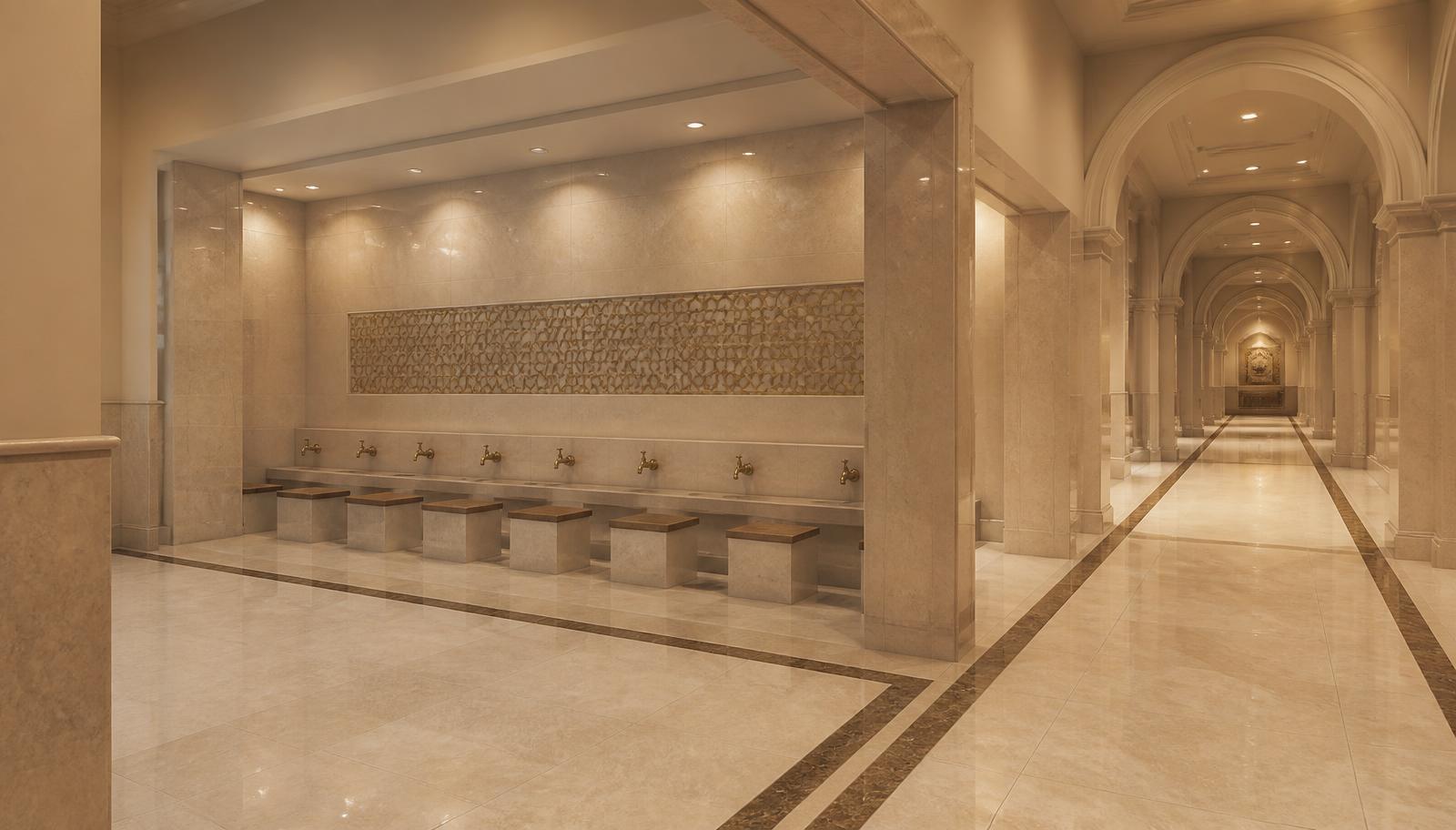 Ablution wing and circulation gallery of the Abu Dhabi mosque with IP44 recessed LED downlights
The ablution wing and linked gallery after retrofit: 4000 K IP44 downlights, UGR 19, sealed optics rated for a 40 °C+ ceiling void.
XHLWX Lighting supplied and engineered the interior lighting only. This is an important scope note for anyone reading this as a reference project: XHLWX manufactures indoor architectural and commercial luminaires — prayer halls, hotels, retail, offices, museums, schools, hospitals and industrial interiors. Minaret floodlighting, dome exterior washing, courtyard and landscape lighting were not part of our supply and are not products we make.
The Technical Brief
The consultant wrote the specification against EN 12464-1:2021 for the functional zones and against conservation practice for the decorated surfaces:
| Zone | Maintained illuminance | Uniformity | Glare | Colour |
|---|---|---|---|---|
| Main prayer hall carpet | 200 lx | Uo ≥ 0.6 | UGR ≤ 16 | 3000 K, CRI ≥ 90 |
| Dome interior (decorated) | 80–120 lx on surface | smooth gradient | no source in view | 3000 K, CRI ≥ 92, R9 ≥ 50 |
| Mihrab / minbar | 400–600 lx accent | — | shielded ≥ 40° | 3000 K, CRI ≥ 95 |
| Women's prayer hall | 200 lx | Uo ≥ 0.6 | UGR ≤ 16 | 2700 K, CRI ≥ 90 |
| Ablution wing | 200 lx | Uo ≥ 0.5 | UGR ≤ 19 | 4000 K, CRI ≥ 80, IP44 |
| Circulation gallery | 150 lx | Uo ≥ 0.4 | UGR ≤ 19 | 3000 K, CRI ≥ 80 |
Two constraints drove the engineering. Nothing could be surface-mounted on decorated plaster, so every new luminaire had to reuse an existing recess, cove or track position. And the mosque could not close: works ran between the Isha and Fajr prayers, in 23 short night windows.
Fixture Engineering
We modelled the whole interior in DIALux evo from a point-cloud scan of the domes, then built a full-scale mock-up of one dome segment before releasing production.
Dome interior — 96 × QH-LN06 linear grazing modules. Mounted in the existing 260 mm cove with a 12° asymmetric optic so the light climbs the dome surface without any source visible from the carpet. 3000 K, CRI 92 with R9 = 58, SDCM ≤ 2 with a five-year matched-bin reserve held for the mosque so a future repair cannot show as a patch. Zero UV and zero IR content in the beam, which is the whole point on hand-gilded plaster.
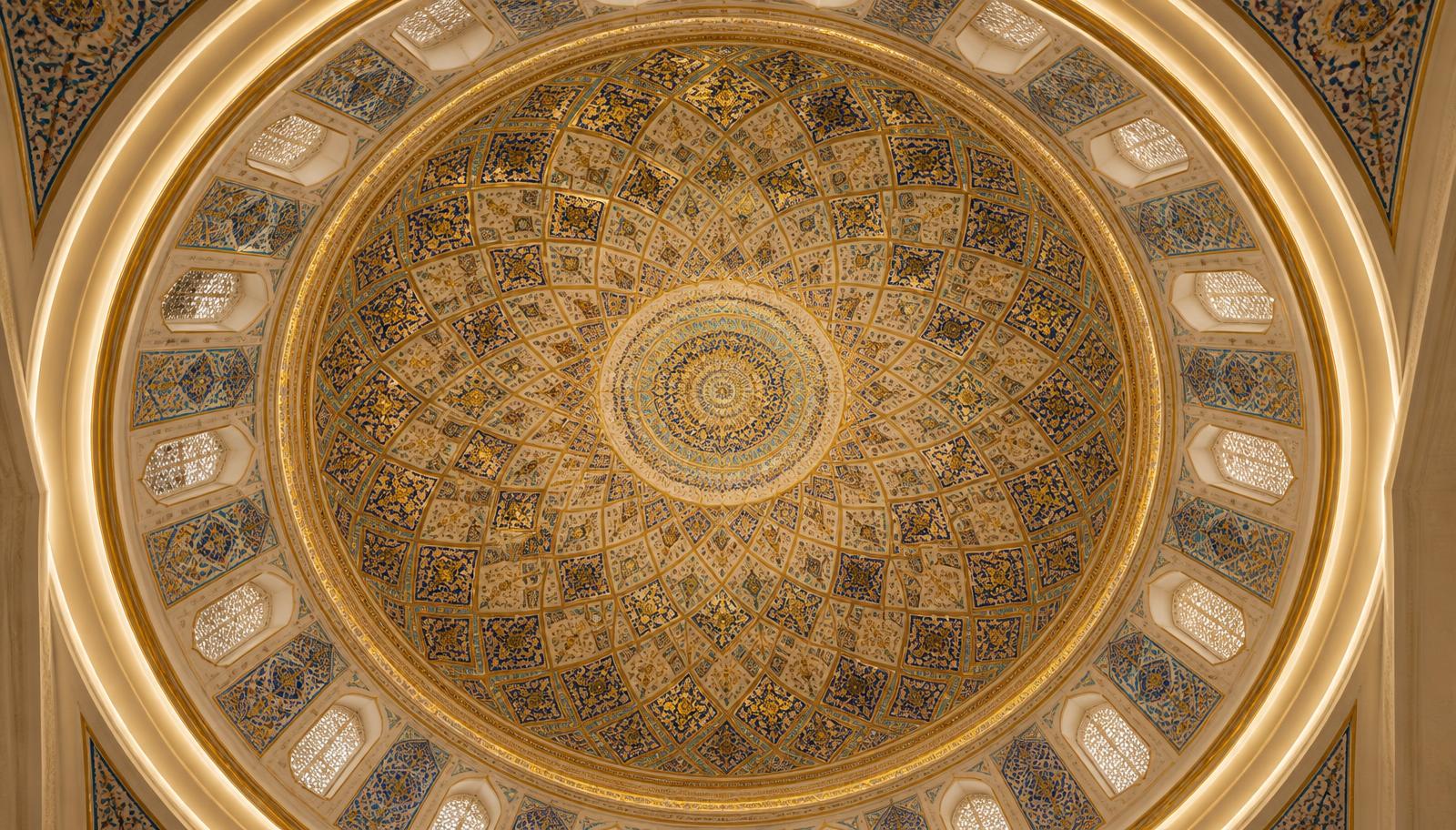 Mosque dome interior lit by concealed linear LED grazing from the cove, even gradient across the gilded pattern
96 grazing modules in the existing cove: 12° asymmetric optic, SDCM ≤ 2, zero UV/IR on the gilded surface.
Main hall general light — 340 × QH-DL05 deep-recessed downlights. 38 mm optical cut-off, UGR 15 at the installed spacing, 128 lm/W, 3000 K, CRI 92. The deep reflector is what makes the hall pass the prostration test: at a 15° upward viewing angle the aperture reads dark, so a worshipper looking up sees a calm ceiling rather than a field of bright dots.
Mihrab and minbar — 34 × QH-MG07 track spotlights. 15° and 24° optics on 48 V magnetic track concealed behind the existing cornice, CRI 95 / R9 90 so the marble carving and the gold calligraphy read with real depth, honeycomb louvres on every head. Because the track is magnetic, the imam's platform can be re-aimed for Ramadan layouts without an electrician on a ladder.
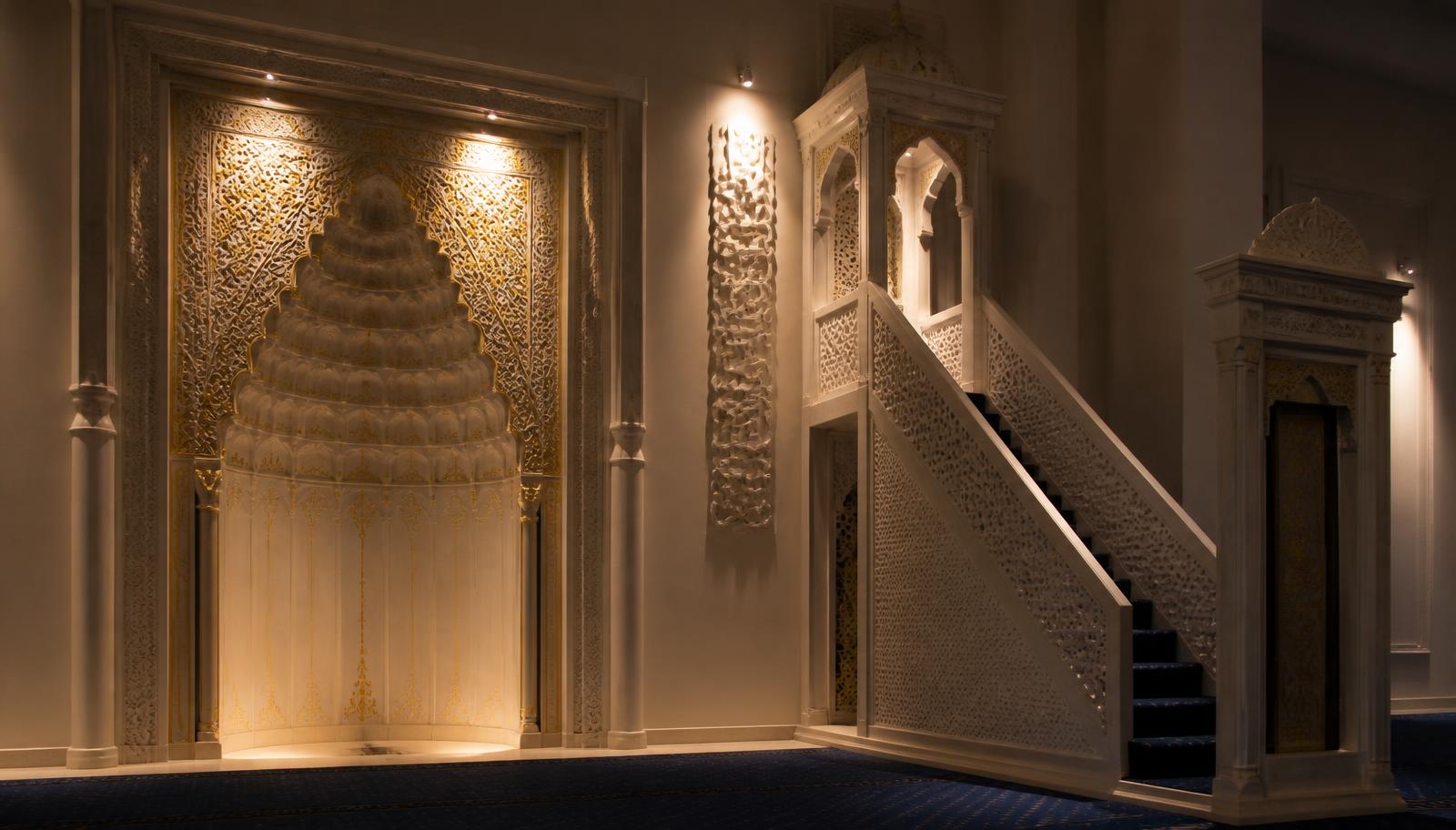 Mosque mihrab and minbar lit with narrow-beam shielded accent spotlights, gold calligraphy detail
Mihrab and minbar accent: 15°/24° optics, CRI 95 / R9 90, honeycomb louvres, all sources out of the congregation's sightline.
Women's prayer hall — 120 × QH-DL05 at 2700 K plus 210 m of QH-LN06 cove. The committee asked for a visibly softer, warmer room; the engineering answer was a lower colour temperature with the same UGR 16 shielding standard and the same 1% dimming floor, not less light.
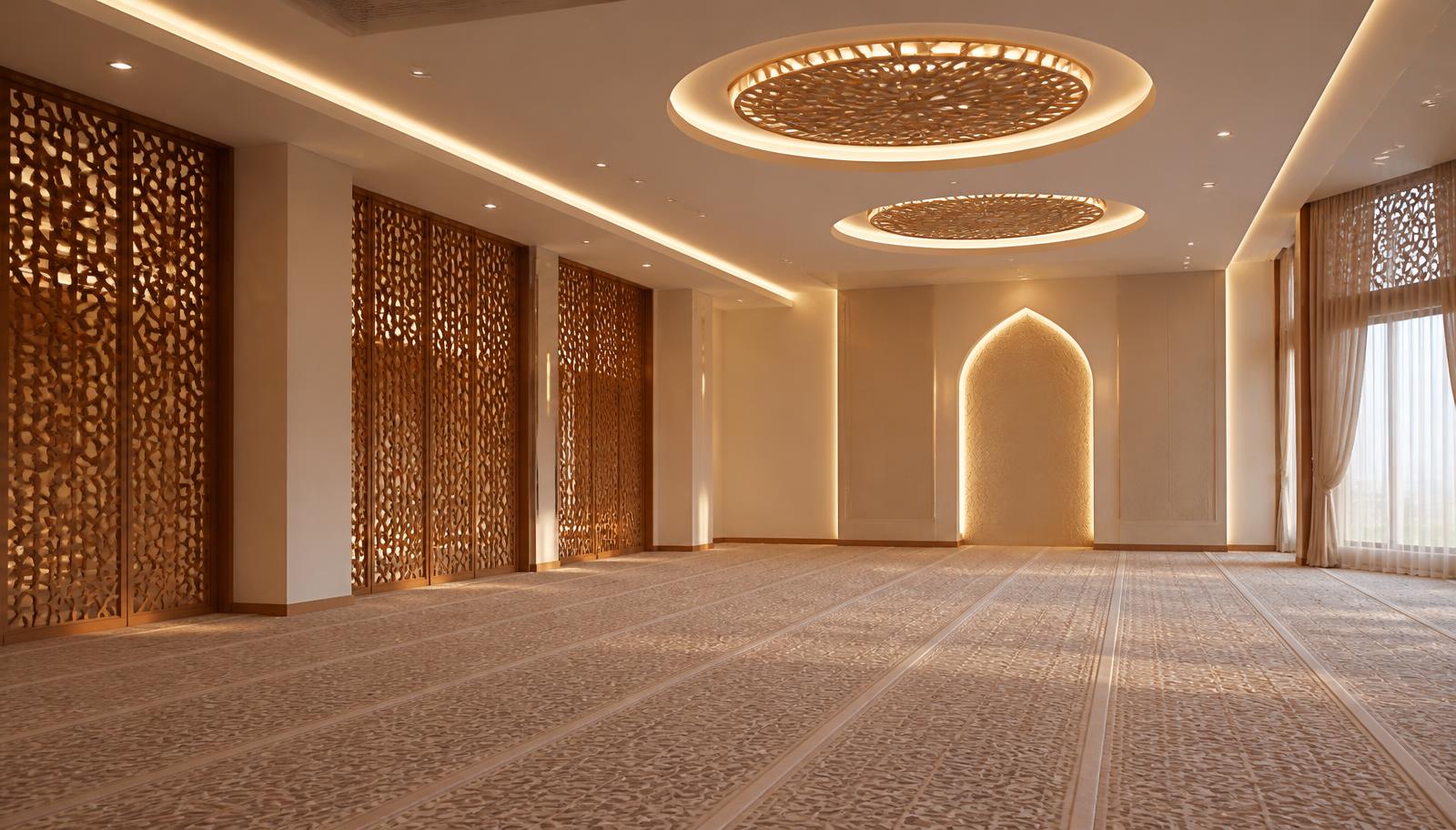 Women's prayer hall interior with warm 2700K cove lighting and mashrabiya screens
Women's prayer hall: 2700 K, UGR 16, dims to 1% for night use — softer in appearance, identical in glare performance.
Ablution wing and gallery — 260 × QH-DL08 IP44 downlights. 4000 K for a clean, hygienic read on wet marble, sealed optic, 40 °C+ ambient rating for the Gulf ceiling void.
Control Architecture: DALI-2 with Prayer-Time Scenes
Lighting in a mosque is a schedule problem before it is an energy problem. The five daily prayers move every day, Ramadan changes the pattern completely, and cleaning crews work in between.
- DALI-2 (DT6/DT8 certified gear) on all 850 interior luminaires, split across 18 lines with one gateway per fire compartment.
- Prayer-time astronomical scheduling: scenes follow calculated prayer times for Abu Dhabi rather than a fixed clock, so the hall is never at full output in an empty building.
- Seven scenes: Fajr (low, warm), daytime prayers, Friday sermon (full hall + mihrab accent), Isha, Ramadan night (extended full), cleaning (high uniform, accents off), and security (perimeter and exit routes only).
- Absolute daylight harvesting in the clerestory bays, which carry very high daylight availability for most of the year.
- Casambi Bluetooth mesh in the gallery and the multi-purpose room, where scene control was wanted without pulling new bus cable.
- Flicker performance held to PstLM < 1 and SVM < 0.4 at all dim levels, including 1% — broadcast crews film the Friday sermon and any stroboscopic artefact would be visible.
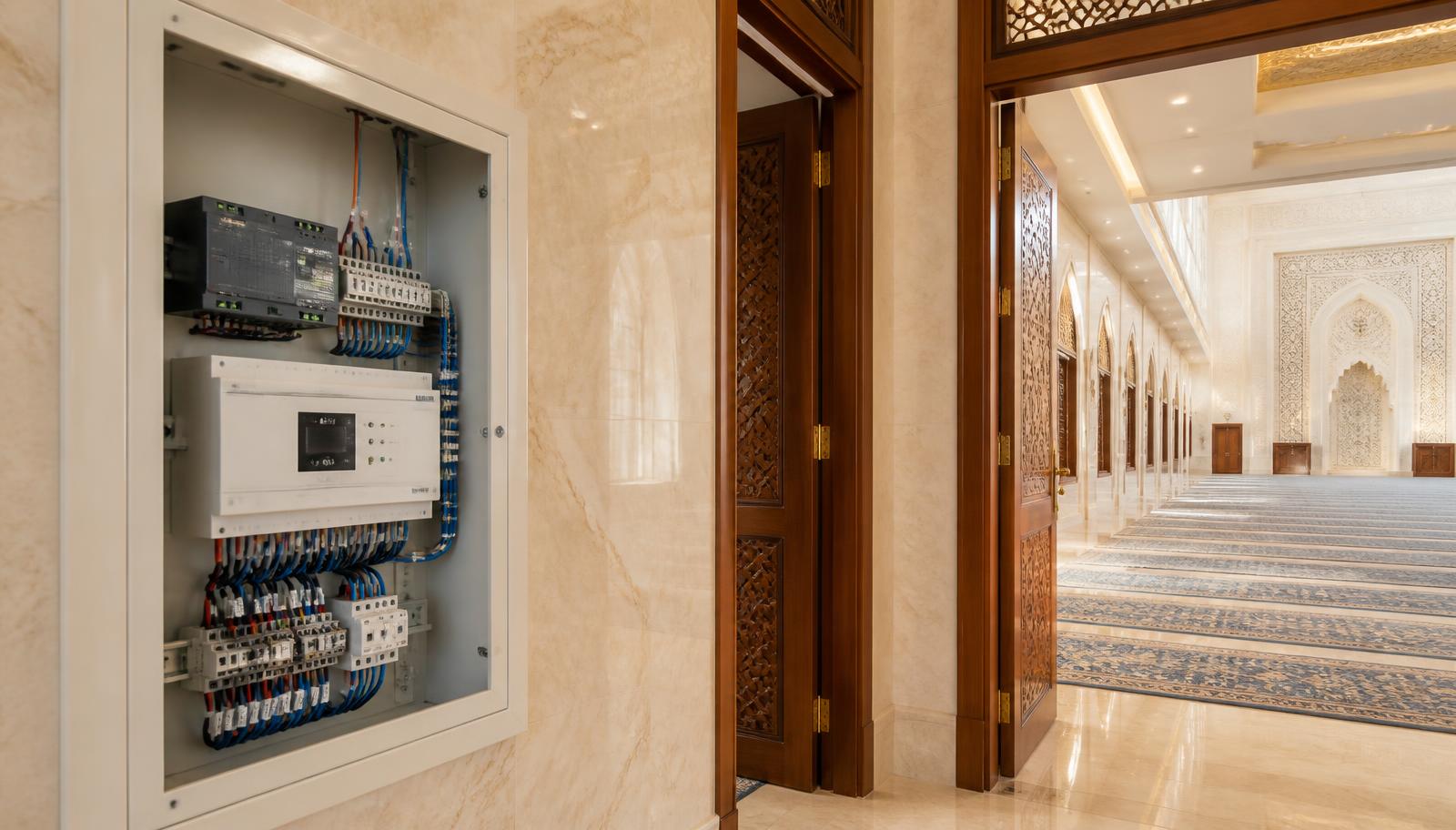 DALI-2 control panel in a marble niche beside the mosque prayer hall, labelled cabling
One of 18 DALI-2 lines: certified DT6/DT8 gear, astronomical prayer-time scheduling, BACnet reporting to the facility system.
Results After Ten Months
Measured against the metered 2024 baseline for the same interior area and occupancy pattern:
| Metric | Before | After | Change |
|---|---|---|---|
| Interior lighting power | 96.4 kW | 28.1 kW | −70.8% |
| Annual lighting energy | 331 MWh | 84 MWh | −74.6% (with scheduling) |
| Main hall maintained illuminance | 148 lx, Uo 0.38 | 212 lx, Uo 0.63 | Compliant |
| Main hall UGR | 21–23 | 15 | Compliant |
| Dome colour spread | 2,900–3,600 K | ≤ 3 SDCM | Uniform |
| CRI / R9 (hall) | 68 / 12 | 92 / 58 | Conservation-grade |
| Lamp failures per year | 74 | 2 | −97% |
| Scaffolding events per year | 4 | 0 | Eliminated |
The energy number splits roughly 55% from the luminaires and 20% from prayer-time scheduling and daylight harvesting. A fixture-only swap would have saved far less, which is the single most useful lesson from the project.
Lessons for Mosque and Place-of-Worship Interiors
- Design for the prostration sightline, not the desk plane. UGR calculated at 1.2 m seated height is the wrong test in a prayer hall. Ask the supplier for the aperture luminance at 0–20° upward viewing angles.
- Buy the binning reserve. On decorated domes, a future colour patch is a conservation problem, not a maintenance ticket. SDCM ≤ 2 plus a matched-bin reserve is cheap insurance.
- Zero UV/IR on gilded and painted surfaces. LED makes this straightforward; the specification still has to say it explicitly.
- Schedule against prayer times, not a clock. This is where the second half of the energy saving lives.
- Reuse existing recesses. In a heritage-sensitive interior, the cheapest luminaire is the one that fits the hole that is already there.
- Keep exterior scope with an exterior supplier. Interior manufacturers should not be asked to supply minaret or facade floodlighting, and a good one will say so.
Frequently Asked Questions
Does XHLWX Supply Mosque Facade, Dome Exterior or Minaret Floodlighting?
No. XHLWX manufactures interior luminaires only — prayer halls, hospitality, retail, office, museum, education, healthcare and industrial interiors. Facade, minaret, courtyard and street lighting are outside our product range and were not part of this project.
Can This Be Done Without Closing the Mosque?
Yes. All works here ran in 23 night windows between Isha and Fajr, with a signed-off mock-up bay before each phase went into production.
How Is Dome Artwork Protected?
Zero UV and zero IR in the beam, illuminance held to 80–120 lx on the decorated surface, and grazing optics that avoid hot spots on any single panel.
What Documentation Is Issued?
DIALux evo calculations, IES/LDT photometric files, CE / ENEC / RoHS certificates, SASO or GCC conformity documentation where required, and a DALI-2 addressing schedule for the facility team.
Typical Lead Time for a Package of This Size?
25–35 days after drawing and mock-up approval for roughly 850 luminaires, with photometric engineering provided before the order is placed.