
Milan Fashion Flagship Relighting: Achieving CRI 98 with Custom LED
Introduction — the On-site Problem
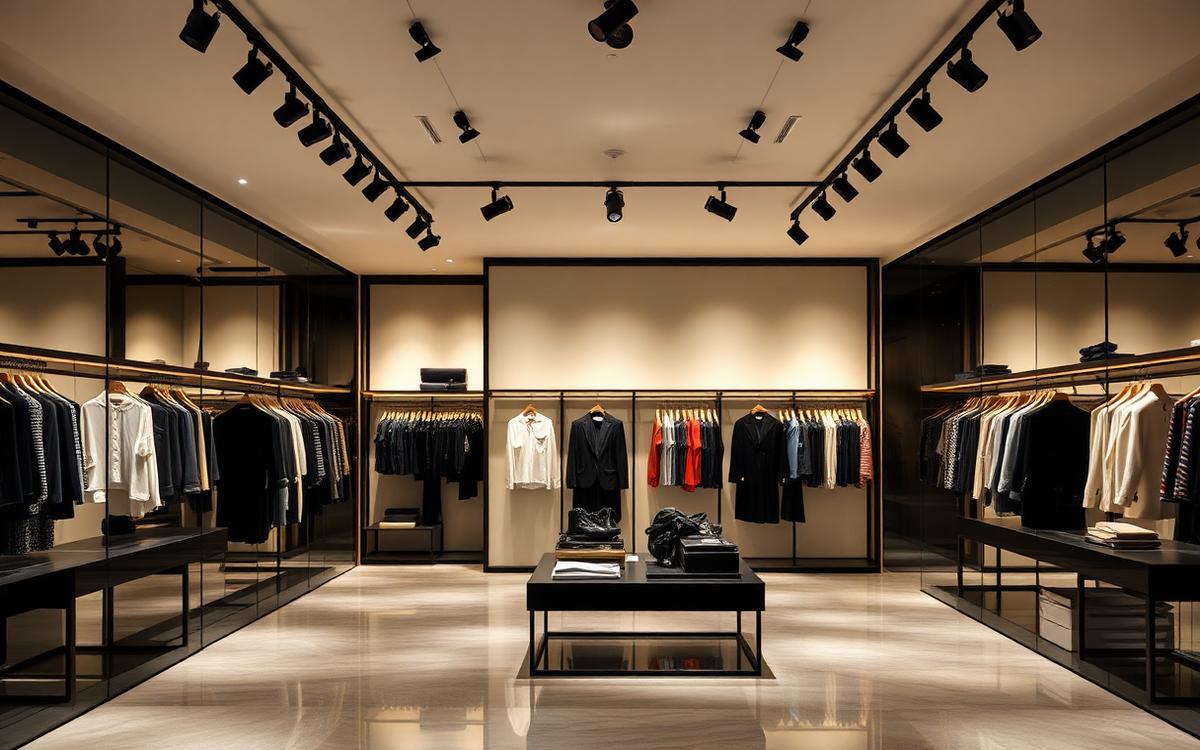
com), a Custom Indoor LED Lighting Manufacturer based in China, we were approached to lead the comprehensive relighting of an iconic fashion flagship store on Via Montenapoleone, Milan. The existing installation, relying on outdated halogen and early-generation LED technology, presented significant challenges.
These included poor color rendering (CRI < 85) that misrepresented the true hues of luxury fabrics, high energy consumption, and substantial heat output that increased HVAC load and risked damaging delicate merchandise. The client required a world-class lighting system for their 2026 renovation that would deliver exceptional visual quality, operational efficiency, and dynamic control to create an immersive, premium shopping experience.
What "custom" Meant on This Project — Capability Matrix
The client's vision demanded a lighting solution that was not merely functional but an integral part of the store's architecture and brand identity. This required bespoke luminaires tailored to specific display cases, architectural coves, and circulation areas.
Our role was to engineer and manufacture a suite of products meeting a stringent set of performance criteria, from optical precision to control integration. The primary luminaire specified was a modular track system with adjustable spotlights, detailed below.
| Parameter | Specification Target | Standard / Method | Notes |
|---|---|---|---|
| Color Temperature (CCT) | 3000K & Tunable 2700K-4000K | ANSI C78.377 | 3000K for general areas; tunable white (DT8) for feature displays. |
| Color Rendering Index (CRI) | Ra > 98, R9 > 90 | CIE 13.3-1995 | Design target to ensure faithful reproduction of fabric colors. |
| Glare Rating (UGR) | < 13 | EN 12464-1 | Achieved via deep-baffle optics and honeycomb louvers. |
| Control Protocol | DALI-2 (IEC 62386) / Casambi | DALI Alliance / Casambi | Full digital addressability for individual fixture control and scene setting. |
| Luminaire Housing | 6063 Aluminum, Custom Lengths | - | Powder-coated matte white finish to blend with ceiling architecture. |
| IP Rating | IP20 | IEC 60529 | Standard for indoor dry locations, sufficient for retail interiors. |
| LED Chip / Driver | Bridgelux Vesta® Series / Tridonic | - | Specified for high-fidelity color and reliable performance. |
| Certifications | CE, RoHS, ENEC (Target) | EU Directives | Ensures compliance for the European market. |
Engineering Solutions
Our engineering process translated the architectural vision and technical requirements into a tangible, high-performance lighting system. This involved a multi-faceted approach focusing on color science, visual comfort, and system flexibility.
How Did We Specify Lighting to Render Fabric Colors and Textures with Near-perfect Accuracy?
To meet the client's non-negotiable demand for color fidelity, we moved beyond basic CRI. Our specification targeted a CRI of Ra > 98 and an R9 value (essential for rendering deep reds) above 90.
We selected Bridgelux Vesta® Series COB LEDs specifically for their smooth spectral power distribution, which closely mimics natural daylight. Furthermore, we provided spectral data and TM-30-18 reports for all specified luminaires.
This modern color rendition metric provided a more complete picture of fidelity (Rf) and gamut (Rg), ensuring that every color—from subtle pastels to rich, saturated tones—would be presented exactly as the designer intended.
What Was the Strategy for Eliminating Glare and Creating Visual Comfort for Shoppers?
Luxury retail environments must feel comfortable and inviting, and harsh glare is a primary detractor. Our design strategy centered on achieving a Unified Glare Rating (UGR) of less than 13 in all key shopping zones, a stringent target for retail.
This was accomplished through a combination of luminaire design and careful lighting layout. Our custom-designed spotlights featured deep-set LED sources and a 40mm black baffle to cut off stray light.
For added control, we fitted each spotlight with an optional honeycomb louver. The entire scheme was modeled and verified using DIALux simulation software to predict and mitigate potential glare from any viewing angle, ensuring the focus remains on the merchandise, not the light source.
How Were Dynamic Lighting Scenes for Product Launches and Events Integrated?
To make the store a versatile space for events and collection launches, a dynamic control system was essential. We engineered the solution around a DALI-2 (Digital Addressable Lighting Interface) backbone.
This allows every single fixture in the store to be individually addressed and controlled. For feature areas like window displays and pop-up zones, we specified DALI Type 8 (DT8) tunable white fixtures, allowing the CCT to be adjusted from a warm 2700K to a crisp 4000K.
The entire system was designed for intuitive control via a Casambi Bluetooth mesh overlay, enabling staff to recall pre-programmed scenes—such as 'Daytime,' 'Evening,' 'Event,' or 'Cleaning'—from a simple tablet interface without needing a technical operator.
Project Results — Measured When Supplied; Otherwise Design Targets
As this project is slated for completion in 2026, the following represent the design targets and simulated outcomes established during the planning phase. On-site measurements will be conducted post-commissioning to verify performance.
- Energy Efficiency: The new all-LED system is projected to reduce lighting-related energy consumption by over 70% compared to the previous halogen installation. This also results in a significant reduction in the cooling load on the store's HVAC system.
- Color & Visual Quality: The design specification mandates a measured CRI of Ra > 98 and UGR < 13 across all primary merchandise areas, with performance to be verified on-site with calibrated spectral and luminance meters.
- Operational Flexibility: The DALI-2 and Casambi control system is designed to provide seamless scene changes, allowing the store's atmosphere to be transformed in seconds to suit different occasions.
- Return on Investment: Based on simulated energy savings and reduced maintenance (L90 B10 lifetime of >50,000 hours), the projected payback period for the entire lighting investment is under three years.
Photometric Files & Compliance (IES / LDT / DIALux / CE / RoHS)
Full technical documentation is a cornerstone of our service. For every custom and standard luminaire supplied for this project, we provide comprehensive photometric data packages.
These include IES and LDT photometric files, which are crucial for accurate lighting design and verification. Our partners and the client's design team used these files extensively within DIALux Evo software to simulate and validate the lighting scheme, ensuring compliance with all design targets before manufacturing began.
All products are engineered to meet stringent European standards, including CE marking for safety and electromagnetic compatibility and RoHS for the restriction of hazardous substances. Our manufacturing facility operates under an ISO 9001:2015 certified quality management system.
Frequently Asked Questions
Q: Why Is a CRI of 98 so Important for Fashion Retail?
A CRI of 98, with an R9 value over 90, ensures that the light source renders colors almost identically to natural daylight. In fashion, this is critical for accurately displaying the hue of fabrics, preventing items from looking different in-store versus outdoors. It builds customer confidence and reduces returns, especially for high-value garments where color accuracy is paramount.
Q: What Are the Main Benefits of a DALI-2 Control System in a Store Like This?
A DALI-2 system offers precise, digital control over every individual light fixture. This allows for creating complex and layered lighting scenes, dimming to as low as 0.1%, and scheduling changes. It also provides valuable feedback for maintenance, reporting lamp or driver failures, and helps maximize energy savings by dimming zones when not in use.
Q: How Long Does the Customization Process for a New Luminaire Typically Take?
For a project of this scale, the customization process from initial concept to first prototype typically takes 6-8 weeks. This includes 3D modeling, thermal simulation, optical design, and creating a functional sample. After prototype approval, mass production lead times are typically an additional 4-6 weeks, depending on quantity and complexity.
Q: What Is the Expected Lifespan and Warranty for the Custom LED Fixtures?
Our custom luminaires for this project are engineered for a long service life, specified as L90 B10 at 50,000 hours. This means after 50,000 hours of operation, 90% of the LEDs will still have at least 90% of their initial light output. We back this performance with a standard 5-year commercial warranty covering the entire luminaire, including LED modules and drivers.
Sources and Technical References
- ANSI/IES TM-30-18: IES Method for Evaluating Light Source Color Rendition. Illuminating Engineering Society.
- IES RP-2-17: Recommended Practice for Lighting Retail Facilities. Illuminating Engineering Society.
- DALI Alliance (DiiA): IEC 62386 - Digital Addressable Lighting Interface. https://www.dali-alliance.org/
- Commission Regulation (EU) 2019/2020: Ecodesign requirements for light sources and separate control gears.
Request a Custom Quote
The Milan flagship project exemplifies the synthesis of art and science in modern retail lighting. Success in such a demanding environment hinges on meticulous planning, deep technical expertise, and manufacturing capability.
com), a Custom Indoor LED Lighting Manufacturer based in China, we specialize in transforming ambitious lighting concepts into reality for clients across the EU, US, and Middle East. If your project requires bespoke luminaires that deliver on performance without compromising on design, contact our engineering team to request a consultation and quote.