
Riyadh Front Retail Mall: 42,000 m² Indoor LED Retrofit
Project Background: Why an Indoor Retail Retrofit, Not a Street Project
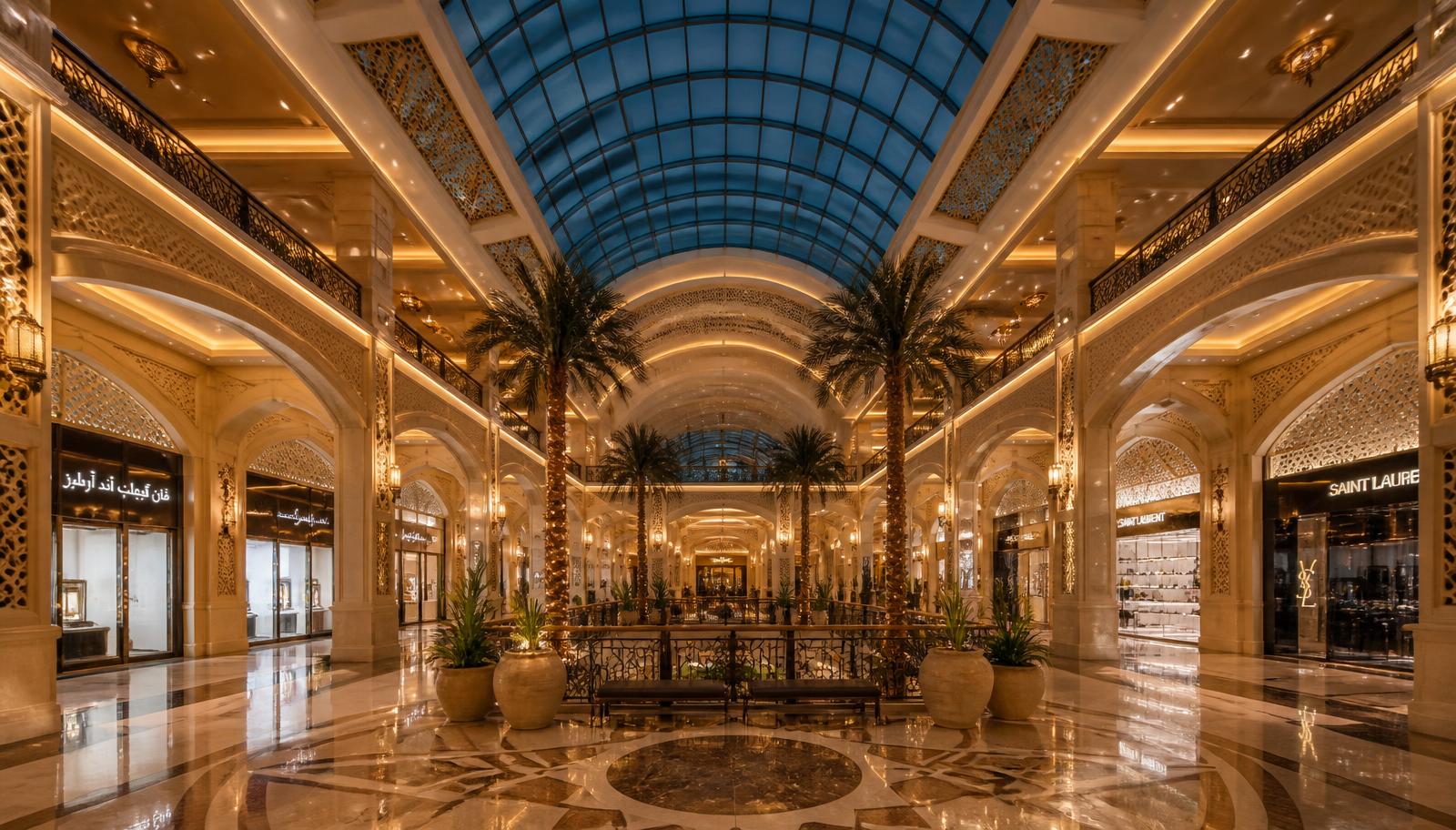
Riyadh Front Retail District is one of the fastest-growing indoor shopping destinations in the Saudi capital: roughly 42,000 m² of enclosed mall area spread across an atrium, two retail levels, a food hall, and back-of-house circulation. When the operator opened the tender in 2025, the brief was not about lumens on paper. It was about three commercial problems that the original 2018 lighting scheme had never solved.
First, merchandise looked wrong. Tenants complained that fabric colours in the corridors did not match what customers saw inside their own stores, so returns went up and premium brands resisted renewing leases on the lower level. The original fixtures were CRI 80 with SDCM 5 binning, and after four years of drift, adjacent downlights were visibly different shades of white.
Second, glare was pushing shoppers through the mall instead of holding them there. Dwell-time analytics showed the food hall emptied 25 minutes earlier than comparable malls in the same portfolio. Ceiling-mounted lensed panels with UGR values above 22 made seating areas visually uncomfortable under a high ambient load.
Third, energy and maintenance costs were indefensible in a building running 15 hours a day, 361 days a year, in a climate where every watt of lighting also becomes a cooling load. The installed lighting density was 14.8 W/m², and lamp replacement in the 9-metre atrium required a scissor lift and a night shift.
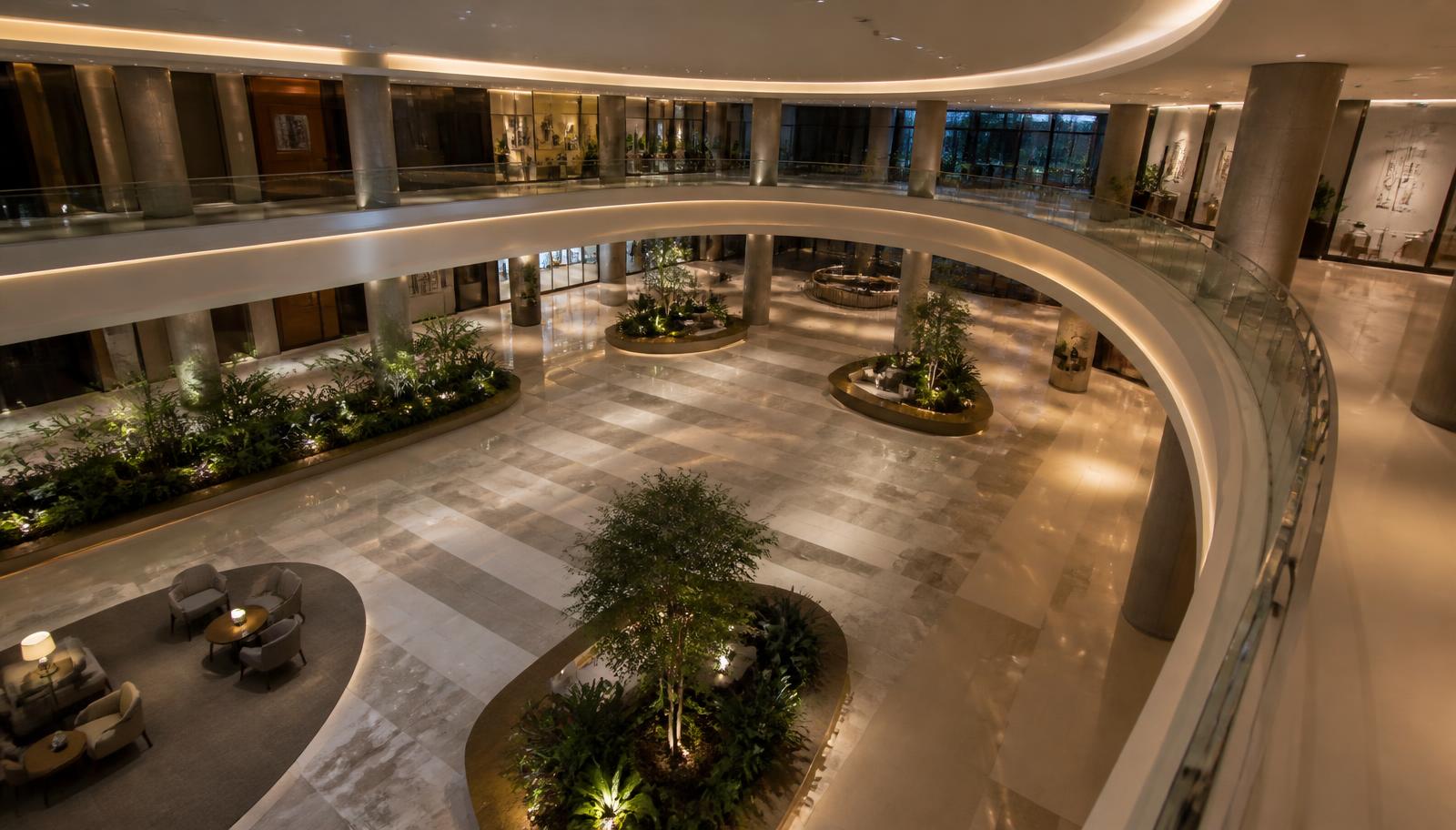 Upper-level view of the Riyadh Front Retail District atrium after the indoor LED retrofit
The atrium after retrofit: 3000K coves for architectural warmth, 4000K accent optics on the retail frontage, all on one DALI-2 backbone.
XHLWX Lighting was selected as the fixture manufacturer and lighting-engineering partner for the interior scope.** XHLWX supplies interior architectural and commercial lighting only — retail, hospitality, office, museum, education, healthcare, and industrial interiors. Street lighting, floodlighting, and facade lighting were outside our scope and outside our product range.
The Technical Brief
The consultant's specification, issued against EN 12464-1:2021 and the tenant fit-out guide, set the following targets for the common areas:
| Zone | Illuminance (maintained) | Uniformity | Glare | Colour |
|---|---|---|---|---|
| Atrium floor | 300 lx | Uo ≥ 0.6 | UGR ≤ 19 | 3000K, CRI ≥ 90, R9 ≥ 50 |
| Retail corridors | 300–400 lx | Uo ≥ 0.6 | UGR ≤ 19 | 3500K, CRI ≥ 90 |
| Shopfront accent | 800–1200 lx on display | — | Shielded ≥ 30° | 4000K, CRI ≥ 95 |
| Food hall seating | 200 lx | Uo ≥ 0.5 | UGR ≤ 16 | 2700K, CRI ≥ 90, dim to 5% |
| Back-of-house circulation | 150 lx | Uo ≥ 0.4 | UGR ≤ 22 | 4000K, CRI ≥ 80 |
Two hard constraints shaped every product decision. The mall could not close, so all works ran between 23:00 and 06:00 in eleven phases. And every luminaire had to survive an ambient ceiling-void temperature of 42 °C without derating — a detail that quietly kills a lot of imported retail spotlights in Gulf projects.
Fixture Selection and Photometric Engineering
We ran the full building in DIALux evo against the as-built ceiling model, then verified two mock-up bays on site before releasing production.
Atrium and corridors — 1,860 × QH-DL05 anti-glare downlights. Deep-recessed reflector, 38 mm cut-off, UGR 17 at the specified spacing, 128 lm/W system efficacy, 3000K/3500K, CRI 92 with R9 = 58. The optical shielding is what allowed 300 lx on the floor without the ceiling reading as a grid of bright dots — in a mall, a comfortable ceiling is a commercial asset, not a comfort luxury.
Shopfront and display accent — 640 × QH-MG07 magnetic track spotlights. 15°/24°/36° interchangeable optics on a 48 V magnetic track, CRI 95 with R9 = 90 for textile and cosmetics frontage, honeycomb louvres on the units aimed toward circulation. Because the track is magnetic, tenants can re-aim or re-position heads at fit-out change without an electrician — over a ten-year lease cycle, that is the single largest soft saving in the project.
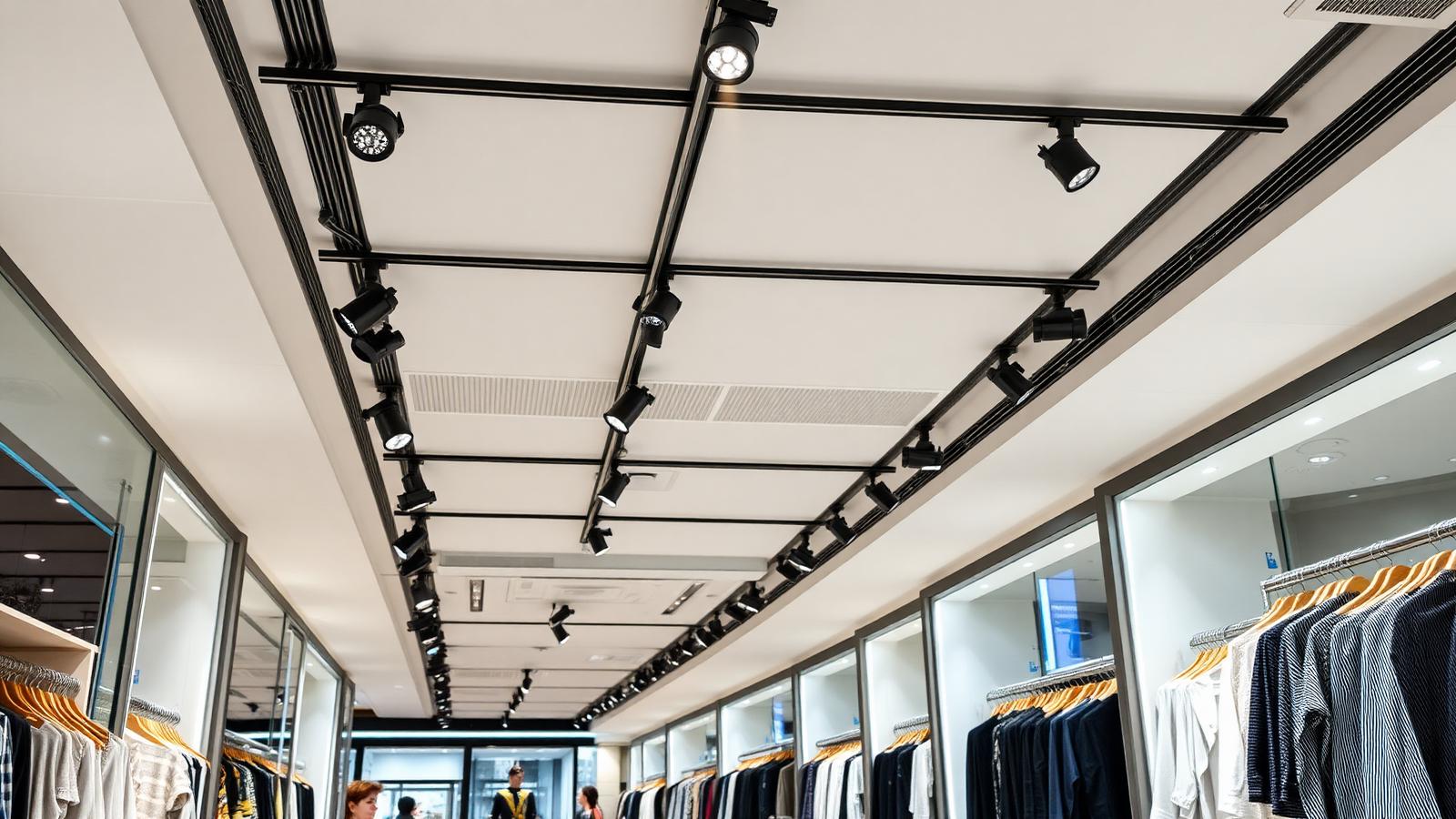 Retail shopfront zone lit with black magnetic track spotlights, crisp accent beams and no visible glare
QH-MG07 magnetic track on tenant frontage: CRI 95 / R9 90 optics, honeycomb louvres facing circulation.
Linear coves — 4,100 m of QH-LN06 modular linear. Continuous run with any-angle connectors, so the curved atrium balustrade and the corridor cornices read as one unbroken line of light with no visible dark joints. 2700K/3000K, SDCM ≤ 3, 5-year batch-matched binning reserve held for the client so future repairs will not show as a colour patch.
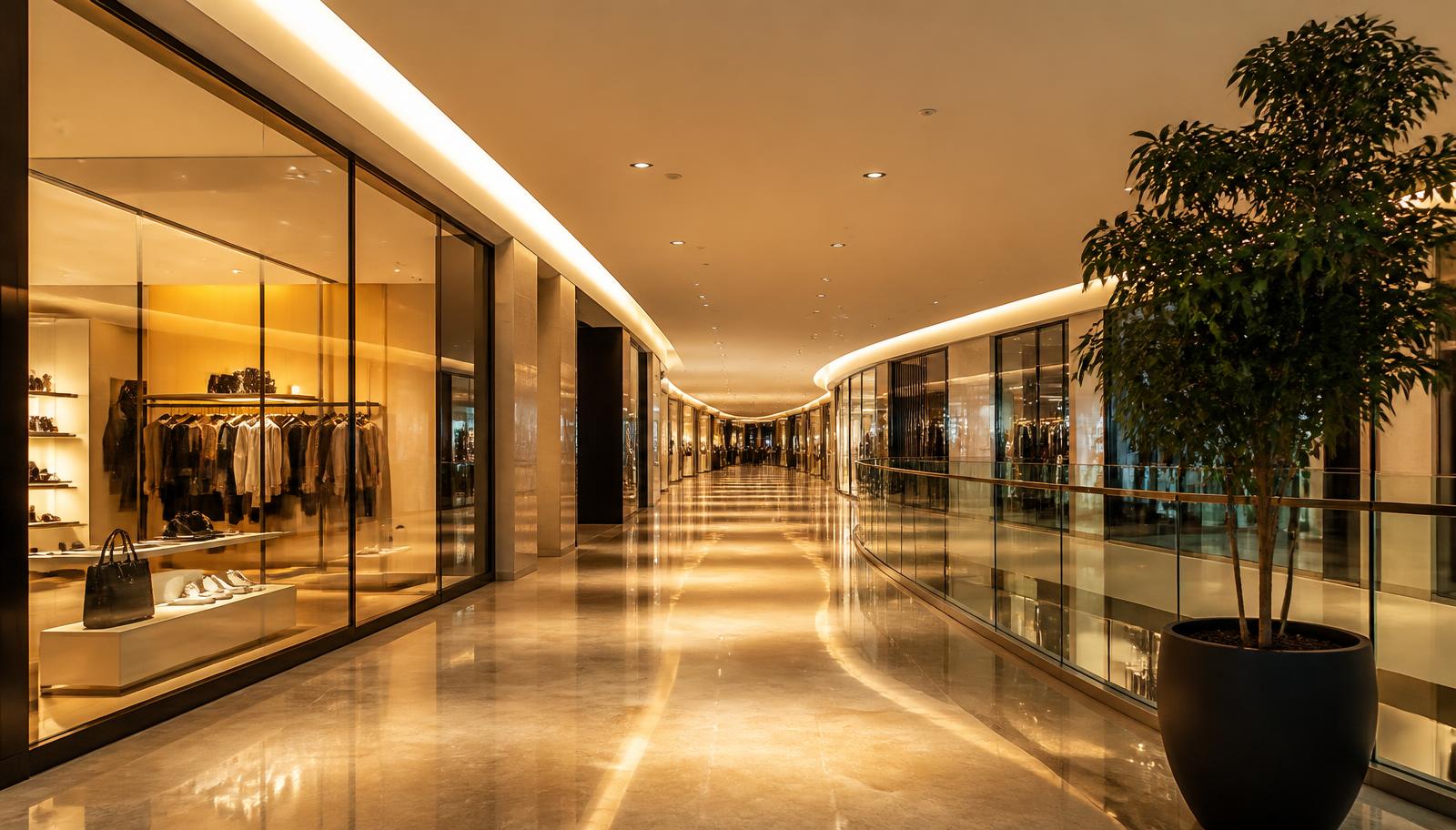 Mall corridor with continuous linear LED coves and polished floor reflections
4,100 m of QH-LN06 modular linear, any-angle connectors, SDCM ≤ 3 with a batch-matched binning reserve.
Food hall — 320 × QH-DL05 in 2700K plus decorative pendants supplied by the interior designer. The engineering contribution here was dimming quality, not raw output: the fixtures dim to 1% on DALI-2 with no visible flicker (PstLM < 1, SVM < 0.4), so the operator can drop the seating zone to a warm evening scene without the stroboscopic effect that phone cameras pick up.
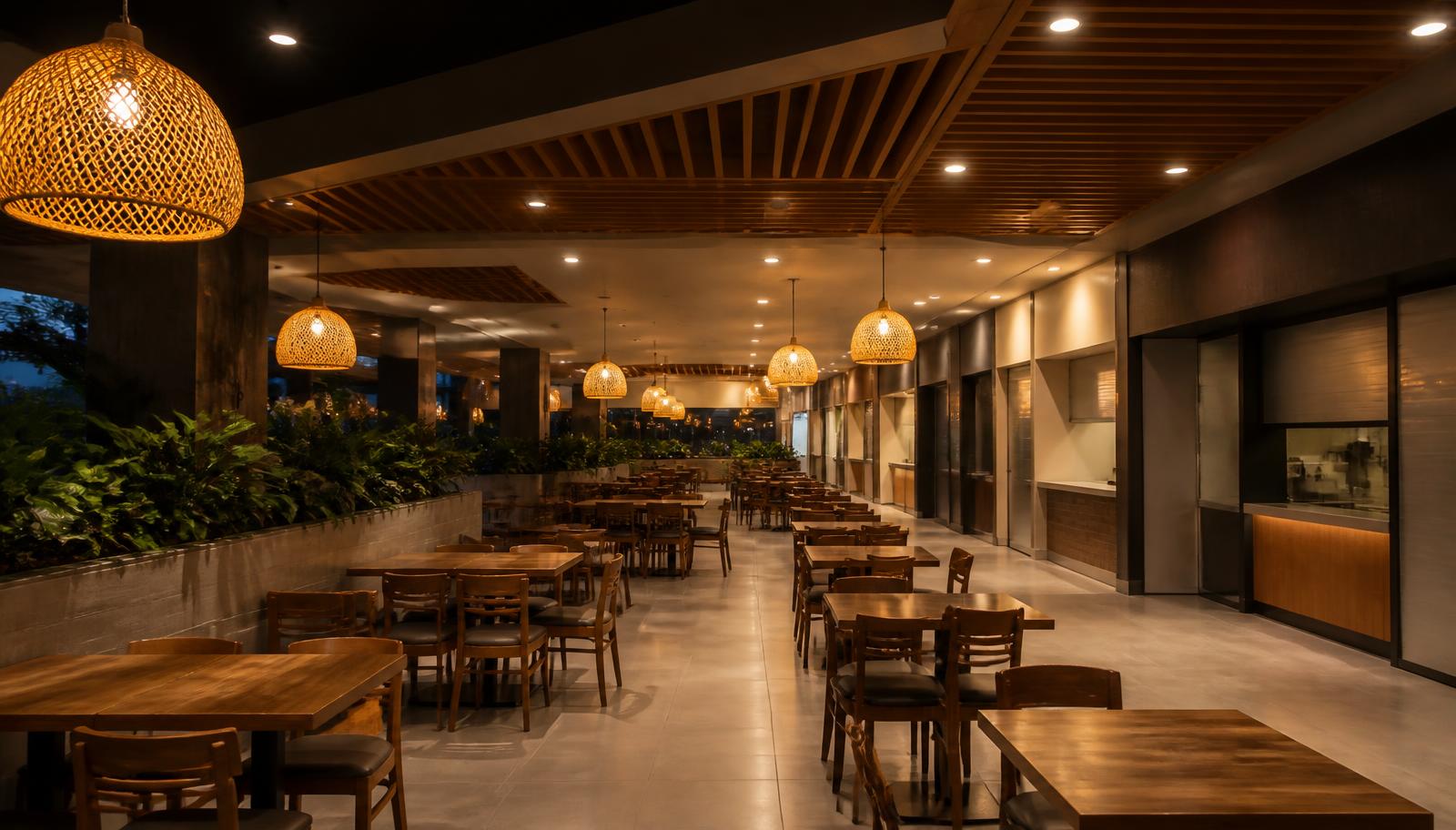 Food hall seating at night, warm pendants and anti-glare recessed downlights at low output
Food hall evening scene: 2700K, UGR 16, dimmed to 20% on DALI-2 with flicker-free drivers.
Control Architecture: DALI-2 Backbone, Casambi at the Edge
The mall has an existing BMS, so the control design had to be open and addressable rather than proprietary.
- DALI-2 (certified DT6/DT8 gear) for all 2,820 common-area luminaires, split into 47 DALI lines with one gateway per fire zone.
- Absolute daylight harvesting in the atrium: sensors under the skylight trim electric light continuously against the very high daylight availability in Riyadh. This is where most of the energy result actually comes from.
- Casambi Bluetooth mesh in the food hall and pop-up retail zones, where the client wanted scene control without pulling new bus cable during tenant churn.
- Six time-based scenes: pre-open cleaning, morning trade, midday daylight-balanced, peak evening trade, prayer-time low, and night security.
- Circuit-level energy metering back to the BMS via BACnet, giving the operator per-zone kWh so lighting can be billed and benchmarked instead of estimated.
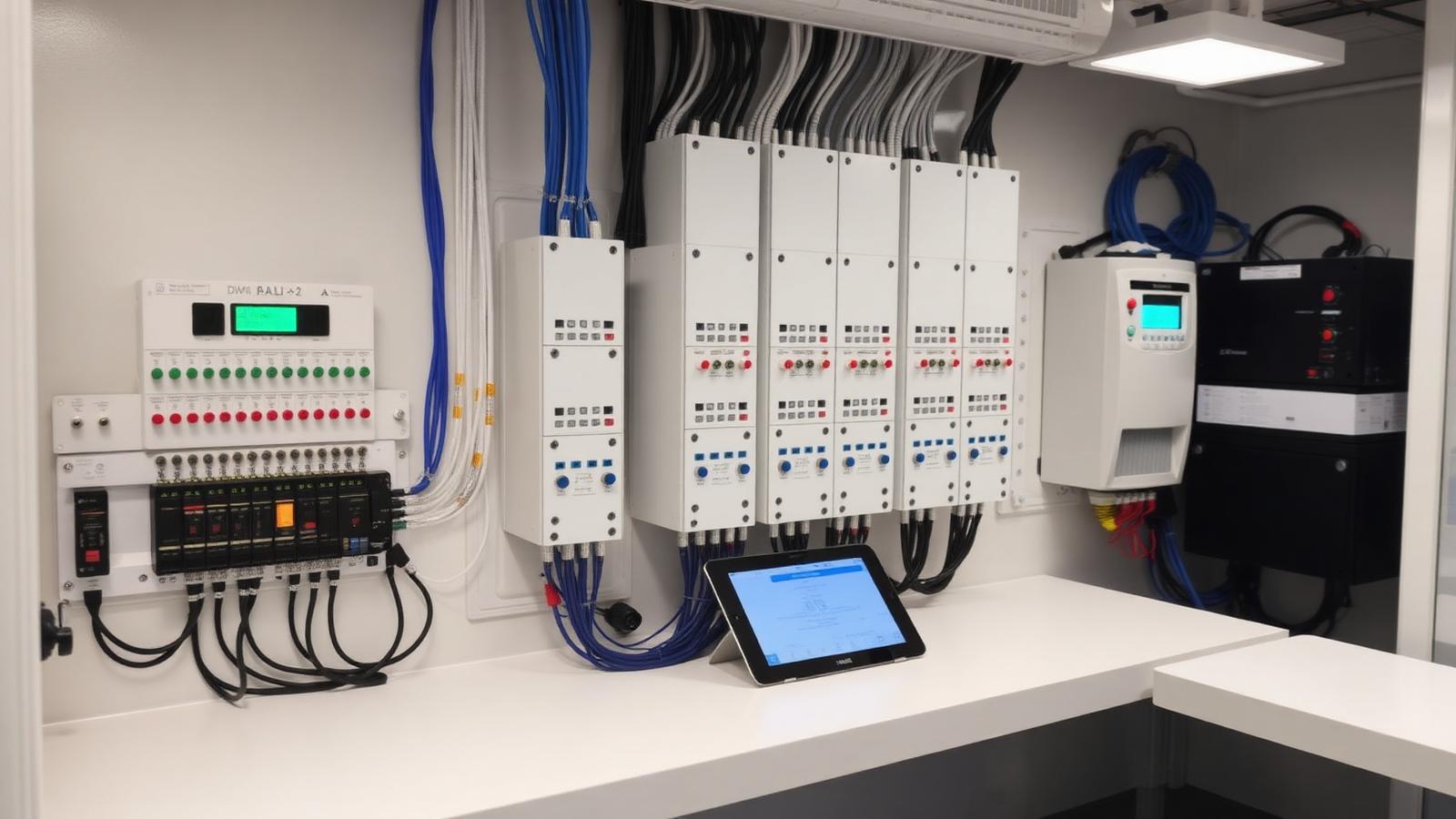 DALI-2 gateway and control panel installed in the mall electrical room with labelled cabling
One of 47 DALI-2 lines: certified DT6/DT8 gear, BACnet gateway to the mall BMS, per-zone energy metering.
Results After Twelve Months of Operation
Measured against the metered 2024 baseline for the same floor area and trading hours:
| Metric | Before | After | Change |
|---|---|---|---|
| Lighting power density | 14.8 W/m² | 5.1 W/m² | −65.5% |
| Annual lighting energy | 1,742 MWh | 486 MWh | −72.1% (with controls) |
| Atrium maintained illuminance | 210 lx, Uo 0.41 | 316 lx, Uo 0.64 | Compliant |
| Corridor UGR | 22–24 | 17 | Compliant |
| CRI / R9 (common areas) | 80 / 18 | 92 / 58 | Merchandise-grade |
| Food hall average dwell time | 38 min | 51 min | +34% |
| Lamp/driver failures in year 1 | 91 (baseline year) | 3 | −97% |
The energy figure deserves one honest caveat: 65.5% of the saving comes from the luminaires, and the rest from daylight harvesting and scene scheduling. A retrofit that changes fixtures but keeps a manual on/off panel would have landed near 480 MWh higher.
The commercial outcome mattered more to the client than the kWh. Two anchor tenants on the lower level renewed after the accent lighting was reworked, and colour-mismatch complaints from tenants dropped to zero in the second half of the year.
Lessons for Indoor Retail Retrofits in the Gulf
- Specify thermal reality, not lab conditions. Ask for L90/50,000 h at 40 °C+ ambient Ta, not L70 at 25 °C. In an enclosed ceiling void in Riyadh, that difference is the whole warranty.
- Buy the binning reserve, not just the fixtures. SDCM ≤ 3 on day one is easy. Holding matched LED bins for five years of repairs is what keeps a corridor from becoming patchwork.
- Glare control pays for itself in dwell time. UGR ≤ 19 in circulation and ≤ 16 in seating is not a comfort nicety in retail; it is a revenue lever.
- Make the accent layer tenant-serviceable. Magnetic track removes the electrician from every fit-out change.
- Keep the control protocol open. DALI-2 plus BACnet meant the operator kept ownership of their own building data.
Frequently Asked Questions
Does XHLWX Supply Street Lighting or Facade Floodlighting for Projects Like This?
No. XHLWX manufactures interior lighting only — retail, hospitality, office, museum, education, healthcare, and industrial interiors. All exterior scopes are handled by other suppliers.
Can the Same Approach Be Applied to an Occupied Mall Without Closing?
Yes. This project ran in eleven night phases between 23:00 and 06:00, with a mock-up bay signed off before each phase entered production.
What Lead Time Applies to a Project of This Size?
Typical production for a 2,800-luminaire indoor package is 25–35 days after drawing approval, plus photometric engineering (DIALux evo) which we provide before order.
Which Certifications Are Available for GCC and EU Projects?
CE, ENEC, RoHS, and SASO documentation, with IES/LDT photometric files and DIALux evo calculations issued for every fixture type.