Shaanxi Museum Qin & Han Hall: CRI95+ Lighting for Ancient Artifacts
Project Background & Customer Challenges
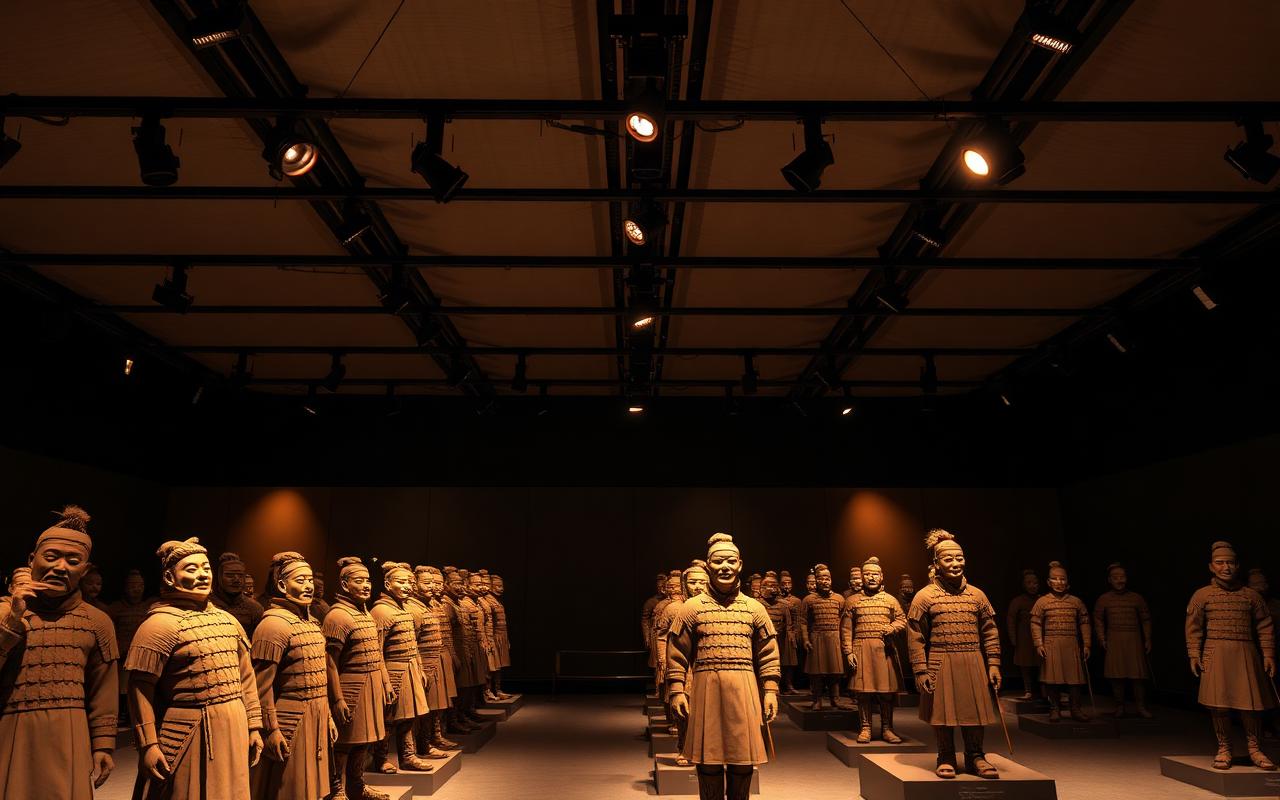
The Shaanxi History Museum in Xi'an is one of China's most important cultural institutions, housing over 1.7 million artifacts that narrate a timeline of Chinese civilization. In 2025, the museum unveiled its highly anticipated Qin and Han Hall, a monumental exhibition space dedicated to two of China's most powerful and influential dynasties. The hall presents a priceless collection, including terracotta warriors, intricate bronze vessels, delicate silk textiles, and lustrous lacquerware.
The museum's curatorial team presented XHLWX Lighting with a complex and non-negotiable set of challenges:
-
Absolute Artifact Conservation: The primary objective was to illuminate these irreplaceable relics without causing harm. Many artifacts, particularly organic materials like silk, paper, and lacquer, are extremely vulnerable to photochemical damage from ultraviolet (UV) and infrared (IR) radiation, as well as fading from visible light. A lighting solution was required that adhered to the strictest international museum conservation standards, demanding precise control over illuminance (lux) levels and the complete elimination of harmful radiation.
-
Authentic Visitor Experience: While conservation was paramount, the lighting also needed to breathe life into the exhibition. The goal was to create a dramatic, immersive journey for visitors, guiding them through the historical narrative. This meant revealing the true colors, textures, and three-dimensional form of each object. Poor lighting could flatten details, misrepresent the color of ancient glazes and pigments, or create distracting glare on display cases, diminishing the overall experience.
-
Curatorial Flexibility and Control: Museum exhibitions are dynamic. Layouts change, artifacts are rotated, and temporary displays are introduced. The museum required a lighting system that was not only powerful but also exceptionally flexible. Curators needed the ability to easily re-aim, refocus, and adjust the intensity and color temperature of individual lights without requiring electricians or complex reprogramming. This adaptability was crucial for future-proofing the exhibition space.
-
Operational Efficiency and Sustainability: As a large-scale public facility, the museum sought an energy-efficient solution to minimize operational costs and its carbon footprint. The chosen fixtures had to offer a long lifespan and low maintenance requirements to ensure reliability and reduce the need for disruptive upkeep within the exhibition halls.
The XHLWX Lighting Solution: Design and Fixtures
Our lighting design team collaborated closely with the museum's curators and exhibition designers to develop a layered lighting strategy centered on the principle of "light on the object, not the space." This approach uses high contrast to make the artifacts the heroes of the space, creating a visually compelling environment while keeping ambient light low to enhance the sense of drama and discovery.
The core of our solution was a carefully selected portfolio of XHLWX's museum-grade luminaires:
-
XHL-TR97 Pro-Focus Track Lights: These fixtures were the workhorses of the exhibition, providing precise accent lighting for the majority of standalone artifacts. We deployed them on extensive track systems recessed into the ceiling. Key features included:
- Exceptional Color Quality: A Color Rendering Index (CRI) of 97+ and a high R9 value (for saturated reds) of >95 ensure that the subtle hues of ancient paints, terracotta, and textiles are rendered with absolute fidelity.
- Interchangeable Optics: A suite of lenses ranging from a tight 8° spot for small jade carvings to a broader 36° flood for larger pottery was used. For specific paintings and manuscripts, we employed framing projectors, an accessory for the TR97, which allows for a perfectly shaped, crisp-edged quadrilateral of light that illuminates the artwork and nothing else.
- Precision Accessories: Each track light was fitted with honeycomb louvers and long snoots to eliminate any potential glare for viewers.
-
XHL-LW20 Linear Wall Washers: To create a smooth, even wash of light on large narrative panels, maps, and architectural backdrops, the LW20 series was employed. Its unique optical design provides floor-to-ceiling uniformity, ensuring text is perfectly legible without any distracting 'scalloping' or hot spots.
-
Custom In-Case Lighting Solutions: For the most sensitive artifacts housed within sealed display cases, we engineered two custom solutions:
- XHL-SLF Fiber Optic Systems: The light source (the 'illuminator') is located remotely, completely outside the display case. Light is then channeled via inert fiber optic cables to miniature projector heads inside the case. This method delivers pure, cool, UV- and IR-free light directly onto the object, eliminating all heat and radiation risk within the hermetically sealed environment.
- XHL-SPL Pico Linear Strips: For long showcases containing rows of smaller items, these miniature LED strips with a 97+ CRI provided a continuous, even line of light, all while operating at very low power to minimize any thermal impact.
Technical Highlights
Three technical pillars defined the success of this project, directly addressing the museum's core needs:
1. Superior Color Rendition & Conservation (CRI 97+, R9 > 95) Authenticity was key. The Qin and Han dynasties are known for their vibrant lacquerware and painted pottery. Our XHL-TR97 fixtures were chosen for their industry-leading color rendering capabilities. A CRI of 97+ ensures that the entire spectrum of colors is displayed naturally. Critically, the R9 value of over 95 guarantees that deep reds—a notoriously difficult color for LEDs to render and a prominent color in Han dynasty artifacts—are shown with richness and accuracy. Furthermore, all fixtures incorporate specialized filters that reduce UV radiation to negligible levels (<10 mW/klm), well below the strict museum conservation limit of 75 mW/klm, ensuring the long-term preservation of the collection.
2. Precision Glare Control for Visual Comfort (UGR<10) In a museum setting, glare is the enemy of observation. Reflections off glass cases and discomfort for the viewer can ruin the experience. Our lighting design rigorously targeted a Unified Glare Rating (UGR) of less than 10, a standard typically reserved for the most demanding visual tasks. This was achieved by using deeply recessed LED sources, precision optics, and a full range of accessories like honeycomb louvers and snoots on every track light. The result is a 'quiet' ceiling where the light sources are virtually invisible. Visitors can gaze upon the artifacts from any angle without experiencing eye strain or distracting reflections, allowing for complete immersion.
3. Intelligent & Flexible Control with DALI-Casambi Hybrid System The challenge of providing both robust, large-scale control and user-friendly, localized adjustability was solved with a powerful hybrid system. The entire hall is wired on a DALI (Digital Addressable Lighting Interface) backbone, allowing for individual addressing, monitoring, and group control of every single luminaire. Layered on top of this is a Casambi Bluetooth Mesh network. This gives curators an intuitive wireless interface via a tablet or smartphone. They can now perform micro-adjustments on the fly—dimming a single spotlight by 5%, tweaking the beam of a framing projector, or creating a new lighting scene for a private tour—without any technical assistance. This pairing provides the best of both worlds: DALI's stability for the building's infrastructure and Casambi's unparalleled ease-of-use for the end-user.
Installation & Commissioning
The installation process was a masterclass in collaboration. Our technical team was embedded on-site for weeks, working in lockstep with the curatorial staff.
First, the track and DALI infrastructure were meticulously installed, ensuring clean architectural integration. Once the artifacts were placed, the commissioning phase began. This was a painstaking, object-by-object process. Each spotlight was aimed, focused, and shaped. A calibrated spectrometer was used to measure the exact lux level and color spectrum falling on every single artifact. Limits were strictly enforced: no more than 50 lux for highly sensitive silks and manuscripts, and a maximum of 150 lux for more robust stone and bronze pieces.
Finally, we programmed several global lighting scenes into the DALI system: a 'Day' scene for public opening hours, an 'Evening' scene for special events, and an 'Archive' scene with minimal light levels for non-public hours. The curatorial team was then trained on the Casambi app, empowering them to take full ownership of their exhibition's lighting.
Measured Results & Project Impact
The project has been hailed as a resounding success by the museum administration, transforming the Qin & Han Hall into a world-class exhibition space.
- Illuminance & Conservation: Target illuminance levels were met with <5% variance across all exhibits, guaranteeing adherence to conservation protocols.
- Color Temperature: A consistent CCT of 3000K was established throughout the hall to provide a warm, classic museum atmosphere, enhancing the earth tones of the terracotta and bronze.
- Energy Savings: The comprehensive LED solution, managed by the intelligent DALI control system, is projected to reduce lighting-related energy consumption by over 75% compared to legacy halogen systems in the museum's older wings.
Most importantly, the visitor response has been overwhelmingly positive. The lighting creates a powerful emotional connection to the past. As the Museum Director stated, "XHLWX did not just light up our artifacts; they gave them a voice. The balance of dramatic presentation and scientific preservation is perfect. Our visitors are not just looking at history; they are experiencing it."
FAQ
1. How does the lighting protect the ancient artifacts from damage? We use a multi-pronged approach. First, all our LED fixtures have filters that eliminate virtually all damaging UV and IR radiation. Second, we use precision optics and dimming controls to deliver the exact minimum amount of light needed (as low as 50 lux for sensitive items). Lastly, for enclosed cases, we use fiber optics to keep all heat and electronics completely separate from the artifact.
2. Can the museum staff easily change the lighting for new exhibitions? Yes, this was a key design requirement. The hybrid DALI-Casambi control system allows curators to use a simple tablet app to individually adjust the brightness and focus of any light in the hall. This means they can re-light a single display case or an entire section for a new exhibition in minutes, without needing an electrician.
3. What makes the colors of the artifacts look so authentic? This is due to the high quality of the light source. Our fixtures have a very high Color Rendering Index (CRI of 97+) and, crucially, a high R9 value (>95). In simple terms, this means the light they produce contains a full and balanced spectrum of color, allowing the human eye to perceive the true, original colors of the ancient pigments, textiles, and mineral patinas, especially deep reds.