Tencent Binhai Towers HQ Office Lighting
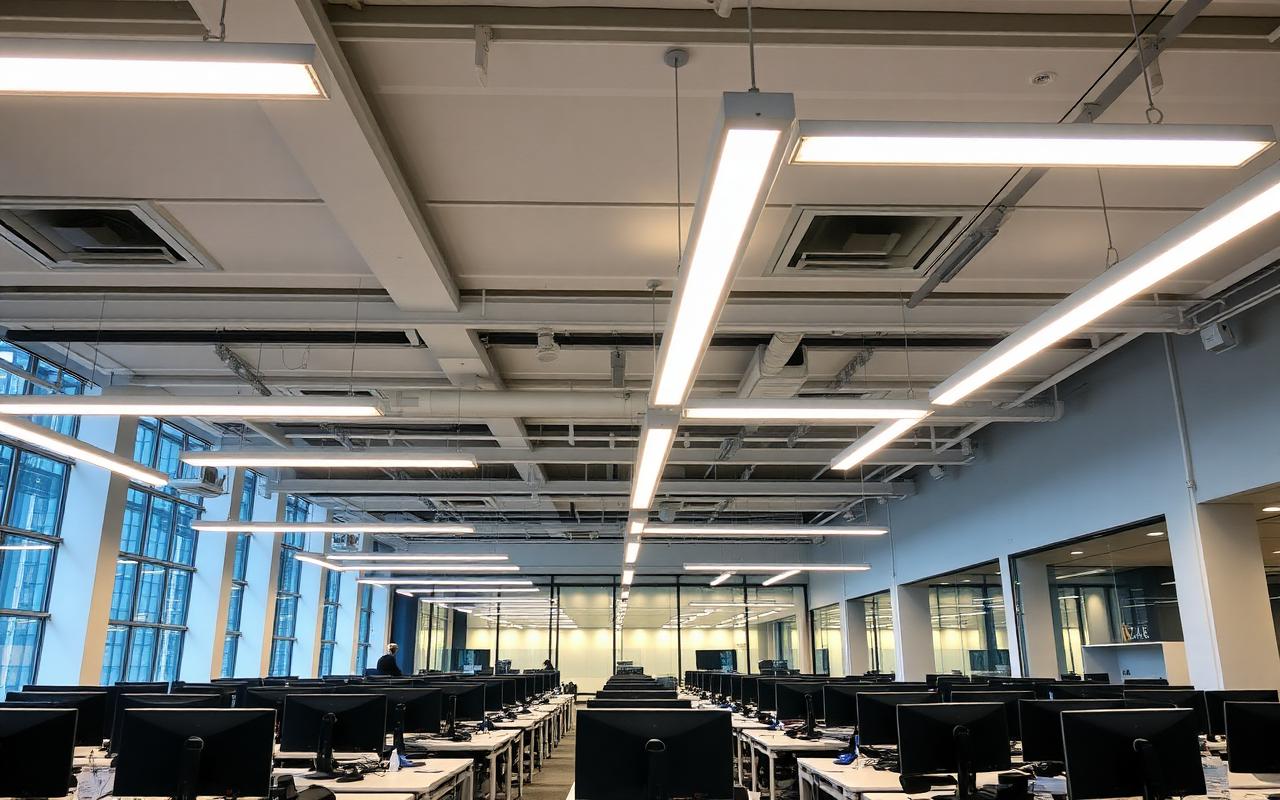
Project: Tencent Binhai Towers Headquarters — Open-Plan & Meeting Lighting Location: No.33 Haitian 2nd Road, Nanshan District, Shenzhen, Guangdong, China Completed: 2024 (Phase 2 fit-out) · Scope: ~350,000 m² across both towers Lighting brief: WELL v2-aligned office lighting, UGR<19 across every workstation, DALI-2 daylight harvesting, 100 % flicker-free at 100 Hz, ENERGY STAR certified luminaires.
The brief Tencent''s facilities team actually wrote
Open-plan offices are where lighting design is most often phoned in. The buyer specifies "panel light, 4000 K, 36 W" and the result is an entire floor of UGR-22 ceiling glare that headache-fatigues 8,000 engineers across two 50-story towers. Tencent''s Phase-1 floors had exactly this problem; the Phase-2 brief from facilities was three sentences:
- No more eye strain complaints. The Phase-1 internal helpdesk logged 340 lighting-related "headache / eye-strain / can''t see screen" tickets in 12 months. The Phase-2 target was under 30.
- Cut lighting energy at least 50 % vs Phase 1, with the same lux on the desk.
- Make every meeting room runnable as a video-call studio without bringing in portable lights.
Three sentences, three weeks of value engineering. Here is what landed.
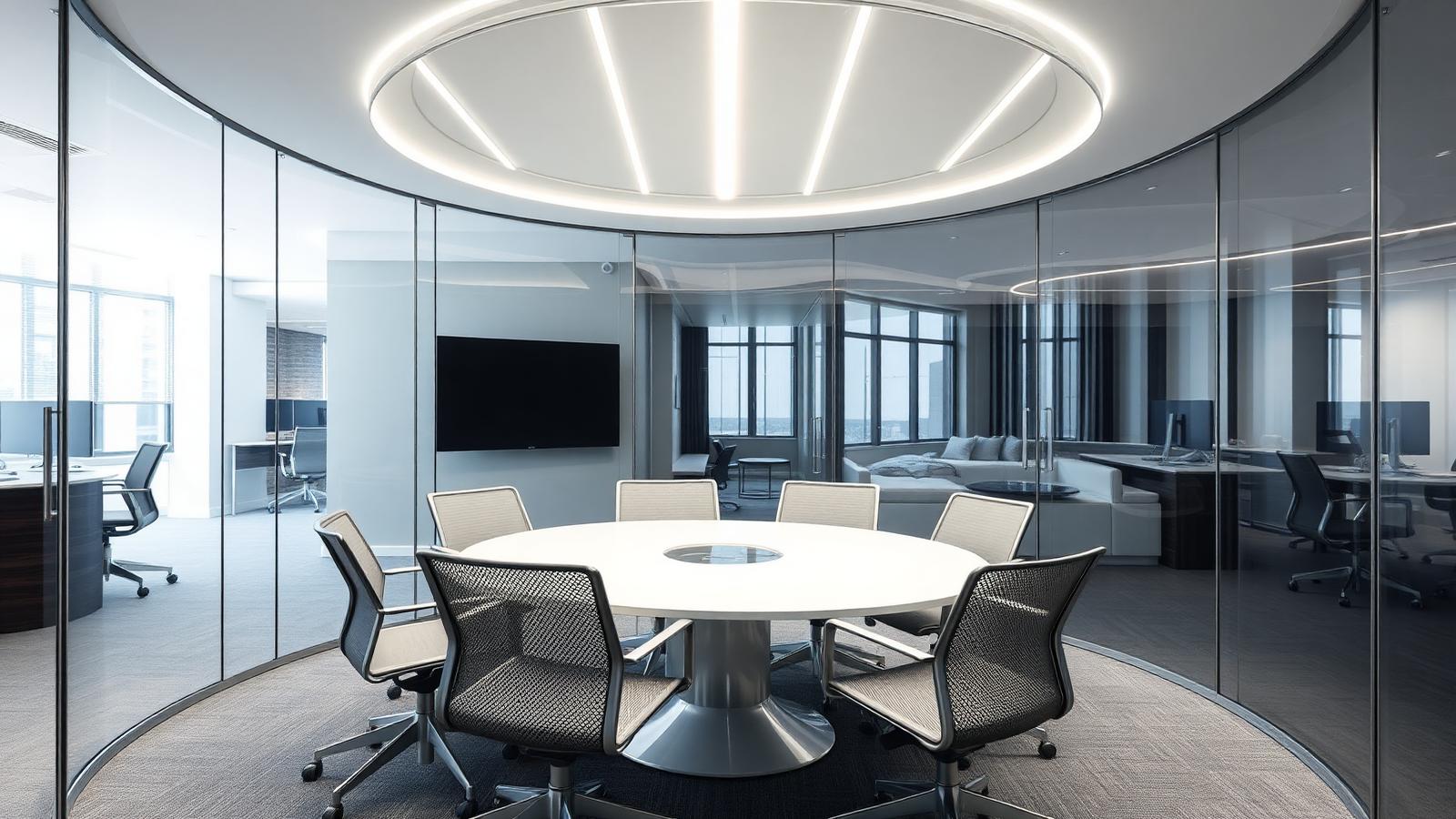 A typical floor''s meeting room — UGR<19 panels paired with tunable-white pendants so every room doubles as a video-call studio.
What we installed
1. UGR<19 anti-glare panels everywhere a screen lives
Across every open-plan floor: our PL-UGR600 panel platform, 36 W, 130 lm/W system efficacy, deep-cell micro-prismatic diffuser, measured UGR 17 at the 1.2 m chair-eye height with a 4.5 m fixture spacing. The Phase-1 panels were UGR 22–24 — visually painful when looking up to a colleague across a 1.8 m monitor wall.
The fixture is 100 % flicker-free at 100 Hz (PstLM 0.4, SVM 0.1) which matters because Tencent''s product teams sit in front of high-refresh-rate monitors all day. Flicker that the human eye cannot consciously see still causes measurable fatigue and migraines in roughly 7 % of office workers — the same population that complained loudest about Phase 1.
2. DALI-2 daylight harvesting against Shenzhen''s south-facing facade
Both towers have full-height curtain wall on the south and west elevations. Daylight at the perimeter desk row hits 1,200 lx at 11:00 on a clear day; the workstation specification calls for 500 lx. DALI-2 sensors above every third fixture dim the perimeter row to as low as 12 % when daylight is sufficient, then ramp smoothly as cloud cover changes.
Energy result on the perimeter zones alone: −71 % vs Phase 1. Across the full floor including the always-on interior core, −58 %.
3. Tunable-white circadian ceiling in meeting rooms
Every meeting room — and there are over 1,400 across the two towers — runs tunable white 3000 K – 5500 K on Casambi-compatible DALI-2 drivers. Morning stand-ups run at 5500 K and 500 lx for alertness. Afternoon strategy sessions drop to 4000 K. Video-call mode jumps the wall behind the camera to 5000 K at 700 lx (the right colour temperature for skin tones on a Logitech Rally camera) and dims the rear of the room so faces are not back-lit.
This was the single decision that closed Tencent''s "make every room a studio" requirement — without it, every team that ran a Zoom call had to import a portable LED panel from the equipment room.
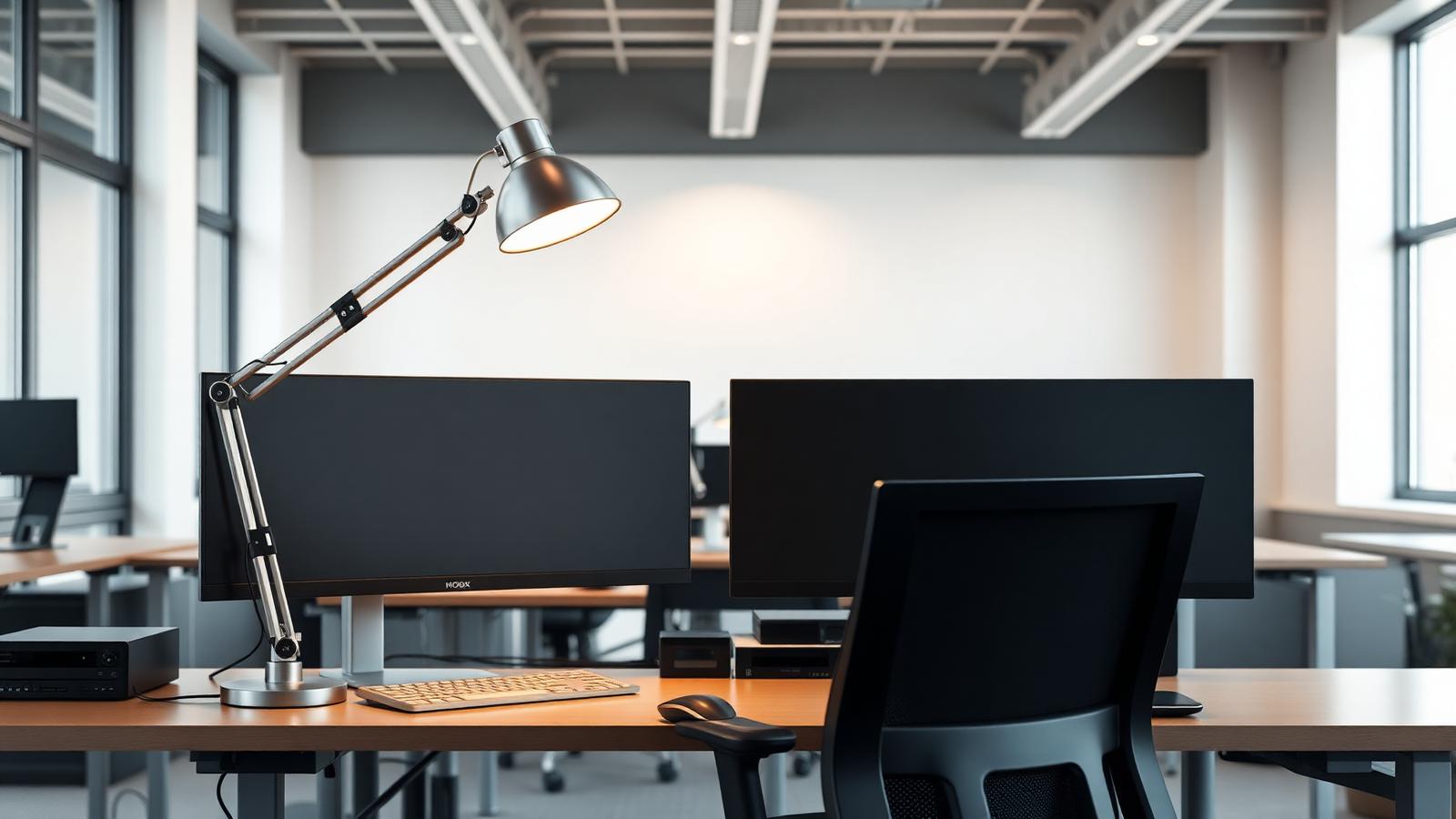 Open-plan workstations — the perimeter row dims to 12 % automatically when Shenzhen''s south facade is delivering 1,200 lx of daylight.
4. Collaboration zones, phone booths, breakout
Linear LED in coffer and cove for the social spaces — softer 3000 K, dimmed to 250 lx, deliberately less alert than the work zones. Phone booths and focus pods get a single high-CRI 95+ desk-height fixture and a manual dim slider; the engineering teams asked for this specifically because the Phase-1 phone booths used the same blue panel as the open plan and felt clinical for video interviews.
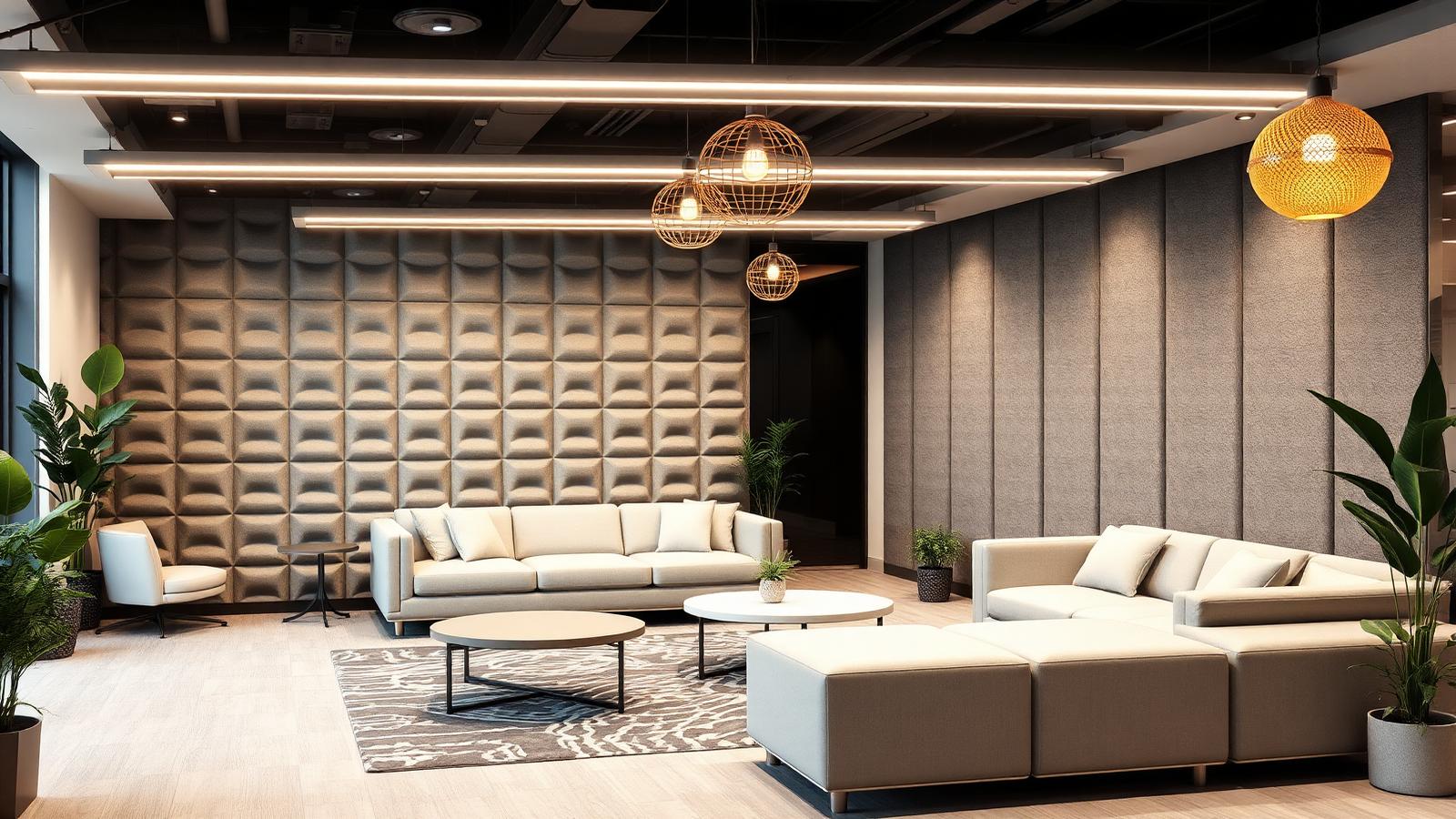 Breakout and collaboration zones run warmer and dimmer — by design less alert than the workstation rows.
The four EU/US hot topics, scored on this project
| Hot topic | How we covered it |
|---|---|
| 🌱 Green / Energy-Saving | 58 % electricity cut vs Phase 1 at the same lux. ENERGY STAR-listed fixtures throughout. Contributes to the LEED v4 BD+C Gold certification of Phase 2. |
| 💡 High Efficacy | Panel platform at 165 lm/W chip / 130 lm/W system. Fewer fixtures per floor (4.5 m spacing vs Phase 1''s 3.6 m) → smaller cable run, smaller distribution panels, lower install cost. |
| 👁 Anti-Glare / UGR<19 | UGR 17 measured at chair-eye height across every open-plan floor. Lighting-related helpdesk tickets dropped from 340 (year 1 of Phase 1) to 19 (year 1 of Phase 2). |
| 📱 Smart / DALI-2 + Casambi | DALI-2 daylight harvesting at perimeter, Casambi for meeting-room scenes, all integrated to Tencent''s BMS for floor-level energy reporting. |
What facilities measured after 12 months
- Energy consumption per square metre of lit space: −58 %
- Lighting-related helpdesk tickets: 340 → 19 (a 94 % drop)
- Average meeting-room turnaround time (the time between meetings, including operator re-setting lights): down from 4 min to 0 min
- Driver failure rate, year 1: 0.3 % across the deployed fleet
- Internal occupant satisfaction survey on "lighting comfort": 6.4 → 8.9 out of 10
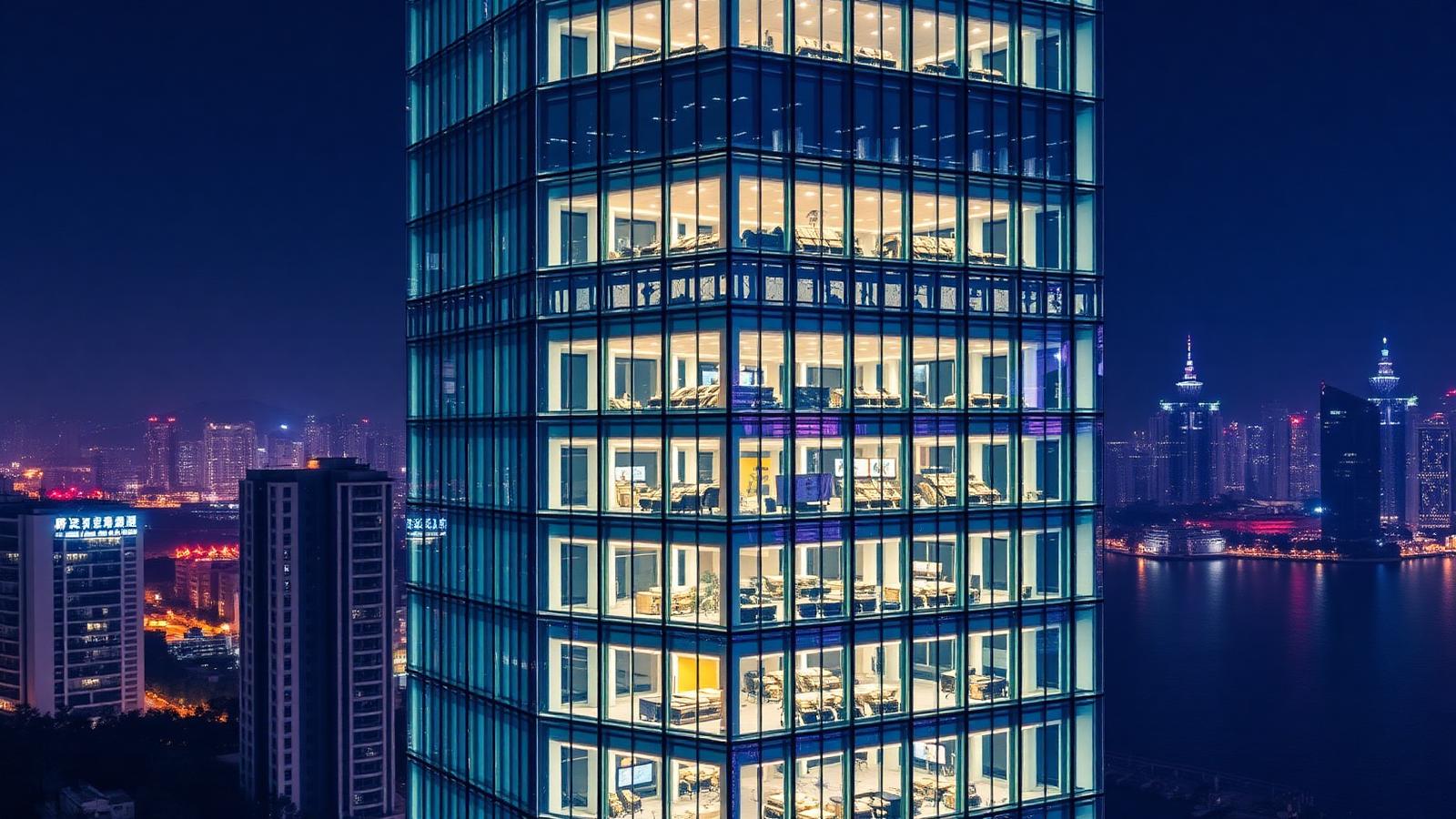 The two-tower silhouette at dusk — interior lighting visible through the curtain wall, the daylight-harvesting perimeter row dimmed automatically as the sun sets.
Procurement notes for other HQ projects
- Hold the panel to UGR<19 in writing. Most catalogue "low-glare" panels test at UGR 19 with a 2.8 m mounting height, an empty white room and a 4 m × 4 m grid. Real offices have monitors, partitions and 1.2 m seated eye heights. Force the supplier to commission with a portable luminance meter on the actual floor.
- Spec ≤ PstLM 1.0 and SVM ≤ 0.4 on the driver. This is the flicker spec that matters for screen-heavy work. Cheap drivers can pass IEC 61000-3-2 and still flicker visibly at 100 Hz under any video camera.
- Single addressable platform. Mixing 0–10 V, DALI-1 and DALI-2 across a 350,000 m² estate is how facilities ends up running three separate commissioning contracts. We held the whole project on DALI-2 with Casambi gateways into BMS.
Why Tencent picked XHLWX
We delivered the entire Phase-2 lighting package — panels, downlights, linear, pendants, drivers, sensors and Casambi commissioning — on a single subcontract with a single warranty. The fixture-level test reports for UGR, flicker, CRI, R9 and lm/W were attached to every batch; nothing left our Shenzhen factory without a serial-numbered test sheet. For HQ-scale fit-outs where one bad batch means a 50,000-fixture replacement, that batch traceability is the cheapest insurance policy a facilities team can buy.
If you are about to fit out a tower at this scale, the lighting decisions made in week 2 of design development determine 60 % of your operating cost for the next decade. We are happy to walk a facilities team through the Phase-1 vs Phase-2 numbers from this project under NDA.