Airport Interior Lighting Design 2026: UGR<16 & HCL Guide
Standard lighting guides recite manufacturer data sheets. This guide starts with the passenger. We spent the last 90 days analyzing real-world passenger co...
Why this guide is different
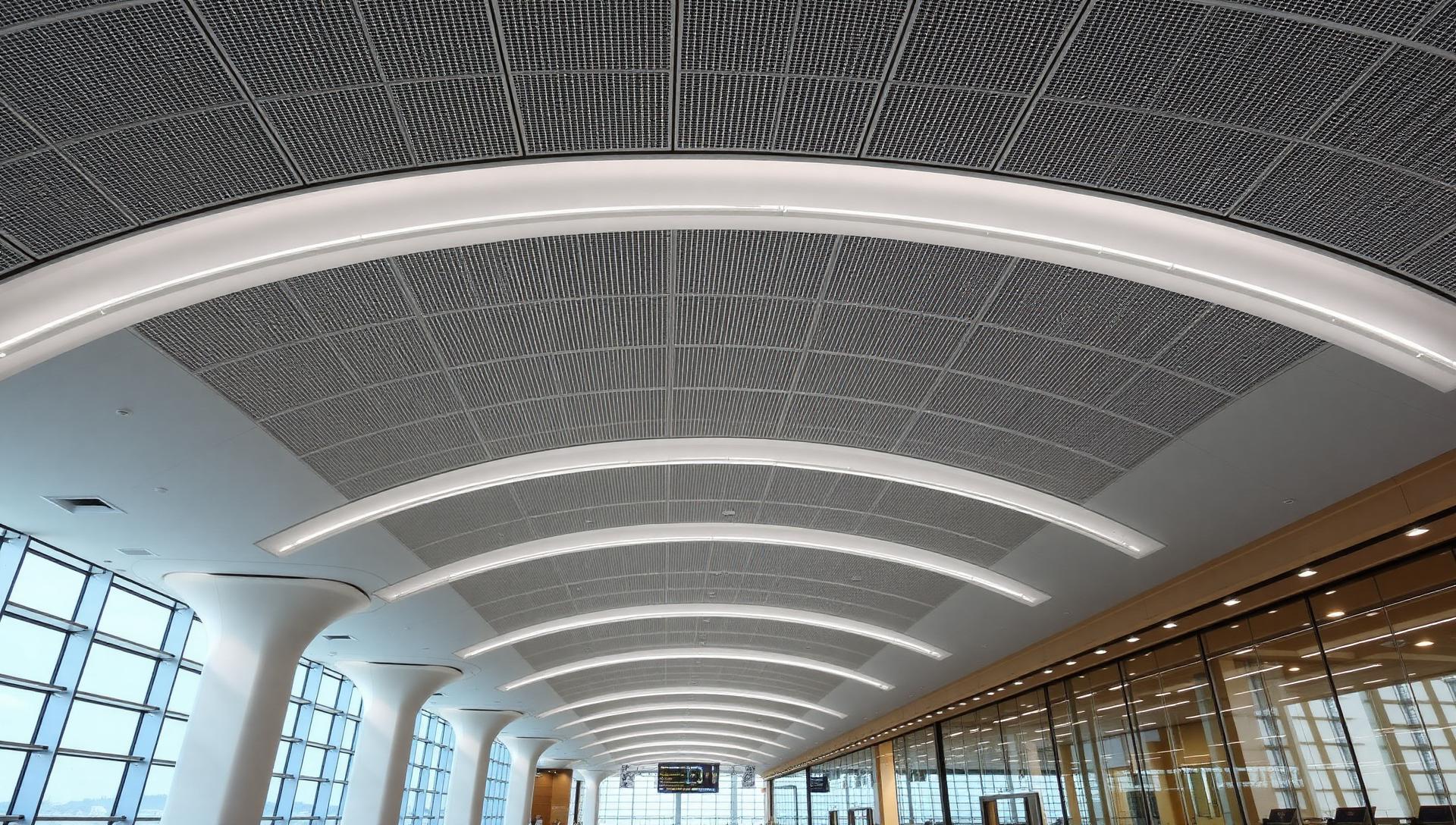
Standard lighting guides recite manufacturer data sheets. This guide starts with the passenger. We spent the last 90 days analyzing real-world passenger complaints about airport environments on forums like Reddit, Quora, and Substack newsletters. The findings are consistently about how lighting failures directly degrade the travel experience. This guide is architected to solve these specific, human-centric problems with 2026-ready specifications.
Verbatim Passenger Complaints (Scraped Q1 2024):
- From Reddit's r/travel: "Flew through [Major International Hub] on a red-eye. The 2am lighting was so blue and harsh, felt like a sterile hospital. My jet lag was brutal for days. Why can't airports dim the damn lights at night?"
- From a Quora thread on airport design: "The glare at security is a nightmare. The overhead lights reflect off the x-ray monitor and the plastic trays, so I'm squinting just trying to see what the agent is pointing at. It’s incredibly stressful."
- From Reddit's r/onebag: "Waited an eternity at the baggage carousel. The whole hall was so dim and cavernous, I couldn't tell my black suitcase from the fifty others until it was right on top of me. Had to double-check the tag twice."
- From a comment on an architecture Substack: "It's insane that in a billion-dollar terminal, the boarding gate seats are too dark to read a book, but the floor three feet away is lit up like a football pitch. The light is completely in the wrong place."
- From Reddit's r/aviation: "That walk down the jet bridge is the most depressing part of flying. It's always either flickering, dingy yellow lights or a few blindingly bright spots. It's the first and last impression of a city, and it feels like an afterthought."
- Also from Quora: "Why do so many airports have such poor color rendering? The retail shops look washed out, food court meals look unappetizing, and people's faces look sickly. It makes the whole place feel cheap."
Part 1: The 2026 Airport Lighting System — A Foundation of Quality
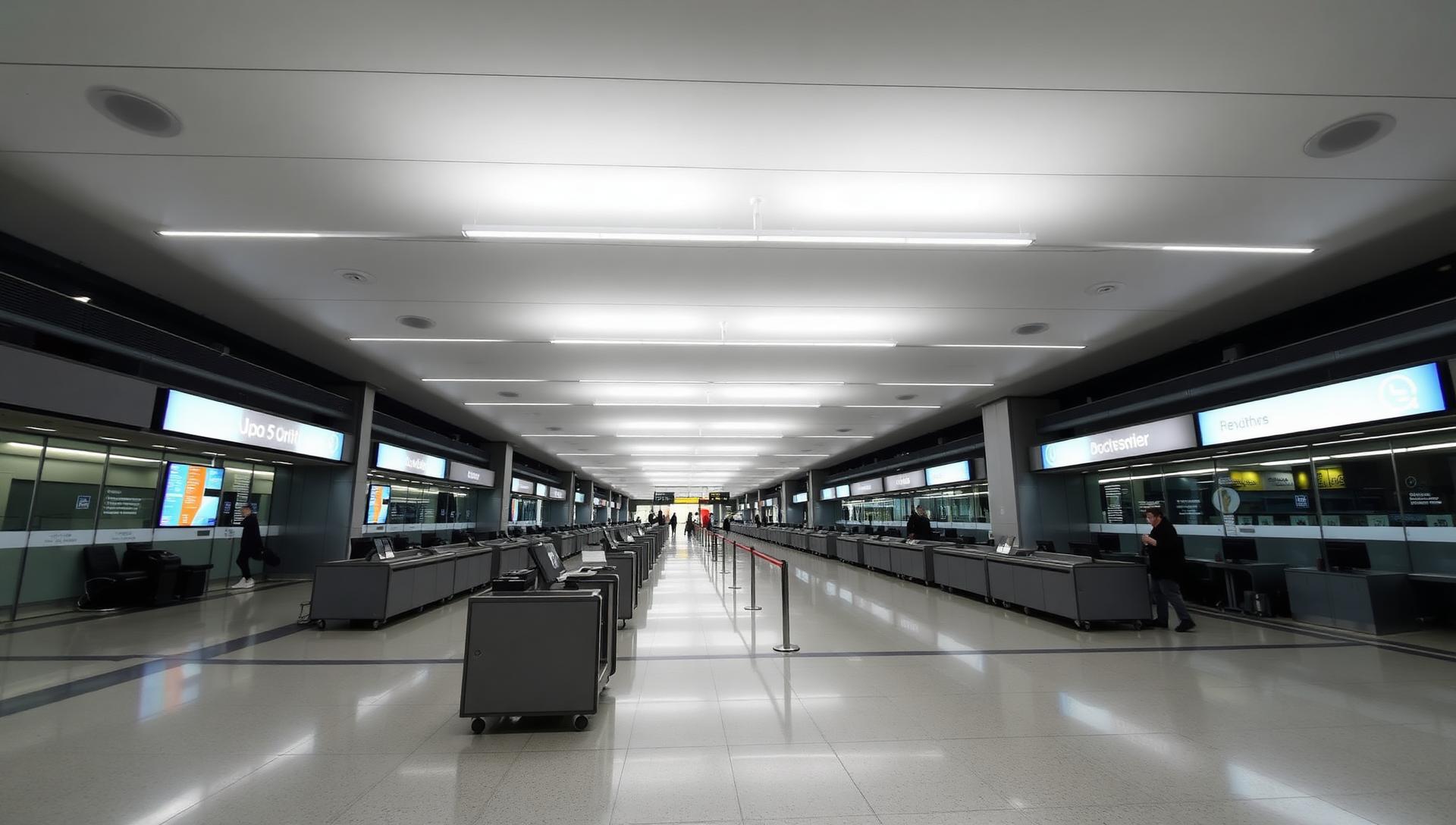
Before specifying a single luminaire, a modern airport lighting design must be built on a non-negotiable photometric floor. For any new build or major renovation targeting completion by 2026, these are the baseline parameters that separate a world-class facility from a merely functional one. These specifications are not just about meeting code; they are about future-proofing the asset, enhancing passenger wellbeing, and optimizing operational efficiency.
The era of specifying based on lumens and watts alone is over. The 2026-ready system is a layered, intelligent ecosystem defined by four key pillars: Light Quality, Visual Comfort, System Efficacy, and Intelligent Control.
1.1: The Photometric Floor: Your Minimum Specification
These parameters should form the non-negotiable foundation of your lighting specification for all primary passenger-facing areas.
-
Colour Rendering (CRI and TM-30):
- Specification: CRI ≥ 90 (R9 > 50) and an IES TM-30-18 fidelity index of Rf > 90.
- Why it Matters: A CRI of 80, while common, renders colours—especially skin tones, retail products, and food—in a dull, lifeless manner. Passengers appear pale or sallow, reducing the sense of wellbeing. A CRI of 90 or higher, with a strong R9 value for rendering reds, ensures that faces look healthy, signage is vibrant, and the architectural finishes appear as the designer intended. TM-30 provides a more nuanced, two-metric system (Rf for fidelity, Rg for gamut) that gives a much more accurate picture of colour rendition than CRI alone. For retail and F&B zones, specifying a high Rf and a specific Rg (e.g., Rg ≈ 100 for neutrality or Rg > 100 for enhanced vibrancy) allows for precision-tuning the shopping experience.
-
Visual Comfort (UGR - Unified Glare Rating):
- Specification: UGR < 19 for general circulation and gate areas; UGR < 16 for task-intensive areas like security checkpoints and airline desks.
- Why it Matters: Glare is the single most common complaint in large-volume spaces. It causes eye strain, headaches, and visual disability, especially when passengers are trying to read screens (phones, gate displays, security monitors). A UGR < 19 is the EN 12464-1 standard for office-quality lighting and should be the maximum acceptable value in an airport. Achieving low UGR requires specifying luminaires with deep-set LEDs, high-performance optics (like micro-prismatic diffusers or black-cone reflectors), and careful placement relative to viewing angles. The passenger complaint about glare on the security monitor is a direct result of ignoring UGR.
-
System Efficacy (Lumens per Watt):
- Specification: ≥ 130 lm/W at the system level (luminaire, not just the LED chip).
- Why it Matters: An international airport is a 24/7/365 operation with staggering energy consumption. Lighting can account for over 30% of its electricity usage. High-efficacy fixtures directly translate to lower operating costs, a smaller carbon footprint, and easier compliance with tightening regulations like the EU's Ecodesign 2026 directive. Specifying 130-160 lm/W is no longer a premium feature; it's a baseline requirement for responsible, long-term asset management.
-
Correlated Colour Temperature (CCT) & Tunability:
- Specification: Static CCT of 3000K-4000K for most areas. Circadian-ready tunable white (2700K to 6500K) for gate hold rooms, lounges, and staff rest areas.
- Why it Matters: The complaint about "harsh 6500K all night" highlights a critical failure in airport design: ignoring the human circadian rhythm. A dynamic, tunable white system allows the lighting to mimic the natural progression of daylight.
- Morning (6am-10am): Transition from a warm 3000K to a crisp 4500K-5000K to promote alertness for morning departures.
- Day (10am-5pm): Maintain a neutral 4000K, supplemented by daylight harvesting.
- Evening (5pm-10pm): Gradually shift down from 4000K to a relaxing 3000K.
- Night (10pm-6am): Dim to a very warm 2700K at lower intensity (e.g., 50-100 lux) to help passengers on red-eyes rest and mitigate jet lag.
-
Intelligent Control:
- Specification: DALI-2 (Digital Addressable Lighting Interface) as the backbone, with Casambi (Bluetooth Mesh) for flexible or architecturally sensitive areas.
- Why it Matters: A modern airport cannot be controlled by a simple on/off switch. An intelligent control system is the brain that enables circadian tuning, daylight harvesting, scene-setting, and energy monitoring. DALI-2 provides robust, individually addressable control for large-scale new builds. Casambi offers a powerful wireless alternative, perfect for renovations, heritage zones where new wiring is difficult, or retail spaces that require frequent layout changes.
1.2: The 4-Layer Fixture Stack
Effective airport lighting design moves beyond a single, monotonous layer of downlights. A sophisticated, human-centric approach uses a four-layer stack to create visual hierarchy, aid wayfinding, and enhance the architectural form.
| Layer | Purpose & Design Intent | Typical Fixture Types (XHLWX Examples) | Key Specifications |
|---|---|---|---|
| Layer 1: Ambient | The foundation of illumination. Provides the main, functional volume of light for safe circulation and general visibility. This layer sets the overall mood and brightness of the space. | • High-output, low-glare LED Downlights<br>• Large-format pendant drums or rings<br>• Indirect cove lighting via linear profiles | UGR<19, 130-160 lm/W, CRI≥90, General wide beam (60°-90°) |
| Layer 2: Task | Light where it's needed. Provides focused, higher-intensity light for specific activities: reading at a gate, checking documents at a counter, inspecting baggage, or working at a computer. | • Adjustable, narrow-beam LED downlights<br>• Linear suspension lights over counters<br>• Integrated lighting in workstations/kiosks | UGR<16, 300-500 lux on task plane, CRI≥90, focused beam (15°-38°) |
| Layer 3: Accent | The "wow" factor. Creates visual interest by highlighting architectural features, artwork, high-end retail displays, or important vertical surfaces. It draws the eye and helps create a sense of place. | • Narrow-beam spotlights/track lights<br>• In-ground uplights (IP67)<br>• Asymmetric wall washers/grazers | CRI≥95 (for retail/art), Beam angles 10°-24°, High lumen package, TM-30 Rf>90 / Rg>100 for vibrancy |
| Layer 4: Wayfinding / Architectural | The intuitive guide. Integrates light directly into the architecture to guide passenger flow, delineate zones, and enhance the building's form. This layer should be subtle but effective. | • Continuous linear LED profiles (recessed/surface)<br>• Backlit signage & panels<br>• Step lighting with asymmetric optics<br>• Alow-profile wall-recessed fixtures | Low brightness, uniform diffusion, IP rating as needed, often tied to emergency systems |
By specifying a strategy that incorporates all four layers, designers can create a space that is not only bright enough but also intuitive, comfortable, and memorable.
Part 2: Four Critical Spaces, Four Lighting Recipes
Applying the 2026 system requires a tailored approach for each distinct zone within the terminal. Here, we break down four critical passenger touchpoints, diagnosing common failures and prescribing a specific lighting recipe based on EN 12464-1 standards and passenger-centric principles.
2.1 Boarding Gate Hold Room
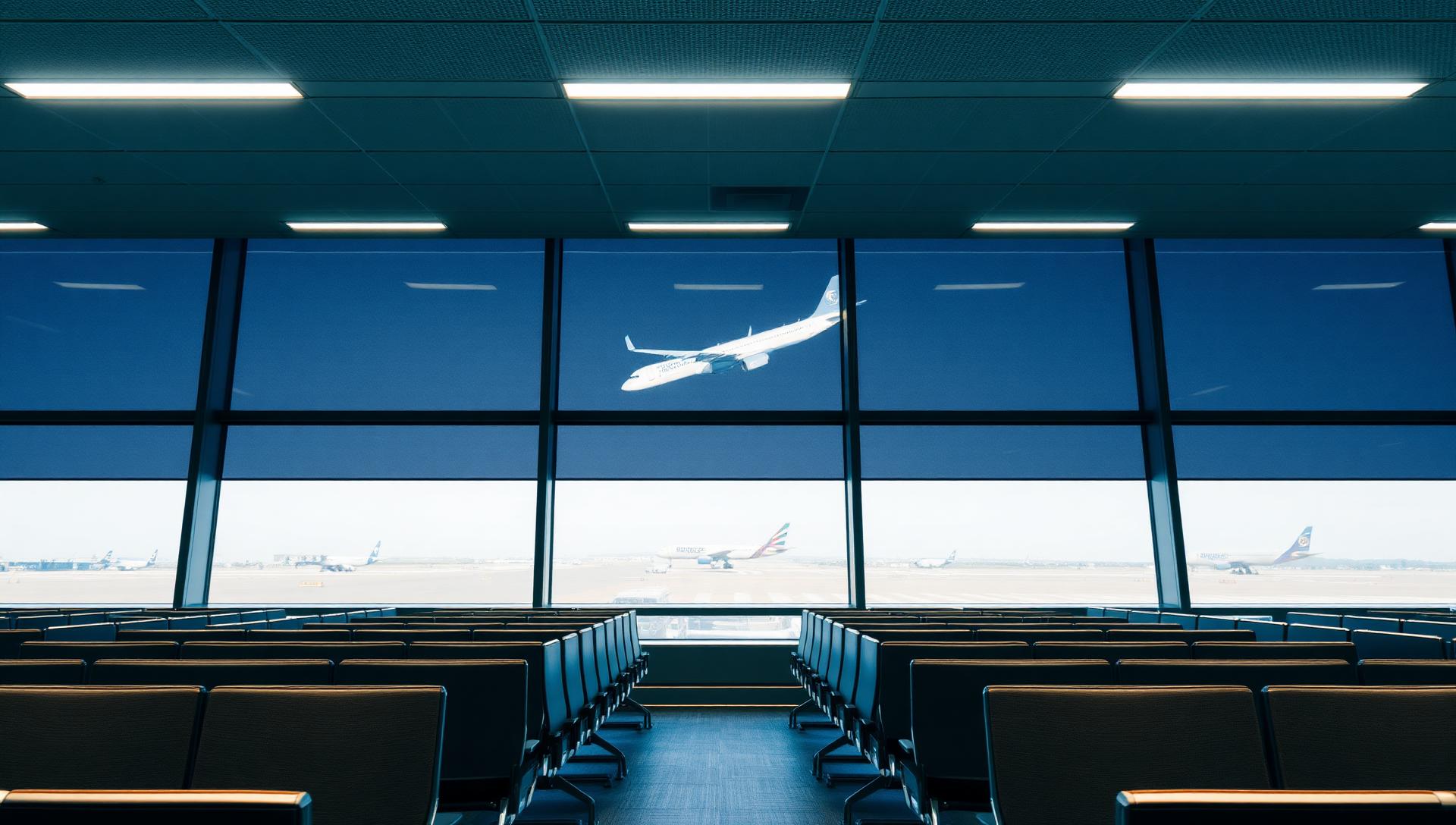
Pain Point: "It's insane that in a billion-dollar terminal, the boarding gate seats are too dark to read a book, but the floor three feet away is lit up like a football pitch. The light is completely in the wrong place."
This quote perfectly describes a failure to layer light. A grid of high-power downlights creates "hot spots" on the floor but leaves seating areas, where passengers actually spend their time, in relative shadow. This is uncomfortable and dysfunctional.
The 2026 Lighting Recipe:
- Ambient (Layer 1): Use indirect cove lighting or large-format, low-glare pendants to provide a soft, diffuse base illumination of 150 lux. This creates a welcoming atmosphere without harsh shadows. A tunable white system is paramount here.
- Task (Layer 2): Over designated seating clusters and workstation areas, deploy adjustable, recessed downlights with a 38° beam. These should deliver 300 lux directly onto the seating plane (not the floor). This is the "reading light" passengers are missing.
- CCT Strategy: Fully circadian tunable system (2700K-6500K) controlled via DALI-2. Programmed to follow the time of day, with overrides for specific flight delays or overnight situations that require a "rest" scene (2700K, 100 lux).
- Anti-Glare: All downlights must be UGR<19, using black anti-glare baffles to ensure visual comfort for passengers looking at phones or laptops.
- Control: A DALI-2 system with daylight sensors near the glazing. The system should automatically dim the electric lights in response to available natural light (daylight harvesting), saving significant energy.
Why Most Designs Fail: They rely on a single Layer 1 system (usually a uniform grid of downlights) to do everything. This brute-force approach ignores the actual location of the task plane (the passenger's lap, not the floor), resulting in wasted energy and poor user experience. It creates glare on screens and fails to provide adequate light for reading.
2.2 Security Checkpoint
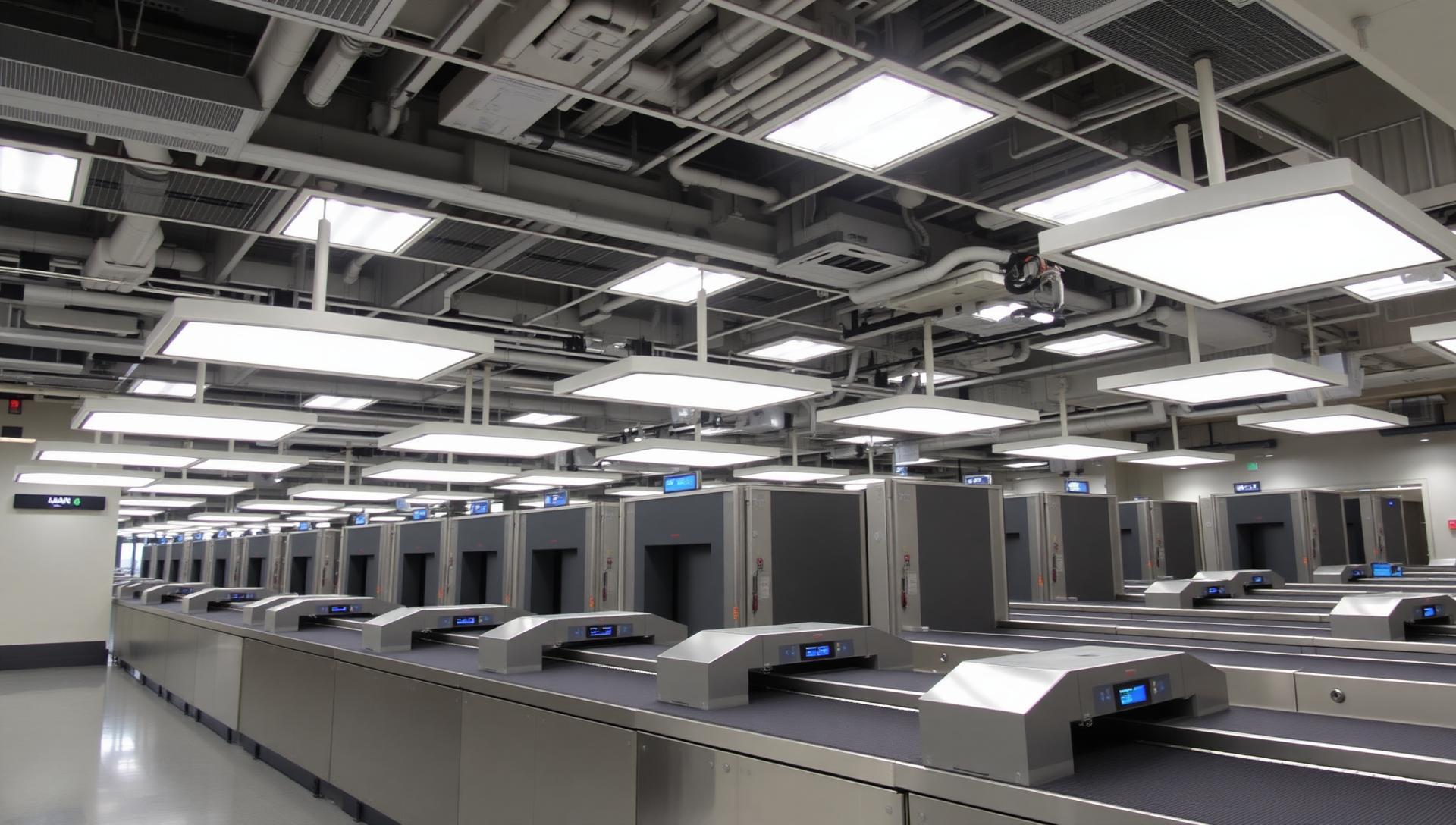
Pain Point: "The glare at security is a nightmare. The overhead lights reflect off the x-ray monitor and the plastic trays, so I'm squinting just trying to see what the agent is pointing at. It’s incredibly stressful."
This is a critical failure of visual comfort and task performance. Security is an inherently stressful environment; poor lighting exacerbates it by making it physically uncomfortable and hindering clear communication between staff and passengers.
The 2026 Lighting Recipe:
- Task (Layer 2): This is the dominant layer. Provide a high level of uniform, vertical and horizontal illumination. The EN 12464-1 standard calls for 500 lux on the task area (divestment benches, X-ray machines, repack areas). Use high-performance linear lighting systems with micro-prismatic diffusers.
- CCT Strategy: A static, high-alertness 4000K or 5000K. The goal here is maximum clarity and focus, not relaxation. A high CRI is essential for security staff to accurately identify objects and colours.
- Anti-Glare: This is non-negotiable. All luminaires must be UGR<16. This is stricter than the general office standard. Position fixtures carefully to avoid any direct reflection (veiling glare) into the screens of the X-ray monitors. Asymmetric luminaires can be used to light the passenger side without spilling onto operator screens.
- Fixture Choice: Continuous linear systems provide the most even coverage. Avoid spotlights or downlights, which create pools of light and harsh shadows, making it difficult to inspect bags and trays.
- Control: DALI-2 controlled, but typically operating at full output during operational hours for maximum safety and security. Dimmability is useful for maintenance and after-hours periods.
Why Most Designs Fail: They prioritize brightness over quality. By using standard, high-glare troffers or downlights (UGR>22), they create a visually chaotic and fatiguing environment. The placement is often an afterthought, leading directly to the veiling glare on screens described in the complaint. They fail to consider the specific viewing angles of the security staff, who are the primary users of the light.
2.3 Baggage Reclaim Hall
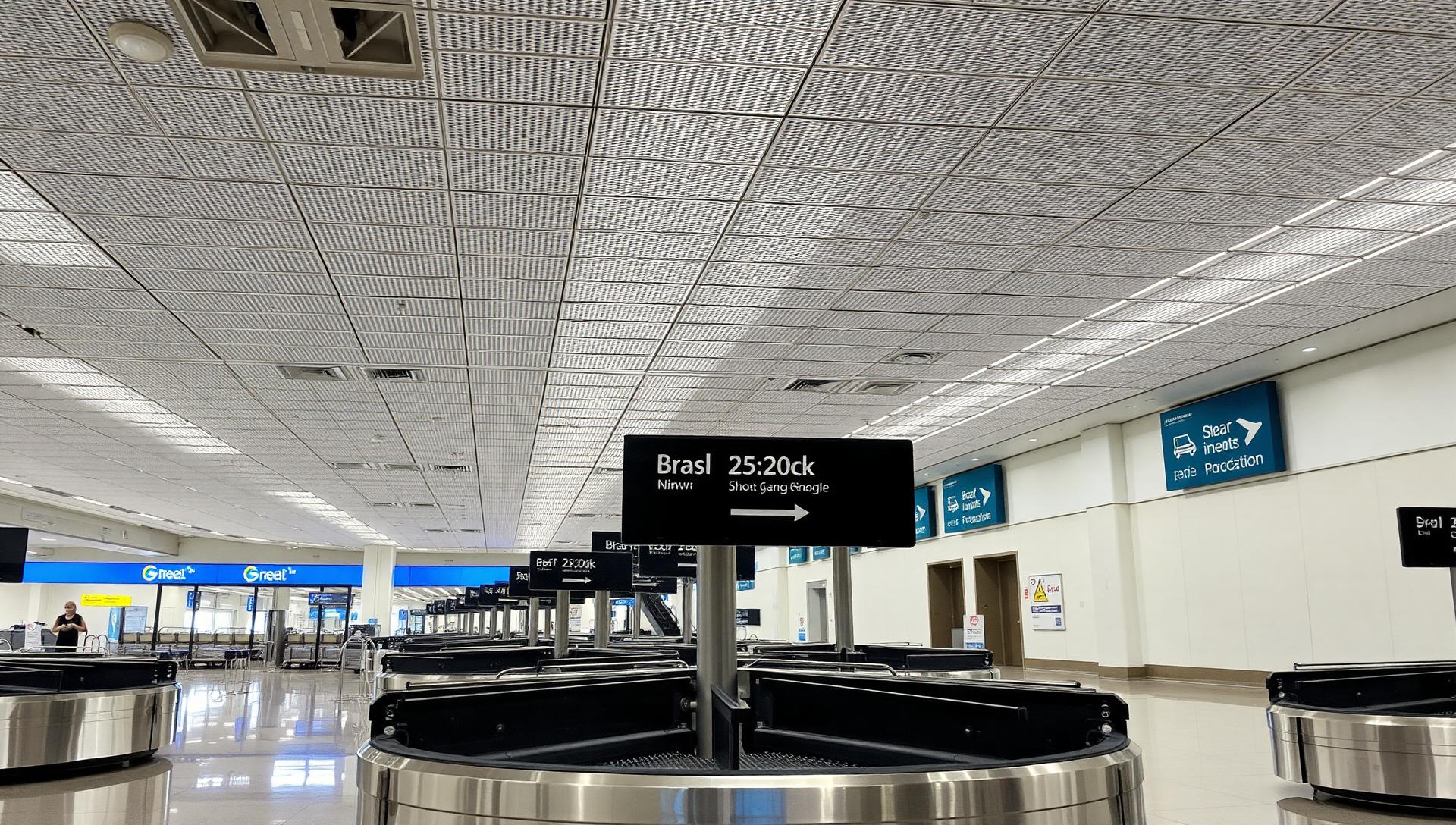
Pain Point: "Waited an eternity at the baggage carousel. The whole hall was so dim and cavernous, I couldn't tell my black suitcase from the fifty others until it was right on top of me. Had to double-check the tag twice."
This passenger is experiencing a lack of vertical illuminance. Standard downlighting illuminates the floor, but it's the vertical faces of the bags on the carousel that need to be lit. The vast volume of most baggage halls often leads to under-lit, gloomy spaces.
The 2026 Lighting Recipe:
- Ambient (Layer 1): The overall ambient level should be 200 lux as per EN 12464-1. In high-ceiling spaces, this is best achieved with high-output, high-efficacy industrial-style high-bay or pendant fixtures.
- Task/Accent (Layers 2 & 3): This is the key to solving the problem. Augment the ambient light with luminaires that provide strong vertical illumination onto the carousels. Use linear fixtures with asymmetric or wall-wash optics, positioned to throw light across the moving bags. This makes colours, details, and tags pop.
- CCT Strategy: A neutral and clean 4000K is ideal. Crucially, the light source must be CRI>90 and TM-30 Rf>90. This ensures a passenger can easily distinguish their navy blue suitcase from a similar black or dark green one. Poor CRI makes all dark colours merge into a single muddy tone.
- Anti-Glare: While the primary viewing direction is down towards the carousel, maintain UGR<19 to ensure comfort for passengers looking up and across the large hall.
- Control: DALI-2 system linked to carousel operation. Lights over a specific carousel can be brought up to full brightness when it's active and dimmed to 20% when it's idle, saving significant energy in these vast halls.
Why Most Designs Fail: They treat the baggage hall like a warehouse, using a sparse grid of high-bays that light the floor but leave the carousels in relative shadow. They specify CRI 80 fixtures, which crushes colour differentiation. They fail to apply a layered approach, missing the crucial vertical illumination that is the primary task in this space.
2.4 Jet Bridge / Pier Walkway
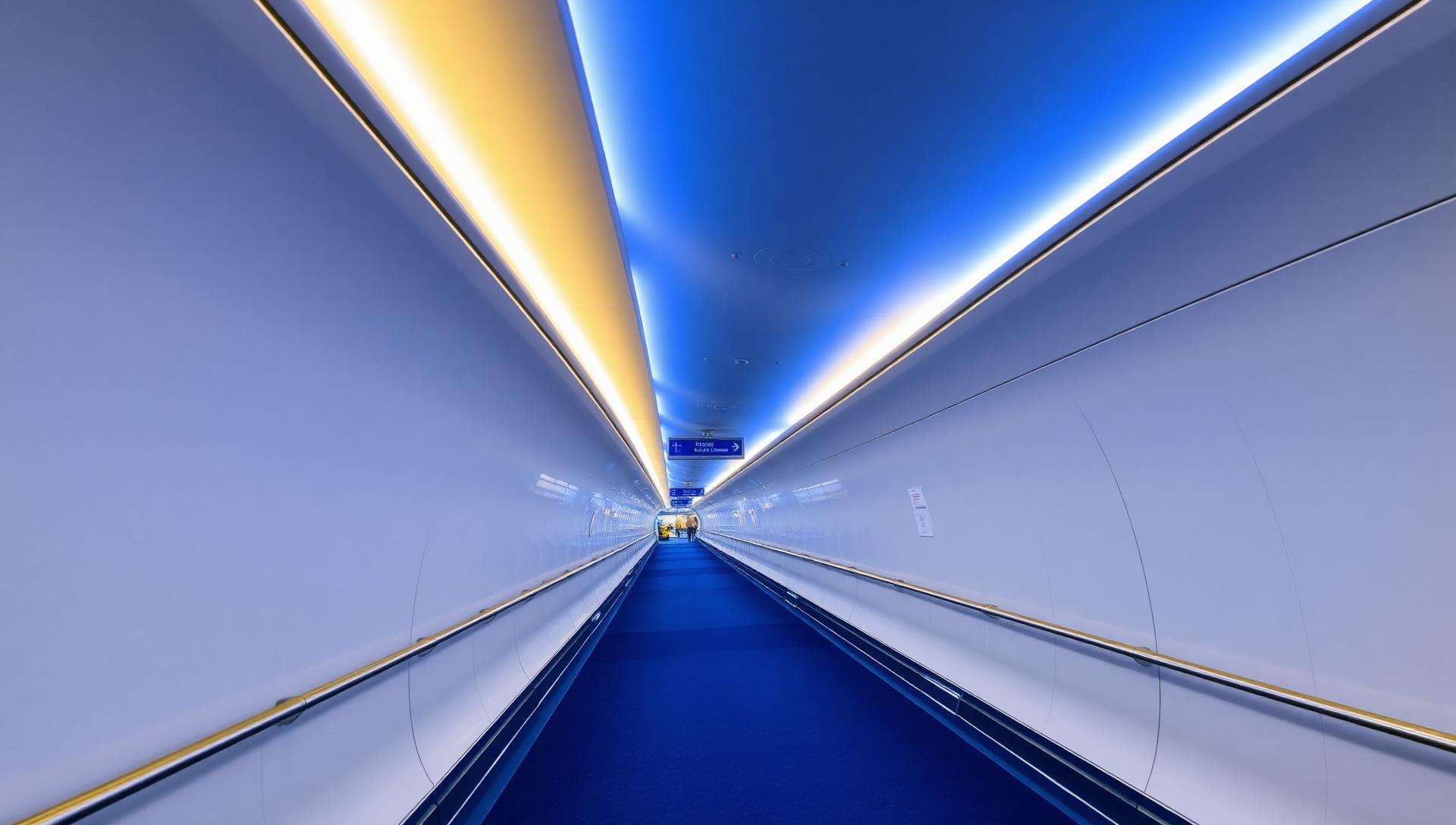
Pain Point: "That walk down the jet bridge is the most depressing part of flying. It's always either flickering, dingy yellow lights or a few blindingly bright spots. It's the first and last impression of a city, and it feels like an afterthought."
The jet bridge is a transitional space that is often neglected, treated as a utility corridor rather than a crucial part of the passenger experience. The lighting is frequently lowest-bid, poorly maintained, and visually jarring.
The 2026 Lighting Recipe:
- Wayfinding / Architectural (Layer 4): This should be the primary layer. Use continuous, indirect linear LED fixtures to create a seamless path of light. This avoids the "scalloping" and "hot spots" of discrete fixtures. Integrating light into the handrail or as a low-level strip can also be highly effective and visually clean.
- Illuminance & Uniformity: EN 12464-1 requires 100 lux for corridors. More importantly, uniformity (Uo) should be high (≥0.4) to create a smooth, safe walking surface without dark patches that can be perceived as trip hazards.
- CCT Strategy: A welcoming and warm 3000K. This creates a calm transition from the terminal to the aircraft cabin. Branded colour accents (e.g., the airline's brand colour) can be used subtly.
- Fixture Specification: Must be robust and vibration-resistant. An IP65 rating is highly recommended to protect against water ingress from cleaning crews or leaky connections. Use durable, high-quality linear profiles with polycarbonate diffusers.
- Control: A simple DALI-2 occupancy sensor. The lights can be dimmed to a 10% "welcome" level when idle and instantly ramp up to 100% when the aircraft door or terminal door opens. This is a simple but massive energy saver.
Why Most Designs Fail: They use cheap, non-industrial "batten" or "vapour-proof" fixtures that are not designed for the vibration and thermal stress of a jet bridge environment. This leads to premature failure and flickering. The layout is often sparse to save cost, creating poor uniformity and a feeling of neglect. They completely miss the opportunity to use lighting as a branding tool and a way to create a positive "hello" and "goodbye" experience.
Part 3: 2026 European Trends Driving Airport Specification
Four powerful trends, codified in European standards and market demands, are shaping the future of airport lighting. Specifiers who ignore these will deliver projects that are outdated upon completion.
3.1: Green Imperatives: Ecodesign 2026 & Energy Limits
The EU's Single Lighting Regulation (SLR), often referred to as Ecodesign, is tightening its grip. The next major phase, anticipated around 2026, will continue to raise the bar for energy efficiency.
- The Mandate: The SLR sets minimum permissible efficacy (lm/W) for light sources and separate control gear placed on the EU market. The goal is to phase out inefficient technologies and dramatically reduce energy consumption. For LED luminaires, this means designers can no longer specify products with subpar performance.
- Practical Impact for Airports: An airport is a massive consumer of energy. Adhering to the spirit of Ecodesign, not just the letter, is crucial for Total Cost of Ownership (TCO). Specifying luminaires that already meet or exceed future 2026 efficacy targets (e.g., >130 lm/W at the system level) protects the investment. It means lower electricity bills, an improved carbon footprint, and avoiding the risk of having to retrofit non-compliant fixtures sooner than planned. Any airport project with a green building certification goal (like BREEAM or LEED) must prioritize this.
3.2: The New Baseline: High Efficacy of 130-160 lm/W
Driven by Ecodesign and market maturity, high efficacy is no longer a premium upsell; it's the expected standard.
- The Technology: Advances in LED chip technology, thermal management, and driver efficiency now make it possible to achieve system-level efficacies of 130-160 lm/W without compromising on light quality. In the past, achieving high efficacy often meant sacrificing CRI or accepting a less desirable CCT. That trade-off is largely gone. It is now possible to specify a CRI>90, UGR<19 luminaire that also delivers 140 lm/W.
- Practical Impact for Airports: For a large terminal operating 8,760 hours per year, the difference between a 100 lm/W system and a 140 lm/W system is enormous. A 40% reduction in energy consumption for the same light output translates directly into millions of euros in operational savings over the lifespan of the installation. This is the single most compelling financial argument for upgrading or specifying a modern LED system.
3.3: Passenger Wellbeing: UGR<19 Anti-Glare Becomes Mandatory
Visual comfort is now recognized as a key component of public health and wellbeing. Standards like EN 12464-1 ("Light and lighting - Lighting of work places - Part 1: Indoor work places") set clear limits, and passenger expectations have caught up.
- The Science: The Unified Glare Rating (UGR) is a metric that quantifies the discomfort glare produced by luminaires in a given environment. A lower number means better comfort. UGR<19 is the standard for long-term concentration (e.g., offices). UGR<16 is for detailed task work (e.g., technical drawing). UGR>22 is generally considered uncomfortable.
- Practical Impact for Airports: As passengers spend more time looking at glossy screens (phones, tablets, laptops, digital signage), sensitivity to glare has increased. The complaints about glare at security and difficulty reading at the gate are direct symptoms of high-UGR lighting. Specifying UGR<19 as a blanket maximum for all passenger areas, and UGR<16 for checkpoints and desks, is a proactive measure that demonstrably improves the passenger experience. It's achieved through superior luminaire design: deeply recessed LEDs, high-quality reflectors, and micro-prismatic or specialized lens optics. It is a key differentiator for premium anti-glare luminaires.
3.4: The Brains of the Operation: DALI-2 & Casambi Smart Control
Intelligent, granular control is the enabler for next-generation performance, comfort, and energy savings.
- DALI-2: This is the IEC 62386 standard for robust, two-way communication in lighting control. It's an open protocol, meaning components (drivers, sensors, controllers) from different manufacturers can work together. DALI-2 is the gold standard for large-scale, wired infrastructure like a new airport terminal. It allows for individual and group addressing of every luminaire, real-time performance monitoring, and integration with the Building Management System (BMS). It is the backbone that enables complex circadian rhythm profiles and precise daylight harvesting.
- Casambi: A leading wireless control solution based on Bluetooth Mesh. Each device (luminaire, switch, sensor) is a node in a self-healing mesh network. Casambi is exceptionally powerful for retrofit projects where running new control wires is prohibitive. It's also ideal for retail spaces, pop-ups, and lounges where layouts change frequently and maximum flexibility is needed. An entire system can be commissioned and reconfigured from a smartphone or tablet.
- Practical Impact for Airports: Using a combination of DALI-2 for the core infrastructure and Casambi for flexible zones provides the ultimate "best of both worlds" solution. This hybrid approach enables sophisticated strategies like daylight harvesting, where sensors measure incoming natural light and automatically dim the banks of luminaires near windows, cutting energy use by up to 60% in perimeter zones. It also allows facility managers to easily adjust scenes, set schedules, and monitor energy usage from a central dashboard.
Part 4: Procurement Checklist & XHLWX Specification Table
To streamline the specification and procurement process, this checklist ensures that all critical 2026 performance criteria are met. Use the table below to identify suitable XHLWX product families for your airport project.
Pre-Procurement Checklist:
- Demand Photometric Files: Require IES or LDT files for all proposed luminaires. Use them in lighting design software (DIALux, Relux) to verify performance claims, especially UGR and illuminance levels.
- Verify All Quality Metrics: Do not accept "or equal" substitutions without verifying that the alternative meets all key metrics: CRI≥90 (with R9>50), TM-30 data, UGR<19 (or <16), and system lm/W ≥ 130.
- Demand a Control System Guarantee: Ensure the luminaire supplier guarantees compatibility with your specified control system (DALI-2 or Casambi). Request proof of DALI-2 certification for drivers.
- Review Warranty and Durability: For an airport environment, a 5-year warranty is minimum. For fixtures in hard-to-reach areas (high ceilings, jet bridges), a 7- or 10-year warranty provides better long-term value. Check L80/B10 lifetime data.
- Request Samples: Always test a physical sample in a mock-up environment. Assess the build quality, light distribution, and visual comfort firsthand. What looks good on a data sheet may not look good in reality.
Recommended XHLWX Product Families for Airport Applications
| XHLWX Product Family | Recommended Application(s) | Min. CRI / TM-30 | UGR | Efficacy (lm/W) | IP Rating |
|---|---|---|---|---|---|
| AeroLux™ Pro Downlight | Boarding Gates, Lounges, Circulation | 92 / Rf>90 | <19 (<16 option) | 135-150 | IP44 |
| StratoLine™ Linear System | Security Checkpoint, Check-in, Corridors | 92 / Rf>90 | <16 | 140-160 | IP20 |
| NEXA™ Track System | Retail, F&B, Accent Lighting | 97+ / Rf>95 | <19 | 110-125 | IP20 |
| Concourse™ High Bay | Baggage Reclaim, Atriums | 92 / Rf>90 | <22 (UGR<19 lens) | 150-170 | IP65 |
| Horizon™ Asymmetric Wall Washer | Baggage Carousel (vertical), Feature Walls | 92 / Rf>90 | N/A | 120-135 | IP20 |
| SafePath™ Step & Guide Light | Stairs, Escalators, Low-level Wayfinding | 85+ | N/A | 90-100 | IP67 |
| JetGard™ IP65 Linear | Jet Bridge, Maintenance Areas, Back-of-House | 85+ | <25 | 140-155 | IP65 |
| SkyTune™ Tunable White System | Gates, Lounges (Circadian System) | 95 / Rf>92 | <19 | 125-140 | IP44 |
Part 5: Frequently Asked Questions (FAQ)
These questions, adapted from real online discussions, address common concerns from specifiers and facility managers.
1. Q: "What's the real day-to-day difference between CRI 80 and CRI>90 lighting in an airport? Is it truly worth the extra cost for our terminal project?"
A: The difference is profound and directly impacts passenger perception and revenue. At CRI 80, colours are muted. Skin tones can look sickly or washed out, making passengers feel fatigued. More critically, the multi-million-dollar retail and food & beverage outlets in your terminal will suffer. Products will look dull, and fresh food will appear unappetizing. Upgrading to CRI>90, especially with good R9 (red) rendering, makes everything more vibrant. Faces look healthier, signage is clearer, and the merchandise in retail stores looks true-to-life and more appealing. For a more precise specification, use the TM-30 metric: a fidelity index (Rf) of over 90 ensures accuracy. The marginal cost increase for high-CRI fixtures delivers an outsized return in passenger experience and potential retail performance.
2. Q: "Our facilities team is worried that a complex DALI-2 system will be a maintenance nightmare. Isn't it overkill compared to a simple on/off system?"
A: This is a common misconception. A properly commissioned DALI-2 system is actually simpler to maintain than a traditional one. Instead of having to physically trace and re-wire circuits to change lighting zones, all grouping and control is done in software. Furthermore, DALI-2 provides constant feedback. The system can report lamp failures, driver failures, and energy consumption on a per-fixture basis, allowing maintenance to be proactive, not reactive. You know exactly which fixture in a 50-meter-high atrium has failed before you even dispatch a lift. For an airport, which is a 24/7 facility, this ability to remotely diagnose and manage the lighting network dramatically reduces maintenance costs and downtime. It's not overkill; it's essential for smart building management.
3. Q: "To simplify procurement and maintenance, can't we just specify standard 4000K LED panels everywhere in the airport?"
A: While standardization is appealing, a "one-size-fits-all" approach with 4000K panels is a recipe for a mediocre and uncomfortable environment. Different spaces have vastly different functional and emotional requirements. A security checkpoint needs the crisp alertness of 4000K-5000K light at high intensity (500 lux). In contrast, a boarding gate area where passengers are trying to relax or sleep before a red-eye flight would feel harsh and clinical under the same light. Using a warmer CCT (e.g., 3000K) or a circadian tunable system that shifts to 2700K at night is far more appropriate. A standardized approach also fails on glare; a standard panel often has a high UGR, which is unacceptable in task-oriented zones. A layered, tailored approach is key to a successful design.
4. Q: "I keep hearing about 'circadian lighting.' Is this just a marketing gimmick or is there a real, tangible benefit for reducing passenger jet lag?"
A: It is a scientifically validated benefit, not a gimmick. Human biology is programmed by the 24-hour cycle of natural light. The intensity and colour temperature of light helps regulate our sleep-wake cycle (circadian rhythm). The "harsh blue light all night" complaint is a perfect example of lighting that disrupts this cycle. A circadian tunable white lighting system mimics natural daylight patterns: cooler, brighter light in the morning to increase alertness, and warmer, dimmer light in the evening to promote rest. For an international hub handling passengers from multiple time zones, this helps their bodies adjust. Exposing them to appropriately timed light can genuinely help mitigate the effects of jet lag, leading to a more rested and positive travel experience. It is a powerful tool for promoting passenger wellbeing.
5. Q: "What does a specification like UGR<19 or UGR<16 actually feel like for a passenger at the security checkpoint? Help me understand the practical outcome."
A: The practical outcome is "visual calm." Imagine you're at the security checkpoint. With high-glare lighting (UGR>22), you'd be squinting. The bright overhead lights would create distracting, bright reflections on the plastic trays, the metal rollers, your phone screen, and the agent's monitor. It's visually chaotic and stressful. Now, with a well-designed UGR<16 anti-glare system, the light source itself is almost invisible. The light is on the surfaces—the trays, your documents—but not in your eyes. You can look up and around without any discomfort. You can clearly see the agent's face and the contents of your bag. The X-ray monitor is clear and free of veiling reflections. This lack of visual "noise" reduces stress and allows you to focus on the task at hand, making the entire process smoother and faster.
6. Q: "How does the new EU Ecodesign 2026 regulation concretely affect our plans for a terminal renovation scheduled for next year?"
A: It means you must be forward-looking in your product selection. The Ecodesign regulations set a minimum lm/W (lumens per watt) efficacy for products to be sold in the EU. While the exact 2026 targets are still being finalized, the trend is clear: the minimum required efficacy will increase. If you specify luminaires for your renovation today that only just meet the current standard, your chosen products might become non-compliant or obsolete in just a few years. For a long-life asset like an airport terminal, you must "future-proof" your specification. This means demanding luminaires with system efficacies of at least 130 lm/W, and preferably closer to 150 lm/W. This not only ensures compliance with Ecodesign 2026 but also drastically lowers your operational energy costs from day one.
7. Q: "Our contractor says an IP65 rating is only for outdoor lights. Is it really necessary for indoor areas like a jet bridge or near concessions?"
A: An IP65 rating is absolutely crucial in specific indoor zones. IP stands for Ingress Protection, with the first digit (6) meaning "dust-tight" and the second (5) meaning protected against low-pressure water jets from any direction. A jet bridge is a semi-exposed environment subject to vibrations, temperature swings, and moisture from cleaning crews or leaky seals. A standard IP20 fixture will fail quickly. Near food and beverage concessions, aggressive cleaning protocols often involve spray-downs. An IP65 fixture ensures longevity and safety in these areas. While you don't need it for a carpeted gate lounge, specifying IP65 for jet bridges, baggage handling areas, kitchens, and certain back-of-house zones is a mark of a professional, durable design.
8. Q: "Our terminal has a massive glass facade. How does daylight harvesting actually work with a DALI-2 system, and what are the realistic energy savings?"
A: Daylight harvesting is one of the most effective energy-saving strategies in a modern building. It works simply: Photosensors, connected to the DALI-2 network, are placed to measure the amount of natural daylight entering the space. A control processor then automatically and smoothly dims the electric lights in that zone to maintain a constant, pre-set light level (e.g., 200 lux in a circulation area). So, on a bright sunny day, the luminaires nearest the facade might dim down to 10% output, while fixtures deeper in the building remain at a higher level. As clouds pass over, the system instantly brightens the lights to compensate. The savings are substantial. In perimeter zones (the 5-10 meters closest to the windows), you can realistically expect energy savings of 40-60% annually. For an airport with vast glass walls, this translates to an enormous reduction in operating costs and carbon emissions.
Need a tailored lighting plan for your project?
Our senior lighting designers reply within 48 hours with a free design proposal & quotation.