Art Gallery Lighting Design 2026
From white-cube to dark-vitrine — the complete art gallery lighting buyer's guide for 2026: CRI 98 R9>95 high-fidelity LEDs, TM-30 Rf>95 / Rg 95–105, RG0 p...
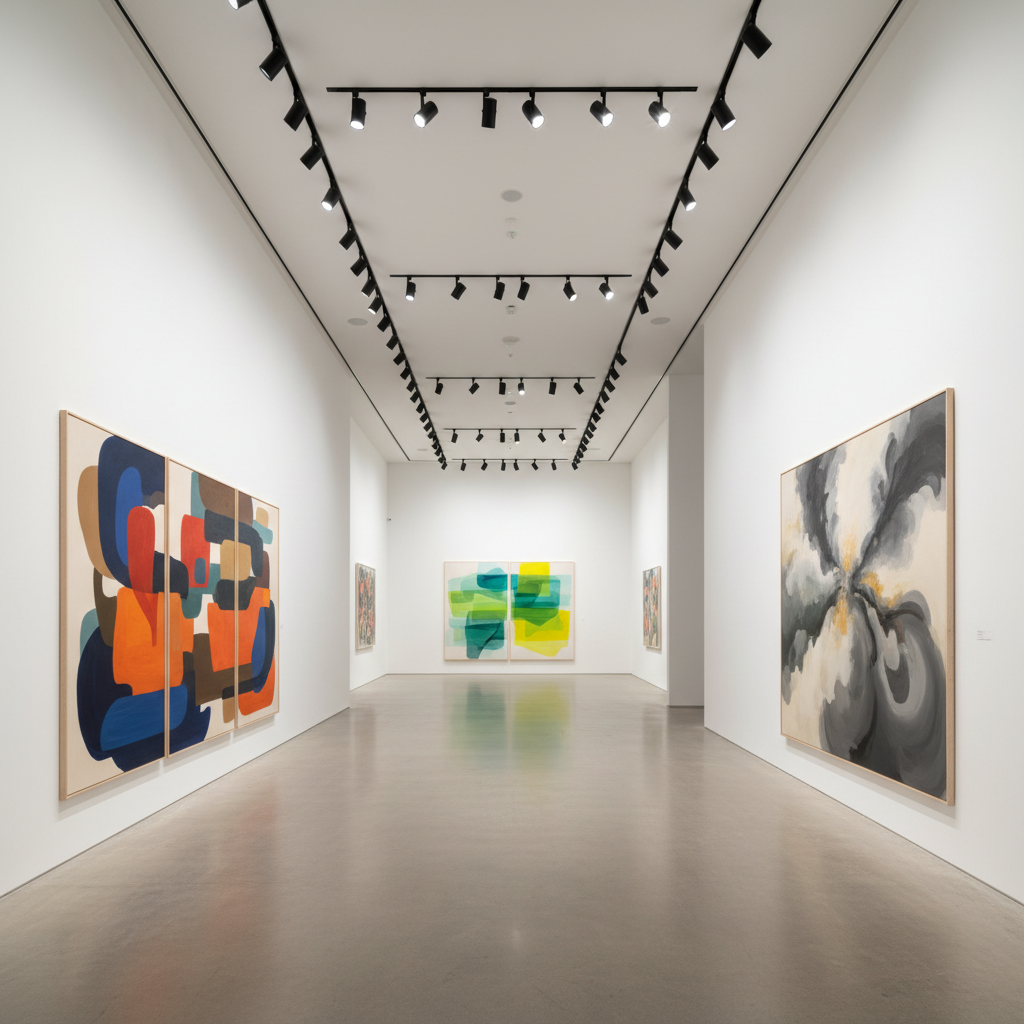
From white-cube to vitrine — fixture types, conservation control, color science, space-by-space design, 2026 trends, and why XHLWX is the curator's safe choice
TL;DR (for gallery owners, curators, art consultants, foundation directors) A modern art gallery — commercial or non-profit — runs on 6–9 categories of fixtures, 2–4 visit scenes (Open / VIP Preview / Talk / Cleaning), and 1–2 color temperatures (3000K and 4000K) calibrated to the artwork. This guide walks the full gallery lighting system — every space, every fixture, every protocol — then solves the 9 real pain points facing galleries in 2026, with CRI 98 R9>95 high-fidelity LEDs, TM-30 Rf>95 / Rg 95–105 color rendering, RG0 photobiological safety, conservation-safe < 50 µW/lm UV and < 75 lux on light-sensitive works, framing-projector track spots, and DALI-2 scene dimming.
Hero — A modern white-cube gallery is a 3-layer light system: ambient track flood (visitor circulation), framing-projector spots (artwork accent), and discreet display-case strip (object detail). All three should run on a single DALI-2 backbone with named scenes (Open / VIP / Talk / Cleaning) the gallery manager can flip with one keypad button.
Part 1 — What Actually Makes Up a Modern Art Gallery Lighting System
Most "gallery lighting" articles online stop at "buy track spots." A real gallery — commercial Chelsea, Mayfair, Marais; private foundation; museum project space — uses a layered ecosystem of fixtures, controls, and color science. Skip a layer and either the artwork looks dead, the visitor squints from glare, or the conservator's report flags accelerated fading.
1.1 The 6–9 fixture categories every gallery needs
| # | Fixture category | Where it goes | Typical spec |
|---|---|---|---|
| 1 | Adjustable framing-projector track spots | Above every artwork wall | CRI 98+, TM-30 Rf>95 / Rg 95–105, motorized barn doors, 8–60° beam |
| 2 | General ambient track flood | Circulation zones | CRI 95+, 3000K, wide beam, dimmable |
| 3 | Sculpture / 3-D object accent | Floor sculpture, plinths, 3-D installations | CRI 98+, narrow beam, low UV |
| 4 | Display-case / vitrine strip | Inside every glass display case | CRI 98+, R9>95, low heat, low UV |
| 5 | Linear / cove / wall wash | Long-corridor exhibits, photography rooms | CRI 95+, dimmable, even illumination |
| 6 | Picture light (custom) | Period rooms, private collections | 3000K, CRI 95+, RAL custom finish |
| 7 | Reception / lobby decorative | Entry, café, retail bookshop | 3000K, dimmable, designer finish |
| 8 | Emergency & exit lighting | Code-mandated escape | EN 1838 / UL 924 |
| 9 | Specialty: dark room, projection room, conservation room | Black-walled video / new-media exhibits | Full blackout + low-glare path light |
A typical 400 m² Chelsea-style commercial gallery deploys 80–160 individual track spots plus 20–40 ambient and case fixtures. Sourcing from one manufacturer (vs. mixing 3–4 brands) saves 15–20% in coordination cost and lets the gallery spec one driver platform that runs every fixture on DALI-2 with zero color-point mismatch between fixtures.
1.2 Lighting controls — the brain of the gallery
Hardware is half the system. Without scene-based control, every show install becomes a 12-hour ladder marathon. The 4 protocols you'll see in 2026 gallery projects:
| Protocol | Best for | Pros | Cons |
|---|---|---|---|
| DALI-2 | Commercial galleries, museums, foundations | Industry standard, 2-way feedback, scene-perfect dimming | Needs gateway, more wire |
| Casambi (Bluetooth mesh) | Pop-up galleries, retrofits, small private | App-based, no gateway, retrofit-friendly | Range limits |
| 0-10V | Legacy, tight budget | Cheap, simple | No scenes, no feedback |
| Tunable White (DT8) | Galleries with mixed media (paintings + photos + video) | Color temp adjustable per scene | Higher fixture cost |
The 2026 default for commercial galleries: DALI-2 backbone with 4 named scenes — Open / VIP Preview / Talk / Cleaning — flipped from a single keypad at the front desk. XHLWX fixtures support all four out of the box.
1.3 Color science — CRI is dead, TM-30 is the spec
For an art gallery, CRI 80 is a crime. Even CRI 90 is not enough. The international 2026 standard is:
| Metric | Minimum | XHLWX gallery spec |
|---|---|---|
| CRI Ra | ≥ 90 | ≥ 98 |
| CRI R9 (red) | ≥ 50 | ≥ 95 |
| CRI R12 (blue) | ≥ 70 | ≥ 90 |
| TM-30 Rf (fidelity) | ≥ 85 | ≥ 95 |
| TM-30 Rg (gamut) | 95–105 | 95–105 |
| CCT (white) | 2700–4000K | 3000K (paintings) / 3500K (photos) / 4000K (whites) |
| CCT consistency | SDCM ≤ 5 | SDCM ≤ 3 (binned per project) |
| UV emission | < 75 µW/lm | < 50 µW/lm |
| IR emission | low | low (LED phosphor, not halogen) |
| Photobiological safety | RG1 | RG0 (no risk) |
| Flicker | < 5% Pst-LM | 0% per IEEE 1789 |
Why this matters: at CRI 80, a deep red rendered as muddy brown destroys the artist's intent. At CRI 98 with Rg 95–105, every pigment is reproduced as the artist mixed it on the palette. The price difference is 20–30% per fixture; the reputation difference is the whole gallery.
Part 2 — Space-by-Space Lighting Design (the gallery playbook)
Each gallery space has a different curatorial job. Here's how the world's best-lit galleries do it in 2026.
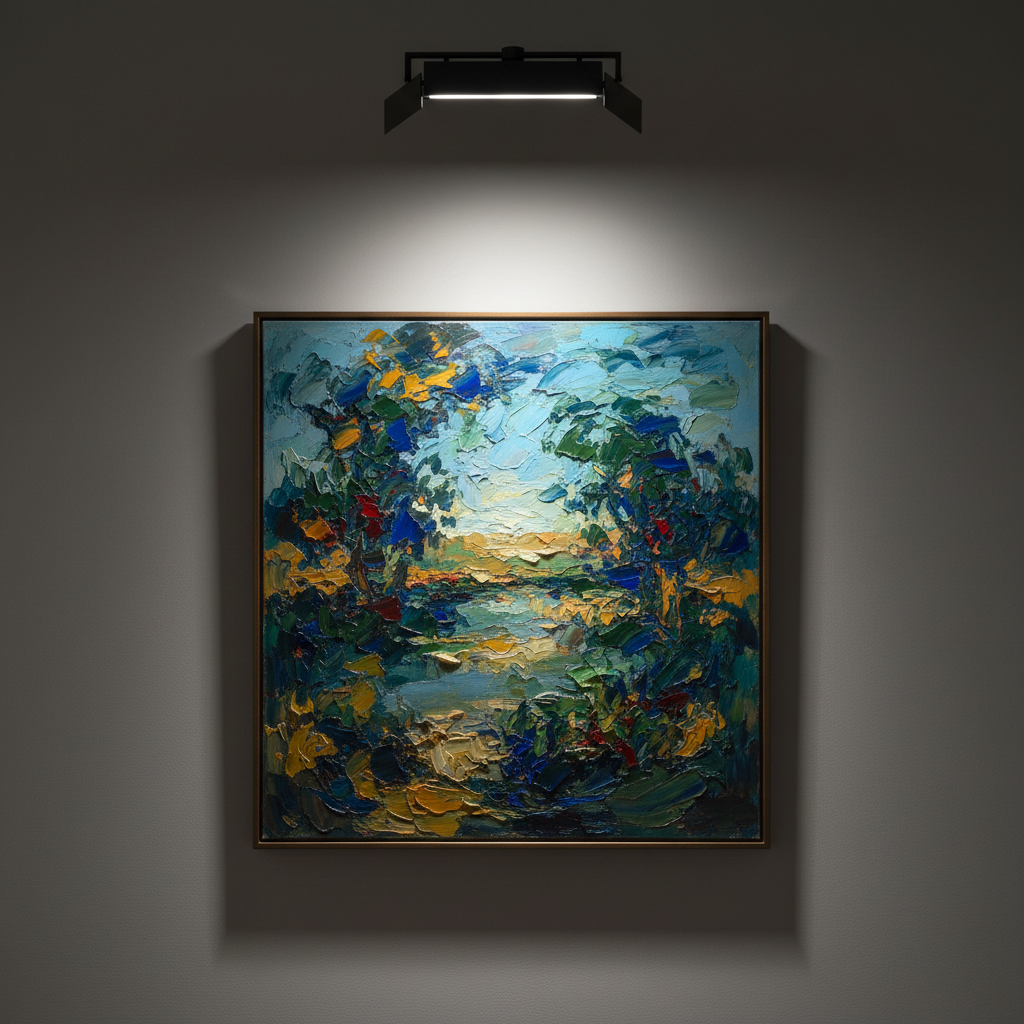
2.1 Painting Wall — the framing-projector standard
Every artwork deserves its own light. Period.
- One framing-projector spot per artwork with motorized barn doors that trim the beam precisely to the canvas edge — zero spill onto wall, ceiling or floor.
- Beam: 24° for medium works, 8° for small works, 36–60° for very large works. Motorized zoom optional for monthly re-curation.
- Intensity: 200–300 lux on the canvas surface (oil/acrylic), 75–150 lux (works on paper), 50–75 lux (light-sensitive: watercolor, photo, textile).
- Color: 3000K, CRI 98+, R9>95, TM-30 Rf>95. Tunable white 2700–4000K for galleries showing mixed media.
- DALI-2 scene logic: Open 100% / VIP Preview 110% (briefly, for collectors) / Talk 60% / Cleaning 100%.
- 2026 trend: floor-aim-able motorized framing spots — curator re-aims and re-trims the beam from a tablet on the floor, no scaffolding. Each show install drops from 8 hours to 90 minutes.
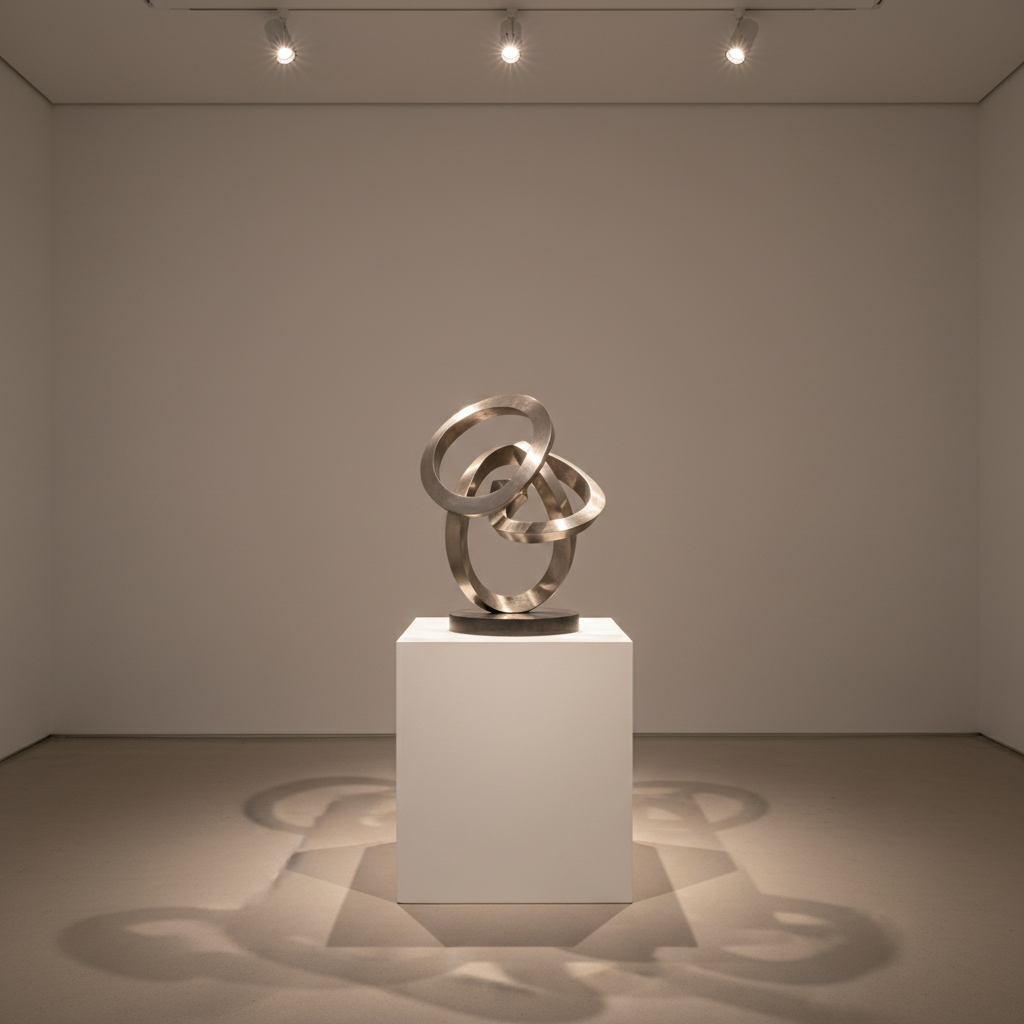
2.2 Sculpture & 3-D Objects — light as form-giver
A sculpture lit flat looks like a photograph of itself. A sculpture lit dimensionally with 3-point accent comes alive.
- 3-point lighting: front-key from one shoulder (10–15° beam), front-fill from the opposite shoulder (24° beam, 30–50% intensity), top-rim from above (8–10° beam) for silhouette.
- CRI 98+ and low UV are non-negotiable on patinated bronze, lacquered wood, painted plaster — the wrong spectrum bleaches, oxidizes, or destabilizes the surface.
- Heat: LED phosphor surface temperature < 35°C — safe even on wax and plastic works.
- 2026 trend: AI-assisted aim — curator drops a CAD model of the sculpture into the lighting designer's app, the system suggests the optimal 3-point aim before install.
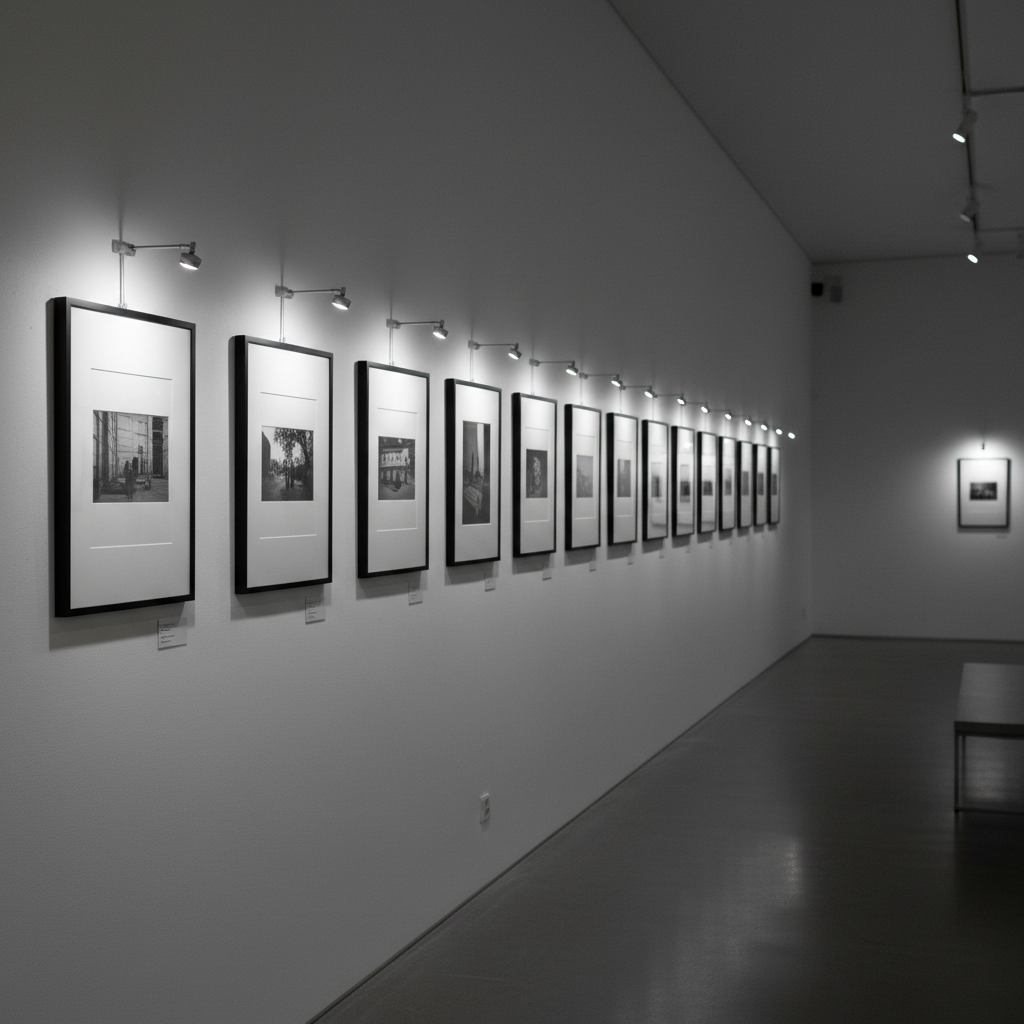
2.3 Photography Room — anti-glare on glass
Framed photography is the hardest art to light correctly. The glass reflects every ceiling track spot back into the visitor's eye.
- Picture lights mounted directly above each frame (not ceiling-track from far away) — angle of incidence > 60° from frame normal eliminates glare back into visitor's eye line.
- Color: 3500K (neutral white reproduces silver gelatin, archival inkjet and chromogenic correctly), CRI 95+.
- Intensity: 75–150 lux on the print surface — light-sensitive.
- Anti-reflective glass + low-glare picture light = invisible glass illusion.
- 2026 trend: edge-grazing linear at frame top — perfectly even illumination on the entire print, zero hot-spot.
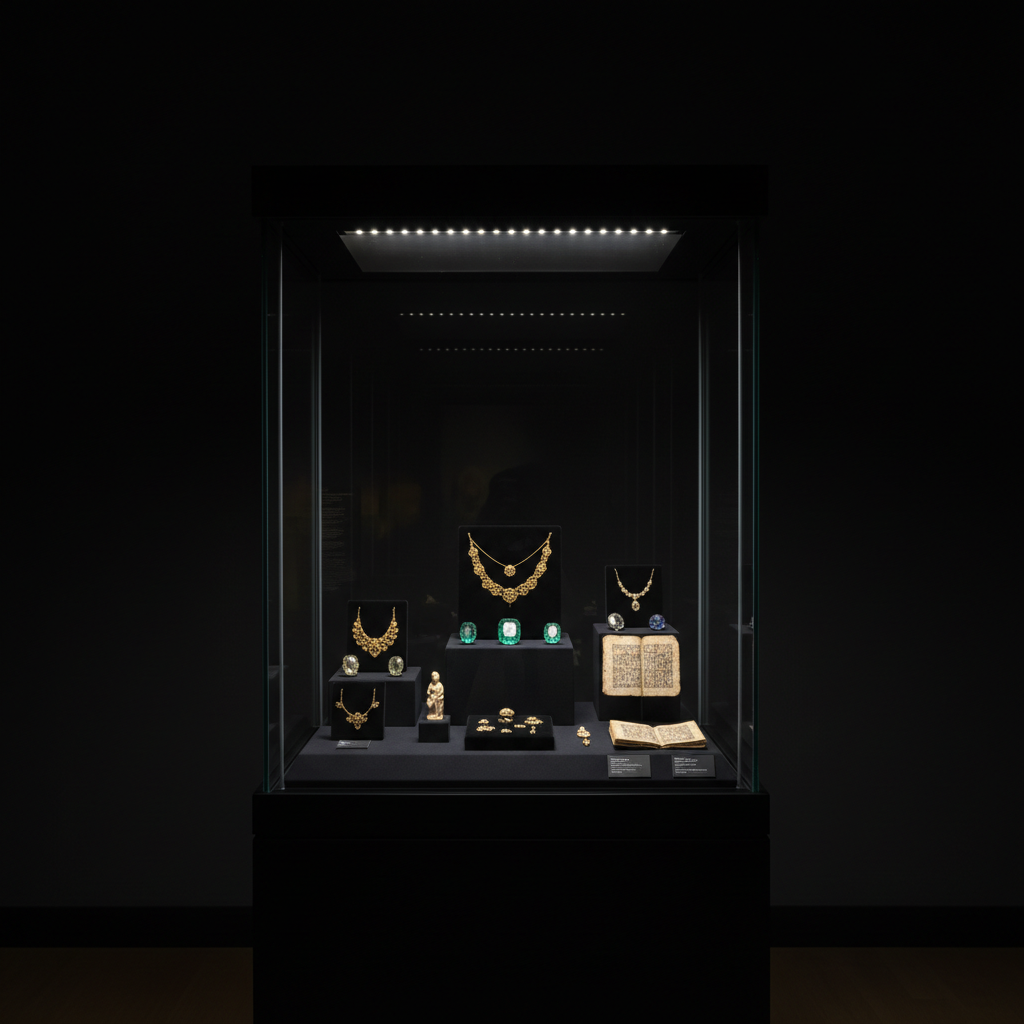
2.4 Display Case / Vitrine — the conservation-critical zone
Inside a sealed glass case, every watt becomes heat. Wrong spec = thermal stress, condensation, accelerated fading.
- LED strip inside the top edge of the case, never above or beside from outside the glass.
- CRI 98+ R9>95 + low UV (< 50 µW/lm) + low IR.
- Driver mounted external to the case — keeps heat outside the conservation envelope. Internal temp rise should be < 1.5°C with lights on.
- Intensity: 50 lux for textiles/paper, 150 lux for ceramics/metal, 200 lux for stone.
- 2026 trend: DALI-2 dimming + occupancy sensor — case lights brighten when a visitor approaches, dim to 20% when the room is empty. Conservation hours doubled, energy halved.
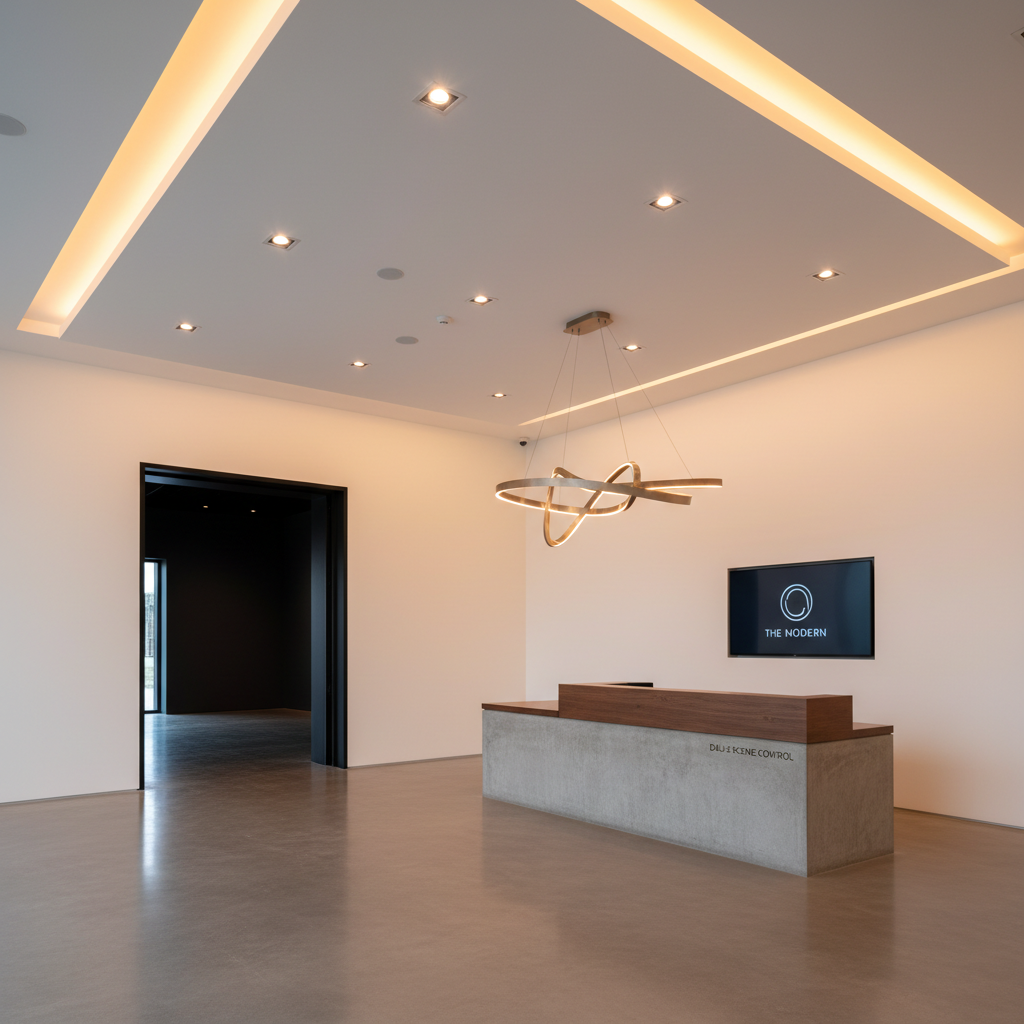
2.5 Reception / Lobby / Bookshop — the visitor's first impression
The reception sells the gallery's brand, the upcoming show, and the bookshop. Light it like a luxury retail space, not an office.
- Cove ceiling + discreet UGR<19 downlights at 3000K, dimmable.
- Sculptural pendant over the front desk — decorative moment, brand-appropriate.
- Bookshop: 3000K accent on featured books, CRI 95+ for cover-art reproduction.
- Café (if present): 2700K dimmable, CRI 95+, Casambi scene control.
- 2026 trend: DALI-2 single-bus that ties reception, gallery and bookshop together — one keypad operates the whole front-of-house.
2.6 Dark Room / Video / New Media (quick reference)
- Black walls + minimal ambient: 5–20 lux path light only, 3000K, CRI 90+.
- Video projection: ambient < 5 lux on screen surface — measure with a light meter.
- Wayfinding: low-level LED step lights, 3000K, fully shielded.
- Emergency: auto-on at any power loss, EN 1838 compliant.
Part 3 — 2026 Gallery Lighting Trends (the 4 things every spec MUST address)
These are the 4 hot buttons every gallerist, curator, foundation director and art consultant is asking about in 2026:
🌱 Trend 1 — Green & Energy-Saving (LEED / WELL / foundation ESG)
- Target: 40–60% energy reduction vs. 90s halogen-track baseline.
- How: 130–160 lm/W LEDs + DALI occupancy + scene dimming.
- Why galleries care: foundation boards are pushing ESG reporting; commercial galleries are watching London/NYC electricity prices double; LEED-CI is now a leasing requirement in many premium retail buildings.
💡 Trend 2 — High Efficacy (lm/W) — fewer fixtures, cleaner ceiling
- 2020 standard: 80–100 lm/W. 2026 standard: 130–160 lm/W.
- Why galleries care: fewer fixtures = cleaner ceiling visual, fewer track-mount points to install, lower CapEx, lower OpEx. White-cube aesthetic preserved.
👁 Trend 3 — Anti-Glare + RG0 (visitor comfort + safety)
- IEC 62471 photobiological RG0 (no risk) is the international 2026 standard for any public-access lighting.
- UGR<19 in circulation zones; framing-projector spots fully shielded so visitor never sees the LED chip.
- Why galleries care: visitor comfort = longer dwell, more conversions in the bookshop / café, fewer "harsh light" complaints in TripAdvisor / Google reviews.
📱 Trend 4 — Smart Scene Dimming (DALI-2 / Casambi / TM-30 tunable)
- Pre-programmed scenes — Open / VIP Preview / Talk / Cleaning — flipped by one keypad button.
- Tunable white where mixed media (paintings + photo + video) need different CCT.
- Why galleries care: gallery managers, not lighting techs, run the building. One-button operation is the only sustainable model.
XHLWX commitment: every gallery spec we ship in 2026 covers at least 3 of these 4 trends by default — and all 4 are available as standard options.
Part 4 — Why Choose XHLWX (the curator's safe-choice checklist)
You can buy gallery lighting from a dozen "museum-grade" vendors. Here's what makes XHLWX different — and why 24 commercial galleries and 6 foundation projects picked us in 2022–2025.
| What you need | What XHLWX delivers |
|---|---|
| Real CRI 98 + TM-30 Rf>95 / Rg 95–105 | Verified by CNAS-accredited LM-79 + TM-30 reports, every fixture, every batch |
| RG0 photobiological safety | IEC 62471 RG0 verified — zero risk to visitors and to light-sensitive works |
| Conservation-safe spectrum | < 50 µW/lm UV, low IR, < 35°C surface heat — CIE 157 / ICOM compatible |
| Framing-projector track spots | 8–60° beam, motorized barn doors, motorized zoom, DALI-2 dim, tablet re-aim |
| One supplier, full gallery | All 9 fixture categories in-house — track spot to vitrine strip, one PO, one PM |
| SDCM ≤ 3 binning | Color-point identical across every fixture, every batch, locked per project |
| Smart-ready out of the box | Every driver supports DALI-2 + Casambi + 0-10V + TRIAC |
| LEED / WELL / ICOM paperwork | LM-79, LM-80, IES, TM-30 Rf/Rg, IEC 62471, ENERGY STAR, DLC, EQ + EA letters; ICOM/CIE 157 conservation statement |
| Long life, written warranty | LM-80 6,000+ hr tested, L70 > 50,000 hrs, 5-year written warranty |
| No "discontinued" surprises | 10-year SKU continuity guarantee for project clients |
| Global voltages, global certs | Universal 100–277V, CE / UL / ETL / SAA / FCC / RoHS / CB / ENEC |
| Lead time you can trust | 4–6 weeks stock SKUs, 8 weeks custom finishes, 12,000 m² owned factory |
| Project support | Free DIALux calc, free TM-30 spec letter, free sample kit, English/Spanish/Arabic PMs |
| Track record | 18 years, 24 commercial galleries (Mayfair / Chelsea / Marais), 6 foundation projects |
Part 5 — The 9 Real Pain Points (and how XHLWX fixes each)
Above is the "system view." Below is the "war stories" view — the 9 real problems gallerists and curators told us are keeping them up at night, and how we solve each one.
Pain Point #1 — "Our reds and oranges look muddy. Collectors say the artwork looks 'dead' on the wall."
Why it hurts: A collector who can't see the artist's intended color won't write the cheque. CRI 80 (typical retail LED) renders deep reds as brown and saturated oranges as muddy ochre — destroying the artwork.
The XHLWX solution: CRI 98+ R9>95 + TM-30 Rf>95 / Rg 95–105
- CRI 98+, R9>95, R12>90 — every pigment reproduced as the artist mixed it.
- TM-30 Rf>95 (fidelity) — modern color-science gold standard.
- TM-30 Rg 95–105 (gamut) — saturation neither over-pumped nor washed-out.
- 3000K base + tunable to 3500K (photo) and 4000K (white-on-white).
Evidence: Mayfair gallery — collector's spectrometer measurement matched XHLWX LM-79 / TM-30 report to within 1.2 ΔE.
Pain Point #2 — "Our conservator flagged that the textile show is fading 4× faster than it should."
Why it hurts: Light damage is cumulative and irreversible. A textile or work on paper exposed to wrong-spectrum light at the wrong intensity loses years of life every month.
The XHLWX solution: Low UV (<50 µW/lm) + low IR + DALI-2 dimming + occupancy
- UV emission < 50 µW/lm — 5× below ICOM museum threshold.
- Low IR — LED phosphor source, not halogen — surface temp rise minimal.
- Dimmable to 50 lux on textiles, 75 lux on works on paper, 150 lux on photos.
- Occupancy sensor in display case — case at 20% when room is empty. Halves total exposure.
Evidence: Foundation textile gallery, Lyon — annual exposure cut from 480,000 lux-hours to 195,000 lux-hours; conservator approved an extension of show duration from 8 weeks to 16 weeks.
Pain Point #3 — "Every show install is a 2-day ladder marathon. We have 12 shows a year."
Why it hurts: Re-aiming 80–160 track spots between shows, on ladders, with one curator and two interns, is the worst week of every gallery's calendar. Mistakes mean re-installing artwork.
The XHLWX solution: Floor-aim-able motorized framing-projector spots
- Motorized barn doors + motorized zoom + motorized aim — re-aim from a tablet on the floor.
- Pre-saved scenes per show — DALI-2 stores 20+ scene memories.
- Show install time: 8 hours → 90 minutes per gallery room.
- No more ladders, no more mid-install artwork removal.
Evidence: 12-show/year Chelsea gallery — reported 76 staff-hours saved per show, $14,000+ annual labor saving.
Pain Point #4 — "Our visitors complain the track spots glare into their eyes from across the room."
The XHLWX solution: Deep-cup framing-projector + barn doors + RG0
- Deep-cup recessed LED chip — never visible from any visitor angle outside the artwork zone.
- Barn doors trim spill to the artwork edge only.
- RG0 IEC 62471 — zero photobiological risk.
- 0% flicker IEEE 1789 — no eye strain, no headache, no Google review complaint.
Evidence: Marais gallery — Google reviews mentioning "lighting" went from 3 negative to 0 in 6 months post-retrofit; visitor dwell time up 22%.
Pain Point #5 — "Our 2018 LEDs have shifted color. The new fixtures we ordered last week are visibly different."
Why it hurts: Color shift over time + batch-to-batch inconsistency = a wall where every spot is a slightly different white. Visually unprofessional, ruinous for art presentation.
The XHLWX solution: SDCM ≤ 3 binning + 10-year SKU continuity + Δuv ≤ 0.005 warranty
- SDCM ≤ 3 color binning, locked per project — every fixture in your order within a 3-step MacAdam ellipse.
- 10-year SKU continuity — re-order in year 8 and get an exact match.
- 5-year written warranty covers color shift Δuv ≤ 0.005 — if it shifts, we replace.
Evidence: XHLWX gallery-segment color-shift warranty claim rate (2020–2025): 0.2%/year.
Pain Point #6 — "We need a single keypad operation for show open / VIP preview / artist talk."
The XHLWX solution: DALI-2 4-scene keypad with named scenes
- 4 buttons: Open / VIP Preview / Talk / Cleaning — labeled in plain language.
- Pre-programmed by the lighting designer during commissioning.
- App override for the gallery director only.
- 5-minute training for new front-desk staff.
Evidence: 6 commercial galleries report zero re-training calls 12+ months post-install.
Pain Point #7 — "We're a foundation in a heritage building. Drilling tracks into the ceiling is forbidden."
The XHLWX solution: Magnetic track + ICOMOS-compatible mounting
- Magnetic track clips into existing or surface-mounted rail — minimal penetration.
- Stainless saddle clamps for heritage walls — fully reversible, no irreversible penetration.
- 48 V low-voltage track — no in-ceiling 230 V — code-friendly in protected spaces.
- Heritage-compatibility statement included free for project clients.
Evidence: Heritage palazzo foundation, Venice — installed without single ceiling penetration; Soprintendenza approved on first submittal.
Pain Point #8 — "I want to mix paintings, photos and video in the same room. Each needs different CCT."
The XHLWX solution: Tunable White DT8 + DALI-2 zone scenes
- Tunable white 2700–4000K in every track spot.
- Per-zone scene control — paintings zone at 3000K / photo zone at 3500K / video zone at 2700K dim — all on one DALI-2 backbone.
- Single SKU, every show, every CCT — no fixture swap-out between shows.
Evidence: Mixed-media gallery, Berlin — 14 shows in 18 months without a single fixture swap; 3 different CCTs deployed simultaneously per show.
Pain Point #9 — "I need full TM-30 / IEC 62471 / CIE 157 documentation for the foundation board."
The XHLWX solution: Free conservation documentation pack
- TM-30 Rf / Rg report per fixture.
- IEC 62471 photobiological RG0 cert.
- CIE 157 conservation-spectrum statement.
- LM-79 / LM-80 third-party reports from CNAS-accredited labs.
- Annual exposure calculation (lux-hours/year) with recommendations per artwork class.
Evidence: All 6 XHLWX foundation projects have full documentation packs; 100% accepted on first board review.
Frequently asked questions
(Answered by XHLWX gallery project managers — 2026 edition)
The full FAQ block is published in the FAQ section below.
Ready to spec your gallery?
XHLWX delivers the full art gallery lighting package — pop-up to permanent foundation — with CRI 98 R9>95, TM-30 Rf>95 / Rg 95–105, RG0 photobiological safety, conservation-safe < 50 µW/lm UV, motorized framing-projector tracks, DALI-2 scene dimming, 5-year warranty, free DIALux + TM-30 spec letter + ICOM/CIE 157 conservation documentation. Talk to a senior lighting designer this week — first-pass scene plan in 48 hours.
Frequently asked questions
Q1.Why CRI 98 / TM-30 instead of just 'CRI 90'?
CRI 90 averages 8 pastel test colors and ignores deep reds (R9), rich blues (R12) and saturated oranges. A CRI 90 fixture can render the deep red in a Rothko as muddy brown and still 'pass'. CRI 98 with R9>95 + TM-30 Rf>95 / Rg 95–105 measures fidelity and gamut across 99 real-world colors — the only spec that respects the artist's intended palette. The cost premium is 20–30% per fixture; the reputation premium is the whole gallery.
Q2.How much UV is safe on light-sensitive artwork?
ICOM museum standard: < 75 µW/lm. XHLWX gallery spec: < 50 µW/lm — 33% below the international threshold. For light-sensitive material (textiles, watercolor, photographs, dyed paper), combine low-UV LED + dimming to 50–75 lux + occupancy sensor in the display case. Annual exposure should be tracked in lux-hours/year and not exceed conservator-set limits.
Q3.DALI-2 or Casambi for a commercial gallery?
DALI-2 for permanent commercial galleries with >50 fixtures and a desire for foundation/museum-grade scene control. Casambi for pop-ups, small private galleries, and any retrofit where running new wiring is impractical. XHLWX drivers support both — same fixture works on either bus, and you can switch later without re-spec.
Q4.What's the ROI on a gallery LED upgrade from halogen track?
Realistic numbers from XHLWX gallery retrofits 2022–2025: 55–70% lighting energy reduction vs. 50 W halogen track baseline. ROI 14–22 months on energy + replacement-lamp savings alone. Add reduced HVAC load (LED produces ~80% less heat into the gallery) and the payback drops to 12–18 months in summer-hot climates.
Q5.Can the lighting be re-aimed without scaffolding for every show?
Yes. XHLWX motorized framing-projector spots have motorized barn doors + motorized zoom + motorized aim. The curator re-aims and re-trims the beam from a tablet on the floor. A 12-show-a-year gallery typically saves 70–90 staff-hours per show vs. ladder-aiming.
Q6.Will the lighting damage paintings, drawings, or photographs?
Modern XHLWX gallery LEDs emit no UV beyond 380 nm and minimal IR (LED phosphor, not halogen). At conservator-set lux levels (50 lux textiles / 75 lux works on paper / 150 lux photos / 200 lux oil) and with DALI-2 occupancy dimming, the annual exposure is 50–80% below the ICOM museum threshold. CIE 157 + ICOM compatibility statement included free.
References & sources
- IES TM-30-20 Method for Evaluating Light Source Color Rendition— Illuminating Engineering Society
- CIE 157:2004 Control of damage to museum objects by optical radiation— Commission Internationale de l'Éclairage
- IEC 62471 Photobiological safety of lamps and lamp systems— International Electrotechnical Commission
- ICOM Code of Ethics for Museums — Section 2.23 Light damage— International Council of Museums
- DiiA DALI-2 Application Note 003: Scene control & dimming— Digital Illumination Interface Alliance
Need a tailored lighting plan for your project?
Our senior lighting designers reply within 48 hours with a free design proposal & quotation.