
Beauty Salon Lighting Design 2026: CRI95 Mirror & Colour Guide
Quick answer
A definitive guide to beauty salon lighting. Learn how CRI95+, tunable white, and glare control create perfect colour-matching environments and enhance client
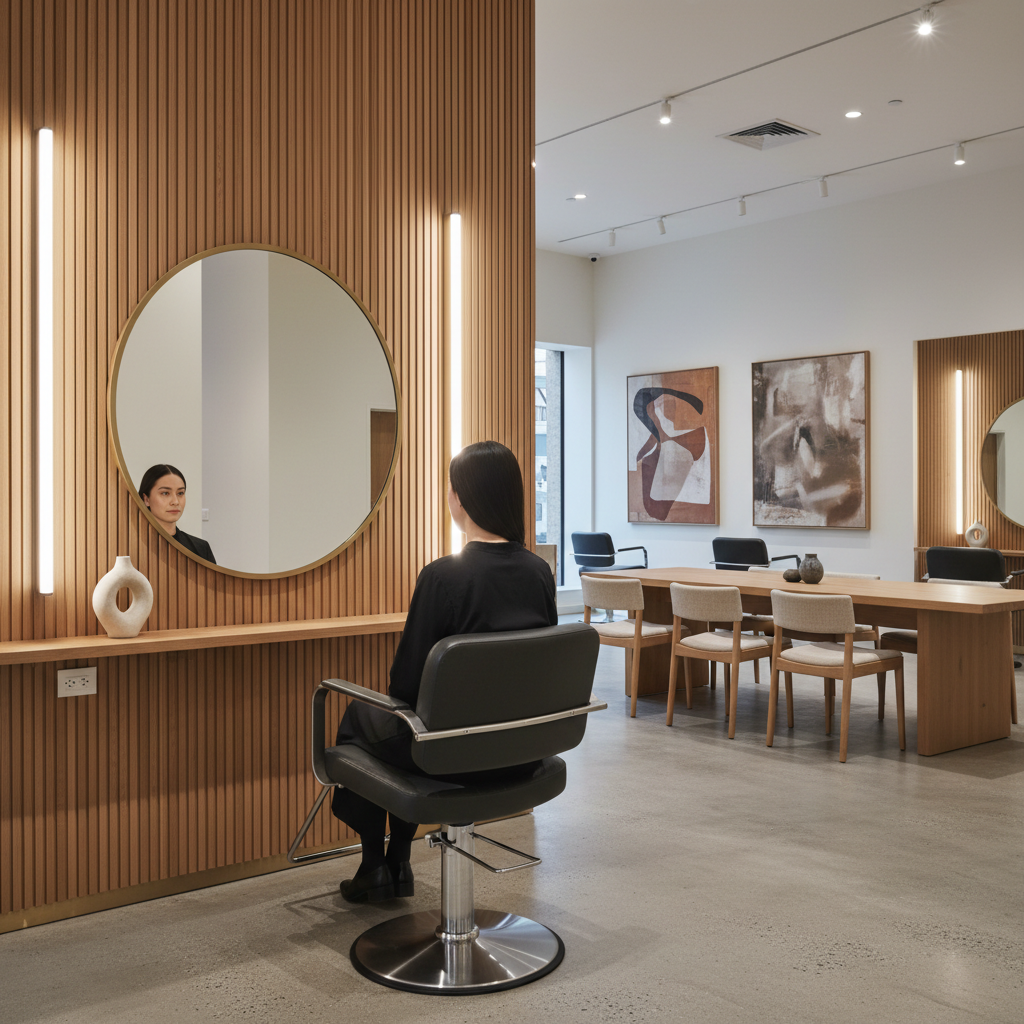
Introduction — the Design Problem in Beauty Salons
At XHLWX (led-project-light.com), a Custom Indoor LED Lighting Manufacturer based in China, we understand that exceptional lighting is not a luxury in a beauty salon; it is a fundamental business tool. The primary design challenge is creating a dual-purpose environment: one that provides technically precise, colour-accurate light for stylists, and another that is comfortable, flattering, and welcoming for clients. Poor lighting can lead to inaccurate hair colour results, client dissatisfaction, and a diminished brand perception. This guide outlines how to solve these challenges using modern LED technology, focusing on high-fidelity colour rendering, glare control, and dynamic control systems to create the perfect salon atmosphere.
Lighting Criteria and Standards for This Application
Effective salon lighting must meet stringent technical and human-centric standards. The goal is to balance task performance for stylists with visual comfort for clients, adhering to established international benchmarks for quality and safety. Key standards like EN 12464-1 dictate minimum illuminance levels for task areas, while modern wellness standards such as WELL v2 emphasize the quality of light, including flicker, glare, and colour rendering fidelity. For salons, achieving a Colour Rendering Index (CRI) of 95 or higher is non-negotiable for accurate colour work. Furthermore, metrics like TM-30-20 provide a more complete picture of colour rendition, which is critical for stylists matching subtle tones in hair and makeup. The table below outlines recommended specifications for a high-performance salon lighting system.
| Parameter | Recommended Specification | Standard Reference | Notes |
|---|---|---|---|
| Illuminance (Task) | 500 – 1000 lux (on face/hair) | EN 12464-1 / IES RP-2 | Vertical illuminance at the mirror is crucial for eliminating shadows. |
| Colour Temperature | 2700K – 6500K Tunable White | WELL v2 | Allows simulation of different environments (daylight, office, evening). Fixed 4000K is a good alternative. |
| Colour Rendition | CRI Ra >95, R9 >90, TM-30 Rf >90 | IES TM-30-20 | Essential for accurate hair colour and skin tone representation. High R9 (red) is critical. |
| Glare Control | UGR < 19 | EN 12464-1 | Prevents client and stylist discomfort, especially during long sessions looking towards luminaires. |
| Control System | DALI-2 DT8 or Casambi | DALI-2 (IEC 62386) | DT8 for tunable white. Casambi offers flexible wireless control, ideal for retrofits and scene setting. |
| Housing & Safety | IP44 (splash zones), IK04 | IEC 60529 / EN 62262 | IP44 near washing stations protects against water spray. General areas can be IP20. |
| Certifications | CE, RoHS, ErP, ISO9001 | EU Directives | Mandatory for EU market access, ensuring safety, environmental, and quality standards. |
| LED Chip / Driver | Samsung/Bridgelux Chips, Tridonic/Mean Well Driver | Manufacturer Spec | Using premium components ensures long-term performance, colour stability, and reliability. |
Luminaire Selection and Optics
Choosing the right luminaires and optics is pivotal to executing the design intent. A common mistake is to rely solely on overhead downlights, which cast harsh shadows on the face. The optimal solution is a layered approach, combining ambient, task, and accent lighting. For the critical mirror stations, vertical linear luminaires are the superior choice. When placed on both sides of the mirror, they provide even, shadowless illumination on the client's face and hair. This is then supplemented by high-CRI, low-glare downlights for general ambient light and adjustable track spots for highlighting retail displays or architectural features.
| Luminaire Type | Application | Pros | Cons | Verdict |
|---|---|---|---|---|
| Vertical Linear LED | Mirror Task Lighting | Shadow-free facial illumination, excellent for colour work, modern aesthetic. | Requires careful integration with mirror design, higher initial cost. | Essential. The gold standard for styling and colouring stations. |
| High-CRI Downlights | Ambient & General Lighting | Provide overall brightness, can be discreetly integrated into the ceiling. | Can create harsh shadows if used as primary task lighting for mirrors. | Recommended. Use low-glare (UGR<19) models for ambient fill light. |
| Adjustable Track Spots | Accent & Retail Lighting | Flexible, easily re-aimed to highlight products or features, creates visual interest. | Can cause glare if not aimed correctly, adds complexity to the ceiling plane. | Recommended. Excellent for creating focal points and driving retail sales. |
| Integrated Backlit Mirror | All-in-one Task Lighting | Sleek, minimalist look, simplifies installation. | Light quality can be inconsistent, difficult to repair/replace, often not bright enough. | Situational. Best for restrooms or secondary areas, not primary colouring stations. |
How Does Tunable White Lighting Improve Client Consultations?
Tunable white lighting empowers stylists to simulate different real-world lighting conditions. A client’s new hair colour will look different under cool office fluorescents, warm evening light at home, or neutral midday sun. By adjusting the CCT from a warm 2700K to a cool 6500K during the consultation, stylists can show clients exactly how their colour will appear in various environments. This manages expectations, builds trust, and dramatically reduces the chance of post-appointment dissatisfaction, turning a technical feature into a powerful sales and client retention tool.
What Is the Ideal Lighting Layout for Individual Mirror Stations?
An ideal mirror station layout prioritizes shadow-free vertical illumination. This is best achieved by placing two linear LED fixtures vertically, one on each side of the mirror. The centre of each luminaire should be roughly at eye level (approx. 1.55m / 61 inches from the floor). This cross-illumination technique models the face and hair evenly, eliminating the harsh shadows created by overhead-only lighting. This task lighting should be supplemented by general ambient light from ceiling downlights positioned behind the stylist to avoid casting their shadow onto the client.
Why Is Glare Control (UGR) Critical for Client Comfort?
Glare control is paramount because clients spend long periods looking up or around the salon. Luminaires with a high Unified Glare Rating (UGR) cause visual discomfort, forcing clients to squint and leading to headaches and fatigue. According to EN 12464-1, a UGR of less than 19 is recommended for task areas to ensure comfort. By specifying low-glare optics, diffusers, and properly positioned fixtures, a salon ensures a relaxing, premium experience, reinforcing the perception of quality and care that justifies high-end services.
Controls, Energy, and Commissioning (DALI-2 / Casambi / Sensors)
A sophisticated control system transforms a static lighting installation into a dynamic asset. For new builds or major renovations, DALI-2 (Digital Addressable Lighting Interface) offers the most robust solution. It allows for individual control of every fixture, enabling precise scene-setting for different tasks (colouring, cutting, cleaning), diagnostics, and energy monitoring. DALI-2 DT8 is the specific standard for colour-tunable fixtures, simplifying control. For retrofits or projects demanding more flexibility, Bluetooth mesh systems like Casambi are ideal. They offer wireless control from a tablet or switch, making it easy to create scenes, set schedules, and adapt the lighting without new wiring. Integrating occupancy sensors in back-of-house areas and restrooms can yield significant energy savings, ensuring lights are only on when needed.
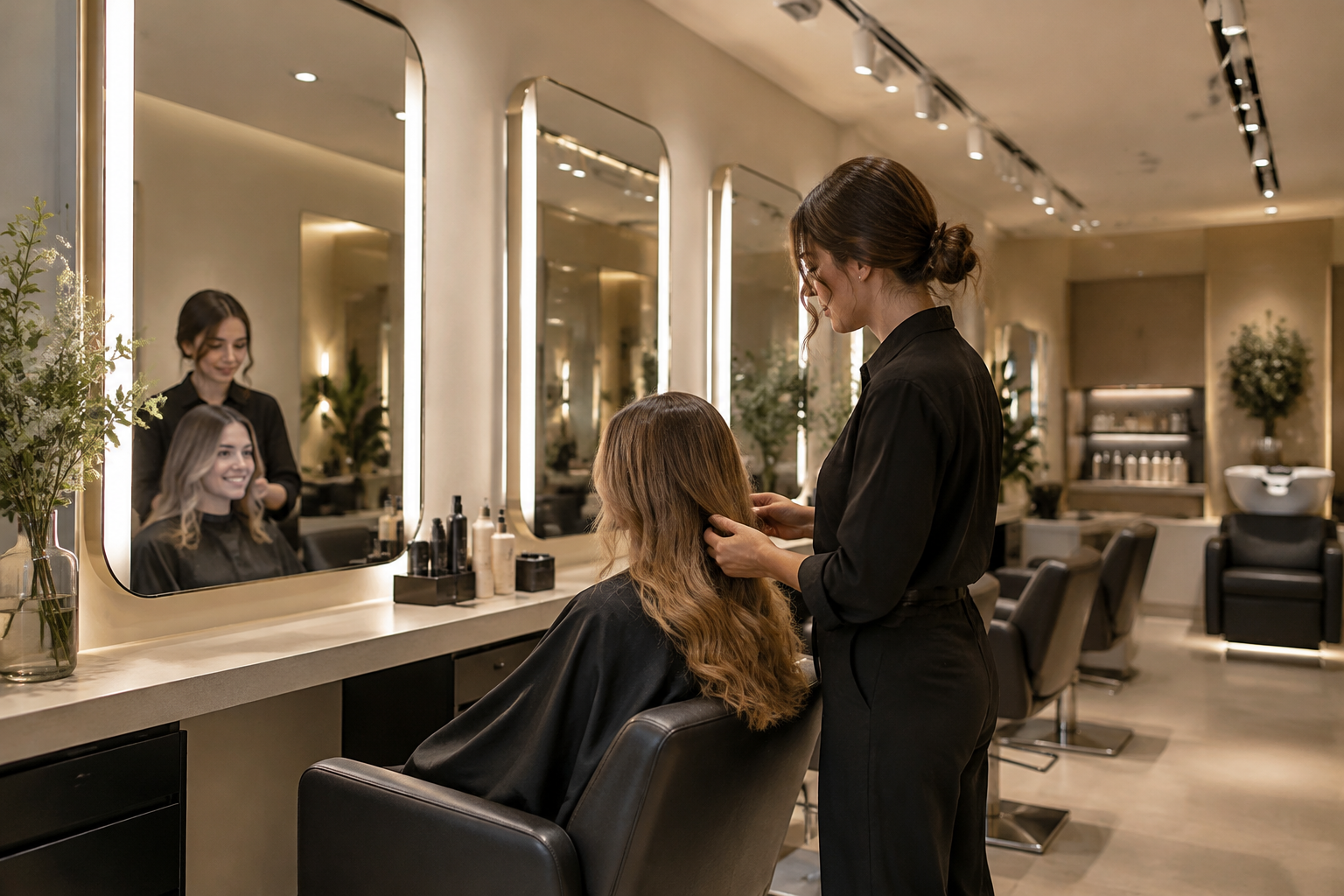 Beauty Salon Lighting Design 2026: CRI95 Mirror & Colour Guide: Why is glare control (UGR) critical for client comfort?
Photometric Files & Compliance (IES / LDT / DIALux / CE / RoHS / ErP)
Professional lighting design requires precise planning and verification. At XHLWX, we provide comprehensive photometric data for all our custom luminaires. We supply industry-standard IES (.ies) and EULUMDAT (LDT, .ldt) files for every product. These files contain the exact light distribution data, allowing architects and lighting designers to create highly accurate simulations in software like DIALux. These simulations verify that the design will meet all target illuminance (lux) levels, uniformity, and glare (UGR) requirements before a single fixture is installed. All our products for the European market are fully compliant with CE (safety), RoHS (hazardous substances), and ErP (energy efficiency) directives, ensuring a smooth and compliant project delivery.
Frequently Asked Questions
Q: What Is the Best CCT for a Hair Salon?
A tunable white system (2700K-6500K) is ideal, allowing stylists to match lighting to outdoor conditions for perfect colour consultations. If a fixed CCT is necessary, a neutral white 4000K or a cool white 5000K with a CRI over 95 provides excellent clarity and colour accuracy for technical work.
Q: How Many Lux Do I Need at the Styling Station?
For critical task areas like the client's hair and face at the mirror, you should target a vertical illuminance of 500 to 750 lux. This level, recommended by standards like EN 12464-1, ensures stylists have ample light for detailed work without causing glare or discomfort for the client.
Q: Is a High CRI Really That Important?
Absolutely. CRI measures how accurately a light source reveals colours. For a salon, a CRI of 95 or higher (with an R9 value over 90 for reds) is essential. It ensures that hair colour, skin tones, and makeup appear exactly as intended, preventing costly mistakes and ensuring client satisfaction with their final look.
Q: Are Vertical Linear Lights Better Than Downlights Around a Mirror?
Yes, for task lighting, vertical linear fixtures flanking a mirror are vastly superior. This setup provides diffuse, shadow-free light across the entire face. A design relying only on downlights creates harsh shadows under the eyes, nose, and chin, which can distort the client's appearance and make the stylist's job harder.
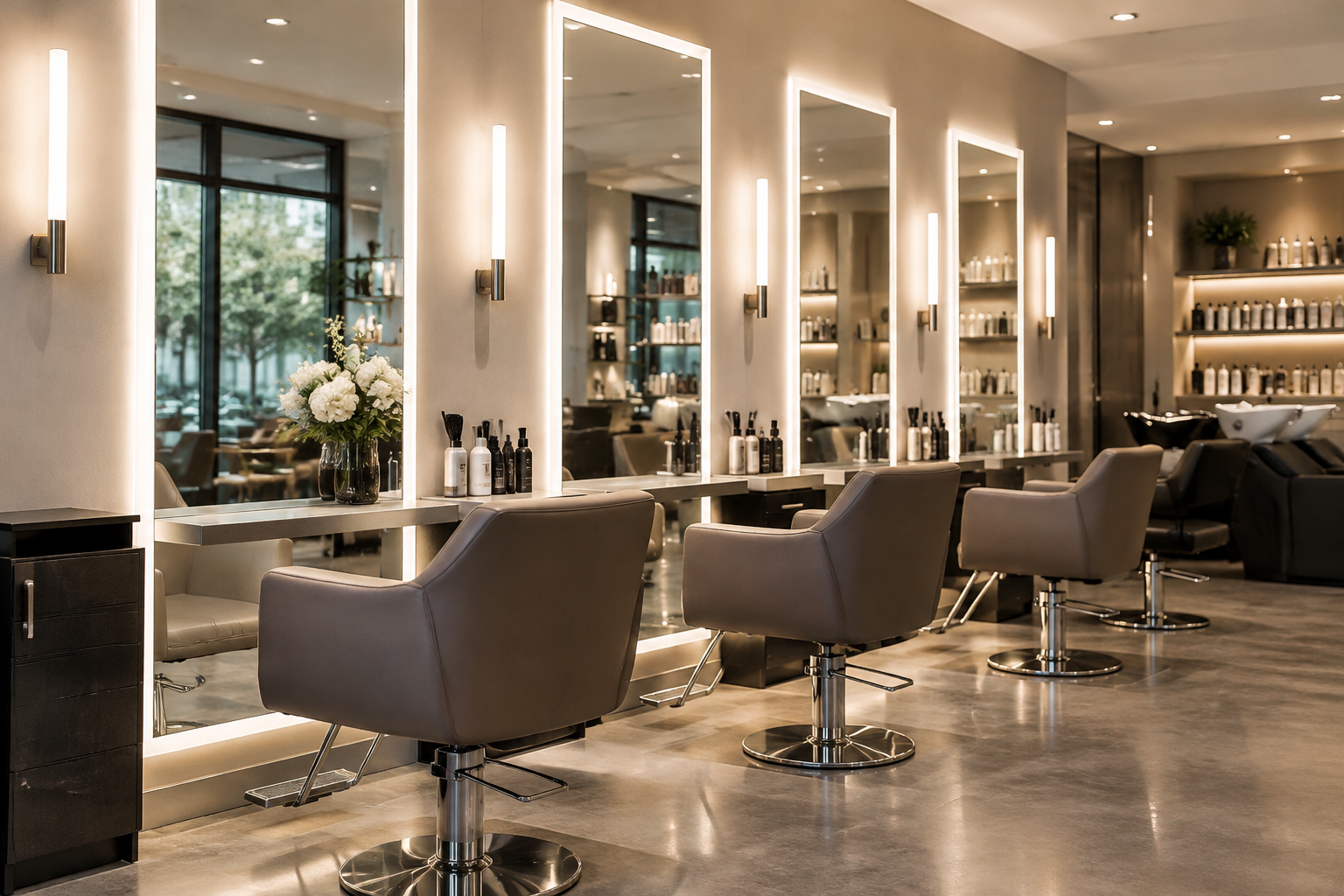 Beauty Salon Lighting Design 2026: CRI95 Mirror & Colour Guide: Q: How many lux do I need at the styling station?
Sources and Technical References
- EN 12464-1:2021: Light and lighting — Lighting of work places — Part 1: Indoor work places.
- IES RP-2-19: Recommended Practice: Lighting for Retail Environments.
- WELL Building Standard v2: Light Concept.
- IES TM-30-20: IES Method for Evaluating Light Source Color Rendition.
Request a Custom Quote
At XHLWX (led-project-light.com), a Custom Indoor LED Lighting Manufacturer based in China, we specialize in developing tailored lighting solutions for commercial projects across the EU, US, and Middle East. From high-CRI linear fixtures for mirror stations to DALI-2 controlled tunable white systems, we provide the technical expertise and manufacturing capability to bring your salon design to life. Contact our solutions team today to discuss your project requirements and receive a no-obligation quote and a complimentary DIALux simulation.
Need a tailored lighting plan for your project?
Our senior lighting designers reply within 48 hours with a free design proposal & quotation.