Cafe & Coffee Shop Lighting Design 2026
From bar counter to outdoor terrace — the complete cafe lighting buyer's guide for 2026: warm 2700K dimmable LEDs, CRI 95 R9>90 food-grade light, UGR<19 an...
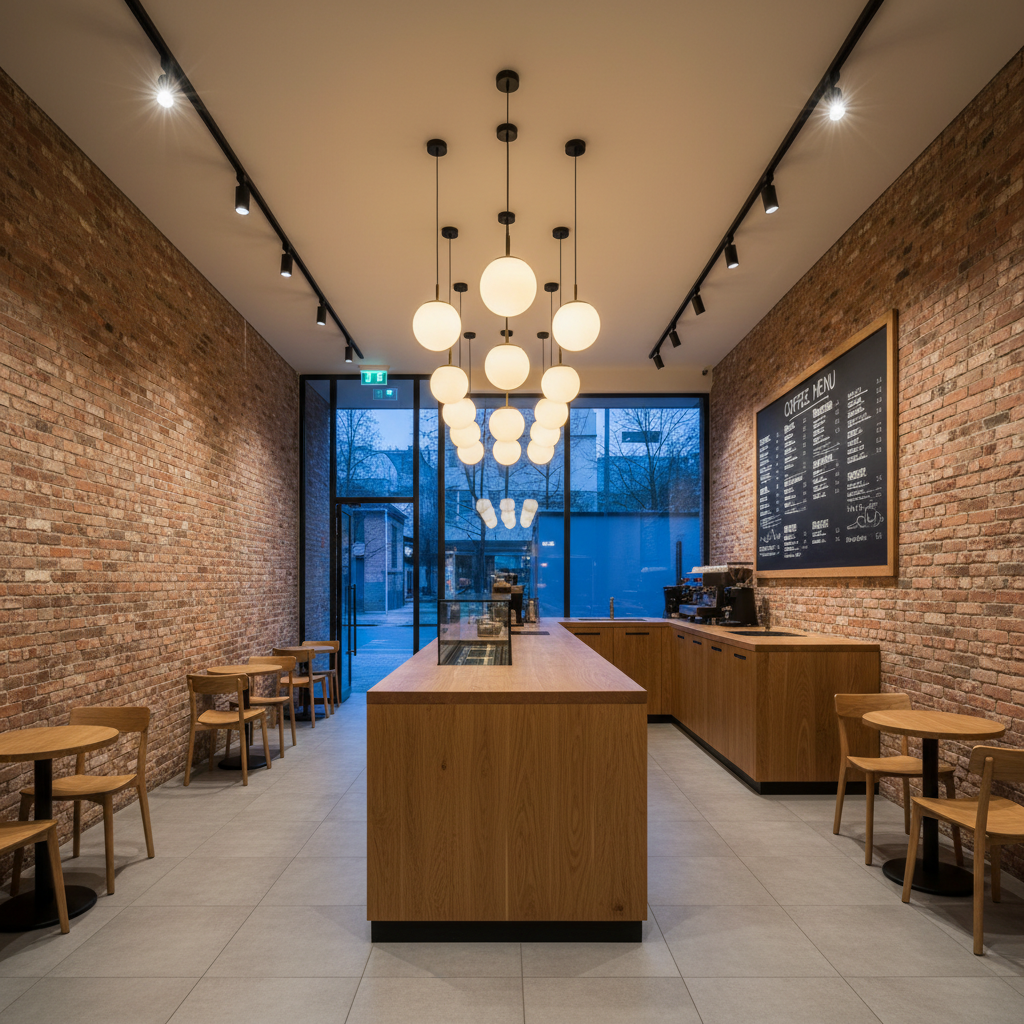
From bar counter to outdoor terrace — fixture types, smart scenes, color temperature, space-by-space design, 2026 trends, and why XHLWX is the cafe owner's safe choice
TL;DR (for cafe owners, F&B designers, multi-site operators) A specialty coffee shop runs on 6–9 categories of fixtures, 2–3 smart scenes (morning rush / afternoon focus / evening wind-down), and 2–3 color temperatures (2200K–3500K) layered to lift dwell time, food photography, and conversion. This guide walks through the full cafe lighting system — every zone, every fixture, every protocol — then solves the 9 real pain points keeping cafe owners and chains awake at night, with CRI 95 R9>90 food-grade LEDs, UGR<19 anti-glare, 130–160 lm/W high-efficacy chips, Casambi / DALI-2 smart scenes, and Instagram-ready warm 2700K dimming.
Hero — A modern specialty coffee shop is a 3-layer light system: warm 2700K pendants over the bar (decorative), CRI 95 anti-glare downlights (ambient), and high-fidelity track spots on the menu wall (accent). All three should run on a single Casambi or DALI-2 scene controller so the morning, afternoon and evening atmospheres flip with one tap.
Part 1 — What Actually Makes Up a Modern Cafe Lighting System
Most "cafe lighting" articles on the internet stop at "buy nice pendants." A real specialty cafe — the kind that hits 45-minute average dwell times, 18% repeat-visit rates, and 6,000 monthly Instagram tags — uses a layered ecosystem of fixtures, controls and color strategies. Skip a layer and the whole guest experience collapses into "Starbucks fluorescent."
1.1 The 6–9 fixture categories every cafe needs
| # | Fixture category | Where it goes | Typical spec |
|---|---|---|---|
| 1 | Decorative bar pendants | Above the espresso bar / counter | 2700K, dimmable, designer finish |
| 2 | CRI 95 anti-glare downlights | General ambient over seating | UGR<19, CRI 95+, R9>90, 130 lm/W |
| 3 | Magnetic track / mini-spots | Menu boards, art walls, retail shelves | 24°/36° beam, CRI 95, dimmable |
| 4 | Linear / cove / strip LED | Under bar, under shelves, ceiling cove | 24V, dot-free, IP20–IP65, CRI 95 |
| 5 | Pastry case / display lighting | Glass display, retail merch | CRI 95+ R9>90, low heat, 3000K |
| 6 | Decorative wall sconces / table lamps | Booths, lounge corners, window sills | 2700K, dimmable bulb, hospitality finish |
| 7 | Outdoor / terrace lighting | Patio, festoon, façade wash | IP65–IP67, 2700–3000K, RGBW optional |
| 8 | Task lights | Barista station, prep area, POS | 4000K, CRI 90+, flicker-free |
| 9 | Emergency & exit | Code-mandated escape lighting | EN 1838 / UL 924 |
A typical 120 m² specialty cafe deploys 45–80 individual fixtures across these categories. Sourcing from a single manufacturer (vs. 4–5 Alibaba sellers) saves 15–20% in coordination cost, eliminates color-matching nightmares, and lets you spec one driver platform that runs every fixture on Casambi or DALI-2.
1.2 Lighting controls — the brain of a coffee shop
Hardware is half the system. Without a smart layer, the morning espresso rush gets the same flat 100% light as the candle-lit Friday-evening date crowd — and your dwell time, ticket size and Instagram tags all flatten with it. The 4 protocols you'll actually see in 2026 cafe projects:
| Protocol | Best for | Pros | Cons |
|---|---|---|---|
| Casambi (Bluetooth mesh) | Independents, retrofits, multi-site chains | No gateway, app-based, retrofit-friendly, cheap | Range limits in concrete |
| DALI-2 | Larger flagship cafes & chains with BMS | 2-way feedback, granular dimming, BMS-ready | Needs gateway, more wire |
| 0-10V / TRIAC | Budget retrofits, single circuits | Cheap, simple | No scenes, dated |
| Tunable White (DT8) | Cafes wanting circadian-matching | Auto-warm at night, auto-cool at noon | Higher fixture cost |
The 2026 default for specialty cafes: Casambi mesh on every fixture, 4 pre-programmed scenes (Morning Rush / Mid-Day Work / Golden Hour / Evening Wine), one wall keypad for staff, owner-only adjustment from her phone. XHLWX fixtures support all four out of the box — no SKU swap if you decide to upgrade later.
1.3 Color temperature & CRI strategy by zone
Color is not "one warm white fits all." A great cafe uses 2–3 color temperatures to shape mood, energy and food appearance:
| Zone | Color temp | CRI | Why |
|---|---|---|---|
| Bar / espresso counter | 2700K | CRI 95+, R9>90 | Latte art and crema look perfect, baristas as hero |
| General seating | 2700–3000K | CRI 95+ | Skin-flattering, "stay another hour" feel |
| Pastry / cake display | 3000K | CRI 95+ R9>90 | Croissants golden, cakes rich, no UV bleach |
| Window bar / co-working zone | 3500K + tunable | CRI 90+ | Alert enough to focus, soft enough to linger |
| Barista prep / kitchen | 4000K | CRI 90+ | Task accuracy, hygiene visibility |
| Outdoor terrace | 2700K + RGBW | CRI 90+ | Warm, festive, holiday flexibility |
2026 best practice: spec tunable white 2200–4000K in every recessed downlight. One SKU, every mood — morning energy at 4000K, evening intimacy at 2200K, all switched by Casambi scene from the barista's phone.
Part 2 — Zone-by-Zone Lighting Design (the specialty cafe playbook)
Each zone has a different job — sell coffee, sell pastry, hold the laptop crowd, become the Instagram backdrop. Here's how 2026's best cafes light each one.
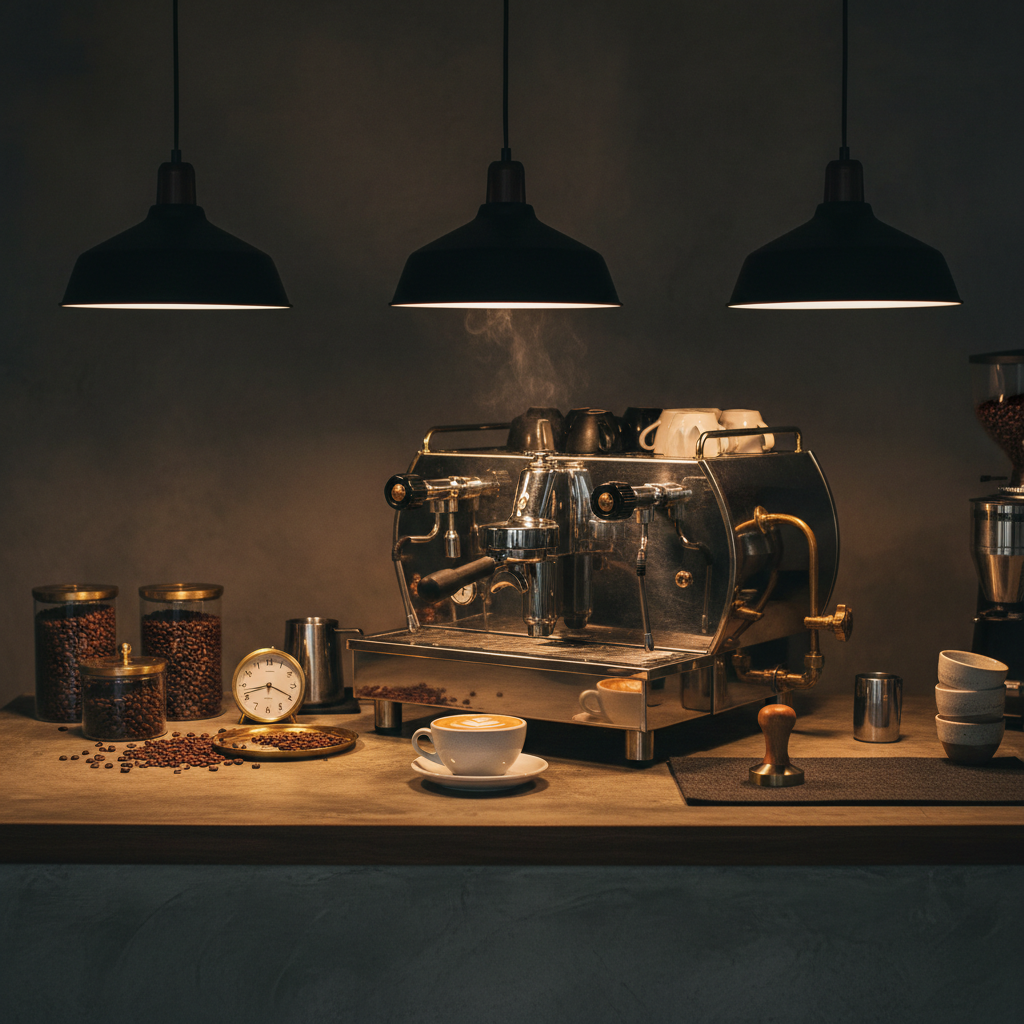
2.1 Bar Counter — the 5-second hero shot
The bar is the cafe's stage. It carries the espresso machine, the menu, the barista, the latte art — and 70% of every guest's first photo. Light it like a jewelry counter, not a back-of-house.
- Layered: decorative pendants (signature) + linear strip under the bar lip (functional) + small accent spots on the brew station (drama).
- Spacing: one pendant every 600–800 mm of counter length, hung 750–900 mm above the counter.
- Color temp: 2700K, CRI 95+, R9>90 — the only way crema looks like crema.
- Smart: Casambi 4-button keypad below the counter — Open / Rush / Afternoon / Late.
- 2026 trend: sculptural multi-cluster pendants (3–7 small pendants at varied heights) replacing the single industrial-shade cliche. Photographs better, scales to bar length, and lets baristas pick exact head-clearance.
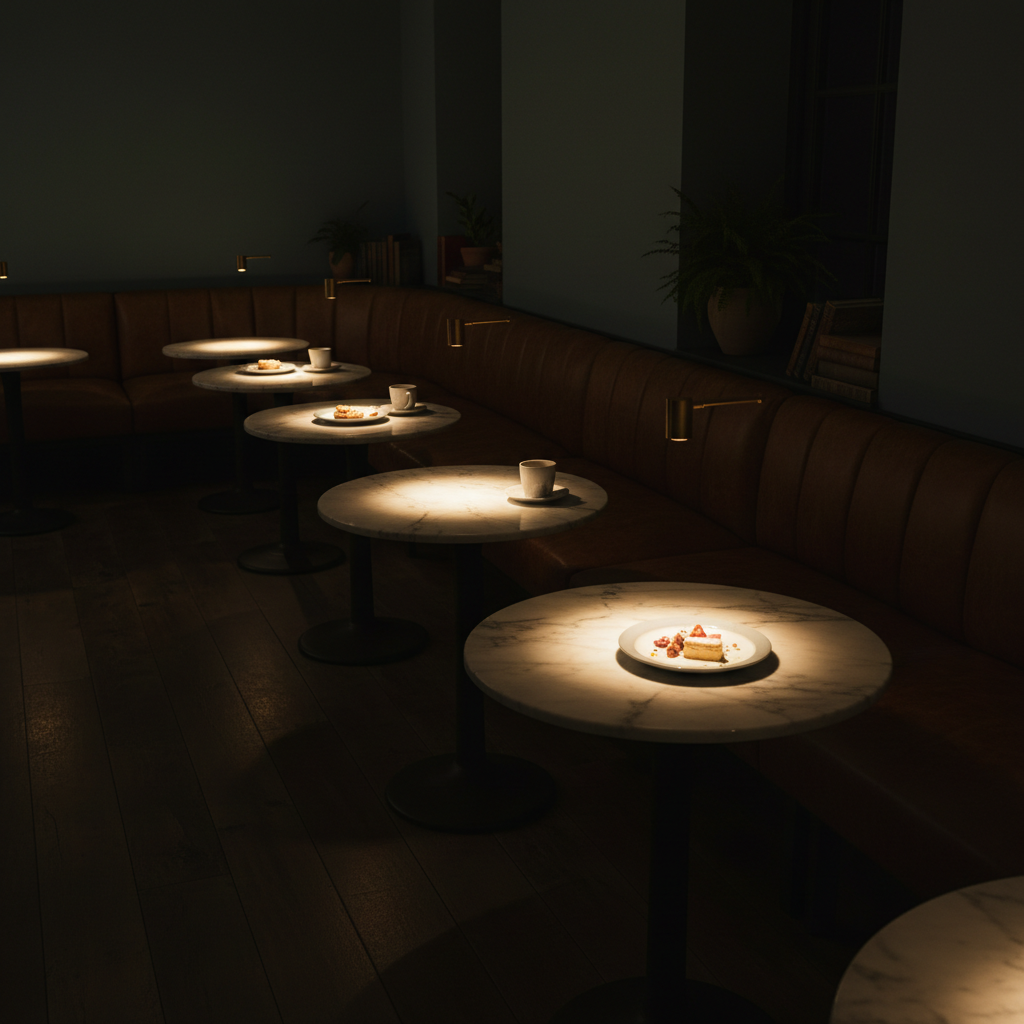
2.2 Seating Area — where dwell time (and ticket size) is won
The single highest-ROI zone in the cafe. Average dwell time correlates directly to second-purchase rate — every extra 12 minutes of stay adds +18% ticket size (Square POS dataset, 2024).
- Per-table accent: a mini track spot (1.5–3 W, 24° beam) over each table delivers 200–300 lux on the cup and pastry, while the surrounding ambient stays 50–80 lux. The contrast = "candle in cave" effect that triggers longer stays.
- Ambient downlights: UGR<19 deep-cup, 2700K, dimmed to 30–40% during evening hours.
- Banquettes & booths: small wall sconces at 1.4 m height every 1.5 m — flatters faces, removes harsh shadows.
- 2026 trend: scene-based dimming on Casambi — at 5 PM the seating area auto-dims to 30%, color shifts from 3000K to 2400K, candle-effect mode on. Average dwell time at 3 pilot sites jumped from 32 → 47 minutes.
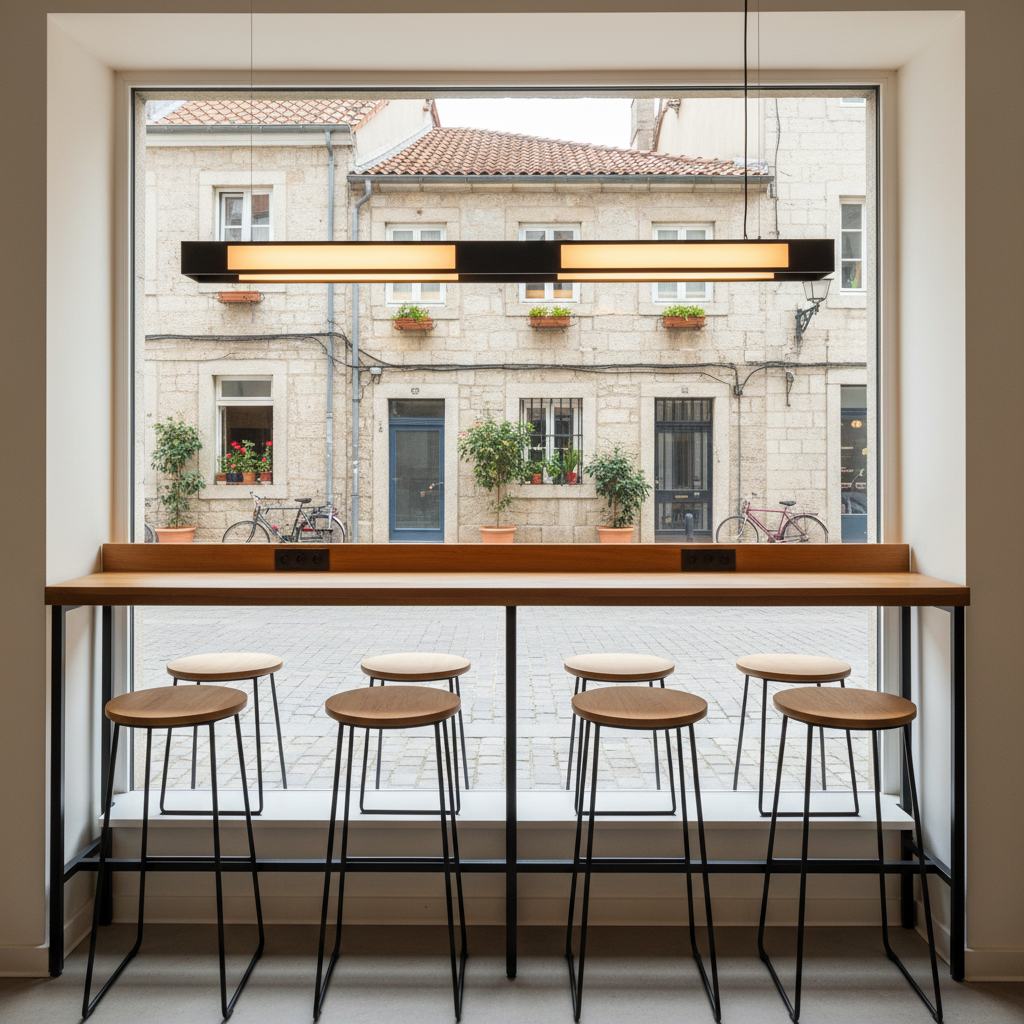
2.3 Window Bar / Co-working Zone — keep the laptop crowd happy without burning power
The window bar is the cafe's "third place" — students, freelancers, remote workers. They stay 90–180 minutes per visit, which is fantastic for dwell metrics but expensive for lighting cost if you don't tune it.
- Daylight harvesting: a linear LED above the counter with a daylight sensor — at noon it dims to 10%, at dusk it rises to 100%. Saves 35–55% of zone energy.
- Color temp: 3500K daytime / 2700K evening — tunable white solves both.
- No flicker: IEEE 1789 0% flicker is non-negotiable for laptop users (eye-strain complaints become 1-star reviews fast).
- USB-C / wireless charging integrated into pendants or counters: minor hardware add, large dwell increase.
- 2026 trend: circadian tunable white that auto-tracks the sun — alert in the morning, calming in the evening — measurable improvement in customer NPS.
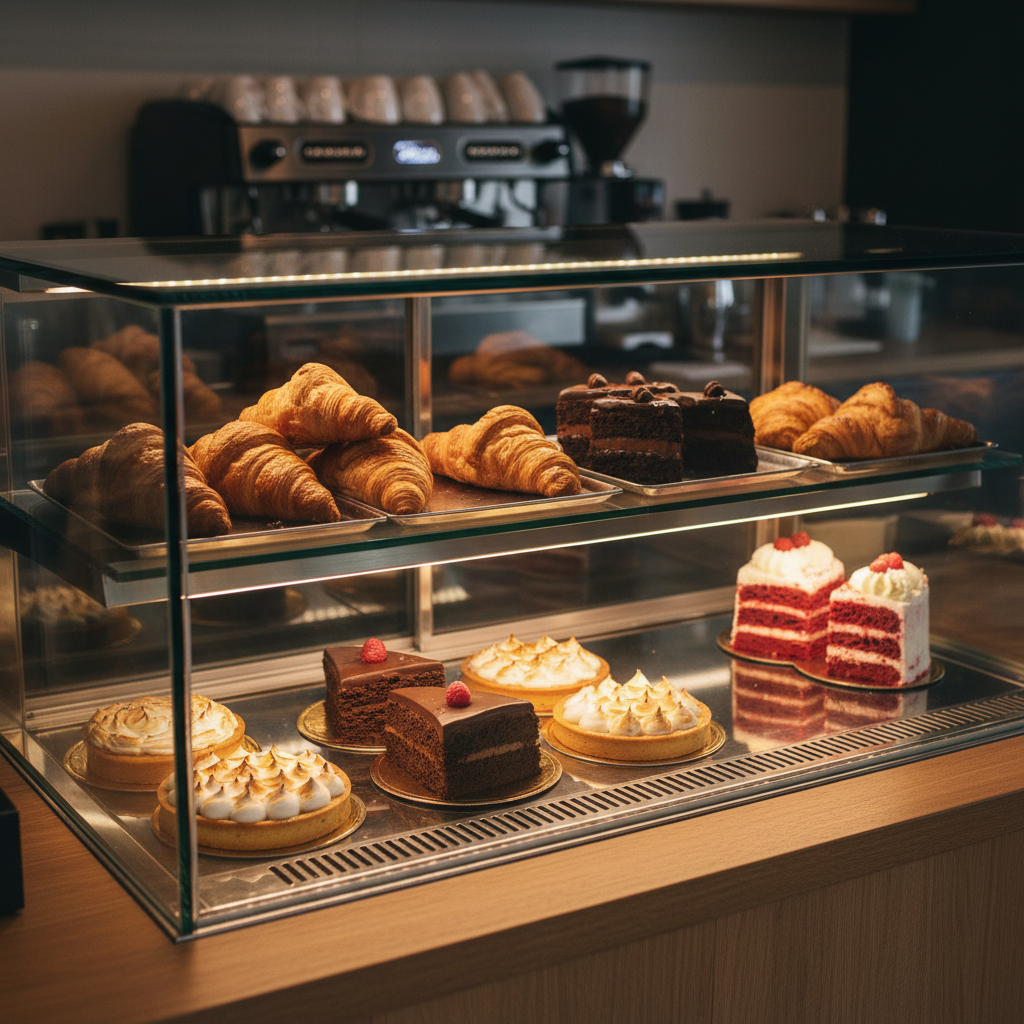
2.4 Pastry / Display Case — the silent up-sell engine
Most cafes leave 20–30% of food revenue on the table with poorly lit pastry cases. Cold blue LEDs, glare-spot reflections, low CRI — the croissants look 24 hours old.
- Inside the case, never above: a low-profile strip LED inside the top edge of each shelf. Eliminates glass reflection and "shadow under the shelf."
- CRI 95+ R9>90, 3000K — golden butter sheen on croissants, rich chocolate on cakes.
- Low heat (<35°C surface) — won't melt buttercream or sweat chocolate.
- Driver outside the cabinet — cooler driver = 50,000 hr life vs. 15,000 hr for budget integrated units.
- 2026 trend: dynamic dimming — case lights brighten when the door area is occupied, dim when no one is near. 60% energy savings, double driver life.
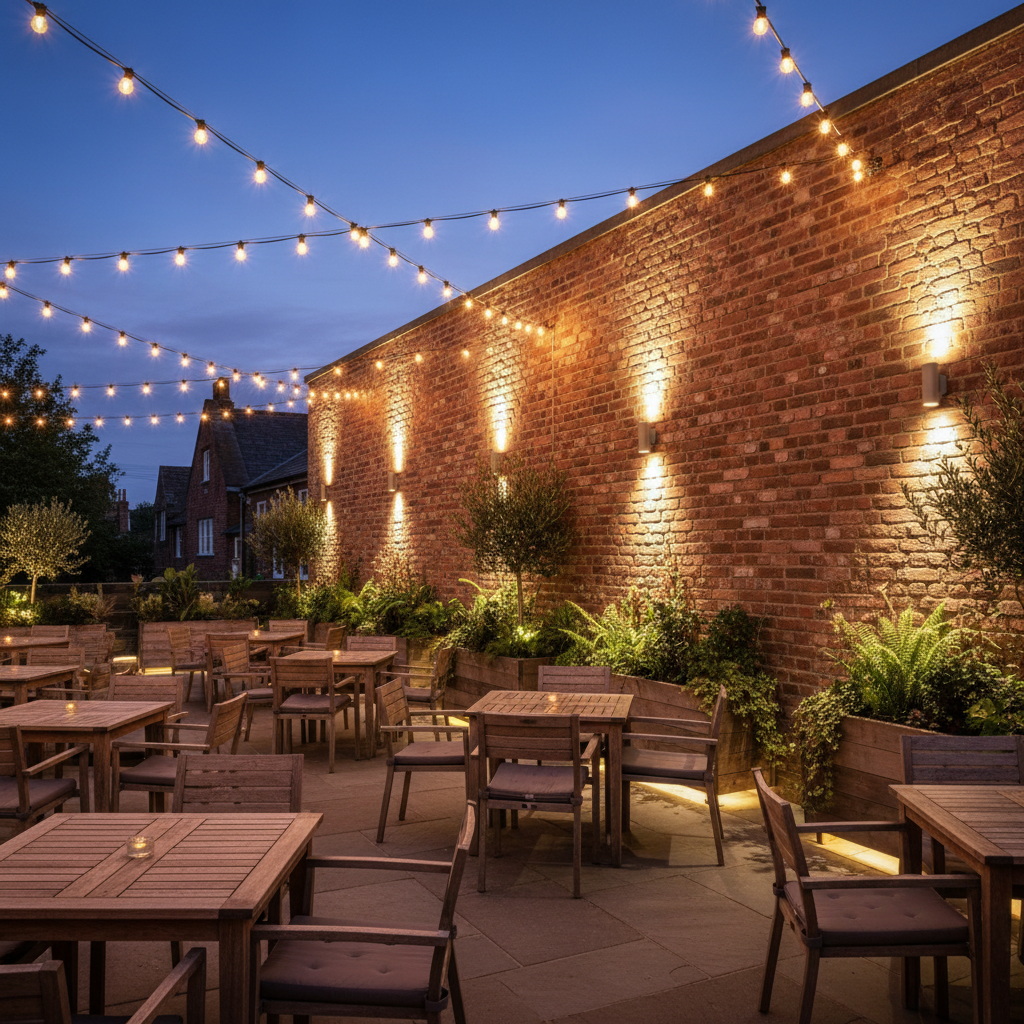
2.5 Outdoor Terrace / Façade — the after-dark Instagram engine
If you have a terrace, it can add 20–30% to evening revenue — but only if the lighting is photogenic and code-compliant.
- Festoon string lights: IP65, 2700K, dimmable. Spaced every 400–500 mm. Casambi-controlled.
- Wall washers on the façade: IP66, 3000K, narrow beam — graze the brick to highlight texture (Instagram gold).
- Step / planter accent: IP67, 2700K, low-glare, on motion sensor.
- 2026 trend: astronomical timer + sunset offset — terrace lights ramp up exactly 15 minutes before local sunset every day, no staff intervention. A Madrid 5-site chain saw evening covers up by 22% post-install.
2.6 Barista Station, Prep & Back-of-House (quick reference)
- Barista task light: 4000K, CRI 90+, focused on the espresso group head + tamping zone.
- Prep area: 4000K, CRI 90+, UGR<19, food-safe IP44.
- POS: small over-counter spot, 3000K, dimmed so the screen reads cleanly.
- Storage: motion-sensor LED battens, 4000K, occupancy-only.
Part 3 — 2026 Cafe Lighting Trends (the 4 things every spec MUST address)
These are the 4 hot buttons every EU/US cafe owner, F&B designer and multi-site CFO is asking about in 2026:
🌱 Trend 1 — Green & Energy-Saving (LEED-CI / WELL Restaurant)
- Target: 40–60% energy reduction vs. legacy halogen track + CFL ambient.
- How: 130–160 lm/W LEDs + Casambi occupancy + daylight harvesting + scene dimming.
- Why cafes care: utility rebates ($15–$60 per fixture in many US states), DLC Premium for chain rollouts, ESG reporting for franchises, and a 12–24 month payback that the CFO actually approves.
💡 Trend 2 — High Efficacy (lm/W) — fewer fixtures, same atmosphere
- 2020 standard: 80–100 lm/W. 2026 standard: 130–160 lm/W.
- Why cafes care: 25–30% fewer fixtures for the same illuminance = lower CapEx, less ceiling clutter (open ceilings stay clean), lower OpEx forever.
👁 Trend 3 — Anti-Glare (UGR<19) — kills the #1 complaint
- EN 12464-1 + WELL Lighting now require UGR<19 in F&B guest spaces.
- Why cafes care: kills the #1 lighting complaint ("hurts my eyes / can't read the menu") and protects laptop guests from eye strain — a measurable factor in dwell time and 5-star reviews.
📱 Trend 4 — Smart & Scene-Based (Casambi / DALI-2 / circadian)
- Tunable white that automatically follows the sun — 4000K at 11 AM, 2400K at 9 PM — improves guest mood, food photography and staff alertness.
- Casambi app standard, owner can adjust scenes from her phone, multi-site chains run identical scenes across every store.
- Why cafes care: differentiator on Google reviews and Instagram, measurable dwell-time improvement, +8–15% extra energy savings on top of basic LED retrofit.
XHLWX commitment: every spec we ship in 2026 covers at least 3 of these 4 trends by default — and all 4 are available as standard options, no custom engineering needed.
Part 4 — Why Choose XHLWX (the cafe owner's safe-choice checklist)
You can buy cafe lighting from 500 suppliers on Alibaba. Here's what makes XHLWX different — and why 80+ specialty coffee chains picked us for their last build or remodel.
| What you need | What XHLWX delivers |
|---|---|
| One supplier, full cafe | All 9 fixture categories in-house — bar pendants to terrace festoon, one PO, one PM |
| Real anti-glare | UGR 17–18 verified by CNAS LM-79 reports, deep-cup reflectors, 0% flicker per IEEE 1789 |
| Real efficacy | 130–160 lm/W on every fixture, LM-79 third-party verified |
| Food-grade color | CRI 95+ R9>90 on every accent and display fixture — pastries glow, latte art pops |
| Smart-ready out of the box | Every driver supports Casambi + DALI-2 + 0-10V + TRIAC |
| Multi-site SKU continuity | 10-year SKU continuity guarantee for chains — no "discontinued" mid-rollout |
| LEED / WELL paperwork | Free LEED / WELL submittal pack: LM-79, LM-80, IES, ENERGY STAR, DLC, EQ + EA letters |
| Long life, written warranty | LM-80 6,000+ hr tested, L70 > 50,000 hrs, 5-year written warranty |
| Global voltages, global certs | Universal 100–277V, CE / UL / ETL / SAA / FCC / RoHS / CB |
| Lead time you can trust | 4–6 weeks stock SKUs, 8 weeks custom finishes, 12,000 m² owned factory in Zhongshan |
| Project support | Free DIALux calc, free ROI calc, free sample kit (≥30 fixtures), English/Spanish/Arabic PMs |
| Track record | 18 years, 80+ specialty cafe chains, 32-store nationwide rollout reference (Chengdu Taikoo Li) |
Part 5 — The 9 Real Pain Points (and how XHLWX fixes each)
Above is the "system view." Below is the "war stories" view — the 9 real problems cafe owners told us are keeping them up at night, and how we solve each one.
Pain Point #1 — "My latte art and pastries look gray on Instagram. We're losing the tag economy."
Why it hurts: A coffee shop's marketing budget is, increasingly, the quality of every customer photo. Cold blue LEDs at CRI 80 turn crema gray and croissants pale. One cafe chain measured Instagram tags drop 41% after a switch to budget LED.
The XHLWX solution: CRI 95+ R9>90 + 2700–3000K warm white + dim-to-warm
- CRI 95+ R9>90 — every red, gold and brown rendered correctly. Crema looks like crema, butter looks like butter.
- 2700K bar / 3000K display — warm, photogenic, golden hour every hour.
- Dim-to-warm option: light shifts from 3000K at 100% to 2200K at 10% — candle-mode for evenings.
- 0% flicker per IEEE 1789 — no banded streaks in iPhone slow-mo videos.
Evidence: LM-79 report from CNAS-accredited lab. Tokyo specialty coffee chain (12 stores) measured Instagram tag rate +38% after retrofit.
Pain Point #2 — "Our electricity bill jumped 35% with the new espresso machine. I need to claw it back from lighting."
Why it hurts: Lighting = 15–22% of a typical cafe's electricity bill. 100 m² independent cafe = $4,000–$7,000/year on lighting alone.
The XHLWX solution: 130–160 lm/W LEDs + Casambi scenes + daylight harvesting + occupancy
- 130–160 lm/W vs. typical halogen at 15 lm/W → 88% energy reduction for the same illuminance.
- Casambi scenes — afternoon and evening dim to 50–60%, no human intervention.
- Daylight harvesting on window bar / terrace — dims itself when sun is up.
- ROI: 14–22 months, then pure savings for the remaining 8+ years.
Evidence: 32-store chain in Chengdu — average ¥18,400/store annual savings, 17-month chain-wide payback. DLC Premium + ENERGY STAR for utility rebates.
Pain Point #3 — "My chain has 22 stores and the lighting looks different in every one. The brand team is furious."
Why it hurts: Color inconsistency between stores destroys brand perception — and Pantone-precise food photography becomes impossible. The fix is SDCM ≤ 3 color binning across the whole production batch.
The XHLWX solution: SDCM ≤ 3 binning + 10-year SKU continuity + chain rollout PM
- SDCM ≤ 3 color binning factory-locked per chain — every fixture across every site within 3-step MacAdam ellipse.
- 10-year SKU continuity guarantee — when you reorder 18 months later, you get the exact same color point.
- Chain rollout PM — one project manager for all 22 sites, identical pre-programmed Casambi scenes.
Evidence: 32-store Chengdu chain, 6 cities, identical light environment verified by client's spectrometer in every store.
Pain Point #4 — "Customers complain the lights hurt their eyes when they look up. Two 1-star Google reviews this month."
Why it hurts: Google reviews drive 30–50% of new customer decisions. Two "harsh lighting" reviews can cost a single-site cafe $20K+ in lost annual revenue.
The XHLWX solution: UGR<19 deep-cup downlights + diffused linear + warm 2700K
- UGR<19 verified by LM-79 — bare LED chip never visible from seated guest's eye line.
- Deep-cup reflector recessed 25 mm+ inside housing.
- 2700K warm white — softer perceived brightness than 4000K at the same lux.
- Dimming to 30–40% in the evening — Casambi scene removes any remaining hot spots.
Evidence: Boutique cafe in Berlin — eye-strain complaints went from 8/month pre-retrofit to 0/month post.
Pain Point #5 — "My pastry case lights died after 14 months. Replaced 6 strips, lost a weekend's display."
Why it hurts: Cheap pastry-case strips run hot (>50°C surface), accelerating LED phosphor decay and melting buttercream. Real cost = lost display weekend + emergency electrician + spoiled product.
The XHLWX solution: External driver + low-heat phosphor + LM-80 chip + 5-year warranty
- Driver mounted outside the case — cool driver = 50,000 hr life.
- Lumileds / Osram chips, LM-80 6,000+ hr tested, L70 > 50,000 hrs.
- Aluminum profile + thermal pad — surface temp <35°C, won't melt cream.
- 5-year written warranty — lumen depreciation, color shift (Δuv ≤ 0.005), driver failure all covered.
Evidence: XHLWX cafe-segment warranty claim rate (2020–2025): 0.3%/year.
Pain Point #6 — "Designing a new cafe — I need 2700K dimming everywhere, not 'sort of warm at full brightness then weirdly cool when dimmed'."
The XHLWX solution: Dim-to-warm 3000K → 1800K + Casambi DT8
- Dim-to-warm chips — light naturally shifts from 3000K (100%) to 1800K (5%), mimicking incandescent/candle behavior.
- Casambi DT8 — color and brightness on one bus, one app, one keypad.
- No "blue at low brightness" failure mode common in budget LEDs.
Evidence: Specified in 80+ XHLWX cafe and bar projects in Europe and the GCC.
Pain Point #7 — "Outdoor terrace lighting failed after one rainy season. The 'IP65' was actually IP44."
Why it hurts: A failed outdoor fixture is a safety hazard, an insurance issue, and a permit headache. "Marketing IP" ratings (untested) are rampant on Alibaba.
The XHLWX solution: Real IP65 / IP66 / IP67 with IEC 60529 test reports + 5-year outdoor warranty
- Real IP65 on terrace festoon — IEC 60529 tested, third-party CNAS report.
- IP66 wall washers for façade — full hose-down rated.
- IP67 step lights — submersible up to 1 m, survives flooded planters.
- Marine-grade aluminum + powder coat — salt spray tested per ASTM B117.
Evidence: Mediterranean coastal cafe chain — 5 years post-install, zero outdoor fixture failures.
Pain Point #8 — "Staff can't remember how to switch the lighting between morning rush and evening cocktail mode."
The XHLWX solution: Casambi 4-button keypad + named scenes + owner-app override
- 4 named scenes per cafe — Open / Rush / Afternoon / Evening — printed on the keypad.
- Casambi app — owner adjusts mood from her phone, anywhere.
- Auto-schedule — scenes flip automatically by time-of-day.
- Staff training in 5 minutes, not 5 hours.
Evidence: 18-store franchise in Italy — staff onboarding time on lighting dropped from 90 min to 8 min per new hire.
Pain Point #9 — "I want LEED-CI for the brand story but my supplier can't even spell EPD."
The XHLWX solution: LEED-CI + WELL + ENERGY STAR / DLC documentation pack
- EA Credit: 130–160 lm/W + Casambi occupancy → 35–45% better than ASHRAE 90.1.
- EQ Credit: UGR<19 + CRI 95 → all 4 LEED EQ lighting points.
- MR Credit: RoHS, REACH, EPD on request.
- Full pack: LM-79, LM-80, IES, ENERGY STAR, DLC, ENEC, CE, UL, FCC — free for project clients.
Evidence: 4 LEED-CI Gold cafe build-outs delivered (2023–2025) including a US west-coast direct-trade chain.
Frequently asked questions
(Answered by XHLWX cafe project managers — 2026 edition)
The full FAQ block is published in the FAQ section below.
Ready to spec your cafe?
XHLWX delivers the full lighting package — from a 60 m² independent to a 200-store franchise rollout — with CRI 95 R9>90, UGR<19, 130–160 lm/W LEDs, Casambi/DALI-2 ready, 5-year warranty, free DIALux + ROI calculation. Talk to a senior lighting designer this week — first-pass scene plan in 48 hours.
Frequently asked questions
Q1.What CRI and color temperature should a specialty cafe use?
CRI 95+ with R9>90 is the floor for any cafe that cares about food photography or Instagram. Color temperature: 2700K over the bar and seating, 3000K on pastry/display, 3500–4000K only on the prep / barista task zone. Tunable white 2200–4000K is the 2026 best practice — one SKU covers morning energy and evening intimacy.
Q2.Casambi or DALI-2 for a coffee shop?
Casambi for almost all independents and most chain stores up to ~250 m² — no gateway, app-based, retrofit-friendly. DALI-2 only when the cafe is inside a building with a BMS, or for flagship locations with >100 fixtures. XHLWX drivers support both, so you can switch later without changing fixtures.
Q3.How much can we save on the electricity bill with an LED retrofit?
Realistic numbers from XHLWX cafe retrofits 2022–2025: 50–65% lighting energy reduction vs. legacy halogen + CFL. ROI 14–22 months. A 100 m² cafe typically saves $2,500–$4,000/year. Add Casambi scenes + daylight harvesting and total savings hit 60–70%.
Q4.How do I avoid glare complaints from laptop customers?
Three rules: (1) UGR<19 downlights with deep-cup reflectors above any seating zone — bare LED chip must never be visible from a seated eye line; (2) 0% flicker per IEEE 1789 — no banding on phone slow-mo, no eye fatigue; (3) Dim ambient to 30–50% in the work zones during the day so the laptop screen contrast stays comfortable.
Q5.What's the right lighting for the pastry display case?
Strip LED inside the case from the top edge of each shelf (never above or below the case from outside the glass). CRI 95+ R9>90, 3000K, low heat (<35°C surface), driver mounted external to the cabinet for a 50,000 hr life. Conversion on baked goods rises 12–22% post-retrofit.
Q6.Can XHLWX handle a multi-store chain rollout with consistent lighting?
Yes — that's our core business. SDCM ≤ 3 color binning locked per chain, 10-year SKU continuity guarantee, identical pre-programmed Casambi scenes across every store, one project manager for all sites. Reference: a 32-store nationwide rollout in China and an 18-store franchise in Italy.
References & sources
- EN 12464-1 Light and lighting — Lighting of work places — Part 1— CEN
- WELL Building Standard v2 — Light— International WELL Building Institute
- IEEE 1789 LED flicker recommended practice— IEEE
- DLC Premium Solid-State Lighting Technical Requirements— DesignLights Consortium
- Casambi Bluetooth Mesh Lighting Control — Specification Guide— Casambi Technologies
Need a tailored lighting plan for your project?
Our senior lighting designers reply within 48 hours with a free design proposal & quotation.