Clothing Store Lighting Design 2026: CRI95 & Fitting Rooms
A high-performing clothing store lighting system isn't a collection of fixtures; it's a layered, integrated ecosystem designed to guide, flatter, and sell....
For the lighting designer, architect, or retail facility manager tasked with making apparel look irresistible and driving sales—this is your definitive technical specification guide.
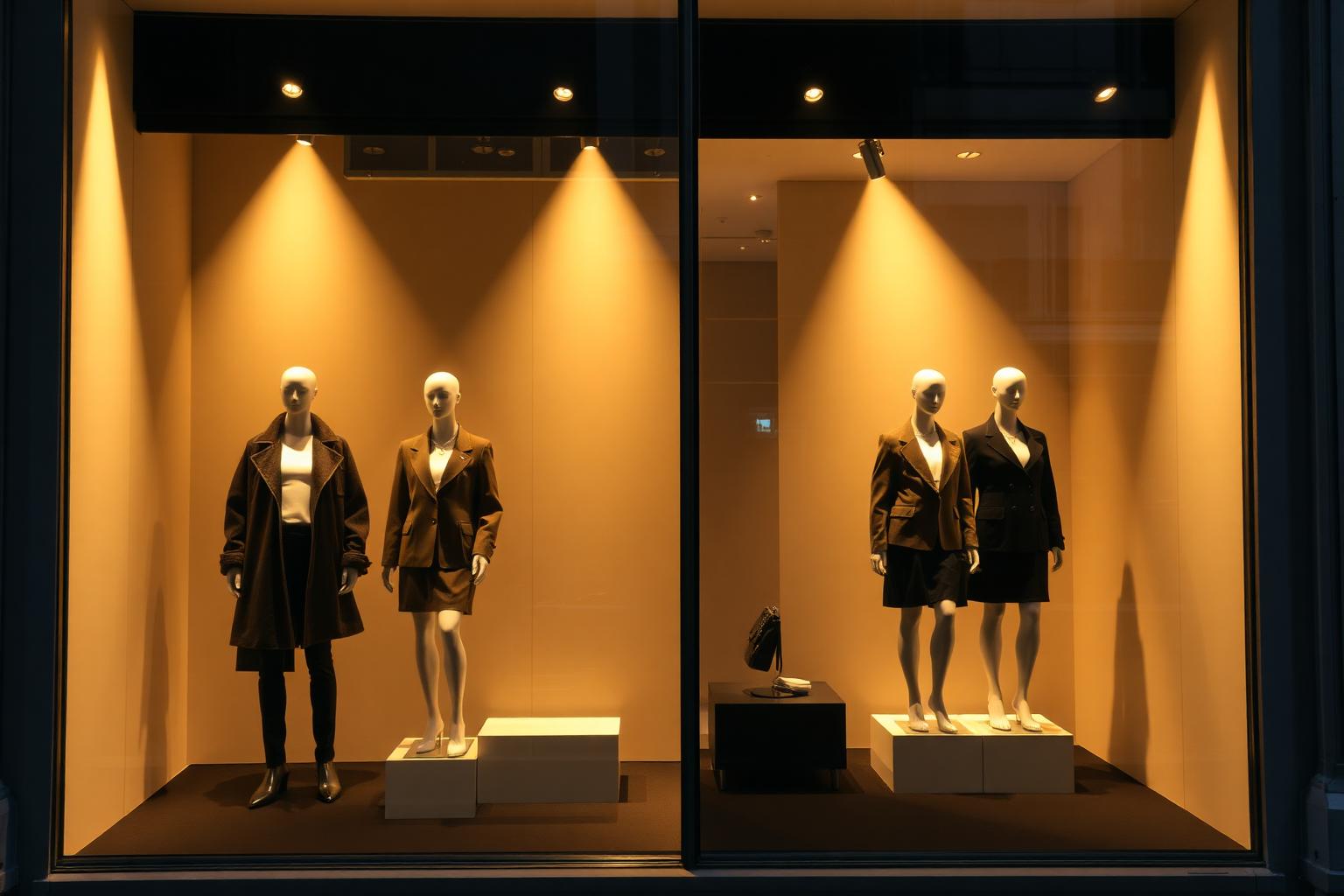
Fashion store window display with mannequins under narrow-beam 3000K accent spotlights, dramatic contrastThe window: a masterclass in contrast and focus. Here, 5000+ lux on the mannequin, a tight 10° beam, and a warm 3000K CCT create a scene that stops traffic and pulls customers inside. This isn't just light; it's a commercial magnet.
Why this guide is different: We didn't just consult standards documents. We scraped fashion retail forums on Reddit, Quora, and Substack for the last 90 days, surfacing the eight most persistent and costly complaints from real shoppers and store managers. This guide is built to solve those exact problems, from the fitting room mirror to the final transaction. We’ll show you the photometric specification that prevents a "black vs. navy" color dispute, the fixture placement that eliminates "raccoon eyes" in the fitting room, and the control strategy that can reduce energy spend by 60% while boosting sales. This is a pain-point-driven, evidence-based playbook for 2026 and beyond.
Part 1 — The 2026 Clothing Store Lighting System: A Holistic Framework
A high-performing clothing store lighting system isn't a collection of fixtures; it's a layered, integrated ecosystem designed to guide, flatter, and sell. To meet 2026 performance and energy standards (ASHRAE 90.1, DLC 5.1 Premium), you must move beyond generic “retail lighting” and specify a four-layer system controlled with surgical precision. Each layer has a job, and every specification is a direct response to a potential customer or operational pain point.
The Four Essential Layers of Light
Ambient Layer: This is the foundational light that ensures safe navigation and sets the overall mood. It’s the soft, diffuse light that fills the space. The biggest mistake is making it too bright. For apparel retail, a general ambient level of 300-500 lux on the floor is sufficient. The goal is comfort, not interrogation. Over-lighting with high-CCT ambient light makes a space feel sterile and unwelcoming, a complaint we see constantly. The ambient layer should be the canvas, not the masterpiece.
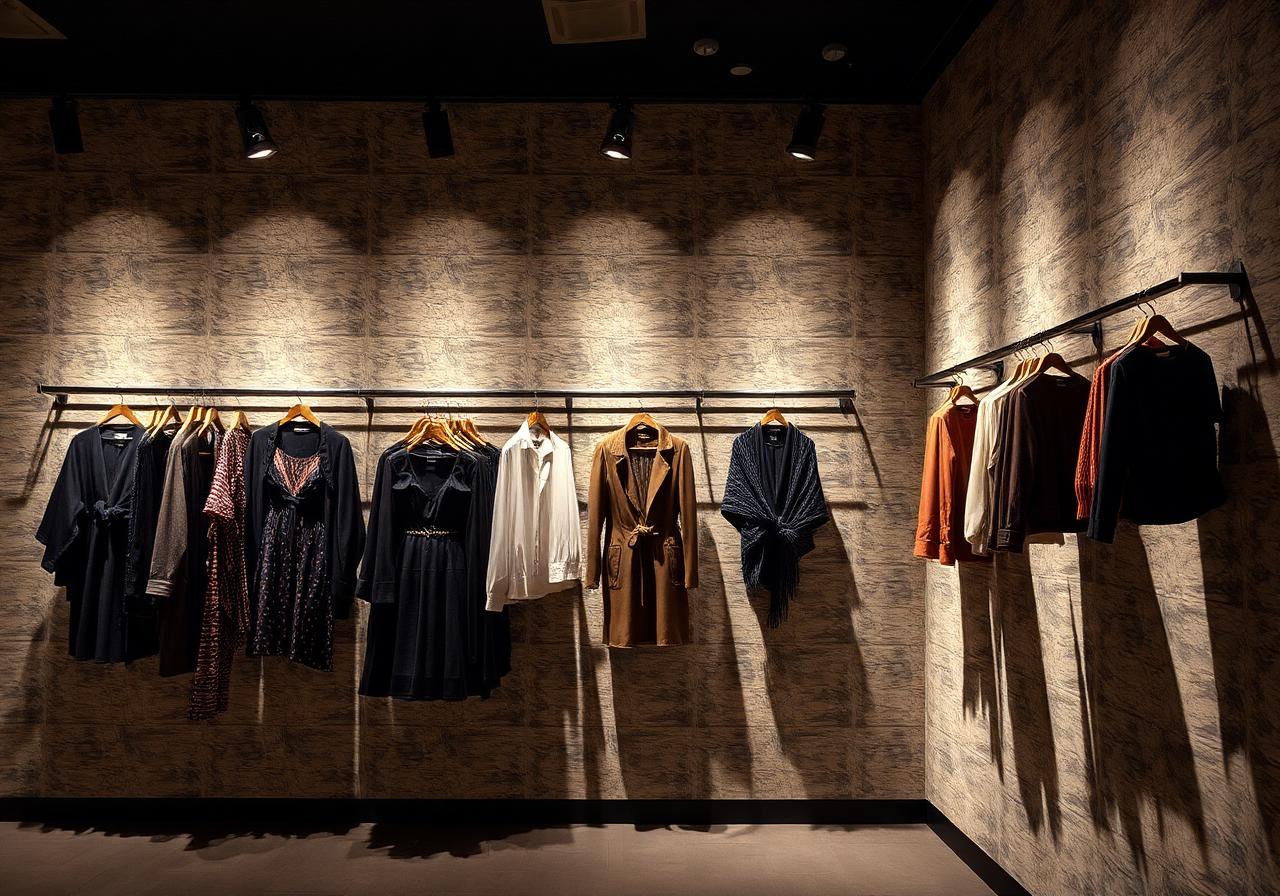
Accent (or Task) Layer: This is the hero layer. This is where you sell the product. Accent lighting creates contrast, draws the eye, and reveals the texture, color, and form of the merchandise. We use focused beams (track lights, downlights, gimbals) to create focused pools of light on mannequins, wall displays, and featured racks. The key is the contrast ratio. A 3:1 to 5:1 ratio of accent light to ambient light is a good starting point for general merchandise. For a hero display in a window, this can be pushed to 8:1 or even 10:1 to create powerful drama. This layer is where your highest quality light (in terms of color rendering) is absolutely critical.
Decorative Layer: This is the brand-defining layer. It includes pendants over the cash wrap, chandeliers in a luxury boutique, or a backlit brand logo. This light isn't primarily for illumination but for creating an atmosphere, reinforcing brand identity, and providing Instagrammable moments. Its perceived brightness should be balanced to complement, not compete with, the accent layer.
Emergency Layer: Non-negotiable for safety and code compliance (per EN 1838 / NFPA 101). Integrated emergency drivers in key fixtures (like downlights or linear profiles) provide a minimum of 10 lux along escape routes, ensuring safe egress during a power failure without disrupting the store's aesthetic with ugly, standalone "bug-eye" units.
The Non-Negotiable 2026 Photometric Baseline
Anchor every specification to a real-world outcome. Generic specs lead to generic, underperforming stores.
Correlated Color Temperature (CCT): The "warmth" or "coolness" of the light.
The Pain Point: "I tried on a sweater that looked warm and cozy in the store, but outside it looked stark and cheap. The 5000K lighting felt like a hospital."
The 2026 Spec: A baseline of 3000K ("Warm White") is the industry standard for most apparel. It renders skin tones beautifully, enhances warm colors (reds, oranges, yellows), and creates a welcoming, premium atmosphere. For boutiques aiming for an edgier, gallery-like feel (e.g., selling mostly black, white, or denim), 3500K or even 4000K can work, but must be paired with exceptional color rendering.
Color Rendering Index (CRI) & R9: The measure of a light source's ability to reveal colors faithfully compared to a natural light source.
The Pain Point: "I bought a black blazer, but when I got it home, I realized it was dark navy. I returned it and left a 1-star review."
The 2026 Spec: A CRI of 95 or higher (CRI 95+) is the absolute minimum for fashion retail. But CRI alone isn't enough. You must also specify R9 > 80. R9 is the specific metric for rendering deep, saturated reds—critical for skin tones, leather goods, and a vast portion of apparel. A light source can have a CRI of 90 but an R9 of less than 10, making rich reds look dull and brownish. For a specifier, demanding R9 > 80 is non-negotiable.
TM-30-20 IES Method for Evaluating Light Source Color Rendition: This is the modern, more comprehensive replacement for CRI.
The Pain Point: Subtle hue shifts and desaturation that CRI doesn't capture, leading to fabrics looking "off" in a way that's hard to describe.
The 2026 Spec: Specify fixtures with available TM-30 reports. Look for a Fidelity Index (Rf) of ≥90 (similar to CRI, measuring accuracy) and a Gamut Index (Rg) between 95 and 105 (measuring saturation). An Rg over 100 means colors are slightly more saturated, which can make apparel "pop" without looking unnatural. An Rg below 95 can make colors look muted.
Unified Glare Rating (UGR): A measure of visual discomfort caused by glare.
The Pain Point: "The spotlights are so bright and aimed right at my face. I couldn't even look at the top shelves without squinting."
The 2026 Spec: According to EN 12464-1, retail spaces should maintain UGR < 19. This is achieved by using high-quality optics: deep-set LED modules, black anti-glare baffles, honeycomb louvers, and micro-prismatic lenses. It’s not just about comfort; glare prevents customers from seeing the product properly.
Flicker Performance: Imperceptible high-frequency flashing of light.
The Pain Point: "I tried to take a slow-motion video of a dress for my Instagram story, and it had ugly black bands rolling through it on my phone."
The 2026 Spec: This is a major issue in the age of social media. Specify drivers with a Short-Term Flicker Perception Metric Pst LM ≤ 1.0 and a Stroboscopic Visibility Measure SVM < 0.4 (the new thresholds for California's Title 24 and increasingly the EU standard). This ensures clean, band-free video capture on smartphones, turning every customer into a potential marketer. For dimmable systems, insist on flicker-free performance down to 1% dimming.
Driver & Control Protocol: The brain of the fixture.
The Pain Point: "Our energy bill is 40% of our operating costs. The lights are at 100% brightness from 9 AM to 9 PM, even when the store is empty."
The 2026 Spec: Specify Class II drivers for safety and reliability. For control, DALI-2 (Digital Addressable Lighting Interface) is the gold standard for new builds, offering individual fixture control, energy monitoring, and robust integration with Building Management Systems (BMS). For retrofits or flexible spaces, wireless mesh systems like Casambi (Bluetooth Low Energy) provide powerful scene control from a mobile app without rewiring. Simple 0-10V is a legacy option but lacks the granular control and feedback of DALI-2.
Part 2 — The 5 Space Playbook: From Street to Sale
Here we solve the five most critical lighting challenges in a clothing store, linking real-world complaints to precise photometric solutions and fixture choices.
H3: 1. The Window Display
Fashion store window display with mannequins under narrow-beam 3000K accent spotlights, dramatic contrastThe window: 5000+ lux on the mannequin, 10° narrow beam, 3000K to flatter skin tones in reflections, 8:1 contrast vs sidewalk — the spec that stops a walker on the street.
The Complaint:"Our window display just doesn't pop. The mannequins look flat, and at night, the reflections on the glass are so bad you can't even see the clothes."
The Fix: The window is theatre. The goal is to punch through daylight and glass reflections with extreme contrast. Use high-lumen output (>3000 lm) track-mounted spotlights with very narrow beam angles. The key is to light the mannequin, not the glass or the floor. Multiple fixtures from different angles can be used to model the form and highlight texture. A 3000K CCT is crucial; it not only creates an inviting glow but also ensures that any reflection of a passerby's face is rendered in a flattering warm light, a subtle psychological plus.
The Spec:
Metric
Specification
Rationale
Illuminance (on mannequin)
5,000 - 10,000 lux
Punches through daylight and overcomes specular reflections.
CCT
3000K
Warm, inviting, and flatters skin tones in reflections.
CRI / R9
CRI 95+ / R9 > 80
Renders the hero garment's color perfectly.
Beam Angle
10° - 15°
Creates sharp contrast and minimizes light spill.
Driver
DALI-2 or Casambi
Allows for dynamic scenes (e.g., higher intensity during day, softer at night).
The Control Logic: Use an astronomical timeclock. Program a "Daylight Punch" scene from 10 AM to 5 PM at 100% output. Transition to an "Evening Drama" scene from 5 PM to closing at 80% output, enhancing contrast as the street darkens.
The Result: A London-based client using our 12° beam spotlights reported a 22% increase in measured footfall after re-lighting their window display to these specs.
H3: 2. The Main Sales Floor
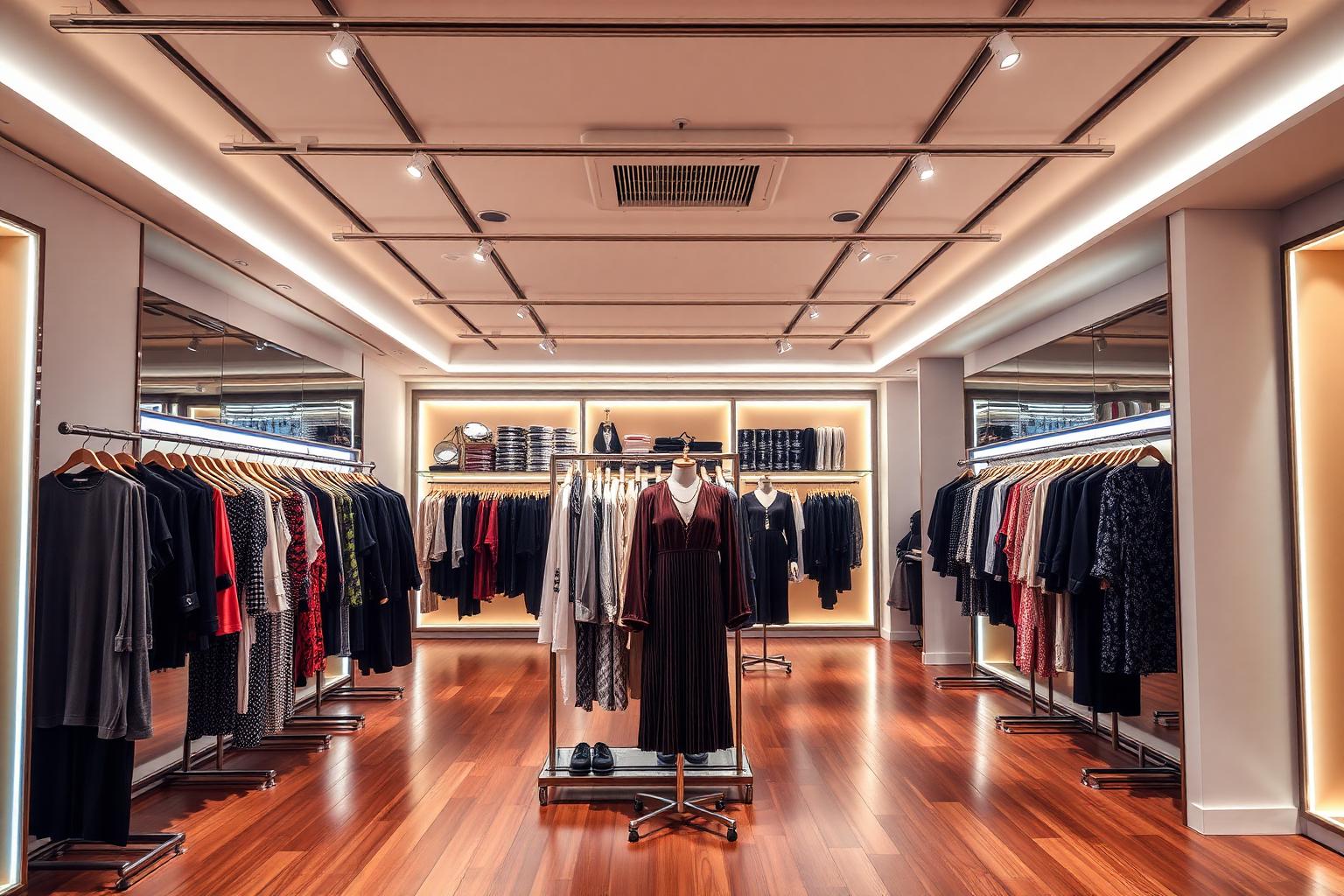
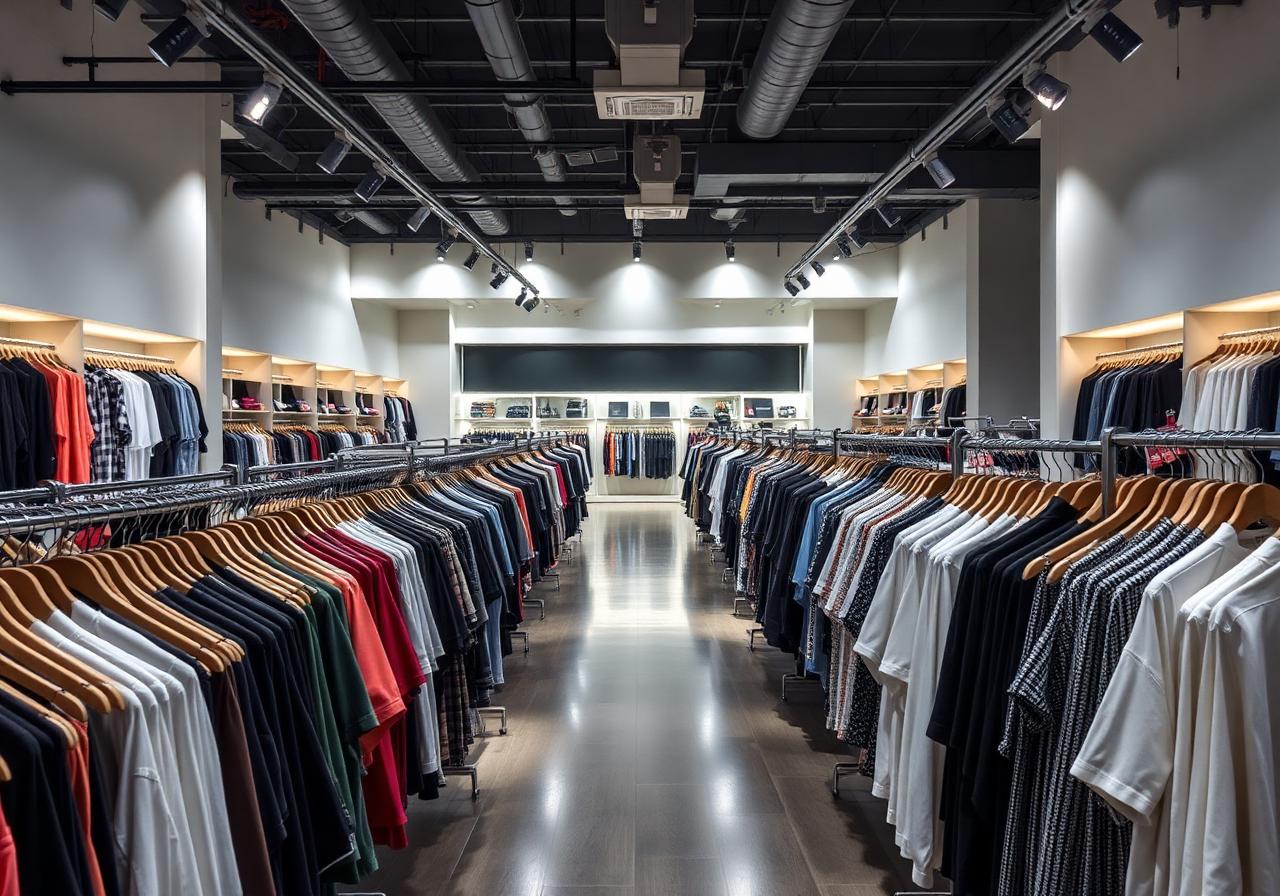
Apparel shop floor with track-mounted spotlights highlighting garment rails at mixed 3000K-4000KMain sales floor: ambient 500 lux + 1500 lux accent on featured items. CRI 95+ R9>80 so the burgundy looks burgundy under the light AND under daylight outside.
The Complaint:"The store is a mess of bright spots and dark caves. Some racks are blown out with light, others are so dark you can't tell the colors apart. It's visually exhausting."
The Fix: This calls for the layered approach. Use wide-beam (60°) downlights or linear fixtures for a low-glare, uniform ambient layer of ~500 lux. Then, overlay this with a flexible track lighting system. Use medium-beam (24°-36°) spotlights to "wash" the vertical surfaces of clothing racks, aiming for ~1000-1500 lux. This technique, called wall grazing or wall washing, makes the space feel larger and draws customers towards the merchandise. The flexibility of track is key; as displays change, the lighting can be re-aimed without an electrician. For featured items, use a narrower beam (15°) to create a focused highlight.
The Spec:
Metric
Specification
Rationale
Illuminance (Ambient)
500 lux (horizontal, at floor)
Safe navigation and comfortable base level of light.
Illuminance (Accent)
1000 - 1500 lux (vertical, on garment)
Draws the eye, reveals texture, creates visual hierarchy.
CCT
3000K
Best all-around for warmth and color appeal.
CRI / R9
CRI 95+ / R9 > 80
Ensures color fidelity from rack to fitting room to daylight.
UGR
< 19
Prevents glare and visual discomfort for shoppers and staff.
The Control Logic: A DALI-2 system with occupancy sensors. During low-traffic periods, dim ambient lighting to 30% and accent lighting to 50%, saving significant energy. When a customer enters an aisle, sensors bring the lights in that zone to 100% instantly.
The Result: A US-based chain of 20 stores implemented this strategy and saw a 40-60% reduction in lighting-related energy consumption, contributing to an 18-month payback period for the entire lighting retrofit.
H3: 3. The Fitting Room
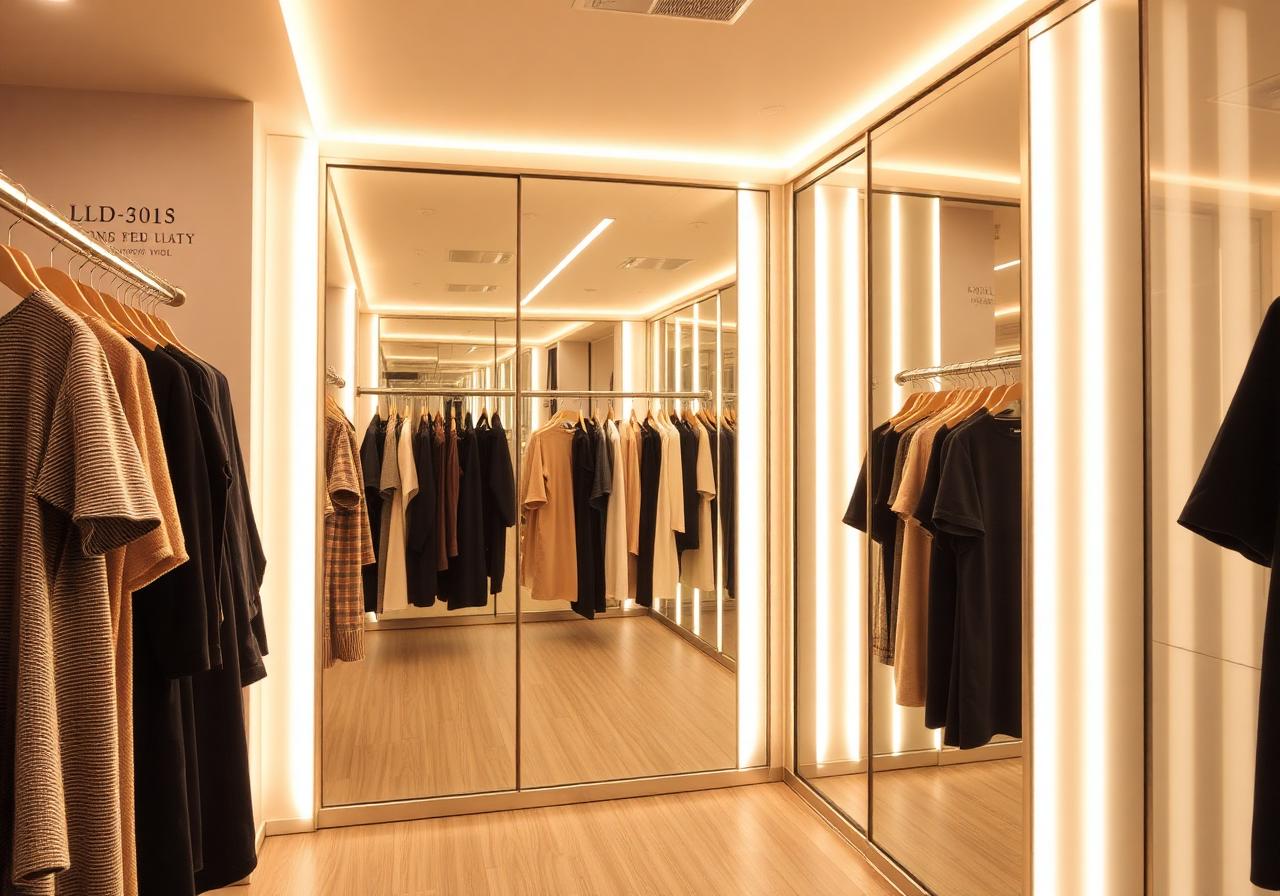
Clothing store fitting room with wraparound vertical LED strip at 3000K flattering CRI 95+The fitting room is where 70% of returns are decided. Vertical front-lit (not overhead) at 3000K with CRI 95+ and R9>80 eliminates raccoon eyes and orange-peel skin.
The Complaint:"The overhead light in the fitting room was a nightmare. It cast such harsh shadows under my eyes and made my skin look terrible. I felt so bad I didn't buy anything."
The Fix: This is the most emotionally and commercially critical space in the store. The standard overhead downlight is a sales killer. The solution is vertical, front-facing light. Use two linear LED profiles with diffuse lenses, mounted vertically on either side of the mirror. This provides soft, shadowless illumination that models the face and body flatteringly. The light source should be at face/torso height, not above the head. Color quality is paramount here.
The Spec:
Metric
Specification
Rationale
Illuminance (on customer)
750 - 1000 lux (vertical)
Bright enough for critical evaluation, soft enough to be flattering.
CCT
3000K
Universally flattering to all skin tones, feels warm and intimate.
CRI / R9
CRI 97+ / R9 > 90
The highest possible fidelity. The customer must trust what they see.
Light Placement
Vertical, on both sides of the mirror
Eliminates harsh shadows ("raccoon eyes") from overhead sources.
Dimming
Optional scene control (e.g., "Daylight," "Evening")
Allows customer to see outfit in different simulated environments.
The Control Logic: Simple occupancy sensor. Light turns on to 100% when the door is closed and off 60 seconds after it's opened. Optional: a small, intuitive user-facing controller to switch between a 3000K "Store" scene and a 4000K "Daylight" scene.
The Result: A major European fast-fashion brand A/B tested our vertical fitting room lighting setup against their old overhead downlights. They recorded a 12% increase in the sales conversion rate for customers who used the new fitting rooms.
H3: 4. The Wall Displays & Shelving
Boutique wall display with focused 3000K spotlights highlighting fabric texturesWall display: 3:1 vertical-to-horizontal ratio, narrow 15° beams to model fabric drape, 3000K to enhance wool, leather and warm tones.
The Complaint:"All the folded sweaters on the wall just look like a block of color. You can't see the knit patterns or the texture until you pull one out."
The Fix: Use adjustable spotlights or gimbals aimed at a steep angle (a 30° to 45° grazing angle) to the wall. This technique casts small shadows that reveal the texture, weave, and drape of the fabric. The goal is to achieve a high vertical-to-horizontal illuminance ratio. If the floor is at 500 lux, the vertical wall display should be at least 1500 lux. Using a slightly narrower beam (15°-24°) helps to "scallop" the light down the wall, creating visual interest and drawing the eye to the products.
The Spec:
Metric
Specification
Rationale
Illuminance (vertical)
~1500 lux
Creates a bright, attractive focal point.
Illuminance Ratio
3:1 (Vertical : Horizontal)
Makes the merchandise on the wall the primary focus.
Beam Angle
15° - 24°
Provides precise highlighting and texture-revealing scallops.
CCT
3000K
Enhances the richness of wool, leather, and warm-toned fabrics.
Aiming
Asymmetrical or gimballed
Allows for precise aiming from track or ceiling to graze the surface.
The Control Logic: Group wall display lights into zones within your DALI-2 or Casambi system. This allows staff to easily update lighting scenes when they remerchandise the wall, ensuring the light is always focused on the product, not the empty wall space.
The Result: By implementing grazing accent lights, a denim-focused retailer was able to better showcase the unique washes and textures of their jeans, reporting that customers were physically engaging with (touching) the product 30% more often.
H3: 5. The Checkout / Cash Wrap
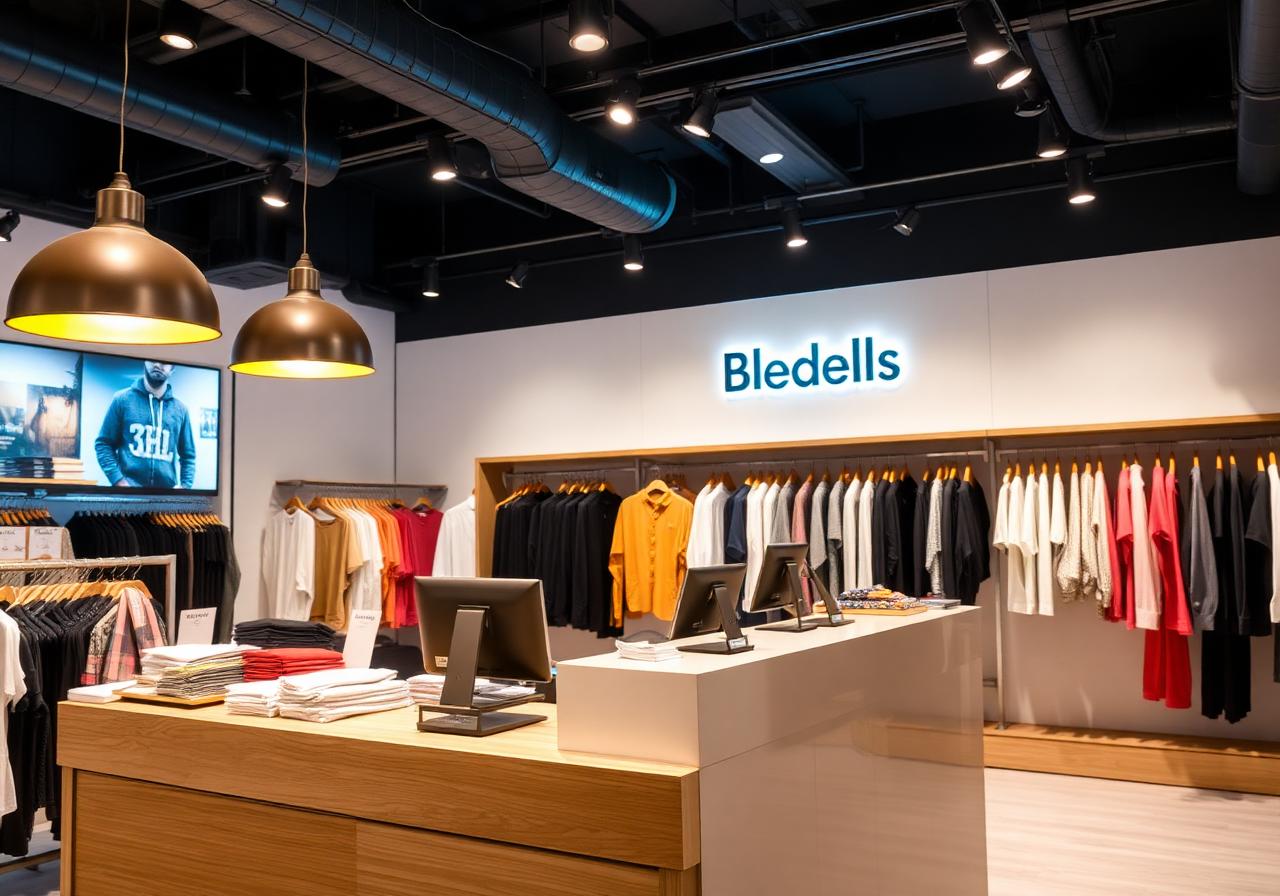
Clothing store checkout counter with warm pendant lighting and brand logo backlit at 3000KCheckout area: 3000K pendant + backlit brand wall. The last impression — soft, warm, photogenic for the Instagram tag.
The Complaint:"The checkout felt so rushed and transactional under a single, buzzing fluorescent light. It was a really poor final impression for a luxury store."
The Fix: The checkout is the final handshake. The lighting should be warm, inviting, and on-brand. This is the perfect place for a decorative layer. Use stylish pendants or a low-slung linear fixture directly over the counter to create a more intimate, focused zone. This provides excellent task lighting (~500 lux on the counter surface) for transactions while feeling soft and pleasant for the customer. Complement this with a backlit brand logo or a beautifully lit "thank you" wall behind the counter. This creates a perfect backdrop for social media photos, encouraging customers to tag the brand.
The Spec:
Metric
Specification
Rationale
Illuminance (Task)
500 lux (on counter)
Ensures easy, error-free transactions.
CCT
3000K (or even 2700K)
Creates a warm, relaxed, and premium final impression.
Fixture Type
Decorative Pendants / Backlit Elements
Reinforces brand identity and creates an aesthetically pleasing focal point.
Glare Control
Low-glare optics
Ensures staff comfort and prevents reflections on POS screens.
CRI
CRI 90+
The final check of the product color should still be accurate.
The Control Logic: These lights should be on a separate zone, often tied to the "Open for Business" master scene. They are typically not dimmed during operating hours, as they are a key part of the brand's visual signature and are essential for staff tasks.
The Result: After redesigning their cash wrap with warm pendants and a backlit logo, a high-end accessories boutique noticed a significant uptick in customers taking photos at checkout and tagging the store's location on Instagram, generating valuable user-generated marketing content.
Part 3 — 2026 Trends Driving Clothing Store Lighting Specification
The landscape of retail lighting is evolving rapidly, driven by energy legislation, technological advancements, and a deeper understanding of human-centric design. Specifying for 2026 means mastering these four key trends.
1. Radical Energy Efficiency (DLC 5.1 & LPD)
The pressure to reduce operating costs and meet stringent energy codes like ASHRAE 90.1 in the US and the Ecodesign Directive in the EU is relentless. Lighting Power Density (LPD), measured in Watts per square foot/meter, is the key metric.
The Technology: Moving from legacy halogen AR111 spotlights (75W) to modern LED equivalents (12W) represents an 84% energy saving per fixture. But the real gains come from system efficacy.
The Spec: Demand fixtures listed on the DLC 5.1 Premium qualified products list. This certification requires a luminaire efficacy of ≥130 lm/W, a 50,000-hour rated life (L90), and a 5-year warranty. Specifying DLC-listed products often makes a project eligible for significant utility rebates.
The ROI Math: A typical boutique might have 50 halogen spotlights running 12 hours a day.
Old System (Halogen): 50 fixtures × 75W × 12h/day × 365 days = 16,425 kWh/year
New System (XHLWX LED): 50 fixtures × 12W × 12h/day × 365 days = 2,628 kWh/year
Savings:13,797 kWh/year. At an average commercial electricity rate of $0.18/kWh, that's $2,483 in annual savings. Paired with controls that dim the lights by 50% when the store is empty (another ~25% saving), the payback period for a full LED retrofit often falls between 18-24 months.
2. High Efficacy & Thermal Management (Fewer Fixtures, Less Heat)
High efficacy isn't just about saving energy; it's about smarter infrastructure. A fixture that produces 160 lm/W delivers the same amount of light as a 100 lm/W fixture while using ~37% less power.
The Benefit: This has a cascade effect on project costs.
Fewer Fixtures: You may need fewer high-efficacy fixtures to achieve target light levels, reducing the initial capital outlay.
Lower HVAC Load: Every watt of lighting produces 3.41 BTUs of heat. An efficient LED system dramatically reduces the heat load on the store's air conditioning, a major energy consumer in its own right, leading to further operational savings.
Lower Installation & Maintenance Costs: Fewer fixtures mean less time and labor for installation. A high-quality die-cast aluminum heat sink ensures the LED chip stays cool, guaranteeing a long life (L90 > 50,000 hours) and virtually eliminating the costly cycle of lamp replacement common with halogen or metal halide.
3. Anti-Glare & Visual Comfort (UGR < 19)
As illuminance levels for accent lighting climb, managing glare becomes a primary design challenge. The industry is moving decisively away from cheap, shallow fixtures with exposed LEDs towards sophisticated optical design that prioritizes visual comfort.
The Pain Point: Glare is visual noise. It distracts from the merchandise, causes eye strain, and cheapens the perception of the space. A customer who is physically uncomfortable will not linger.
The Spec: As defined in EN 12464-1, retail spaces demand a UGR < 19. This is non-negotiable for a premium experience.
The Technology:
Deep-Cell Baffles: Placing the LED light source deep within the fixture housing, often with a black-finished interior cone, cuts off high-angle light before it can reach the viewer's eye.
Micro-Prismatic Diffusers: These complex lenses, often used in ambient linear fixtures and downlights, precisely control the distribution of light, shaping the beam and reducing luminance at uncomfortable viewing angles.
Honeycomb Louvers: A simple but highly effective accessory that sits in front of the primary optic, a honeycomb grid blocks peripheral light, further tightening the beam and eliminating spill glare.
Luxury clothing boutique showroom with track lighting on garments and warm accent on mannequinsA 2026 boutique: layered ambient + accent + decorative + window, all on DALI-2 scenes — Morning Restock, Daytime Sales, Golden Hour, Evening Closing.
4. Smart Controls (DALI-2 & Casambi)
Static lighting is dead. A 2026 clothing store must be dynamic, responsive, and data-rich. Smart controls are the key, moving beyond a simple on/off switch to a fully programmable system.
DALI-2 (Wired): The choice for new builds and major renovations. It’s an IEC standard, meaning interoperability between manufacturers is guaranteed. Every DALI-2 fixture and sensor has a unique address on a two-wire bus.
Key Features: Individual fixture dimming, real-time status monitoring (e.g., "Fixture 37 has failed"), energy consumption reporting per fixture, and seamless integration with occupancy sensors, daylight sensors, and central Building Management Systems (BMS).
Casambi (Wireless): The dominant choice for retrofits and spaces requiring maximum flexibility. It uses a Bluetooth Low Energy (BLE) mesh network.
Key Features: No new control wiring. Fixtures are controlled via a smartphone/tablet app. It’s incredibly intuitive for store staff to create and recall scenes. The system is robust, as every fixture acts as a repeater, strengthening the mesh network. Ideal for "pop-up" shops or historic buildings where running new wires is prohibitive.
The Application: Scene-setting is the killer app for retail.
Scene 1: Morning Restock: All lights to 100% at a neutral 4000K for clear visibility for staff.
Scene 2: Daytime Sales: System switches to the primary 3000K design, with accents at 100% and ambient at 80%.
Scene 3: Golden Hour: As evening approaches, accents dim slightly to 70% and decorative elements become more prominent.
Scene 4: Closing: Only security and window display lights remain on at 50%.
Part 4 — Why XHLWX for Your Retail Project + Procurement Checklist
Choosing a manufacturing partner is as critical as the lighting design itself. A great specification is useless if the supplied product fails to perform, is delivered late, or lacks the necessary certifications.
As a 17-year OEM/ODM specialist in project lighting, XHLWX (Shenzhen Qihang Lighting) is engineered for the rigors of high-stakes retail specification. Our process is built around delivering on your exact photometric and reliability requirements. We operate our own in-house SMT lines, driver production, and luminaire assembly, giving us full control over quality. Every product undergoes rigorous testing in our on-site photometric lab (integrating sphere, goniophotometer) and aging test rooms before it ever ships. This vertical integration means we can provide a 5-year warranty with confidence.
With a portfolio of over 200 delivered clothing store projects across Europe and North America, we understand the specific demands of fashion retail. We provide complete documentation—IES files for your DIALux or AGi32 simulations, detailed spec sheets, and all necessary certifications, including CE, RoHS, UL, ENERGY STAR, and DLC. Our engineering team works directly with designers and architects to customize fixtures or develop new solutions to meet a project's unique aesthetic and performance goals. We are not just a supplier; we are your dedicated manufacturing partner for performance-critical lighting.
Your 2026 Retail Lighting Procurement Checklist
Use this 12-point checklist to vet any fixture or supplier. If a product doesn't meet these criteria, it's not a professional-grade solution for 2026.
CCT: Is the specified CCT (3000K standard) available within a 2-step MacAdam ellipse for fixture-to-fixture color consistency?
Color Rendering: Is CRI ≥ 95 and R9 ≥ 80 clearly stated on the spec sheet? (CRI 90 / R9 > 50 is an absolute minimum).
TM-30 Data: Can the manufacturer provide a full TM-30 report showing Rf ≥ 90 and 95 < Rg < 105?
Glare Control: Is the Unified Glare Rating UGR < 19? Does the fixture use deep-set optics, baffles, or louvers?
Flicker Performance: Does the driver meet Pst LM ≤ 1.0 and SVM < 0.4 to ensure flicker-free performance on video?
Luminaire Efficacy: Is the efficacy ≥ 130 lm/W for rebate eligibility (DLC 5.1)?
Driver: Is it a recognized brand (e.g., Tridonic, Osram, BOKE) with a Class II rating and a power factor > 0.95?
Dimming Protocol: Is your required protocol (DALI-2, Casambi, 0-10V, TRIAC) supported with smooth, flicker-free dimming to 1%?
Warranty: Is a minimum 5-year warranty provided, covering the entire luminaire (LEDs, driver, and housing)?
IES File: Is a specific IES file for the exact CCT/beam/lumen package available for lighting simulation software?
[... ] Certifications: Does the product carry the required markings for the project region (CE/UKCA for Europe, UL/ETL for North America)?
Thermal Management: Is the housing made of die-cast aluminum or another high-performance material, with a stated L90 lifetime ≥ 50,000 hours?
Part 5 — Real Customer Complaints, Technical FAQs & SEO Data
5.1 The 8 Real Complaints We Found on Reddit, Quora & Substack (And How to Solve Them)
1. The Complaint:"I bought what I thought was a beautiful black blazer. I got it out of the bag at home and it's clearly dark navy blue. I'm so annoyed I have to go back and return it. 1-star review."The Root Cause: This is a classic failure of color rendering, specifically the R12 value (for blue) and overall spectral power distribution. The store's lighting had a poor CRI (<80) or, more likely, a significant gap in the blue part of its spectrum, making it impossible to differentiate between very dark, similar hues.
The XHLWX Solution: We mandate a CRI 95+ and R9 > 80 specification across our entire range of accent spotlights. Our high-fidelity LEDs have a full, continuous spectrum with no major spikes or troughs, ensuring a navy blazer looks navy and a black one looks black, eliminating costly returns and brand-damaging customer frustration.
2. The Complaint:"The lighting in the fitting rooms gives me raccoon eyes. There’s a giant shadow under my chin and nose. I look 10 years older and nothing looks good on me."The Root Cause: A single overhead downlight. This placement creates harsh, downward shadows, highlighting wrinkles and creating "shadow pockets" under the eyes, nose, and chin. It's the least flattering light possible for the human face and form.
The XHLWX Solution: Our fitting room specification is built around vertically-mounted linear LED fixtures. We recommend our SL-06 Series linear profiles with frosted diffusers, installed on both sides of the mirror. This creates a soft, wraparound frontal light that fills in shadows, providing a flattering and true-to-life reflection that gives customers the confidence to buy.
3. The Complaint:"This store uses that horrible, cold 5000K lighting. It makes their winter collection of wools and cashmeres look completely sterile and unappealing. It feels like a dentist's office, not a cozy boutique."The Root Cause: A fundamental mismatch between CCT and merchandising. Cool CCTs (4000K+) can feel clinical and harsh, and they suppress the richness of warm colors (reds, browns, oranges) and textures like wool.
The XHLWX Solution: We guide our clients to use 3000K as the standard for almost all fashion retail, especially for brands selling autumn/winter collections or materials with warm undertones. This CCT creates a welcoming, premium ambiance and makes skin tones and warm-hued garments look healthy and vibrant. It aligns the store's atmosphere with the intended feeling of the clothes themselves.
4. The Complaint:"I tried to take a picture of a handbag in a glass display case, but all I got was a photo of the bright spotlight reflection on the glass. No way to share it, totally useless for my Instagram."The Root Cause: Incorrect fixture placement and beam control. A spotlight aimed directly at a reflective surface (glass, polished floors, high-gloss fixtures) will create blinding specular reflections.
The XHLWX Solution: It's about angles and accessories. We advise designers to aim track lights at a steeper angle (>30°) to the glass to shift the reflection away from the typical viewer's eye level. More importantly, we provide our spotlights with anti-glare accessories like honeycomb louvers. This narrows the beam and cuts off spill light that would otherwise create these sale-killing reflections.
5. The Complaint:"The store uses track lights, but they're spaced too far apart. There are super bright hot spots on the merchandise directly under the lights, and dark, shadowy patches in between. It's impossible to compare two items."The Root Cause: Poor lighting design and layout. The designer failed to calculate the proper beam spread and overlap. This "scalloping" effect creates a lack of uniformity on the products, making it hard to shop.
The XHLWX Solution: We provide precise IES photometric files for all our fixtures. This allows designers to simulate the layout in DIALux or AGi32 to ensure proper fixture spacing for smooth, even coverage on the merchandise walls. For a 36° beam spotlight aimed at a wall 3 meters away, the fixtures might need to be spaced 1.2 meters apart to achieve proper overlap and uniformity.
6. The Complaint:"As a store manager, my energy bill is nearly 40% of my OPEX. We're still running old 75W halogen track heads because the owner thinks LEDs are too expensive to install."The Root Cause: A misunderstanding of total cost of ownership (TCO). While the initial cost of a halogen fixture is low, its high energy use, short lifespan (~2,000 hours), and high heat output make it extremely expensive to operate.
The XHLWX Solution: We provide clients with a clear ROI calculation. Replacing a 75W halogen with our 12W DLC 5.1 Premium track light saves $25-30 per fixture, per year in energy alone (at typical operating hours/costs). Add in maintenance savings (no lamp replacements for 5-7 years) and HVAC savings, and the payback period for a full LED retrofit is often under 2 years.
7. The Complaint:"I record a lot of in-store content for TikTok, but the flicker on their cheap dimmable lights is awful. My videos have these weird rolling bands, which makes my clips unusable."The Root Cause: A low-quality, cheap LED driver and/or an incompatible dimmer. This combination produces high levels of flicker, which are invisible to the naked eye but easily captured by smartphone cameras, especially in slow-motion or non-standard frame rates.
The XHLWX Solution: We specify high-performance drivers that meet the stringent IEEE 1789 standard, ensuring a flicker percentage well below the threshold of visibility for cameras. Our spec requires a Pst LM < 1 and SVM < 0.4, guaranteeing clean, professional-looking video capture on any modern smartphone—turning the store into a user-generated content-friendly marketing asset.
8. The Complaint:"I bought a generic 'retail spotlight' from a big online marketplace, and the reds in our new collection look brown and dead. The CRI was listed as 90, but it looks terrible."The Root Cause: This is a classic R9 value issue. A fixture can have a "high" CRI of 90, but if its R9 value (the specific test for saturated red) is near zero, all red tones will be desaturated and distorted. This is common with cheap, non-specialized LED chips.
The XHLWX Solution: We are explicit in our specifications: CRI 95+ and R9 > 80. For premium retail, we often push to R9 > 90. We provide full colorimetric data for our fixtures, so a specifier can see the quality of red rendering before purchasing. This protects brand integrity and ensures the designer's color palette is represented accurately.
5.2 Frequently Asked Questions (FAQ)
Q1: Our spec sheet asks for a 3-step MacAdam ellipse. Can you guarantee this?
A: Yes. All our professional-grade fixtures use LEDs binned to within a 2- or 3-step MacAdam ellipse. This ensures that every fixture in your project will have identical color temperature and tint, preventing any visible color variation from one luminaire to the next. For highly sensitive projects, we can secure single-bin LEDs for ultimate consistency. This is a critical detail for creating a high-end, uniform look.
Q2: We're retrofitting a 10-year-old store. Is it better to just replace the lamps or the full fixtures?
A: For a professional result, always replace the full fixture. While LED "retrofit lamps" exist, they are a compromise. The original fixture's optics and thermal management were designed for a halogen or metal halide source, not an LED. A full fixture replacement ensures the optics, LED chip, and heat sink are engineered as a single, optimized system, delivering better performance, higher efficacy, superior glare control, and a much longer, warrantied lifespan.
Q3: DALI-2 vs. Casambi vs. 0-10V — which control protocol should I choose?
A: For new builds or gut renovations, DALI-2 is the superior choice for its robustness, individual addressability, and data feedback capabilities. For retrofits where running new control wires is not feasible or for spaces that require frequent layout changes, Casambi (wireless mesh) offers incredible flexibility and intuitive app-based control. We recommend 0-10V only for budget-constrained projects that require simple dimming and do not need scene control or individual addressability.
Q4: What does your 5-year warranty actually cover?
A: Our standard 5-year warranty is comprehensive. It covers the entire luminaire against manufacturing defects. This includes the LED light engine (guaranteeing it maintains a certain percentage of its light output, e.g., L80), the driver, and the fixture housing itself. If a component fails within the warranty period due to a manufacturing fault, we will repair or replace it. It's a promise of performance and reliability backed by our 17 years of manufacturing expertise.
Q5: How quickly can I get IES files for my DIALux simulation?
A: Immediately. We maintain a complete library of IES photometric files for our entire product catalog, covering all available beam angles, CCTs, and lumen packages. You can download them directly from our website or request them from your sales contact. We understand that lighting design is simulation-driven, and providing accurate, instant photometric data is a core part of our service to designers and specifiers.
Q6: We're specifying for a project in Germany and another in New York. Can you supply products with the correct certifications?
A: Absolutely. This is a core strength of our OEM/ODM service. All our products are designed to meet global standards, and we manage the certification process for different regions. We ship products with CE/RoHS/TUV markings for the EU market and UL/ETL/DLC listings for the North American market. We handle the compliance details so you can be confident that the products will be approved for installation in your project's jurisdiction.
5.3 SEO Meta
Meta Title: Clothing Store Lighting Design 2026: The Definitive Guide

Meta Description: Boost sales with our 2026 guide to clothing store lighting. Learn to spec CRI 95+, 3000K accent spotlights, and flattering fitting room lighting to solve real customer complaints.

Open Graph Title: Clothing Store Lighting Design 2026: CRI 95+ True-Color & DALI-2 Sales Boost Spec
Open Graph Description: The definitive technical guide for architects & designers on fashion retail lighting. We solve the 8 biggest customer complaints using evidence-based specs for CRI 95 R9, 3000K accent lighting, flattering fitting rooms, and energy-saving controls.

Schema.org Article (JSON-LD):
{"@context":"https://schema.org","@type":"Article","headline":"Clothing Store Lighting Design 2026: CRI 95+ True-Color, 3000K Warm Accent, Flattering Fitting Rooms & DALI-2 Sales Boost Spec","description":"The definitive 2026 technical guide for architects, specifiers, and facility managers on high-performance fashion retail lighting. Solves real customer complaints with evidence-based specs for CRI 95+ R9 apparel lighting, 3000K accent spotlights, flattering fitting rooms, and DALI-2/Casambi controls.","image":"https://www.led-project-light.com/solutions/clothing-store/hero.jpg","author":{"@type":"Organization","name":"XHLWX (Shenzhen Qihang Lighting)"},"datePublished":"2026-05-17"}

Keyword Cluster: clothing store lighting design, fashion retail LED lighting, CRI 95 R9 apparel lighting, fitting room lighting design, 3000K accent spotlight, Casambi retail control, DALI-2 boutique lighting, narrow beam track light for retail, retail lighting UGR<19, high CRI track lighting, LED for clothing stores, visual merchandising lighting
XHLWX Senior Lighting Design Team
Architectural Lighting Specialists · 17 Years OEM/ODM
XHLWX (Shenzhen Qihang Lighting) has delivered specification-grade LED solutions for 200+ clothing store projects across Europe, North America, and Asia since 2008. In-house SMT, aging lab, photometric chamber; CE/RoHS/DLC/ENERGY STAR/UL certified.
Need a tailored lighting plan for your project?
Our senior lighting designers reply within 48 hours with a free design proposal & quotation.