
Conference Room Lighting Design 2026: DALI Scene & Camera Guide
Quick answer
Master 2026 conference room and ballroom lighting. Our guide covers DALI-2 scenes, camera-friendly CRI 95+, UGR<19, and standards like EN 12464-1 for modern s
Introduction — the Design Problem in Modern Conference Spaces
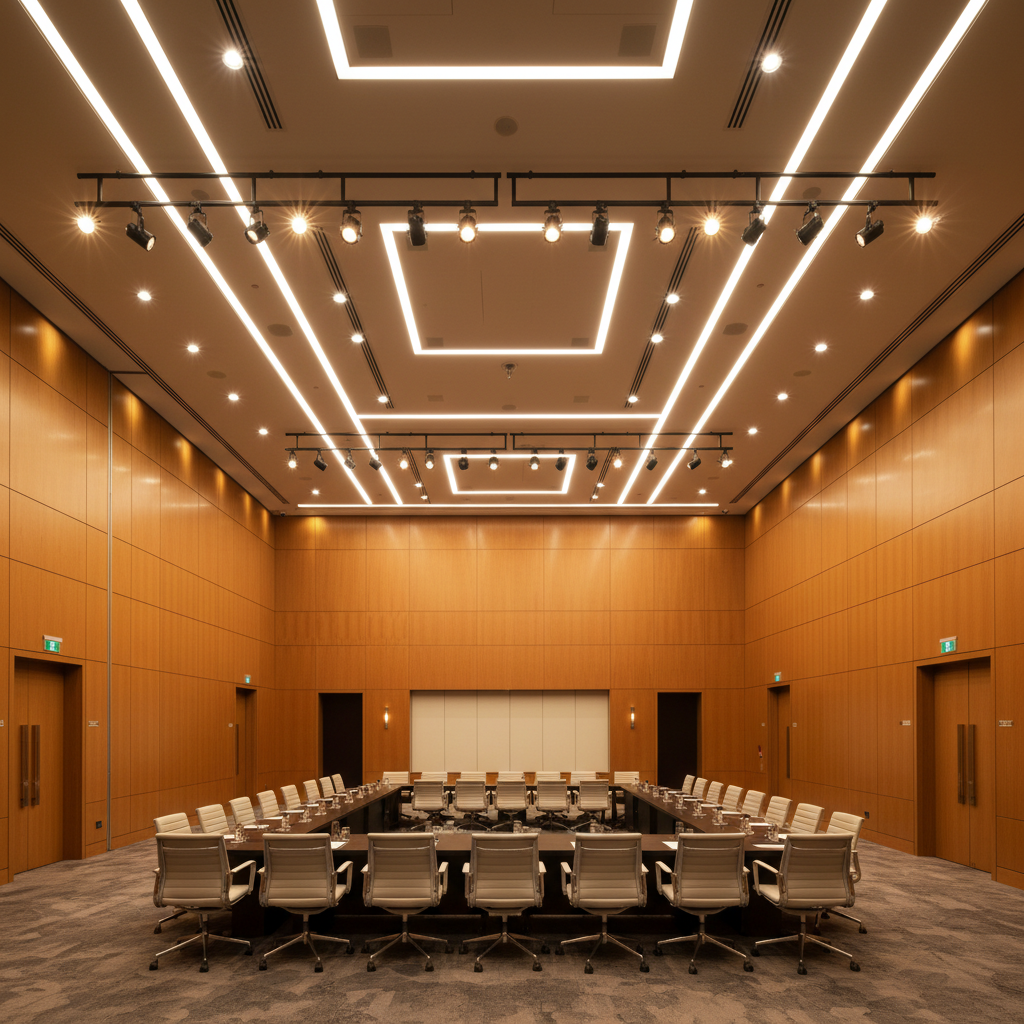
Modern conference rooms and hotel ballrooms are no longer single-purpose venues; they are dynamic, multi-functional assets demanding highly adaptable lighting.com), a Custom Indoor LED Lighting Manufacturer based in China, we see clients across the EU, US, and Middle East grappling with the challenge of creating environments that are equally effective for a focused board meeting, a global video conference, a formal gala, or a high-energy product launch.
The core problem is designing a single lighting system that delivers exceptional visual comfort, perfect on-camera appearance, and effortless scene transitions, all while meeting stringent energy efficiency regulations. This requires a holistic approach that moves beyond simple illuminance targets to embrace sophisticated optics, color rendering science, and intelligent digital control.
Lighting Criteria and Standards for Multi-Function Rooms
Effective lighting design for these spaces is governed by precise, internationally recognized standards. Adhering to metrics for illuminance, glare, and color quality is not just about compliance; it's fundamental to ensuring user comfort, productivity, and the successful execution of events.
Key standards include Europe's EN 12464-1 (also as DIN EN 12464-1 in Germany), the Illuminating Engineering Society's IES RP series in North America, and the global WELL v2 building standard, which focuses on human health and well-being. For conference tasks, these standards converge on a recommended illuminance of 500 lux on the primary task area (the table) and a Unified Glare Rating (UGR) of less than 19 to prevent visual discomfort.
For video conferencing, color quality becomes paramount, pushing requirements for CRI well above the standard 80.
| Parameter | Recommended Specification | Governing Standard | Notes |
|---|---|---|---|
| Illuminance (Ēm) | 300 lx (General), 500 lx (Conferencing) | EN 12464-1, IES RP-7 | Maintained illuminance on the task plane (e.g., conference table). |
| Unified Glare Rating (UGR) | < 19 (Design Target) | EN 12464-1 | Critical for visual comfort, especially with screens. Achieved through luminaire optics and placement. |
| Color Rendering / Quality | CRI Ra > 95, R9 > 80, TM-30 Rf > 90 | WELL v2 Light Feature L04 | Essential for accurate color representation, particularly skin tones and brand colors on camera. |
| Correlated Color Temp (CCT) | Tunable White: 2700K – 6500K | Project-specific (WELL v2) | Enables scene-setting: Warm for social events, neutral for meetings, cool for high focus. |
| Control Protocol | DALI-2 (IEC 62386), D4i | IEC 62386 | Enables individual addressing, scene recall, color tuning (DT8), and energy monitoring. |
| Flicker Performance | PstLM < 1, SVM < 0.4 (Recommended) | ErP, IEEE 1789 | Crucial for visual comfort and preventing banding/flicker on video recordings. |
| Housing / Protection | IP20 (Min), IK03 (Min) | IEC 60529, EN 62262 | Standard for indoor, dry locations. Higher ratings may be needed for specific zones. |
| LED Chip / Driver Brand | Bridgelux / Osram / Samsung (LED); Tridonic / Mean Well (Driver) | Manufacturer Specific | Ensures reliability, performance consistency, and long-term warranty support. |
| Certification | CE, RoHS, ErP, ISO9001 | EU Directives, ISO | Mandatory for EU market access (CE/RoHS/ErP); ISO9001 indicates quality management systems. |
Luminaire Selection and Optics
A layered lighting strategy using a mix of luminaire types is the most effective approach for multi-use spaces. The selection of fixtures and their optical properties—beam angle, shielding, and lens material—directly impacts glare control, light distribution, and overall aesthetic.
While a single luminaire type cannot meet all needs, a carefully curated combination creates a flexible and visually stunning environment. The goal is to combine general (ambient), focused (task), and highlighting (accent) layers that can be independently controlled and integrated into pre-programmed scenes.
| Luminaire Type | Application Focus | Glare Control (UGR) | Flexibility | Verdict |
|---|---|---|---|---|
| Adjustable Downlights | Primary task lighting (tables), accent lighting | Excellent (when deep-recessed with black baffles) | High (can be aimed at features or tables) | Excellent for Task & Accent. The workhorse for providing high-quality, low-glare light exactly where it is needed. |
| Recessed Linear Systems | Architectural integration, ambient lighting, wall washing | Good to Excellent (with prismatic or microprismatic diffusers) | Moderate (fixed position, but can create lines of light) | Best for Architectural Definition. Integrates seamlessly into ceilings and walls to define space and provide smooth ambient fill. |
| Track Spotlights | Accent lighting for artwork, speakers, displays, architectural features | Good (with snoots/honeycomb louvers) | Very High (fully repositionable and re-aimable) | Highest Flexibility. Ideal for spaces where focal points change frequently, such as ballrooms used for exhibitions or events. |
| Decorative Pendants/Chandeliers | Creating a focal point, contributing to ambient/decorative layer | Poor to Fair (often a source of glare if not shaded) | Low (fixed decorative element) | Essential for Atmosphere. Provides brand identity and style, but must be supplemented with architectural lighting for functional tasks. |
How Do You Achieve Truly Camera-Friendly Lighting?
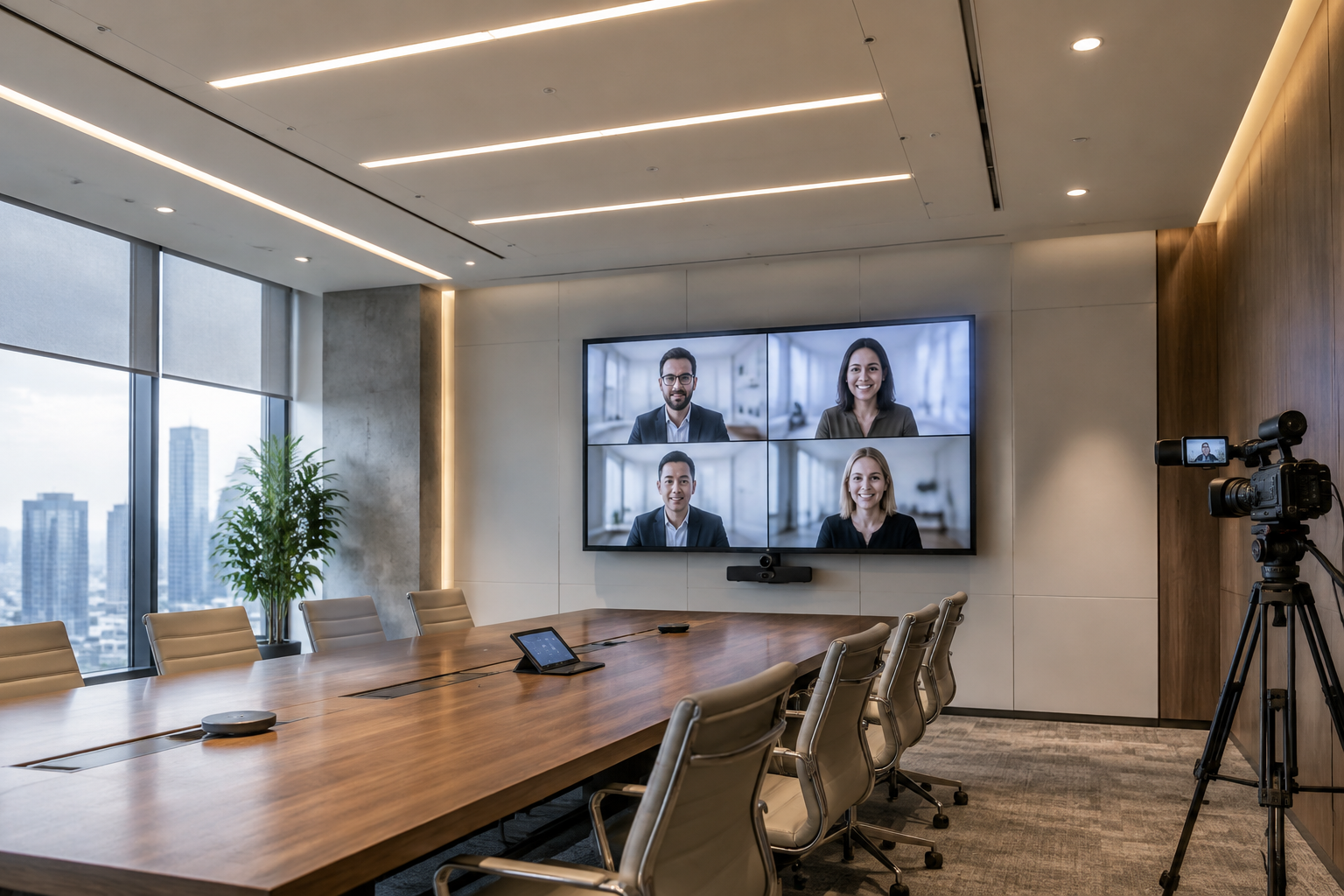
Camera-ready lighting prioritizes color fidelity and temporal stability above all else. This is achieved by specifying luminaires with a Color Rendering Index (CRI) of Ra > 95 and, critically, a high R9 value (>80) for saturated red rendering, which is vital for natural skin tones.
Beyond CRI, the IES TM-30-20 standard provides a more complete picture with its Fidelity Index (Rf) and Gamut Index (Rg). For video, flicker-free performance is non-negotiable.
Specify drivers compliant with IEEE 1789 recommendations or that meet the latest ErP directive's PstLM and SVM metrics to avoid distracting bands or flicker on camera.
What Is the Best Way to Layer Lighting in a Ballroom?
The most successful ballroom designs employ four distinct lighting layers that work in concert. The Ambient Layer provides the base level of general illumination, often using wide-beam downlights or linear systems.
The Task Layer delivers focused, higher-intensity light onto tables, lecterns, or stages using adjustable spotlights or narrow-beam downlights. The Accent Layer uses narrow spotlights to draw attention to architectural details, artwork, or centerpieces.
Finally, the Decorative Layer, including chandeliers and wall sconces, adds visual interest and defines the room's character. Scene control systems then mix the outputs of these layers to create distinct moods.
Why Is Tunable White Essential for Multi-Scene Rooms?
Tunable white technology is the key to unlocking true environmental adaptability in a conference space. It allows the Correlated Color Temperature (CCT) of the lighting to be adjusted, fundamentally changing the room's atmosphere to suit its function.
For a daytime corporate meeting, a neutral 4000K promotes alertness and focus. For a formal evening gala, a warm 2700K creates a relaxed, intimate, and inviting ambiance.
This ability to dynamically shift the color of light, often automated in line with circadian principles as outlined in the WELL v2 standard, makes a single room feel purpose-built for any event.
 Conference Room Lighting Design 2026: DALI Scene & Camera Guide: How Do You Achieve Truly Camera-Friendly Lighting?
Controls, Energy, and Commissioning (DALI-2 / Casambi / Sensors)
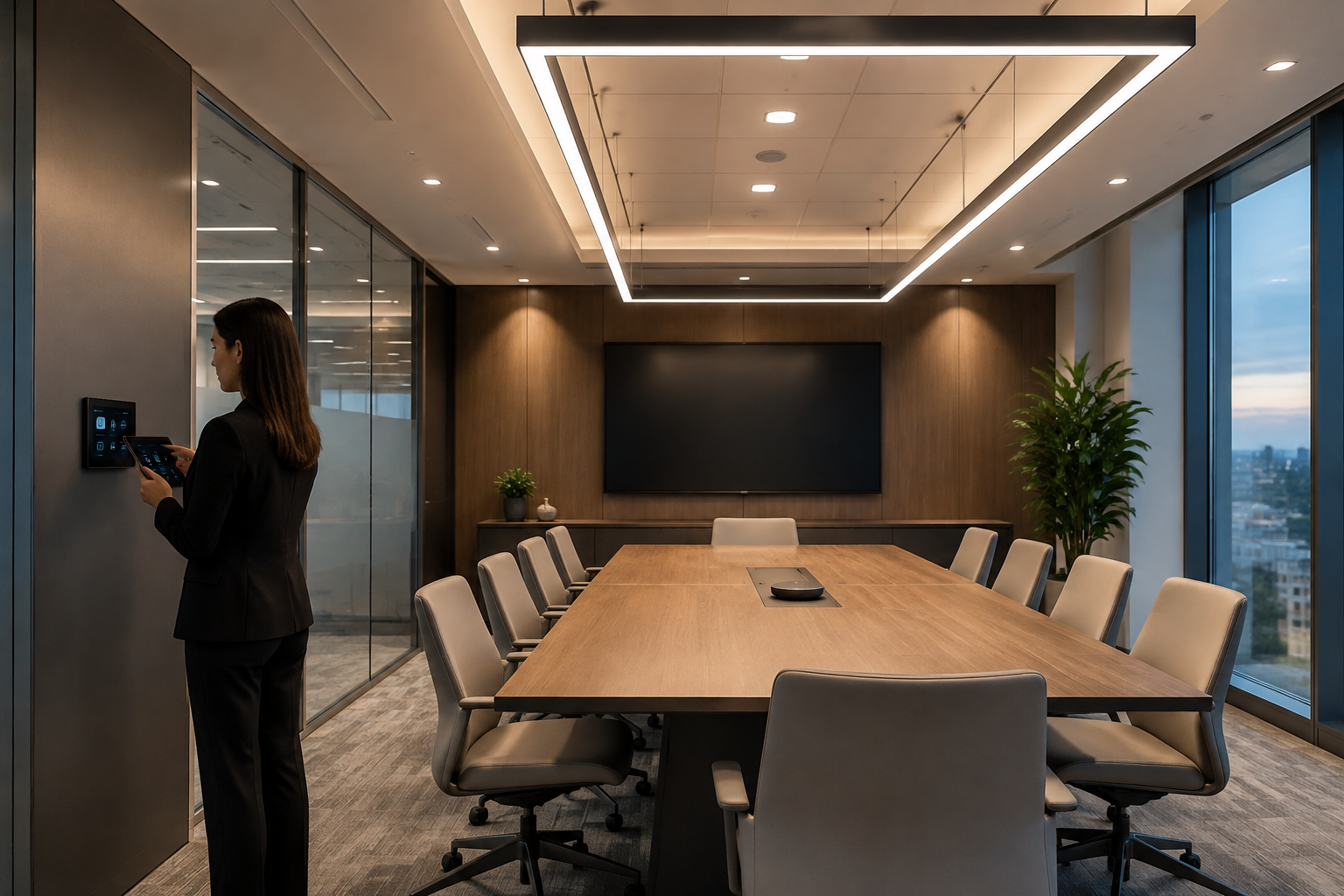
Sophisticated control is what transforms a collection of high-quality luminaires into an intelligent lighting system. DALI-2 (Digital Addressable Lighting Interface) is the global standard for robust, interoperable control in professional applications.
Each DALI-2 luminaire or sensor has a unique address, allowing for individual control, grouping, and the creation of complex scenes that can be recalled with a single button press. Common scenes for a conference ballroom include 'Presentation Mode' (stage bright, seating dim), 'Video Conference Mode' (even, high-CRI 4000K light), 'Dining Mode' (warm, low-level decorative and accent light), and 'Full Bright/Cleaning'.
Tunable white is managed via DALI-2 Device Type 8 (DT8), which allows for smooth dimming and CCT control over a single DALI address. For smaller spaces or retrofits where new control wiring is impractical, wireless mesh systems like Casambi offer a powerful and flexible alternative.
To meet modern energy codes like the EU's ErP directive, these control systems must integrate occupancy and daylight harvesting sensors to dim or switch off lights when the space is unoccupied or when sufficient natural light is present.
 Conference Room Lighting Design 2026: DALI Scene & Camera Guide: Controls, Energy, and Commissioning (DALI-2 / Casambi / Sensors)
Photometric Files & Compliance (IES / LDT / DIALux / CE / RoHS / ErP)
Verifiable performance is the foundation of a professional lighting specification. At XHLWX, we provide comprehensive photometric data for all our custom luminaires in industry-standard formats, including IES and LDT photometric files.
These digital files are the unique fingerprint of a luminaire's light distribution, allowing lighting designers to import them into simulation software like DIALux or AGi32. This simulation process is critical for verifying a design's compliance with standards like EN 12464-1 before a single fixture is ordered.
It allows designers to predict illuminance levels, assess uniformity, and, most importantly, calculate the UGR to ensure visual comfort. Beyond performance verification, product compliance is mandatory for market access.
All XHLWX products for the European Union are certified CE (Conformité Européenne), RoHS (Restriction of Hazardous Substances), and compliant with the latest ErP (Energy-related Products) directive. Our manufacturing processes are also ISO9001 certified, ensuring a consistent standard of quality and reliability.
Frequently Asked Questions
Q: What Is a Good UGR Value for a Modern Conference Room?
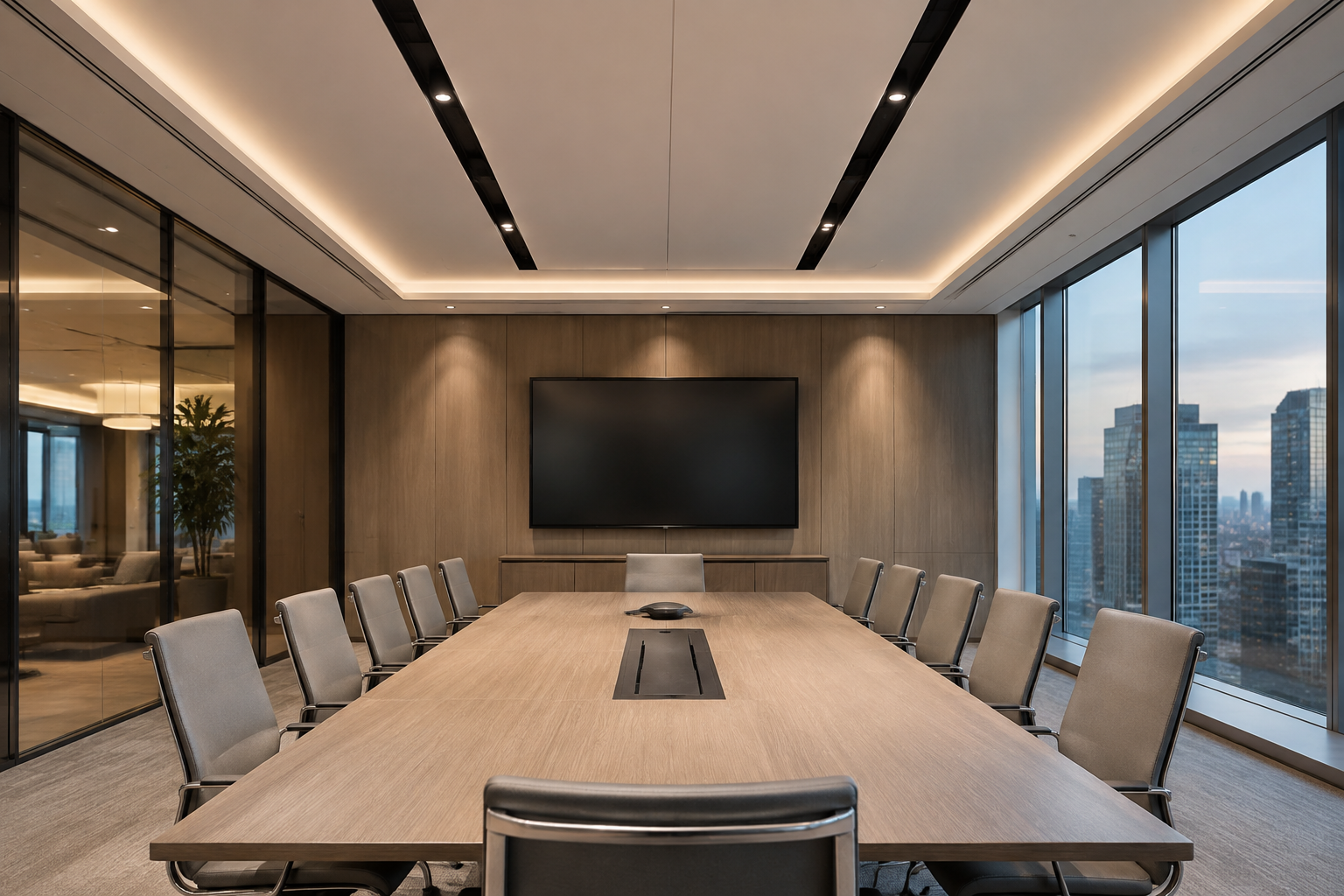
For tasks like presentations and meetings, the European standard EN 12464-1 mandates a Unified Glare Rating (UGR) of less than 19. This ensures a high level of visual comfort, minimizing distracting and fatiguing glare for participants, especially when they are viewing screens or presenters for extended periods. Achieving a UGR < 19 is a primary design target for quality conference room lighting and depends heavily on luminaire selection and placement.
Q: How Many DALI Scenes Are Typical for a Large, Multi-function Ballroom?
A typical setup includes 4 to 8 pre-programmed DALI scenes to cover the most common uses. Examples include 'Presentation' (500 lx on stage, seating at 50 lx), 'Dining' (150 lx, warm 2700K CCT), 'Video Conference' (even 500 lx, neutral 4000K CCT), and 'Full Bright/Cleaning' (100% output at 4000K). The beauty of DALI-2 is that these scenes are easily configured and can be customized to the client's exact needs during commissioning.
Q: Is CRI 90 Enough for Professional Video Conferencing?
While CRI 90 is considered high quality, for professional broadcast or high-stakes video calls, specifying CRI 95 or higher is strongly recommended. More importantly, ensure a high R9 value (for saturated red) of over 80. This combination delivers superior rendering of skin tones and brand colors, ensuring that participants and products look natural and accurate on camera. This small step up in specification makes a significant visual difference.
Q: What Is the Difference Between DALI DT6 and DT8 for Controlling LEDs?
DALI Device Type 6 (DT6) is the standard for controlling intensity, meaning it is used for single-channel drivers to dim the light level up and down. DALI Device Type 8 (DT8) is the standard for color control. It allows both brightness and color temperature (for Tunable White) or color hue/saturation (for RGBW) to be controlled using a single DALI address, greatly simplifying the wiring and programming for advanced, dynamic lighting systems.
 Conference Room Lighting Design 2026: DALI Scene & Camera Guide: Q: What is a good UGR value for a modern conference room?
Sources and Technical References
- EN 12464-1:2021: Light and lighting - Lighting of work places - Part 1: Indoor work places.
- IES RP-7-21: Recommended Practice: Lighting for Educational Facilities (includes conference rooms).
- WELL Building Standard v2: Light Concept, Feature L04: Electric Light Quality.
- IEC 62386: Digital addressable lighting interface (DALI).
- IES TM-30-20: IES Method for Evaluating Light Source Color Rendition.
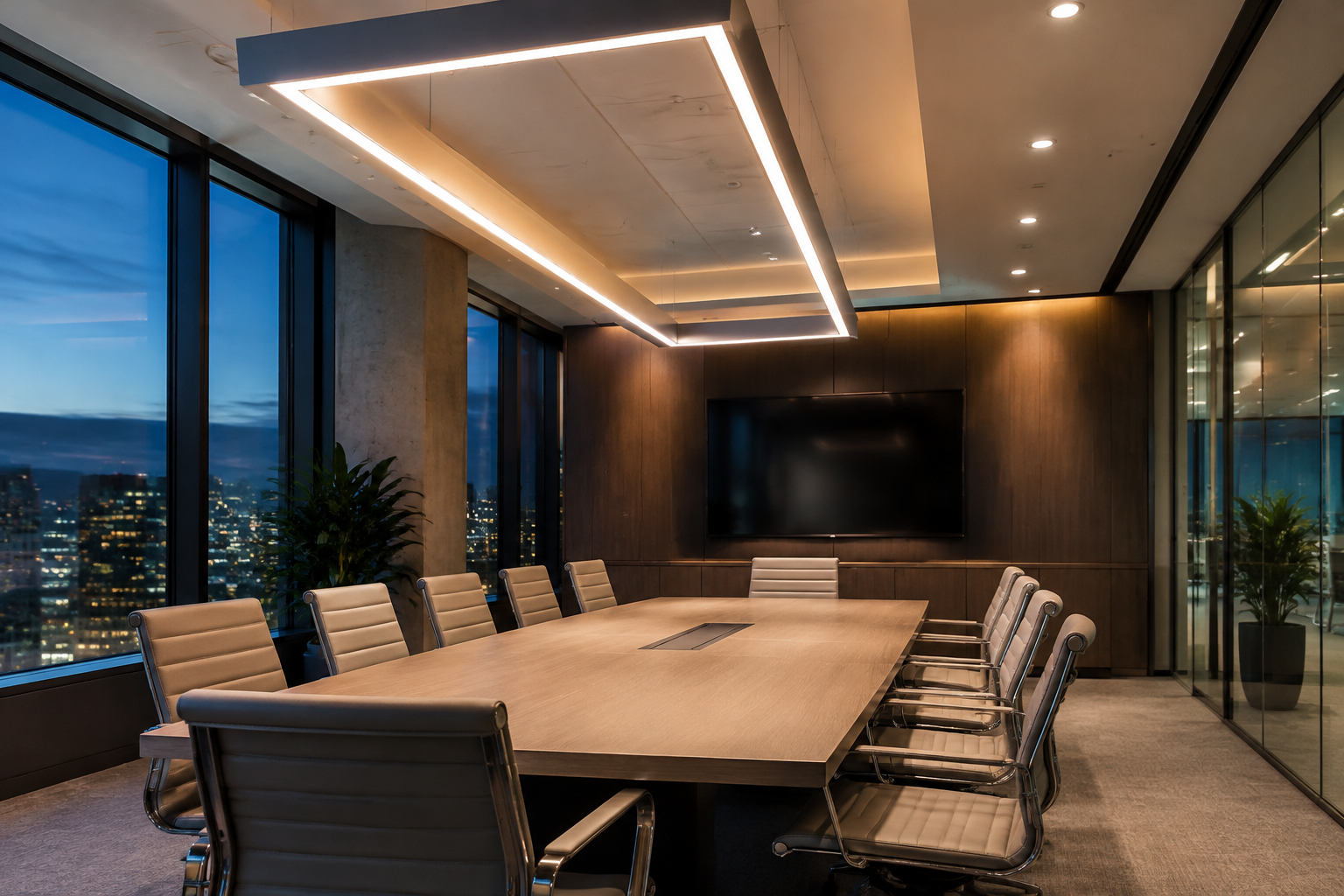 Conference Room Lighting Design 2026: DALI Scene & Camera Guide: Q: What is the difference between DALI DT6 and DT8 for controlling LEDs?
Request a Custom Quote
Designing the optimal lighting solution for a modern conference room or ballroom requires a deep understanding of both technology and application standards.com), a Custom Indoor LED Lighting Manufacturer based in China, we specialize in partnering with designers and architects to develop luminaires that meet the precise optical, control, and compliance requirements of your project.
We provide full support, from initial specification and DIALux simulation to final product delivery. Contact our team today to discuss your project and receive a custom quote for a tailored lighting solution.
Need a tailored lighting plan for your project?
Our senior lighting designers reply within 48 hours with a free design proposal & quotation.