
Convenience Store Lighting 2026: 4000K Uniformity Guide
Quick answer
Expert guide to 2026 convenience store lighting. Learn how to achieve 4000K uniformity, meet EN 12464-1 standards, and select the right LED luminaires for chi
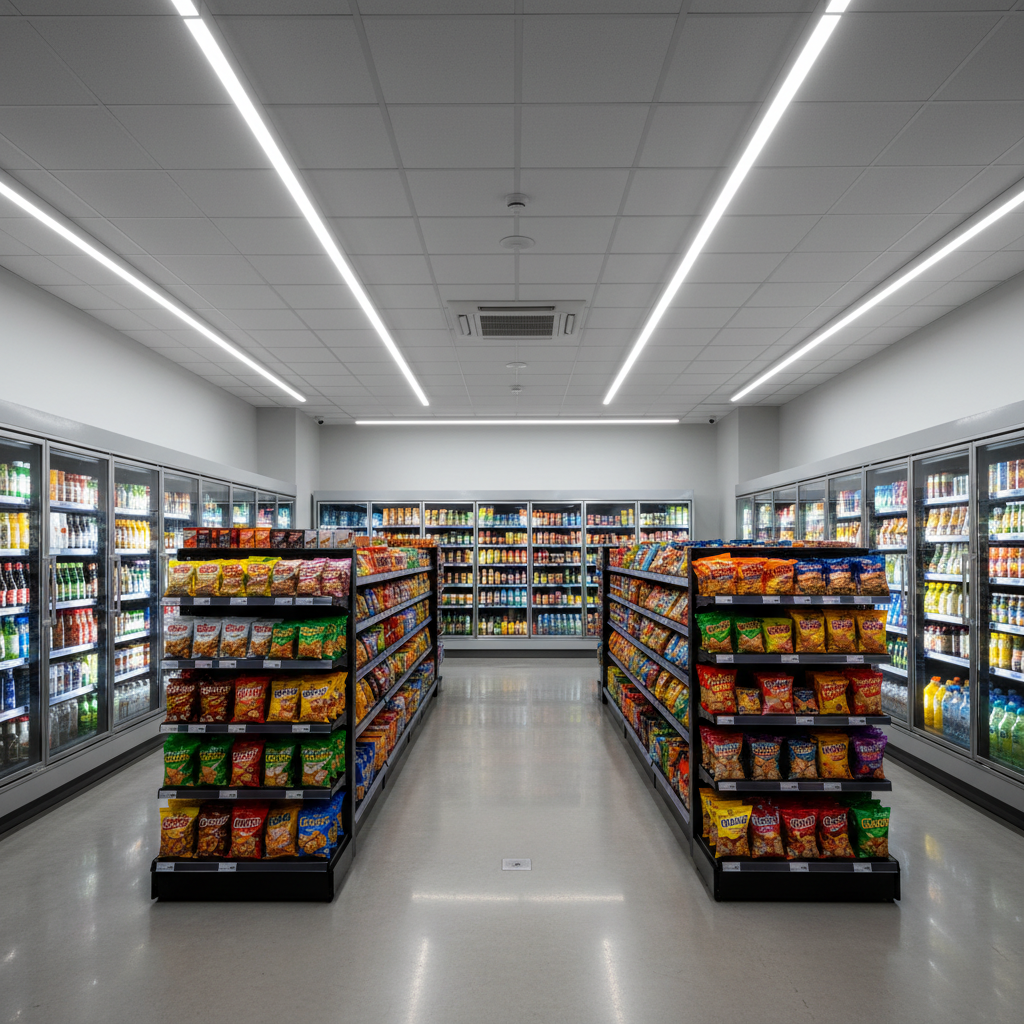
Introduction — the Design Problem in Convenience Stores
com), a Custom Indoor LED Lighting Manufacturer based in China, we understand that effective convenience store lighting is a science of attraction and efficiency. The core challenge lies in balancing the competing demands of a 24/7 operational cycle.
Lighting must be inviting enough to draw customers in from the street, powerful enough to make products pop, and efficient enough to keep operational costs down. A poorly lit store appears unsafe and unappealing, while excessive or glaring light can be uncomfortable for staff and customers.
Different zones—from the general aisles and vertical chillers to the critical point-of-sale (POS) counter—require distinct lighting strategies. Achieving high uniformity with a specific color temperature, such as 4000K neutral white, is paramount for creating a clean, modern, and trustworthy environment that encourages sales and ensures a positive customer journey from entrance to checkout.
Lighting Criteria and Standards for Convenience Stores
Adhering to established lighting standards ensures safety, comfort, and compliance for retail environments. For convenience stores, particularly in the EU and US, key standards dictate minimum illuminance (lux), glare control (UGR), color rendering (CRI), and uniformity.
These metrics are not merely suggestions; they form the basis of a successful design that enhances the space functionally and aesthetically. According to EN 12464-1, general sales areas should be lit to 500 lux to ensure products are clearly visible, while ancillary areas like storage rooms require less.
The standard also mandates a Unified Glare Rating (UGR) of less than 19 for task areas like the checkout counter to protect staff from eye strain. Furthermore, standards like WELL v2 push for higher quality, human-centric lighting, emphasizing excellent color rendering (CRI and TM-30) and flicker control to create healthier indoor spaces.
Meeting these targets is the first step in any professional lighting specification.
| Parameter | Recommended Specification | Governing Standard | Notes |
|---|---|---|---|
| Color Temperature (CCT) | 4000K (Neutral White) | WELL v2 Light | Provides a clean, alert atmosphere ideal for 24/7 operations and accurate product color perception. |
| Color Rendering | CRI Ra > 90, R9 > 50 / TM-30 Rf > 88, Rg > 98 | IES RP-2-19 | Essential for making product packaging, fresh foods, and brand colors appear vibrant and true-to-life. |
| Glare Control (UGR) | < 19 (in task areas and main aisles) | EN 12464-1 | Crucial for visual comfort of staff at the POS and customers navigating the store. Prevents distracting reflections. |
| Control Protocol | DALI-2 (IEC 62386) / Casambi | IEC 62386 | A DALI-2 specification enables addressable control, energy monitoring, and advanced scheduling for maximum efficiency. |
| Efficacy & Components | > 150 lm/W; Tridonic/Mean Well Driver, Osram/Samsung Chip | ISO9001:2015 | A design target using quality components ensures long-term reliability, energy savings, and performance consistency. |
| Housing Protection | IP44 / IK06 | EN 60529 / EN 62262 | Protects luminaires from dust and water splashes, important in high-traffic areas and during cleaning routines. |
| Market Certifications | CE, RoHS, ErP | EU Directives | Non-negotiable for EU market access, verifying safety, material compliance, and energy efficiency. |
Luminaire Selection and Optics
Selecting the right luminaire type is crucial for creating a layered and effective lighting scheme. A one-size-fits-all approach using only recessed panels will create a flat, uninspiring environment.
Instead, a successful design combines different luminaire types and optical distributions to define zones and guide the customer's eye. General ambient lighting forms the base layer, while accent and task lighting add focus and functionality.
For instance, aisles benefit from wide-distribution linear fixtures for high uniformity, while vertical displays and chillers require specialized asymmetric optics to prevent glare and highlight products effectively. The checkout counter, as the primary task area, demands focused, high-quality light that enhances visibility without causing discomfort.
| Luminaire for General Aisles | Optics | Uniformity (Uo) Potential | Verdict |
|---|---|---|---|
| Recessed Linear LED Profile | Microprismatic or Opal Diffuser | High (Design Target > 0.7) | Best Choice. Delivers excellent, seamless ambient light with low glare (UGR<19). Creates a modern, clean ceiling line perfect for new builds. |
| LED Track Lighting System | 60° Flood or 90° Wide Flood Spotlights | Medium (Design Target > 0.6) | Highly Flexible. Ideal for adaptable layouts. Requires careful spacing to achieve good uniformity and avoid a 'spotty' effect. Excellent for combining ambient and accent lighting. |
| Suspended LED Panel | Edgelit or Backlit Diffuser | High (Design Target > 0.7) | Good for spaces with high or open ceilings. Can provide high uniformity but may lack the visual appeal and directional control of track or linear systems. |
| High-Bay Pendants | Reflector or Refractor Optics | Medium (Design Target > 0.6) | Suitable for stores with very high, industrial-style ceilings. Offers a distinct aesthetic but requires careful selection of optics to control glare. |
How Does 4000K CCT Impact Product Appearance and Customer Perception?
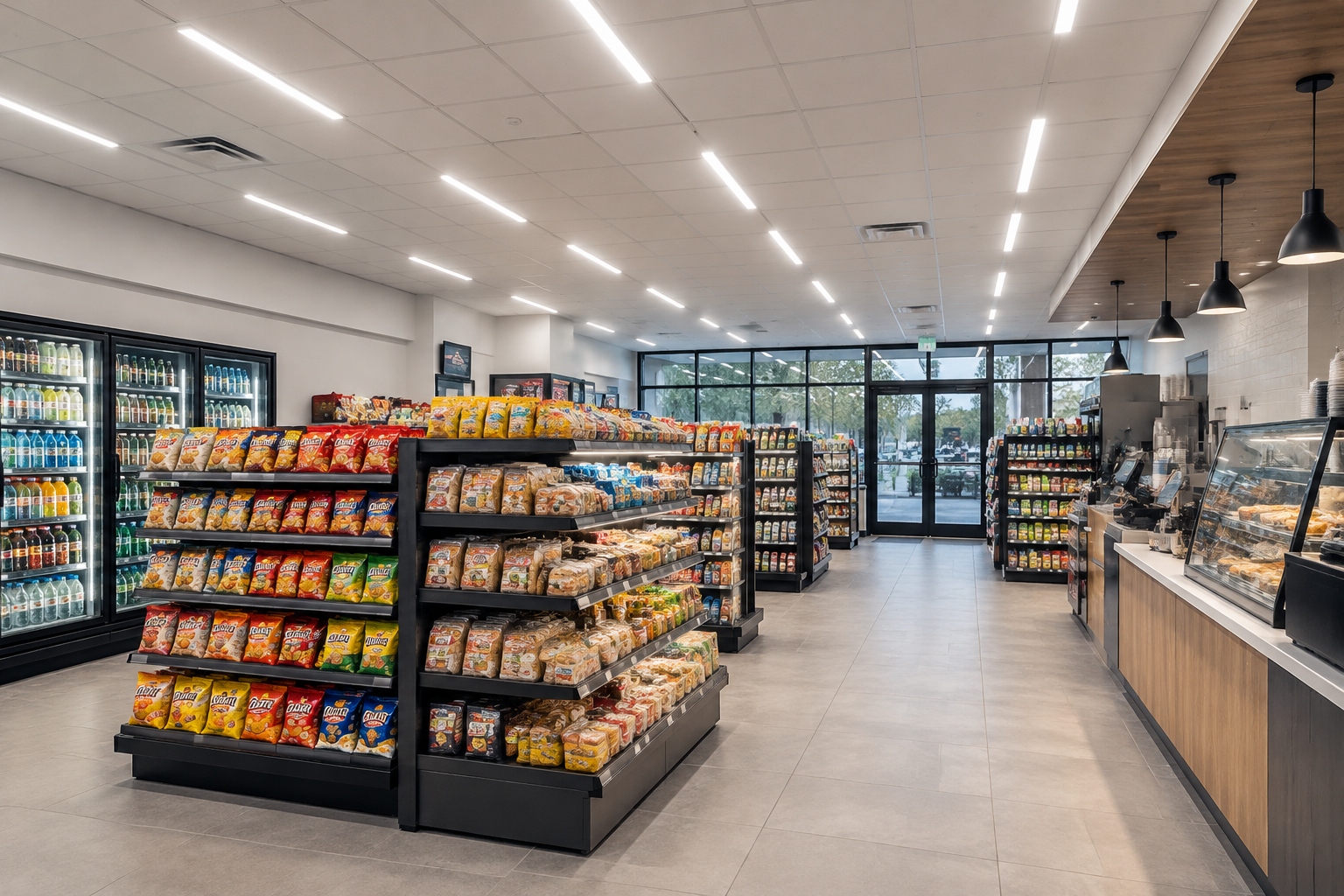
A 4000K CCT provides a clean, neutral white light that enhances product appeal without feeling sterile. This color temperature is often considered the sweet spot for retail environments because it renders a wide spectrum of colors accurately and vibrantly.
Unlike warm 3000K light, which can cast a yellowish hue, or cool 5000K+ light, which can feel harsh and clinical, 4000K presents products in a crisp, natural way. This is especially beneficial for packaged goods, where brand colors are critical, and for fresh items in chillers.
For staff and customers in a 24/7 setting, this neutral light also supports alertness and visual acuity better than warmer tones, contributing to a perception of cleanliness and efficiency.
What Is the Best Way to Light Vertical Chiller Cabinets?
Asymmetric wall-wash optics are the superior solution for lighting vertical refrigerated displays. The primary challenge with chiller lighting is avoiding veiling reflections—the glare that obscures products behind the glass doors.
By placing linear fixtures or track spotlights with asymmetric lenses in front of and slightly away from the chillers, light is directed downwards across the vertical face of the products. This technique illuminates the merchandise evenly from top to bottom while directing reflective glare away from the customer's line of sight.
This is vastly more effective than relying solely on the often inefficient, glary, and color-poor LED strips integrated inside the chiller frames.
How Do You Achieve a High Uniformity Ratio (Uo)?
Achieving high uniformity requires precise luminaire spacing calculated from photometric data. Uniformity (Uo) is the ratio of minimum illuminance to average illuminance (Emin/Eavg) on a surface.
7 for retail aisles (as per DIN EN 12464-1 guidelines), signifies even light distribution with no distracting dark spots. This is achieved in lighting design software like DIALux by using a luminaire's specific photometric file.
The calculation considers the luminaire's beam angle, lumen output, ceiling height, and the resulting spacing-to-height ratio (SHR). Generally, luminaires with wider beam angles, when spaced correctly to allow for overlapping light cones, will produce higher uniformity.
 Convenience Store Lighting 2026: 4000K Uniformity Guide: How does 4000K CCT impact product appearance and customer perception?
Controls, Energy, and Commissioning
Intelligent lighting controls are essential for minimizing energy costs in a 24/7 operational environment. While LED lighting is inherently efficient, significant further savings are only possible through dynamic control.
DALI-2 (Digital Addressable Lighting Interface) is the gold standard for this application. It allows each luminaire to be individually addressed, controlled, and monitored.
This enables powerful strategies like scene setting and scheduling—for example, running lights at 100% during peak daytime hours, dimming to 70% during quieter evening periods, and reducing to 50% overnight. Integrating DALI-2 presence sensors in back-of-house areas and daylight sensors near windows further optimizes energy use by ensuring light is only used when and where it is needed.
For retrofits where new wiring is impractical, wireless mesh systems like Casambi offer comparable flexibility. Proper commissioning is the final, critical step where these scenes, dimming levels, and sensor thresholds are programmed to match the store's specific operational patterns, unlocking the system's full savings potential.
Photometric Files & Compliance
Verified photometric files and compliance documentation are non-negotiable for professional lighting projects. Before committing to a large-scale rollout, a lighting designer must be able to predict performance accurately.
This is done using IES and LDT photometric files, which are standardized data formats containing a detailed digital map of how a specific luminaire distributes light. By importing these files into simulation software like DIALux, designers can generate accurate 3D models that predict illuminance levels, uniformity ratios (Uo), and UGR values throughout the store.
This process eliminates guesswork and ensures the final installation will meet the strict requirements of standards like EN 12464-1. Furthermore, for market access, especially in the European Union, all luminaires must be accompanied by declarations of conformity for CE (ensuring product safety), RoHS (restricting hazardous substances), and ErP (detailing energy efficiency), proving the product is legal and performs as claimed.
 Convenience Store Lighting 2026: 4000K Uniformity Guide: Photometric Files & Compliance
Frequently Asked Questions
Q: What Is the Ideal Lux Level for a Convenience Store?
According to EN 12464-1, general circulation areas require at least 300 lux, while sales areas and checkout counters require 500 lux to ensure product visibility and task performance. A uniformity of 0.6 or higher is also recommended to avoid dark spots and create a welcoming atmosphere.
Q: Is CRI 80 Good Enough for a Retail Store?
While CRI 80 is a common minimum, for optimal product presentation we strongly recommend a CRI of 90 or higher. This ensures that colors, especially reds (R9 > 50), on packaging and fresh produce appear vibrant and true-to-life, which can directly influence purchasing decisions and brand perception.
Q: How Much Energy Can DALI-2 Controls Save in a 24/7 Store?
In a 24/7 convenience store, implementing DALI-2 controls with scheduling and daylight harvesting can achieve a simulation target for energy savings of 30-50% over a non-controlled system. For example, dimming lights to 70% during late-night hours (12am-5am) and utilizing daylight sensors near windows contributes significantly to these savings.
Q: Why Is UGR so Important at the Checkout Counter?
A low Unified Glare Rating (UGR < 19) is critical at the checkout counter to prevent visual discomfort for both staff and customers. High glare can cause eye strain and headaches for employees working long shifts and create an unpleasant final impression for shoppers, negatively impacting their overall experience.
Sources and Technical References
- EN 12464-1:2021: Light and lighting — Lighting of work places — Part 1: Indoor work places.
- DIN EN 12464-1:2021-11: German edition of the European standard, often cited with application notes.
- IES RP-2-19: Recommended Practice for Lighting Retail Environments.
- WELL Building Standard v2: Light Concept (L01-L09).
- IEC 62386: Digital Addressable Lighting Interface (DALI).
 Convenience Store Lighting 2026: 4000K Uniformity Guide: Q: How much energy can DALI-2 controls save in a 24/7 store?
Request a Custom Quote
com), a Custom Indoor LED Lighting Manufacturer based in China, we specialize in creating tailored lighting solutions that meet these exacting standards. Our expertise covers the full project lifecycle, from initial design and DIALux simulation to manufacturing and delivery of certified luminaires for the EU, US, and Middle East markets.
We provide complete photometric data for all our products to ensure full compliance and predictable results. Contact our engineering team today to discuss your convenience store project requirements and receive a complimentary lighting design proposal and quote.
Need a tailored lighting plan for your project?
Our senior lighting designers reply within 48 hours with a free design proposal & quotation.