
Duty-Free Store Lighting 2026: A CRI95+ Accent Lighting Guide
Quick answer
Discover expert strategies for airport duty-free lighting. This guide covers high CRI95 accent lighting for perfume and liquor, EN 12464-1 standards, and DALI
Introduction — the Design Problem in This Space
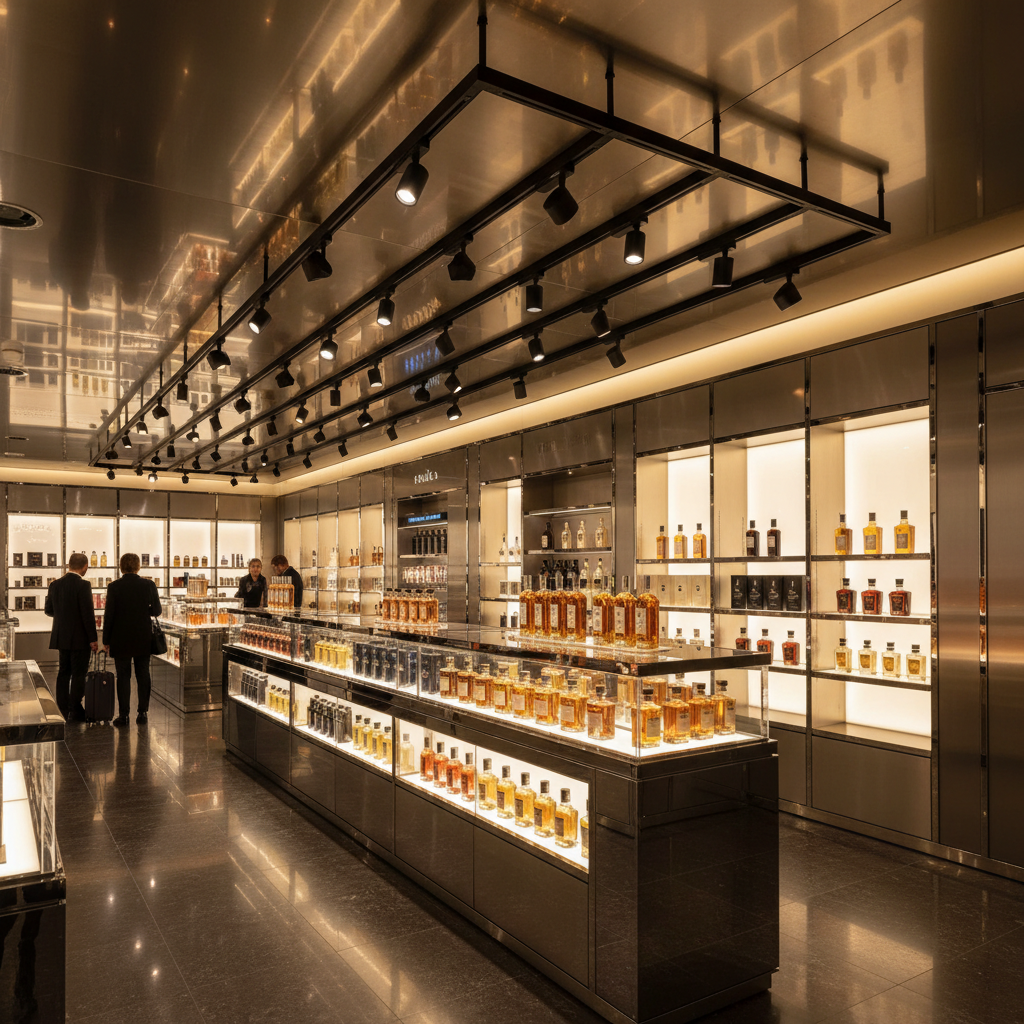
At XHLWX (led-project-light.com), a Custom Indoor LED Lighting Manufacturer based in China, we understand that exceptional lighting is the silent salesperson in a competitive airport duty-free environment. The core design challenge is to create an immersive, premium shopping journey that captures travelers' attention in seconds, elevates brand perception, and drives sales. This involves cutting through the visual noise of a busy terminal, making products like fine liquors and perfumes look irresistible, and ensuring a comfortable, luxurious atmosphere that encourages browsing and purchasing within a limited timeframe.
Lighting Criteria and Standards for This Application
Effective duty-free lighting design is governed by precise technical standards. Meeting these criteria ensures product appeal, customer comfort, and operational efficiency, forming the foundation of a successful retail space. The key is to balance high-impact accent lighting with comfortable, energy-efficient ambient light, all while adhering to international norms.
For general circulation areas, European standard EN 12464-1 Light and lighting - Lighting of work places - Part 1: Indoor work places provides a strong baseline, recommending 300-500 lux on the horizontal plane and a Unified Glare Rating (UGR) of <19 to prevent discomfort for staff and shoppers. For vertical displays, which are critical in retail, achieving 150-300 lux ensures products are clearly visible. However, for hero products like premium perfumes and aged liquors, accent lighting must create a much higher contrast, often targeting 1000-2500 lux directly on the product.
Colour quality is non-negotiable. A Colour Rendering Index (CRI) of Ra >95 is the minimum recommended specification to accurately render brand colours, packaging details, and the rich tones of the products themselves.
Furthermore, modern standards like IES TM-30-20 provide a more complete picture of colour rendition, with targets for Fidelity (Rf >90) and Gamut (Rg between 95-110) ensuring colours are not just accurate but also vibrant and saturated. This is crucial for making a bottle of single malt scotch look rich and amber, not flat and brown.
Table 1: Recommended Lighting Specifications for Duty-Free Retail
| Parameter | Recommended Specification | Standard / Guideline | Notes |
|---|---|---|---|
| Ambient Illuminance | 300–500 lux | EN 12464-1 | Measured on the floor/horizontal plane. |
| Vertical Illuminance | 150–300 lux | IES RP-2-19 | On wall shelving and general merchandise. |
| Accent Illuminance | 1000–2500 lux | Retail Design Best Practice | On feature products; creates a 5:1 or higher contrast ratio. |
| Colour Quality | CRI Ra >95, R9 >80 | WELL v2 Light Concept | Essential for rendering brand colours and product textures accurately. |
| Colour Fidelity/Gamut | Rf >90, 95<Rg<110 | IES TM-30-20 | Ensures colours are both faithful and vivid. |
| Unified Glare Rating | UGR < 19 | DIN EN 12464-1 | Critical for visual comfort in circulation areas and at cashier desks. |
| Control Protocol | DALI-2 or Casambi | DiiA / Casambi | Provides addressability for zoning, scheduling, and energy savings. |
| Luminaire Components | Osram, Bridgelux, or Samsung COB | Manufacturer Spec | Ensures reliability, colour consistency, and long lifetime (L90B10 @ 50,000h). |
| Driver Components | Tridonic, Mean Well, or OSRAM | Manufacturer Spec | Key for flicker-free performance and system longevity. |
| Certifications | CE, RoHS, ErP (EU); UL (US) | Regional Regulations | Mandatory for market access and demonstrates safety/performance compliance. |
Luminaire Selection and Optics
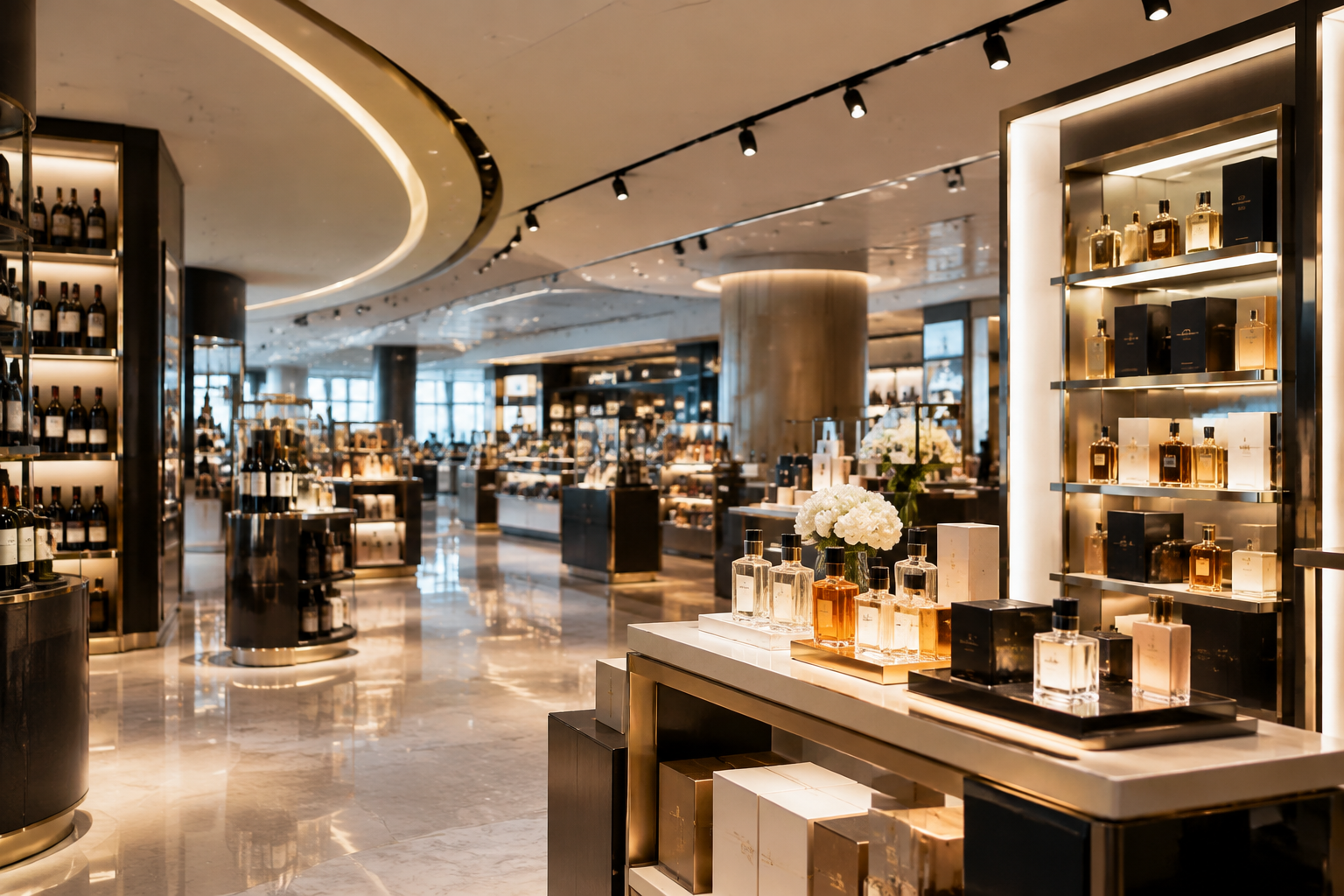
Selecting the right luminaires is crucial for translating design intent into reality. The choice of fixture directly impacts flexibility, visual impact, and maintenance overhead in a fast-paced retail environment. A layered approach combining different luminaire types creates a dynamic and visually interesting space.
Track lighting is the workhorse of duty-free accent lighting due to its unparalleled flexibility. As brands change promotions and displays are reconfigured, track heads can be easily moved, re-aimed, and fitted with different beam angles.
For general illumination, high-CRI LED downlights or linear profiles with low-glare optics can provide the ambient layer. Integrated lighting within shelving and display cases is the final, critical layer, bringing the light source intimately close to the product for maximum sparkle and definition.
Table 2: Luminaire Comparison for Duty-Free Applications
| Luminaire Type | Primary Use Case | Pros | Cons | Verdict |
|---|---|---|---|---|
| LED Track Lights | Accent & feature lighting | Highly flexible, easy to re-aim, wide range of beam angles & accessories (honeycomb louvers, snoots). | Can look cluttered if overused, requires track infrastructure. | Essential. The primary tool for creating drama and highlighting key products. Use narrow beams for pinpoint accents. |
| Adjustable Downlights | Accent & wall washing | Clean, minimalist ceiling appearance. Can be aimed to highlight vertical surfaces. | Less flexible than track; requires precise placement during initial installation. | Excellent for perimeter wall washing and highlighting entire brand sections from a fixed position. |
| Fixed Downlights | General ambient lighting | Provides uniform, comfortable ambient light. Low glare options available. | No flexibility for accents. Purely for functional illumination. | Necessary for circulation paths, back-of-house, and creating a base layer of light. |
| Integrated Linear LED | In-shelf & cove lighting | Brings light close to products, eliminates shadows, creates a 'glowing' effect. | Requires custom integration into joinery; can be difficult to service. | Highly Recommended for premium displays, especially for liquor bottles and cosmetic testers, to create visual hierarchy. |
How Does CRI95+ Lighting Enhance Perfume and Liquor Displays?
High-CRI lighting fundamentally transforms how customers perceive high-value products. For perfumes, CRI95+ with a high R9 (red rendering) value ensures that the subtle hues of the liquid, the intricate details of the packaging, and the metallic finishes of the bottle caps are rendered with absolute fidelity. This accuracy builds trust and conveys a sense of luxury. For liquors, the effect is even more pronounced. A high-CRI source reveals the deep amber and mahogany tones of whiskeys, the golden shimmer of cognacs, and the crystal clarity of gins, making them appear richer and more appealing. Lower CRI lighting can make these same products look dull, washed-out, or even incorrectly coloured, diminishing their perceived value.
What Are the Best Beam Angles for Accenting Duty-free Products?
Choosing the correct beam angle prevents wasted light and maximizes visual impact. For individual perfume bottles, small cosmetic items, or the neck of a premium liquor bottle, a very narrow spot (VNS) of 8-15 degrees is ideal. This creates a dramatic, high-contrast 'punch' of light that draws the eye precisely to the target. For a small group of products or a single, larger champagne bottle, a narrow spot (NS) of 20-24 degrees provides a slightly larger pool of light. For larger wall displays, bottle collections, or general accenting of a branded bay, a narrow flood (NF) of 30-38 degrees offers broader coverage while still maintaining a clear focus. Wide flood beams (>45 degrees) are generally reserved for wall washing or ambient fill.
How to Light a Brand's Shop-in-shop Area Effectively?
The key to a successful shop-in-shop is creating a distinct yet harmonious brand environment. This starts with collaborating with the brand to understand their global lighting guidelines, which often specify a precise Correlated Colour Temperature (CCT) and luminaire style. The lighting must carve out the brand's territory visually. This can be achieved by using a slightly different CCT (e.g., 3000K for a warm, classic brand versus 4000K for a modern, clinical one) or by employing unique fixtures. Layering is critical: a base of ambient light, layers of accent light on products, decorative pendants for brand identity, and integrated light within displays all combine to create a bespoke, immersive experience that distinguishes the brand from its neighbours.
 Duty-Free Store Lighting 2026: A CRI95+ Accent Lighting Guide: Table 2: Luminaire Comparison for Duty-Free Applications
Controls, Energy and Commissioning (DALI-2 / Casambi / Sensors)
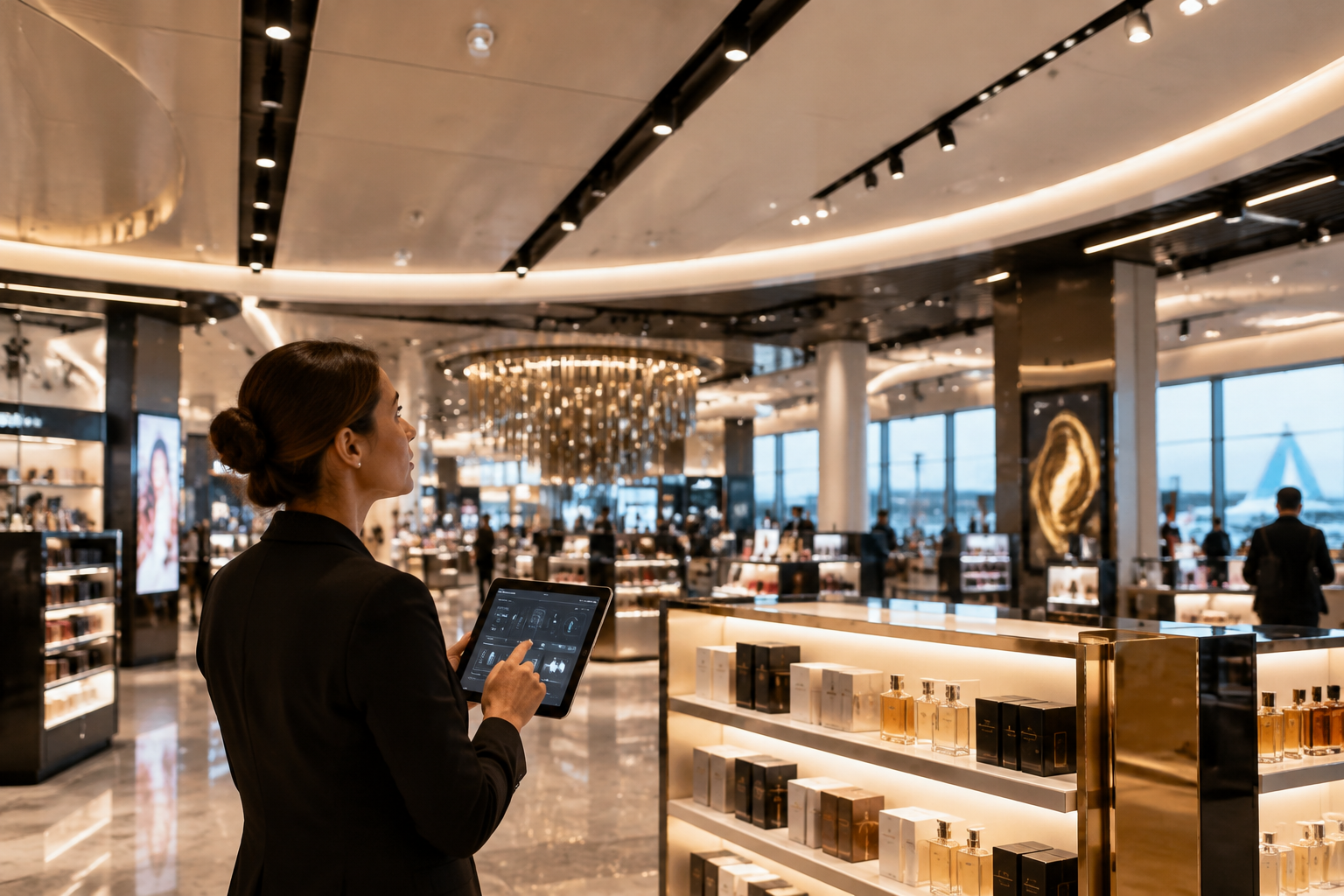
Intelligent lighting controls are essential for managing energy and adapting to store needs. In a 24/7 airport environment, a DALI-2 (Digital Addressable Lighting Interface) system offers the most robust and granular control. It allows each luminaire to be individually addressed, enabling precise zoning, scene-setting for different times of the day (e.g., brighter during peak hours, softer overnight), and detailed energy consumption monitoring. For example, accent lights can be programmed to 100% during opening hours and dimmed to 30% for cleaning or security periods, significantly reducing energy waste.
Wireless solutions like Casambi (Bluetooth Low Energy) offer comparable flexibility without the need for dedicated control wiring. This makes them ideal for retrofitting existing stores or for areas where running new cables is difficult. Both systems can integrate occupancy sensors in staff areas and daylight sensors near windows to automate dimming and further optimize energy use, aligning with sustainability goals and reducing operational costs.
Photometric Files & Compliance (IES / LDT / DIALux / CE / RoHS / ErP)
Verifying a lighting design's compliance and performance before installation is a critical, risk-mitigating step. At XHLWX, we provide comprehensive photometric data for all our luminaires. These are available in industry-standard IES and LDT photometric files, which describe the exact light distribution pattern of a fixture. Lighting designers import these files into simulation software like DIALux or Relux to build a virtual 3D model of the duty-free store.
This simulation process allows designers to predict illuminance levels, check for compliance with EN 12464-1 UGR limits, and visualize the final lighting effect on displays. It confirms that accent ratios are achieved and that light is delivered only where needed, preventing glare or light spill.
This virtual commissioning saves significant time and money by identifying potential issues before a single fixture is installed. Furthermore, all our products for the European market are fully compliant with CE (safety), RoHS (hazardous substances), and ErP (energy efficiency) directives, ensuring a smooth and compliant project delivery.
 Duty-Free Store Lighting 2026: A CRI95+ Accent Lighting Guide: Controls, energy and commissioning (DALI-2 / Casambi / sensors)
Frequently Asked Questions
Q: What Is the Ideal CCT for a Luxury Duty-free Store?
The ideal Correlated Colour Temperature (CCT) is typically in the warm-to-neutral range of 3000K to 3500K. This range creates a welcoming, high-end ambiance without feeling too yellow or sterile. A CCT of 3000K is often used for classic luxury brands to evoke warmth and richness, while 3500K offers a slightly crisper, more contemporary feel. Consistency across the store is key to a cohesive design.
Q: Are High CRI95+ Lights Significantly More Expensive?
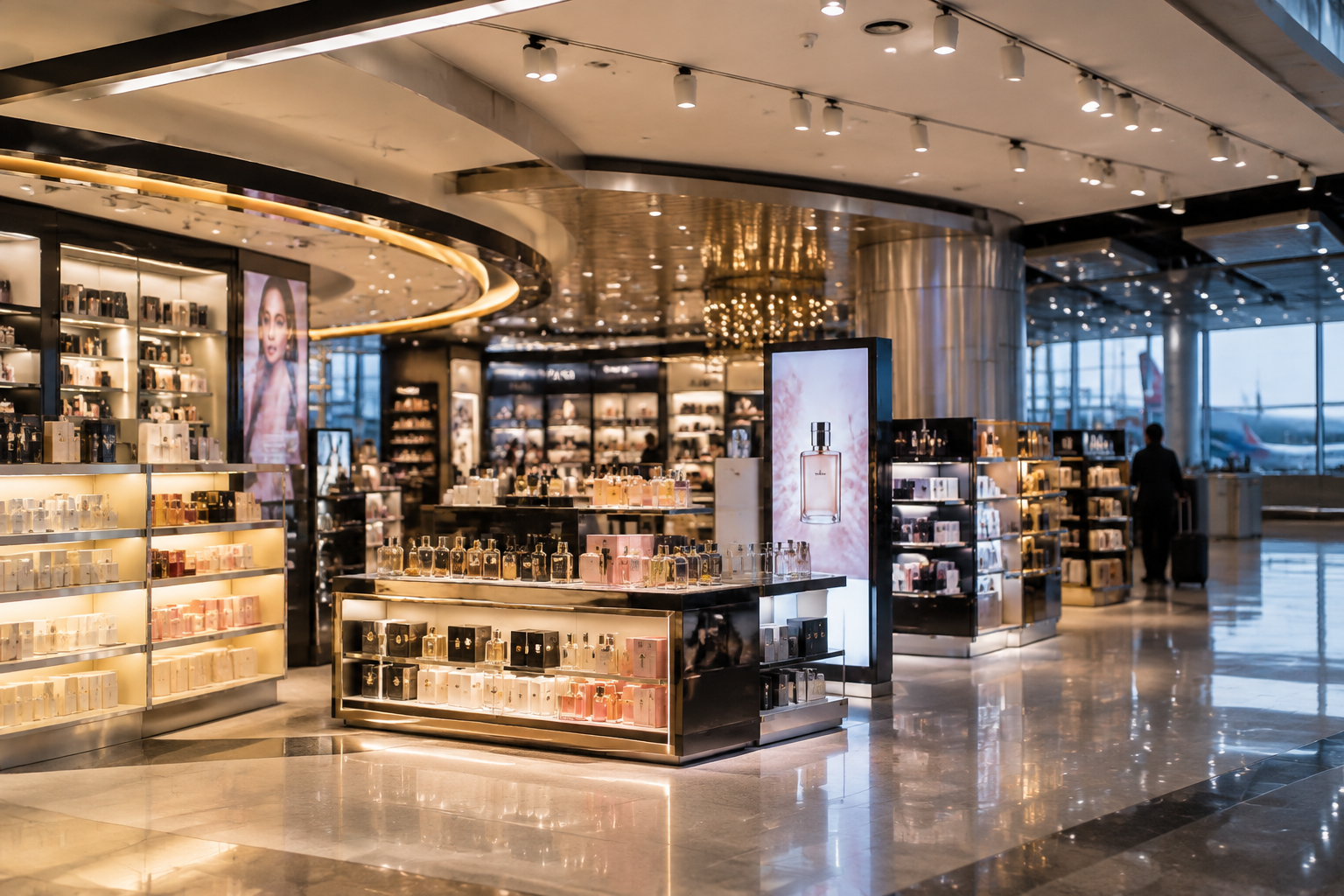
While luminaires with CRI95+ LEDs can have a higher initial cost, the premium is often only 10-20% over standard CRI80 models. This modest investment delivers a disproportionately large return by dramatically improving product presentation, which directly influences customer perception and purchase decisions. The enhanced sales potential and brand elevation far outweigh the marginal increase in upfront capital expenditure, making it a high-value investment for retail.
Q: How Much Energy Can DALI-2 Controls Save in an Airport Store?
In a 24/7 airport retail environment, a well-commissioned DALI-2 control system can achieve energy savings of 30-50% compared to a simple on/off switch. This is accomplished through strategies like task-tuning (setting maximum light levels to 85-90%), scheduling scenes for opening/closing/cleaning hours, and dimming non-essential lights during off-peak periods. The precise savings depend on the store's operating hours and the control strategy implemented.
Q: What UGR Value Should We Target for Staff and Customer Comfort?
For all areas where staff and customers spend time, such as circulation paths, sales counters, and general floor areas, you should target a Unified Glare Rating (UGR) of less than 19. This is a key recommendation in the EN 12464-1 standard for indoor workplaces and retail environments. Achieving UGR<19 ensures visual comfort, prevents headaches and fatigue, and contributes to a more pleasant, premium shopping experience.
Sources and Technical References
- EN 12464-1:2021 Light and lighting - Lighting of work places - Part 1: Indoor work places.
- IES RP-2-19: Recommended Practice: Lighting Retail Environments.
- IES TM-30-20: IES Method for Evaluating Light Source Color Rendition.
- WELL Building Standard v2, Light Concept.
- DiiA: DALI Alliance (dali-alliance.org).
 Duty-Free Store Lighting 2026: A CRI95+ Accent Lighting Guide: Q: Are high CRI95+ lights significantly more expensive?
Request a Custom Quote
At XHLWX (led-project-light.com), a Custom Indoor LED Lighting Manufacturer based in China, we specialize in developing and producing high-performance, specification-grade LED lighting solutions for demanding retail environments like airport duty-free. From high-CRI track spots to custom-integrated linear fixtures, we provide the tools and expertise to bring your vision to life. Contact our solutions team today to discuss your project requirements and request a no-obligation quote or a DIALux lighting simulation.
Need a tailored lighting plan for your project?
Our senior lighting designers reply within 48 hours with a free design proposal & quotation.