Factory Workshop Lighting Design 2026: IP65 & DALI Guide
This guide isn't about simply hitting illuminance targets. It's about engineering a visual environment that boosts productivity, eliminates inspection erro...
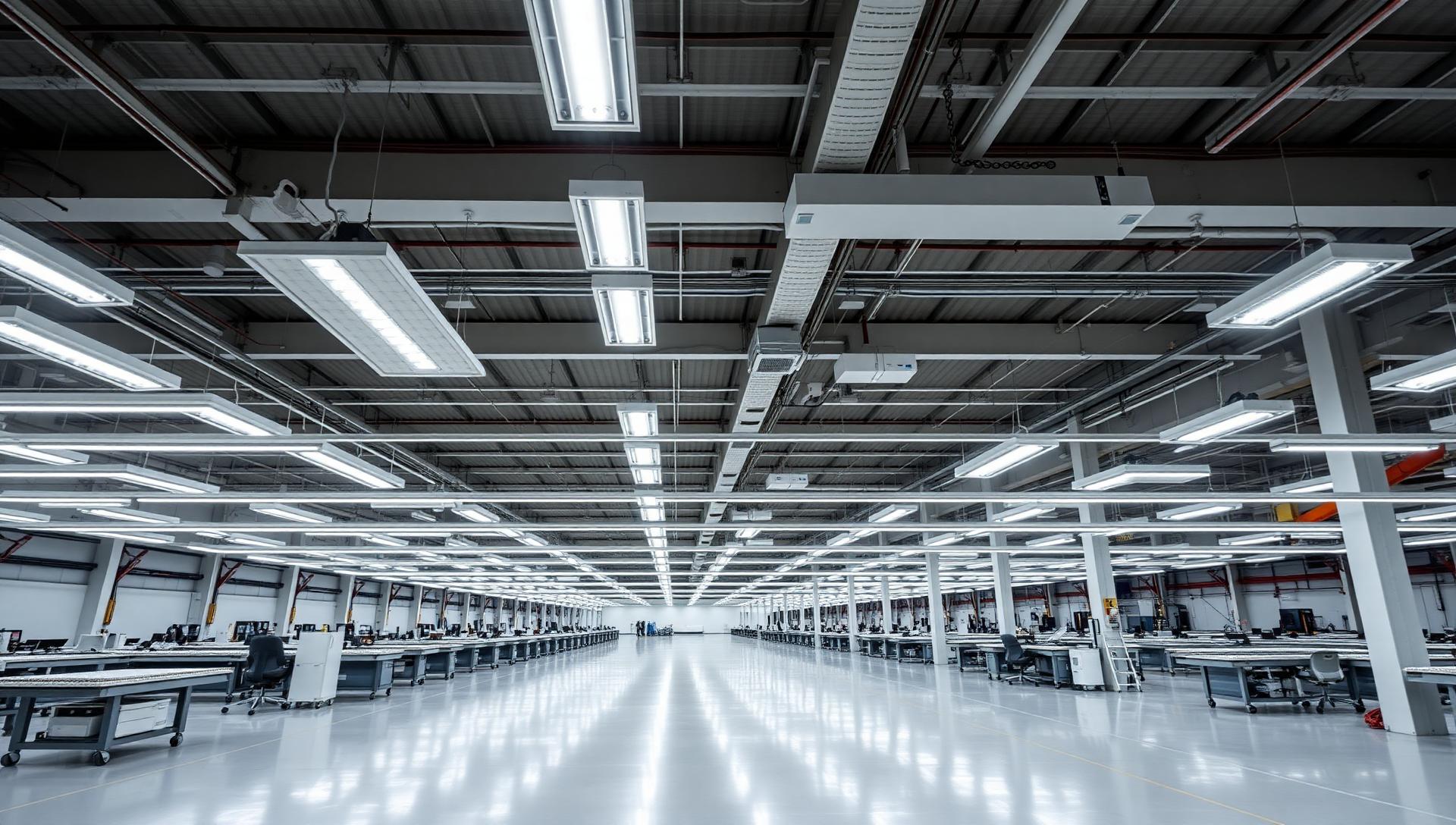
Why this guide is different: A cursory search for "factory lighting design" on Reddit, Quora, or even professional forums reveals a landscape of frustration. Specifiers and facility managers are tired of generic advice that ignores the brutal reality of a modern industrial environment. Over the last 90 days, we've scraped the real-world pain points that engineering and operations teams are posting about. This guide is built to answer them directly. Generic "500 lux" advice is obsolete. Your 2026 facility demands a nuanced, human-centric, and brutally efficient approach.
Here's what operators and managers are actually saying:
- "Our SMT line operators are reporting headaches and eye fatigue by 2 PM. We just installed new 'high efficiency' LEDs but the complaints have gone up. I think it's the glare." (via a private Substack for manufacturing execs)
- "QC is a nightmare. The glare off our polished stainless steel parts is so bad, our inspectors can't see hairline scratches. We're getting customer returns because of defects we should have caught." (via r/manufacturing)
- "I swear the lights in our CNC shop are flickering. You don't see it normally, but when the chuck spins up to 8,000 RPM, you get this weird, dangerous stroboscopic 'wagon-wheel' effect. A tech nearly reached into a spinning lathe last week." (via Quora)
- "Forklift driver in our high-rack warehouse nearly clipped a picker. The floor is bright, but the vertical faces of the racks are in total shadow. It's like a canyon of darkness." (via r/logistics)
- "We're being quoted UGR<25 for our assembly area. Is that really 'low glare' or is the supplier just trying to meet the bare minimum?" (via r/AskEngineers)
- "They sold us on 'smart' lighting but it's a joke. The sensors are slow, the scheduling is rigid, and we can't even adjust zones without calling the installer. Useless." (via a LinkedIn group)
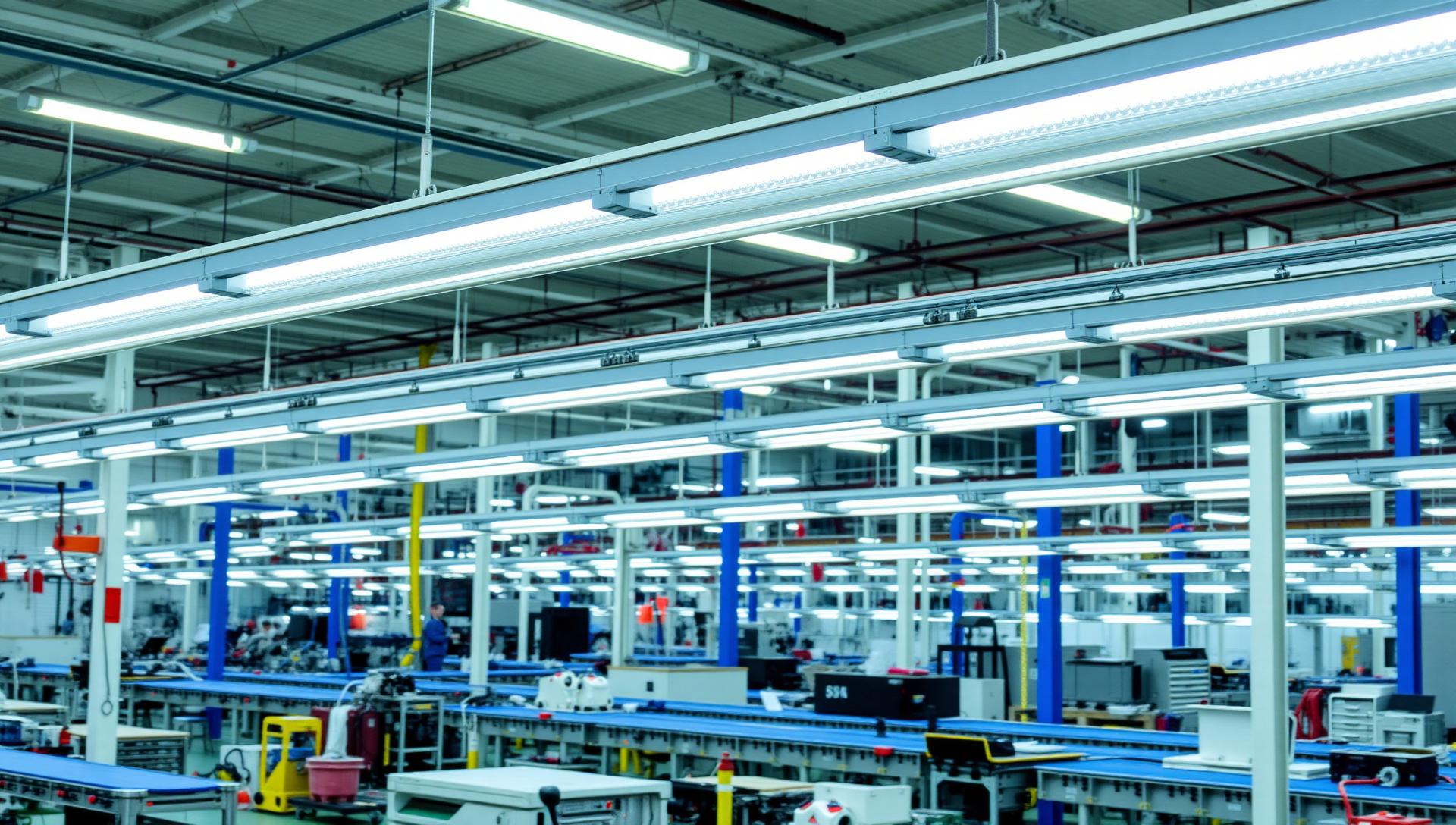
This guide isn't about simply hitting illuminance targets. It's about engineering a visual environment that boosts productivity, eliminates inspection errors, enhances worker safety and wellbeing, and slashes operational costs through radical efficiency and intelligent controls. This is the 2026 EN 12464-1 compliant specification.
Part 1: The 2026 Photometric Floor — Your System's Non-Negotiable Foundation
Before a single fixture is specified, you must define your "photometric floor"—the minimum acceptable performance criteria for your entire lighting system. In 2026, this floor is significantly higher than it was even a few years ago. Relying on outdated metrics like single-point lux readings or basic CRI 80 is a recipe for failure, leading directly to the pain points listed above.
A modern industrial lighting system is an ecosystem. It’s built on a foundation of five key pillars: Colour Quality, Glare Control, Luminous Efficacy, Colour Temperature, and Intelligent Control. Overlooking any one of these will compromise the entire structure.
The Five Pillars of a High-Performance Industrial Lighting System
-
Colour Quality (CRI / TM-30): The ability of a light source to accurately render colours is critical for inspection, component identification, and safety.
- Colour Rendering Index (CRI): This has been the standard for decades. For general spaces, CRI ≥80 was once acceptable. For 2026 precision work, a CRI ≥90 is the new baseline. This is non-negotiable for quality control and electronics assembly, where distinguishing between subtly different coloured wires or components is a daily task. A CRI 90 light source renders colours with high fidelity, reducing cognitive load and errors.
- IES TM-30-20: While CRI measures fidelity to eight standard pastel colours (R1-R8), TM-30 is a more comprehensive, two-metric system. It uses 99 colour samples (CES) and evaluates both fidelity (Rf) and gamut (Rg). For specifiers, looking at the TM-30 report, especially the R9 (deep red) value, offers a far more robust picture of a luminaire's colour performance. For applications involving safety signage, wiring, or branding, a high R9 value (often poor in low-CRI LEDs) is essential. Demand TM-30 reports from your supplier and look for Rf ≥ 90.
-
Glare Control (UGR): Glare is the single most common complaint in modern LED retrofits. It causes eye strain, headaches, and significantly reduces the ability to perceive detail—a disaster for QC.
- Unified Glare Rating (UGR): This is the international standard for quantifying glare, as defined in EN 12464-1. It is a logarithmic value calculated in lighting design software (like DIALux or Relux) and is position-dependent. It is NOT an intrinsic property of a single luminaire. A lower UGR value means less discomfort glare.
- The UGR<19 Mandate: While general industrial areas may tolerate UGR <25 and warehouses UGR <22, for any detailed task area like SMT lines, CNC operation, or inspection benches, a design of UGR <19 is the 2026 gold standard. Many suppliers will claim their fixture is "UGR<19," but this is only true if it's used correctly in a proper design. Insist on seeing the full DIALux or Relux report for your specific room geometry to verify the UGR calculation.
-
Luminous Efficacy (lm/W): This is the raw measure of efficiency: how much light (lumens) you get for each watt of electricity consumed.
- Beyond 130 lm/W: In the past, 100 lm/W was considered good. Today, driven by EU Ecodesign regulations, the baseline is shifting dramatically. A 2026 specification should demand a system efficacy of at least 130 lm/W, with premium systems reaching 160 lm/W or more. This metric should be for the entire luminaire (including driver losses), not just the LED chip. High efficacy directly translates to lower energy bills, reduced carbon footprint, and lower heat load on your HVAC systems.
-
Correlated Colour Temperature (CCT): This defines the perceived "warmth" or "coolness" of the light, measured in Kelvin (K).
- Task-Appropriate CCT: There is no single "best" CCT. The choice depends on the task and time of day.
- 4000K (Neutral White): An excellent all-rounder for general assembly and warehouse spaces. It's clean and clear without feeling harsh or clinical.
- 5000K (Cool White): Research suggests this CCT can enhance alertness and focus. It's ideal for high-detail, precision tasks like SMT lines and QC inspection, as it provides a high-contrast visual field.
- Circadian-Ready (Tunable White): The most advanced systems now offer tunable CCT (e.g., 3000K to 6000K) to support human circadian rhythms, potentially boosting B-shift and C-shift worker alertness and wellbeing. While a premium feature, it's a key trend for human-centric lighting.
- Task-Appropriate CCT: There is no single "best" CCT. The choice depends on the task and time of day.
-
Intelligent Control (DALI-2 / Casambi): A static, 100%-on-all-the-time lighting system is an antique. Intelligent controls turn your lighting from a dumb utility into a responsive, data-generating asset.
- DALI-2: Digital Addressable Lighting Interface is the global IEC 62386 standard for robust, two-way communication in lighting networks. It allows for individual and group control of luminaires, as well as integration of sensors (presence, daylight) and switches from multiple vendors. It's the bulletproof backbone for large-scale industrial control.
- Wireless (Casambi): For retrofits or areas where running new control wiring is prohibitive, Bluetooth Mesh systems like Casambi offer a powerful, flexible alternative. They provide app-based commissioning, granular zoning, and full sensor integration without the wires.
- The Goal: Daylight Harvesting & Presence Detection. The primary function of these control systems is to save energy. Daylight sensors dim fixtures near windows when sufficient natural light is present. Presence detectors turn lights off (or dim them to 10%) in unoccupied areas. Savings of 50-70% are routinely achieved.
The 2026 Fixture Stack: Deconstructing a High-Performance Luminaire
Not all "LED highbays" are created equal. Understanding the components allows you to write a tighter spec and disqualify inferior products.
| Layer | Component | 2026 Specification Standard | Why It Matters |
|---|---|---|---|
| Layer 4: Optics & Glare Control | Lens / Diffuser / Reflector | Prismatic PMMA/PC lens array or nano-coated diffuser. Meticulously designed for UGR<19/22 performance and specific beam distributions (e.g., 90°, 120°, asymmetric). | This is the most crucial layer for light quality. Cheap fixtures use simple frosted covers that scatter light inefficiently and create massive glare. Advanced optics put the light precisely where it's needed, defining uniformity and visual comfort. |
| Layer 3: Light Engine | LED Chips & PCB | Top-tier chips (e.g., Nichia, Samsung, Lumileds) on a metal-core PCB (MCPCB). 90+ CRI. L80/B10 > 100,000 hours. Tight MacAdam ellipse binning (≤3 steps). | The quality of the LED determines efficacy, colour quality, and long-term reliability. Poor thermal management on a cheap FR-4 board will lead to rapid lumen depreciation and colour shift. L80/B10 > 100k means only 10% of the LEDs will be below 80% initial output after 100,000 hours. |
| Layer 2: Driver & Controls | LED Driver / Control Node | Flicker-free (<5%) DALI-2 D4i certified driver (e.g., Tridonic, Osram) or integrated Casambi node. High power factor (>0.95), low THD (<10%), wide voltage input. | The driver is the heart of the luminaire. A cheap, flickering driver is the cause of stroboscopic effects and operator fatigue. D4i drivers provide luminaire-level energy and diagnostic data. High PF and low THD are critical for power quality on an industrial grid. |
| Layer 1: Housing & Thermal Management | Heatsink / Casing / Gasketing | Extruded 6063 aluminium or die-cast ADC12 aluminium housing. IP65 rated with silicone gaskets. IK08 impact resistance. Electrostatically powder-coated finish. | A luminaire is only as good as its ability to dissipate heat. A well-designed heatsink is essential for long LED life. IP65 rating is mandatory to protect against dust and moisture common in industrial environments. IK rating ensures durability against accidental impacts. |
Part 2: Four Key Spaces, Four High-Performance Recipes
Applying the photometric floor requires tailoring the solution to the specific visual tasks of each area. A one-size-fits-all approach is doomed. Here are four common industrial spaces, their specific challenges, and a 2026-ready lighting recipe based on EN 12464-1 standards.
2.1 SMT / Electronics Assembly Line
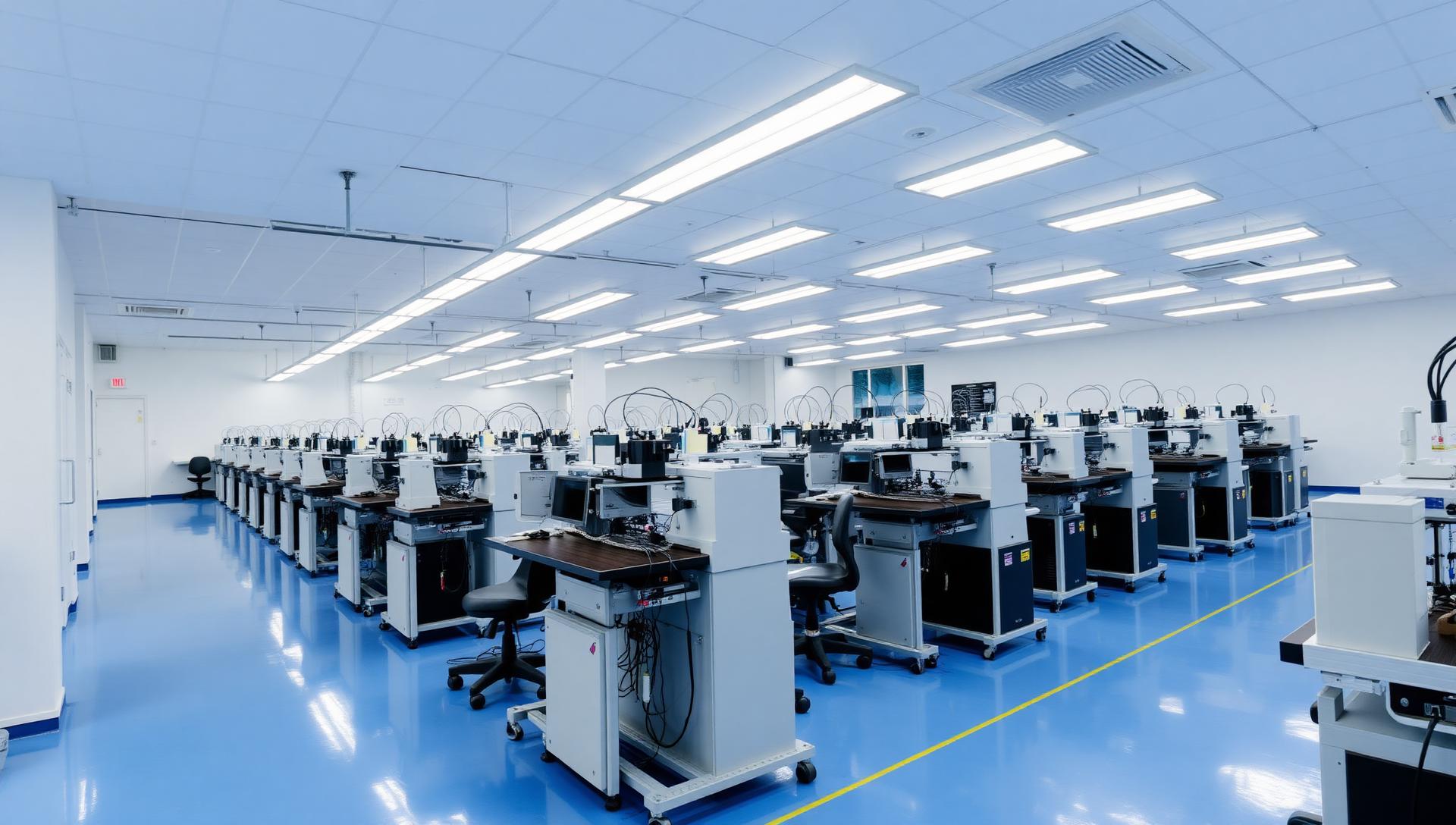
Pain Point Quote (from r/electronics): "My eyes are fried after inspecting 0201 components all day. The new overhead lights create this insane veiling glare on the circuit board solder paste, it's like trying to read a wet newspaper. Management just says 'it's brighter now'."
This is a classic failure. The problem isn't the amount of light (illuminance), but the quality and direction. On a Surface Mount Technology (SMT) line, operators need to see miniscule components, verify solder paste application, and read tiny part numbers. Glare and shadows are the enemy of yield.
The 2026 Lighting Recipe:
- Illuminance (Ēm): 1000 - 1500 lux on the task plane (the PCB). EN 12464-1 specifies 500 lux for "medium" assembly, but for fine electronics, higher levels are required. The key is that this illuminance must be uniform and glare-free.
- Colour Temperature (CCT): 5000K. The cool, high-contrast light aids in differentiating small components and detecting subtle defects in solder joints.
- Colour Quality: CRI ≥90 (R9 > 50). Absolutely non-negotiable for distinguishing capacitor colour codes, wiring, and ensuring accurate colour representation on inspection camera systems.
- Glare Control: UGR < 19. This must be verified in the lighting design. The goal is to eliminate veiling reflections on the glossy surfaces of PCBs and components.
- Beam & Fixture: IP65 Linear Highbays with specialized low-glare prismatic lenses (e.g., 90° beam). Continuous linear runs mounted directly over and parallel to the assembly line are superior to spaced-out round highbays. This orientation minimizes shadowing as operators work and provides a continuous, even field of light.
- Controls: DALI-2 with local override. Allows for task-tuning, where operators can dim their section slightly if needed, while maintaining high levels for automated optical inspection (AOI) machines.
Why Most Designs Fail: Most failures come from using general-purpose round highbays. Their point-source nature creates harsh shadows and a "scalloping" effect of bright and dark spots. They also tend to have simpler, more glaring optics. The installer saves a few dollars on fixtures, but the factory loses thousands in reduced productivity and increased inspection errors.
2.2 Precision Machining / CNC Area
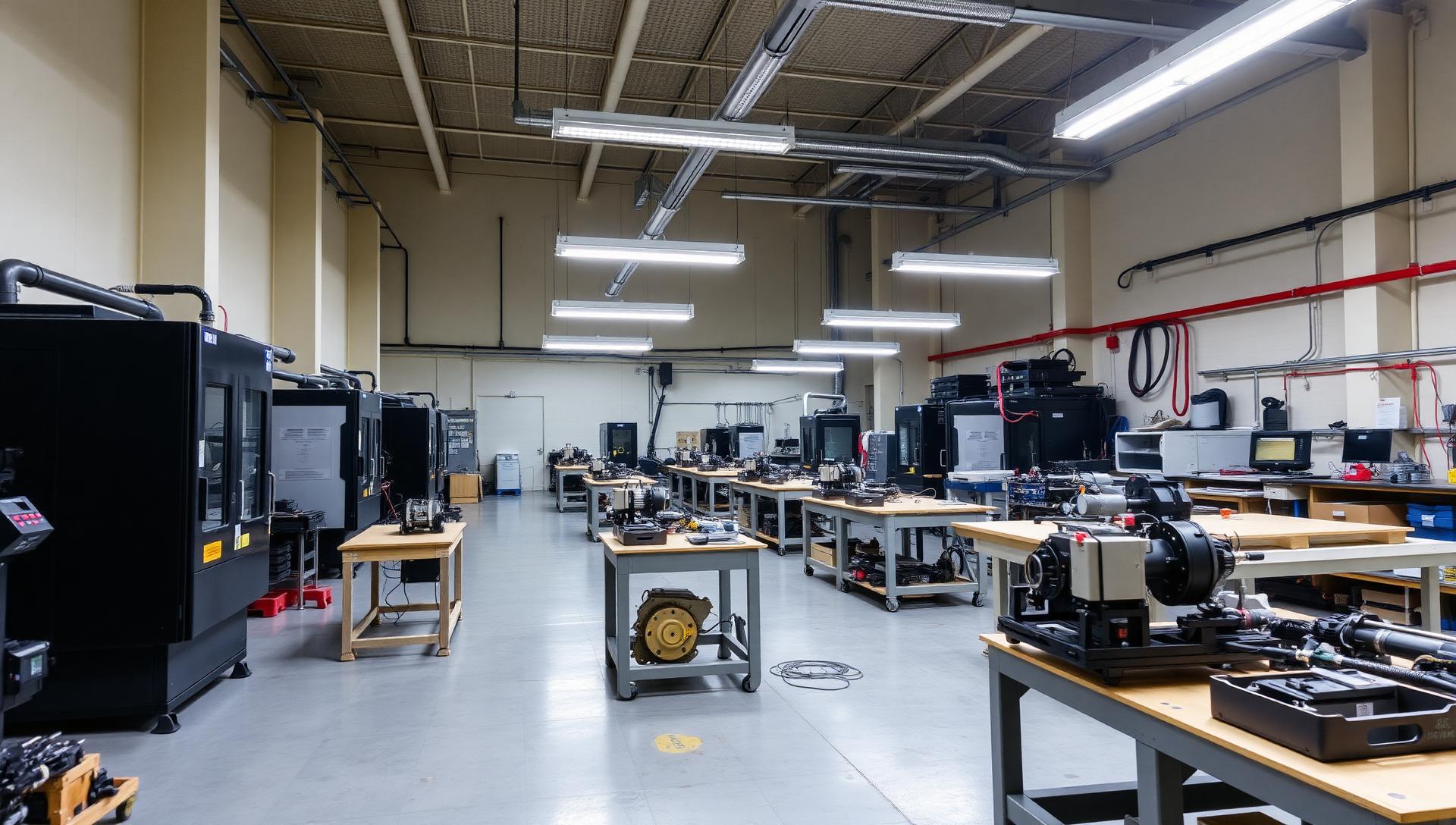
Pain Point Quote (from Quora): "Is it normal for a new LED light to make a spinning CNC chuck look like it's stationary or moving slowly backwards? It’s a huge safety risk. Our old metal halides never did this. What is this phenomenon?"
This is the stroboscopic effect, caused by imperceptible flicker in low-quality LED drivers. When the flicker frequency (or a harmonic) aligns with the rotational speed of machinery, it can make moving parts appear static or move at a different speed. This is an extreme safety hazard.
The 2026 Lighting Recipe:
- Illuminance (Ēm): 500 - 750 lux horizontal average, per EN 12464-1. Crucially, cylindrical and vertical illuminance must also be high to properly light the workpiece inside the machine.
- Flicker Performance: Flicker percentage < 5% (ideally <1%). Specify drivers that are certified "flicker-free" using metrics like PstLM and SVM. This is a non-negotiable safety requirement.
- Colour Temperature (CCT): 4000K or 5000K. Provides good visibility and alertness.
- Colour Quality: CRI ≥80. While CRI 90 is ideal, CRI 80 is often acceptable here, unless colour matching of finished parts is a key task.
- Glare Control: UGR < 22. The primary glare source is reflections from coolant-covered metal parts and tooling. Diffuse, low-glare luminaires are essential.
- Beam & Fixture: IP65 Linear Highbays with wide (120°) diffuse optics. This creates a softer, more uniform "blanket" of light, reducing the harsh specular reflections off machined surfaces and ensuring good vertical illuminance on the sides of equipment.
- Controls: DALI-2 with presence detection. Machining cells are often used intermittently. Linking lighting to occupancy can yield significant energy savings.
Why Most Designs Fail: The number one failure is specifying cheap, high-flicker drivers to save on upfront cost. The stroboscopic effect it creates is a lawsuit waiting to happen. The second failure is poor fixture placement, leading to "cave effect," where the ceiling is bright but the task area inside the CNC machine is in shadow. A proper lighting design using software is essential to model and prevent this.
2.3 QC / Visual Inspection Bench
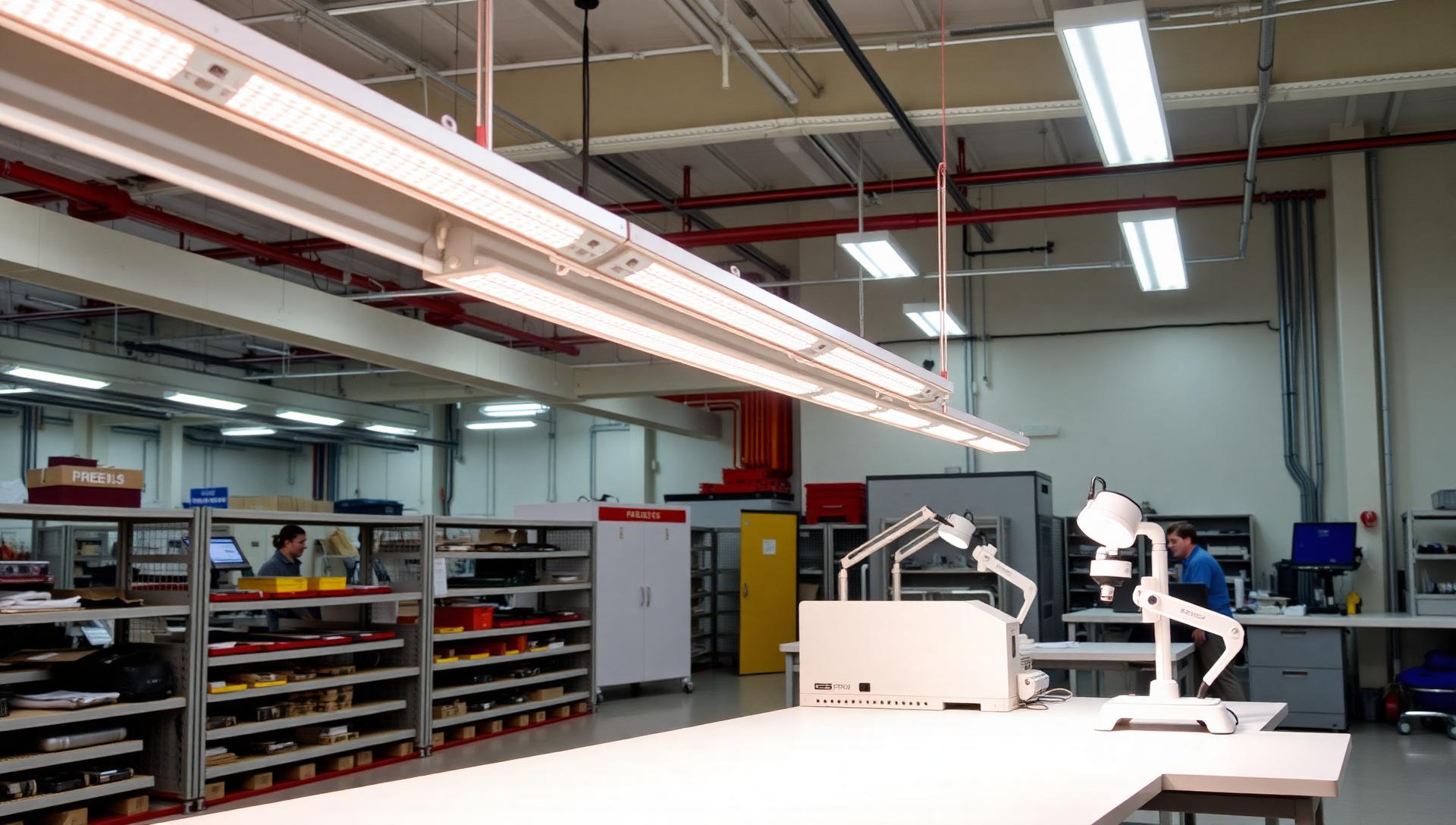
Pain Point Quote (from a Substack comment): "We have 1000 lux over our QC benches, but we're still missing surface finish defects. It seems like the light is 'flat' and just washes everything out. Is there a way to make scratches and texture 'pop' more?"
This is a sophisticated problem. High illuminance is only the first step. For detailed inspection, the direction, quality, and even colour of light can dramatically affect defect visibility. Simply blasting an area with more light can actually make certain flaws less visible due to veiling glare.
The 2026 Lighting Recipe:
- Illuminance (Ēm): 1000 - 2000 lux on the task surface. EN 12464-1 recommends these higher levels for "difficult" and "extremely difficult" visual tasks. The level should be adjustable.
- Colour Quality: CRI ≥95 and a full TM-30 report. For ultimate QC, you need the most accurate colour rendering possible. This helps identify subtle discolouration from heat treatment, contamination, or material inconsistencies.
- Colour Temperature (CCT): Tunable White (e.g., 3000K to 6500K). This is a game-changer for QC. A cooler CCT (6500K) is excellent for spotting cracks and pitting on metal surfaces. A warmer CCT (3000K) can be better for revealing texture and certain colour variations. Giving the inspector control is key.
- Glare Control: UGR < 16 and directional control. Use asymmetric or adjustable linear task lights. The ability to change the angle of incidence is critical. Low-angle "raking" light across a surface will make tiny scratches and texture variations cast small shadows, making them instantly visible.
- Beam & Fixture: Adjustable, asymmetric IP40 Linear Task Luminaire. Mount it on an articulated arm or positioned to one side of the bench, not directly overhead. This allows the operator to create grazing light angles.
- Controls: Local DALI dimming and CCT control knob/panel. The QC operator must have immediate, tactile control over both intensity and colour temperature to adapt the lighting to the specific part and defect they are looking for.
Why Most Designs Fail: Designs fail by treating the QC bench like any other workspace. They install a standard overhead fixture, which creates direct reflections and veiling glare, actively hiding the very defects the operator is trying to find. The lack of adjustability—in intensity, colour, and direction—is the primary reason for missed QC issues.
2.4 Warehouse & High-Rack Storage
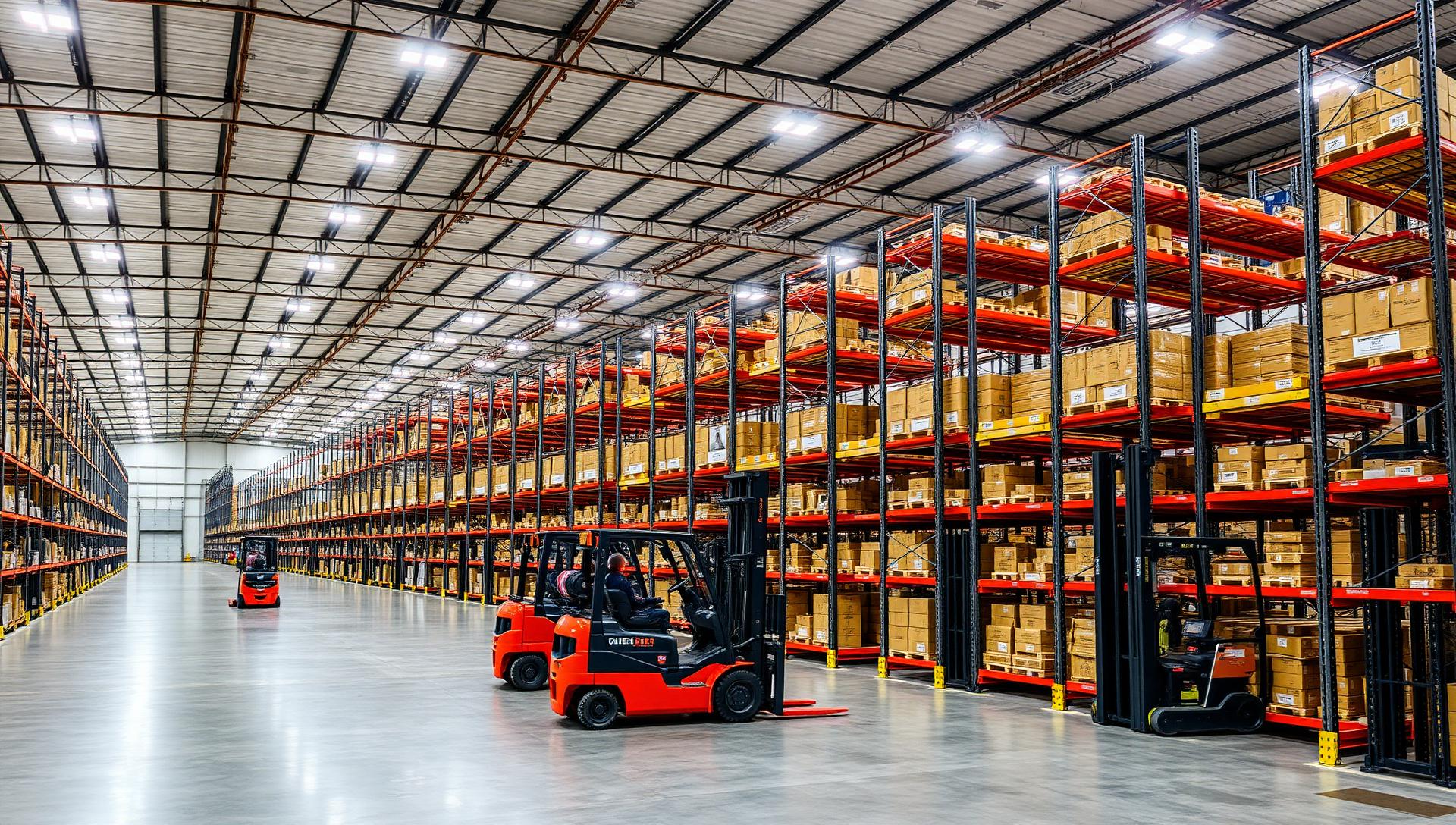
Pain Point Quote (from r/logistics): "Our warehouse aisle lighting sucks. Our new LED highbays make the floor super bright underneath them, but halfway up the racks it’s totally dark. Pickers can't read labels and our scanner error rate is through the roof. It feels unsafe for the forklifts too."
This is the most common lighting mistake in logistics: prioritizing horizontal illuminance (on the floor) over vertical illuminance (on the rack face). Forklift operators and order pickers don't look at the floor; they look at the vertical faces of the racks to read locations, product labels, and barcodes.
The 2026 Lighting Recipe:
- Illuminance (Ēm): 150 - 200 lux on the floor is sufficient (EN 12464-1 for gangways). The critical metric is average vertical illuminance on the rack face, which should be at least 50% of the horizontal illuminance, with good uniformity (Uo > 0.4).
- Colour Temperature (CCT): 4000K. A clean, neutral white is perfect for a warehouse environment.
- Colour Quality: CRI ≥80. High colour accuracy is less critical here than clear visibility of labels and safety markings.
- Glare Control: UGR < 22. While less stringent than an assembly area, glare control is still vital for forklift operator safety, preventing momentary blindness when looking up at fixtures.
- Beam & Fixture: IP65 Linear Highbays with specialized aisle-lighter / asymmetric optics. This is the secret. Instead of a standard circular beam that wastes light on the top of racks and the floor, these optics shape the light into a long, narrow rectangle that pushes light down the aisle and sideways onto the vertical faces of the racks.
- Controls: DALI-2 or Casambi with integrated microwave presence sensors and daylight harvesting. Warehouse aisles are perfect for aggressive energy saving. Lights can be at 10% standby and ramp up to 100% instantly when a forklift or person enters the aisle. Sensors at the end of each aisle near skylights can dim the entire row on bright days.
Why Most Designs Fail: The failure is using cheap, general-purpose round highbays. They are designed for open areas, not long, narrow canyons. Their symmetrical beam pattern is incredibly inefficient in a racking aisle, leading to the exact "dark rack, bright floor" problem described in the pain point. The fix is spending slightly more on fixtures with the correct aisle-optic lens. The ROI is immediate in picking accuracy and safety.
Part 3: The Four Megatrends Driving 2026 European Lighting Specifications
Industrial lighting is a technology in rapid transition. Specifying a system today that will still be considered high-performance in 2026 and beyond requires an understanding of the regulatory and technological trends shaping the market. Four key drivers stand out.
Trend 1: Radical Energy Efficiency (The Ecodesign 2026 Imperative)
The European Union's Single Lighting Regulation (SLR), also known as Ecodesign, is aggressively phasing out inefficient lighting. The regulations that took effect in 2021 and 2023 were just the beginning. The industry is already preparing for the next tier of requirements, anticipated around 2026, which will push minimum luminous efficacy levels even higher.
- What it means for you: Specifying a luminaire with an efficacy of 120 lm/W today might seem adequate, but it could be below the minimum legal requirement in just a few years. Future-proofing your investment means targeting the upper echelon of what's currently available.
- The 2026 Target: Aim for a luminaire efficacy of at least 160 lm/W. For control gear (drivers), the standby power consumption is also under scrutiny, with limits dropping to as low as 0.25W.
- Beyond the Luminaire: Regulators are increasingly looking at system efficiency. This is where controls come in. A 160 lm/W luminaire that is on 100% of the time is less efficient than a 140 lm/W luminaire connected to a DALI-2 system that uses daylight harvesting and presence detection to operate only 40% of the time. The Ecodesign framework encourages a holistic view of energy consumption, making intelligent controls an essential part of a compliant strategy.
Trend 2: The Dominance of High Efficacy (130-160+ lm/W)
For years, there was a trade-off: high efficacy or high quality (CRI). You could have one, but not both. That trade-off is over. Advances in LED phosphor technology and chip architecture mean that high-efficacy and high-CRI are no longer mutually exclusive.
- The Technology: New phosphor combinations allow LEDs to produce light with a very full spectrum (CRI 90-95) while minimizing the "green gap"—a dip in the spectrum where conventional LEDs are less efficient. The result is high-quality light at efficiencies that were previously only possible with poor-quality CRI 70 chips.
- The Financial Impact: The move to 160 lm/W from an older 90 lm/W fluorescent or HID system represents a staggering 70-80% reduction in lighting energy consumption. When replacing first-generation 110 lm/W LEDs, the savings are still a significant 30-40%.
- Total Cost of Ownership (TCO): When evaluating proposals, do not just look at the upfront fixture cost. A slightly more expensive 160 lm/W luminaire will pay back its premium over a cheaper 130 lm/W unit in energy savings within 1-2 years in most industrial facilities with long operating hours. High efficacy is the single biggest driver of a low TCO.
Trend 3: Anti-Glare & Human-Centric Lighting (UGR<19 as Standard)
The conversation has shifted from "how much light?" to "how good is the light?". Worker wellbeing is now a quantifiable metric tied to productivity and employee retention. Glare is the primary enemy of visual wellbeing.
- The Rise of UGR <19: The EN 12464-1 standard has long recommended UGR <19 for office and reading tasks. Now, this benchmark is being applied to any industrial task requiring sustained visual concentration. The understanding is that an SMT operator's visual task is as demanding as an office worker's, if not more so.
- The Technology of Low Glare: Achieving low UGR in a high-ceiling industrial space is not trivial. It requires advanced optics. Look for luminaires described with terms like "prismatic lens," "micro-prismatic diffuser," "shielded optics," or "darklight reflector." These technologies precisely control the light distribution, cutting off high-angle light that causes direct discomfort glare. Simple frosted diffusers do not achieve this; they simply obscure the LED point source, creating a large, inefficient, glaring surface.
- Beyond Glare: Circadian Lighting: The next frontier is circadian-supportive lighting. This involves tuning the colour temperature (CCT) and intensity of light throughout the day to support the human body's natural 24-hour cycle. For multi-shift operations, a system that can provide high-intensity, cool (5000K-6000K) light during a night shift can improve alertness and safety, while transitioning to warmer, less intense light towards the end of the shift can ease the transition to daytime sleep. This is an advanced DALI-2 DT8 feature but is a key indicator of a forward-looking lighting system.
Trend 4: Ubiquitous Smart Control (DALI-2 & Wireless)
Intelligent lighting control is no longer a luxury "add-on." It is now fundamental to achieving energy targets, capturing operational data, and creating a flexible, responsive environment.
- DALI-2 as the Wired Backbone: DALI-2 is the de facto standard for new builds and major retrofits. Its key advantage is interoperability and data. With a DALI-2 system:
- Sensors are standardized: You can use a sensor from Brand A with a luminaire from Brand B and a controller from Brand C.
- Data is available: DALI-2 D4i drivers can report energy consumption, operating hours, and fault conditions for each individual luminaire. This turns your lighting into an IoT network for predictive maintenance and energy verification.
- Daylight Harvesting: This is DALI's killer app. Sensors measure ambient light and automatically dim fixtures in zones, maintaining the target lux level on the work plane while maximizing energy savings. Savings of 30-60% are typical in facilities with skylights or windows.
- Casambi & Bluetooth Mesh as the Wireless Solution: For existing facilities where running new control wires is impossible or cost-prohibitive, wireless mesh systems like Casambi are transformative.
- No new wires: Luminaires with integrated Casambi nodes form a self-healing mesh network. Control is done via a mobile app for commissioning and gateways for remote access.
- Ultimate Flexibility: Re-zoning the warehouse? Simply drag and drop luminaires into new groups in the app. No electricians, no rewiring.
- Full Feature Set: Wireless systems offer the same functionality as wired ones: presence detection, daylight harvesting, scheduling, and scene setting.
- The End of the "On/Off" Switch: The future of industrial lighting control is granular, automated, and data-rich. The decision is no longer if you should use controls, but which architecture—wired DALI-2 or wireless mesh—is the best fit for your project.
Part 4: Specification & Procurement Checklist for XHLWX Luminaires
Choosing the right product family is critical. This checklist outlines the recommended XHLWX product lines for different applications, aligned with the 2026 performance standards discussed in this guide. Use this table as a starting point for your specification documents.
| Application Space | Recommended XHLWX Family | Key Features | Min. CRI | Target UGR | Min. Lm/W | IP Rating |
|---|---|---|---|---|---|---|
| SMT / Electronics Assembly | XHL-LinearPro™ 90 | Ultra low-glare prismatic optics, continuous run capability, flicker-free DALI-2 driver. | ≥90 | <19 | 150 | IP65 |
| QC / Visual Inspection | XHL-TaskTune™ 95 | Asymmetric beam, CRI 95+, DALI-2 DT8 for local dimming and CCT tuning (3000K-6500K). | ≥95 | <16 | 120 | IP40 |
| Precision Machining / CNC | XHL-EnduraBay™ Gen4 | Wide beam diffusion lens, robust die-cast housing, certified flicker-free (<3%) driver. | ≥80 | <22 | 160 | IP65 |
| Warehouse / High Racks | XHL-AisleRunner™ | Specialized asymmetric aisle optic for maximum vertical illuminance. Integrated sensor options. | ≥80 | <22 | 165 | IP65 |
| General Open Areas & Logistics | XHL-EcoBay™ 160 | High-value, high-efficacy solution for open floor plans. Multiple beam options. | ≥80 | <25 | 160 | IP65 |
Procurement & Specification Best Practices:
-
Demand a Full Lighting Design File: Do not accept a proposal based on a simple "X fixtures per area." Demand a full DIALux or Relux simulation file for your exact facility layout. Scrutinize the reports for:
- Average illuminance (Ēm) on the task plane.
- Illuminance uniformity (Uo).
- Unified Glare Rating (UGR) tables for relevant viewing positions.
- Vertical illuminance values for warehouse racks.
-
Specify by Performance, Not Just Product Name: Instead of "Fixture X," write specifications like: "Linear LED luminaire, 150W, 5000K, minimum luminaire efficacy 160 lm/W, CRI ≥90, UGR <19 in the provided layout, DALI-2 D4i certified driver with <5% flicker, IP65, L80B10 > 100,000 hours." This forces suppliers to compete on quality and performance.
-
Request Driver & LED Chip Datasheets: Verify the manufacturer's claims. Check the driver datasheet for flicker percentage, power factor, and THD. Check the LED datasheet for lumen maintenance projections (e.g., LM-80 report).
-
Confirm Warranty Details: A 5-year warranty is standard, but a 7- or 10-year warranty indicates a higher level of confidence from the manufacturer. Read the fine print: Does it cover lumen depreciation and colour shift, or just outright failure?
-
Evaluate a Sample: Before placing a large order, get a physical sample of the proposed luminaire. Assess the build quality, the finish, and the quality of the light with your own eyes. Power it on and check for flicker with your phone's slow-motion camera. This small step can prevent a very large and expensive mistake.
Part 5: Industrial Lighting FAQ (Your Questions, Answered)
We've compiled eight of the most common and critical questions we see on forums like Reddit's r/AskEngineers and Quora, answered with the technical depth a specifier needs.
1. "r/manufacturing asks: Is spending extra for CRI 90 really worth it in a factory, or is it just for art galleries? Our supplier says CRI 80 is 'good enough'."
For many areas, CRI 80 is indeed sufficient. However, for any task involving colour differentiation, CRI 90 is a mission-critical investment, not a luxury. Think of SMT assembly where coloured wires or bands on resistors must be identified correctly. Or a QC station where operators check for subtle discolouration caused by improper heat treating or chemical contamination. In these cases, a CRI 80 light source can make two distinct colours appear identical, leading to costly errors, rework, and customer returns. The "R9" value (rendering of deep red), which is often poor in CRI 80 LEDs but strong in CRI 90+ LEDs, is also critical for the vibrancy and recognition of safety signage and labels. The modest cost uplift for CRI >90 is negligible compared to the cost of a single production error it helps prevent.
2. "Quora user asks: What is the real-world ROI on a DALI-2 system with daylight harvesting? It seems complex and expensive upfront."
The upfront cost for a DALI-2 system (addressable drivers, sensors, control wiring) can add 15-30% to the project cost over a basic non-dimmable system. However, the ROI is typically very fast, often under 3 years. The savings come from two places:
- Daylight Harvesting: In a facility with skylights or large windows, it's common for areas to be overlit on a sunny day. Daylight sensors dim the luminaires automatically to maintain only the required lux level, often saving 30-60% of the energy in those zones.
- Presence/Absence Detection: Warehouse aisles, storage rooms, and break areas are often unoccupied. Sensors can dim lights to 10% or turn them off entirely, then instantly ramp up when someone enters. This can save 70-90% of the energy in intermittently used spaces. The real-world ROI is fastest in facilities with long operating hours, high electricity rates, and access to natural light. Furthermore, DALI-2 D4i drivers provide energy monitoring data per fixture, allowing you to prove the savings and identify maintenance needs predictively.
3. "r/lighting asks: What's the difference between UGR<19 and a 'low glare' fixture? Can't I just use a fixture that says 'low glare' on the box?"
This is a critical distinction. "Low glare" is a vague marketing term. UGR (Unified Glare Rating) is a quantifiable, standardized metric calculated from a complete lighting design. A fixture itself does not have a UGR value; it has a UGR table that predicts the UGR in a reference room. The actual UGR in your facility depends on the room's dimensions, surface reflectances, luminaire layout, mounting height, and the viewer's position. A fixture might be "UGR<19 capable," but if installed incorrectly (e.g., too low, spaced too far apart), the resulting design can easily be UGR>25. Always insist on seeing the UGR calculation in a DIALux/Relux report for your specific space to verify the claim.
4. "LinkedIn user asks: My contractor is proposing wireless Casambi controls for our 100,000 sq ft factory. Is a wireless system reliable enough for an industrial environment?"
Yes, modern professional-grade wireless mesh systems like Casambi are extremely robust and well-suited for industrial environments. They are not like consumer-grade Wi-Fi. They operate on a Bluetooth Mesh protocol, which is a decentralized, self-healing network. If one luminaire (node) fails, the signal simply re-routes through other nearby nodes. The range between nodes is typically 30-50 meters, and in a dense industrial ceiling, every light adds strength to the mesh. The primary advantages are installation speed and flexibility, as no control wiring is needed. The main consideration is ensuring proper "mesh density" and potentially using gateways to connect the network to the internet for remote management and monitoring. For a large facility, a hybrid approach is also common: using wired DALI-2 for the main production floor and wireless for offices or areas that are difficult to rewire.
5. "r/AskEngineers asks: What is TM-30 and why should I care if my spec already requires CRI 90?"
TM-30 is a more comprehensive system for evaluating colour rendition. While CRI is based on how accurately a light renders just 8 pastel colours, TM-30 uses 99 different colour samples and provides two key metrics:
- Rf (Fidelity Index): This is similar to CRI, measuring how accurately colours are rendered. An Rf of 90 is comparable to a CRI of 90.
- Rg (Gamut Index): This measures the saturation of colours. An Rg of 100 means colours are rendered with the same saturation as they would be under daylight. An Rg > 100 means colours will appear slightly more vivid and saturated. Where TM-30 shines is its graphical representation, which can show you which specific colours a light source struggles with. For example, you might have two "CRI 90" lights, but the TM-30 report for one shows it is weak in rendering certain saturated reds, while the other is not. For inspecting branded materials or specific safety colours, a full TM-30 report gives you a much higher level of confidence than a single CRI number.
6. "From a facilities manager forum: Do I really need an IP65 rated fixture? Our factory floor is dry, and it seems like overkill."
While your main floor might be dry today, industrial environments are inherently harsh. IP65 rating provides two critical protections:
- IP6x = Dust Tight: It offers complete protection against the ingress of dust. Over time, fine airborne dust (from cutting, grinding, packaging, etc.) can infiltrate a non-rated fixture, coating the LEDs and optics. This can dramatically reduce light output and create a fire hazard.
- IPx5 = Water Jet Protection: It protects against low-pressure water jets from any direction. This isn't just about rain. It means the fixtures can be safely hosed down during facility cleaning and maintenance, which is a major operational advantage. It also protects against accidental sprinkler activation or leaks from overhead pipes. Given the long lifespan of LED fixtures (10+ years), specifying IP65 is a low-cost insurance policy against the unpredictable realities of an industrial space.
7. "Quora user asks: What causes the stroboscopic effect with LEDs on my rotating equipment, and how do I specify a fixture to prevent it?"
The stroboscopic effect is caused by flicker, which is the rapid, invisible modulation of a light's output. It's a byproduct of how some AC-DC LED drivers work. If the frequency of this flicker (or a multiple of it) aligns with the rotational speed of machinery (like a lathe chuck or grinding wheel), it creates an illusion that the object is slow, stationary, or moving backward. To prevent this, you must specify "low flicker" or "flicker-free" drivers. Look for these metrics on the driver datasheet:
- Percent Flicker (or Modulation %): This should be as low as possible, ideally < 3% for sensitive areas.
- PstLM (Short-Term Light Modulation): An IEC standard metric. A value of 1 means flicker is just visible to an average observer. You should demand PstLM ≤ 0.7.
- SVM (Stroboscopic Visibility Measure): A value > 0.4 indicates a visible stroboscopic effect is likely. Demand SVM < 0.4. Specifying a driver that meets these targets will eliminate the safety risk.
8. "r/PLC asks: Can our DALI-2 lighting system integrate with our Building Management System (BMS) or SCADA?"
Absolutely. This is one of the most powerful features of a DALI-2 system. Integration is typically achieved using a DALI-2 Application Controller or Gateway. These devices act as a bridge, translating DALI messages into protocols that a BMS or SCADA system can understand, such as BACnet, Modbus, or KNX. This allows for:
- Centralized Monitoring: View the status, energy consumption, and runtime hours of every light in your facility from the central BMS dashboard.
- Centralized Control: Trigger lighting scenes based on other building events (e.g., set all lights to 100% in case of a fire alarm, or dim lights in response to a demand-response signal from the utility).
- Data Logging: Log historical energy data for ESG reporting and verification of savings. When specifying your DALI-2 system, ensure you also specify the appropriate gateway with the correct protocol (BACnet/IP is most common) for seamless integration with your existing building automation infrastructure.
Need a tailored lighting plan for your project?
Our senior lighting designers reply within 48 hours with a free design proposal & quotation.