
Crystal vs Hand-Blown Glass Hotel Chandeliers: Cost & Lead Time
Quick answer
Compare crystal and hand-blown glass hotel lobby chandeliers by cost drivers, lead-time targets, maintenance, controls, and procurement requirements.
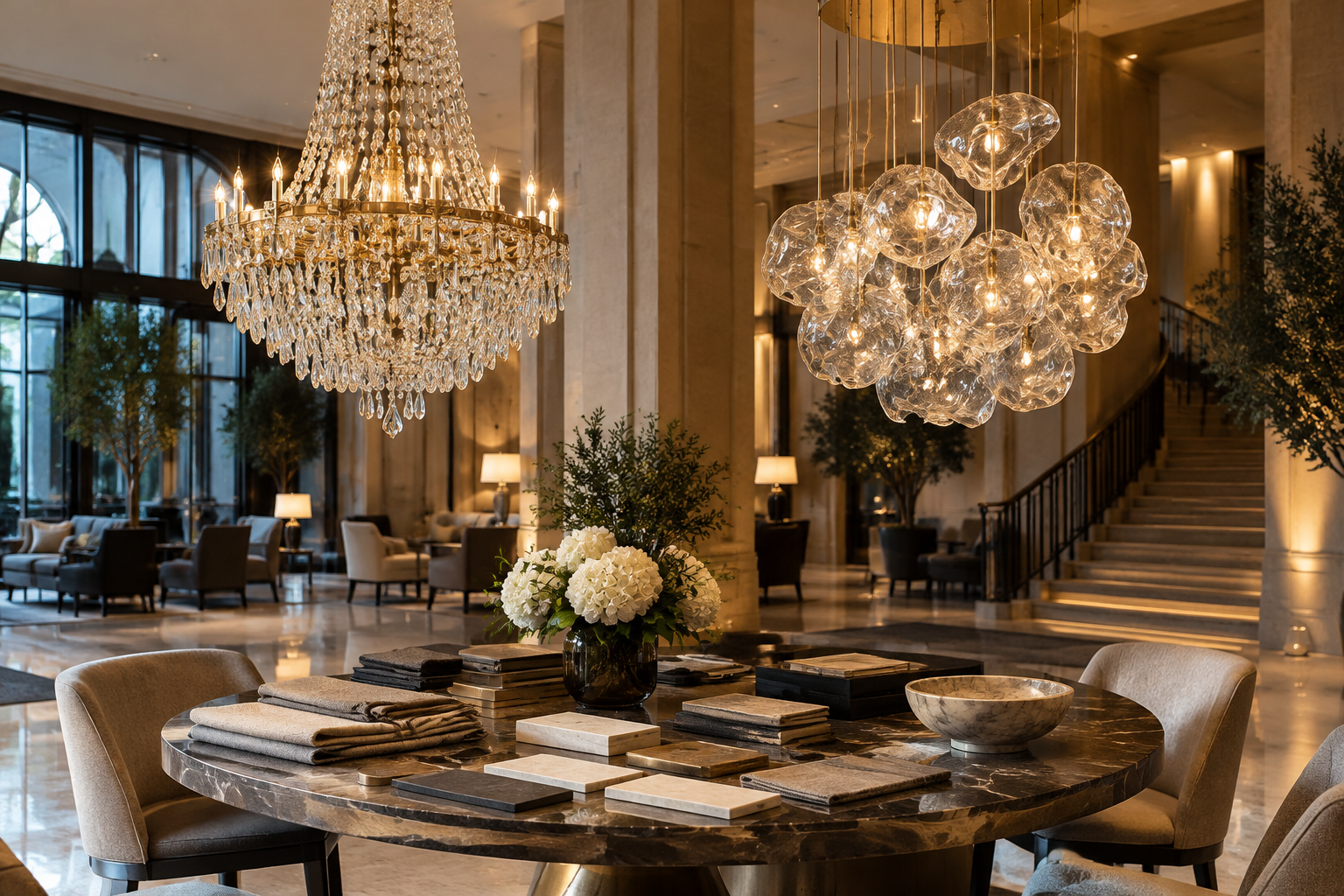
Introduction — Which Hotel Lobby Chandelier Costs Less and Arrives Sooner?
At XHLWX (led-project-light.com), a Custom Indoor LED Lighting Manufacturer based in China, ... standard-component crystal can cost less and arrive sooner than bespoke hand-blown glass. Use a recommended specification of 2 comparable quotations and 1 approved module; oversized crystals, intricate frames, moulds, and glass rejection rates can reverse that comparison.
For hotel owners, interior designers, and FF&E buyers, the useful comparison is between complete installed assemblies—not the price of individual decorative pieces. Crystal generally creates sharper sparkle through cut or moulded facets.
Hand-blown glass offers organic shapes, translucency, and controlled variation. Neither description establishes quality, electrical compliance, or delivery certainty.
The decision rule is straightforward: favour repeatable components when replacement speed and budget predictability dominate; favour hand-blown forms when a distinctive composition justifies sampling and variation management. Compare both against the same lobby geometry, lighting performance, installation scope, and acceptance criteria.
Design Criteria and Standards — What Should the Lobby Chandelier Specification Contain?
A hotel lobby chandelier needs a coordinated optical, mechanical, and electrical specification before material pricing becomes meaningful.
Treat the chandelier as one layer of indoor lighting. Reception work, circulation, seating, and decorative sparkle have different requirements. A bright decorative assembly does not automatically provide comfortable reception lighting, and low average illuminance does not eliminate glare from exposed LEDs.
The following values are recommended specifications or design targets, not reported product performance. Final requirements depend on the actual layout, operator brief, and destination-market review.
| Parameter | Spec | Standard | Notes |
|---|---|---|---|
| CCT | Recommended specification: 2700–3000 K | EN 12464-1, where applicable | Approve crystal and glass under the proposed LED spectrum. |
| Colour rendering | Recommended specification: CRI Ra ≥90 | EN 12464-1; WELL v2 where pursued | Review skin tones, finishes, and coloured glass; CRI alone is insufficient. |
| Glare / UGR | Design target: UGR ≤19 at relevant reception work positions, where the calculation method applies | EN 12464-1 | Not a universal chandelier rating; assess sparkling elements from actual viewpoints. |
| Beam distribution | Recommended specification: test 24° and 36° source optics | IES photometric reporting conventions | Final selection follows simulation and sample review, not nominal beam angle alone. |
| Control | Recommended specification: select DALI-2, Casambi, KNX integration, or 0-10V | Applicable IEC 62386 requirements for DALI; protocol-specific documentation | These are different architectures, not interchangeable labels. |
| Housing / material / IP | Recommended specification: steel or aluminium load-bearing frame; IP20 for suitable dry interiors | EN 60598; IEC 60529 | Engineer mounting, earthing, thermal paths, and decorative-element retention. |
| LED / driver brands | Recommended specification: evaluate Osram, Bridgelux, or Samsung LEDs with Tridonic or Mean Well drivers | Component documentation and applicable safety requirements | Approve exact models; brand names do not establish assembly compliance. |
| Market compliance / quality | Recommended specification: verify applicable CE/RoHS obligations, UL pathway, SAA relevance, and ISO9001 evidence separately | EN 60598; destination electrical rules | CE is a conformity marking; ISO9001 concerns management systems. No certification is asserted here. |
Use EN 12464-1 for applicable indoor workplace lighting requirements, including relevant reception tasks. Use EN 60598 as the luminaire safety standards family, identifying the applicable part and national adoption.
WELL v2 is a building certification framework, not a chandelier approval. IES publishes lighting guidance and measurement standards; an IES file is not a safety certificate.
Customisation Options and Materials — How Do Crystal and Hand-blown Glass Compare?
Standardisation, assembly labour, and replacement strategy usually explain more of the commercial difference than the decorative material name.
Define what “crystal” means in the quotation: supplier, composition, cutting or moulding method, finish, and accepted optical defects. Define hand-blown glass by its approved reference sample and dimensional tolerance. Handmade variation can be intentional, but it still needs boundaries.
| Procurement factor | Crystal chandelier | Hand-blown glass chandelier | Verdict |
|---|---|---|---|
| Decorative-component cost | Catalogue drops can simplify sourcing; precision-cut or unusual pieces may command premiums | Standard blown forms may be economical; unique shapes add development and rejection exposure | Compare approved components, not material labels. |
| Initial development | Repeatable drops can use established connection details | New shapes may require moulds, annealing trials, and attachment development | Standard-component crystal often has less development risk. |
| Visual character | Facets produce crisp highlights and sparkle | Organic forms offer softer transmission and sculptural identity | Select through a lit sample in the actual interior palette. |
| Production predictability | Repeated component sizes support repeatable assembly | Colour, wall thickness, and dimensional consistency require batch control | Glass needs explicit variation limits. |
| Replacement logistics | Common drops may be easier to stock and match | Bespoke forms may require retained moulds and batch references | Confirm availability before choosing either material. |
| Installation and care | Many small pieces can increase hanging and cleaning labour | Larger fragile forms can require careful handling and indexed positions | Access and element count can outweigh purchase-price differences. |
How Should Buyers Compare Chandelier Costs Without Misleading Price-per-piece Figures?
A reliable cost comparison separates decorative elements from engineering, installation, compliance, and lifetime support.
Request an itemised bill of quantities covering the frame, suspension, decorative components, light engines, drivers, controls, finishes, packaging, spare parts, and documentation. Identify whether installation supervision, access equipment, structural review, freight, duties, and local taxes are included or excluded.
Use this comparison basis: installed acquisition cost = approved fixture scope + logistics + destination charges + installation + required testing or approvals. Track cleaning and replacement costs separately over the owner's chosen operating period.
For EU, US, Middle East, and Southeast Asia buyers, record the destination country and delivery term. A factory quotation cannot establish landed cost without the shipping route, packing dimensions, import treatment, and local installation scope. Avoid an unsupported universal percentage premium for hand-blown glass.
Which Finishes and Suspension Materials Suit a Large Hotel Lobby?
Finish consistency and engineered suspension matter more than decorative material alone in a large lobby installation.
Steel can suit load-bearing frames; aluminium can reduce some component weights; brass can provide visible detailing. None should be selected without checking strength, joining methods, finish compatibility, and maintenance exposure. Warm plated finishes and coloured glass must be approved together because reflections change their appearance.
Require total assembly weight, attachment-point reactions, ceiling-interface drawings, and access provisions. A qualified local professional should verify structural anchorage and any seismic requirements. Large suspended glass elements also need retention details that avoid concentrated stress at drilled holes or clamps.
How Much Handmade Variation Should the Designer Accept?
Acceptable handmade variation should be documented through physical references rather than left to subjective inspection at delivery.
Approve an acceptable sample range showing colour, bubbles, striations, dimensions, and wall-thickness variation. Distinguish intentional texture from cracks, sharp edges, unstable attachments, or other unacceptable defects. Review transmitted and reflected appearance with the proposed light source.
Recommended specification: retain 1 signed reference set and assign component identification codes to the installation drawing. Photographing glass helps traceability, but camera exposure and white balance make photographs unreliable as the sole colour reference. Agree ownership and retention arrangements for any custom moulds.
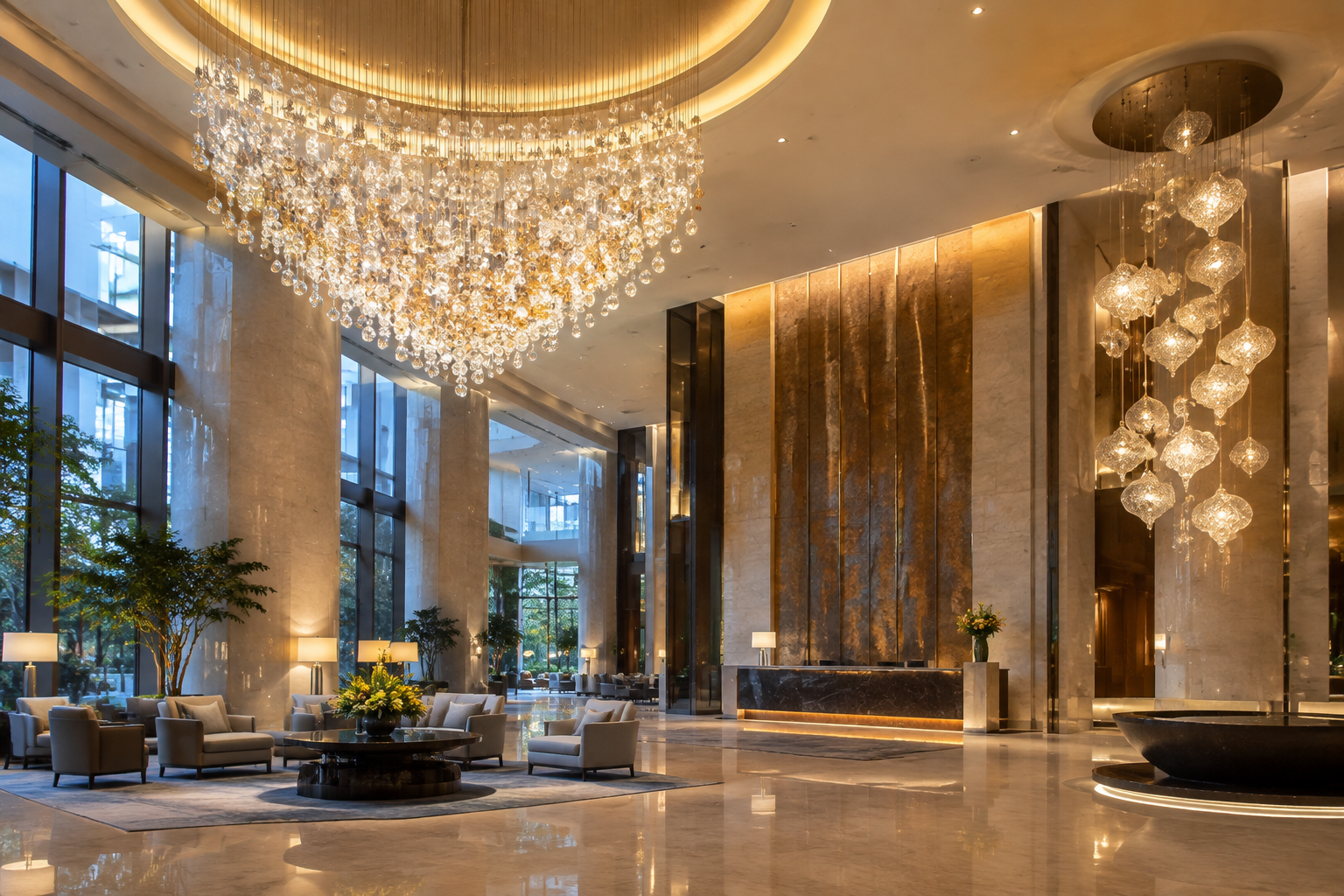 Crystal vs Hand-Blown Glass Hotel Chandeliers: Cost & Lead Time: Which finishes and suspension materials suit a large hotel lobby?
Controls and Commissioning — How Can Lobby Sparkle Remain Comfortable After Dark?
A chandelier should dim predictably and integrate with the lobby lighting scenes without relying on untested driver claims.
DALI-2 is useful where device interoperability, addressing, and commissioning are specified. Casambi can support wireless scene control, subject to network design and compatible hardware.
KNX commonly integrates lighting with wider building functions through suitable interfaces. With 0-10V, confirm dimming behaviour, wiring, and the separate switching arrangement where required.
Recommended specification: demonstrate stable dimming to 1% light output if the selected LED-driver combination supports it. This is an acceptance target, not a guaranteed property of the named protocols. Observe flicker, audible noise, low-end instability, and colour behaviour on the complete sample.
Recommended specification: commission 3 scenes—arrival, evening, and cleaning—with the chandelier coordinated with reception and ambient lighting. Confirm power-restoration behaviour, emergency-lighting separation, driver access, and handover documentation. Emergency functions require their own applicable design and approvals.
Sampling, MOQ, Lead Time and Quality Control — What Determines the Delivery Programme?
Lead time becomes credible only after drawings, samples, component availability, and compliance responsibilities are agreed.
For early scheduling only, consider these design targets, not XHLWX delivery commitments or industry averages: 2–3 weeks for coordinated drawings, 3–5 weeks for sample development, then 6–10 weeks for standard-component crystal production or 8–14 weeks for bespoke hand-blown glass production after approval and material readiness. Tasks may overlap; complex work can exceed these targets.
These factory planning allowances exclude freight, customs clearance, destination testing, and site installation. Crystal sourced to unusual dimensions can take longer than readily available hand-blown forms. Request dated supplier confirmation instead of treating material choice as a delivery guarantee.
MOQ is quotation-specific. Ask separately about the minimum finished-assembly quantity, decorative-component batch, finish batch, and spare-parts order. A custom mould or colour run can create a component minimum even when the project requires a single chandelier.
Use approval gates for drawings, the illuminated module, finish references, pre-shipment assembly, and packing. The inspection plan should address dimensions, weight, wiring, applicable electrical safety tests, dimming, appearance, component retention, and package identification. Record defects and corrective action before shipment; do not substitute a generic factory checklist for the agreed acceptance criteria.
Photometric Files & Compliance — What Evidence Should the Consultant Receive?
Photometric evidence and market-access documentation answer different questions and must be checked separately.
Request IES and LDT photometric files for the proposed optical configuration, with source information and the test or calculation basis identified. Generic downlight data cannot substantiate the distribution of a complete decorative assembly. If only module data exists, explain the modelling limitation explicitly.
Use DIALux to evaluate relevant reception tasks, circulation, and the chandelier's contribution alongside other luminaires. Crystal reflections and variable glass transmission may not be fully represented by a simplified model; supplement calculation with a lit mock-up and viewpoint review.
For EU supply, establish applicable CE documentation and RoHS obligations. For US installations, confirm the required listing or evaluation route with the authority having jurisdiction.
Middle Eastern and Southeast Asian requirements vary by country and project; neither CE marking nor a UL-listed component automatically establishes local acceptance. SAA-related requirements are generally relevant to Australian-market pathways, not substitutes for these reviews.
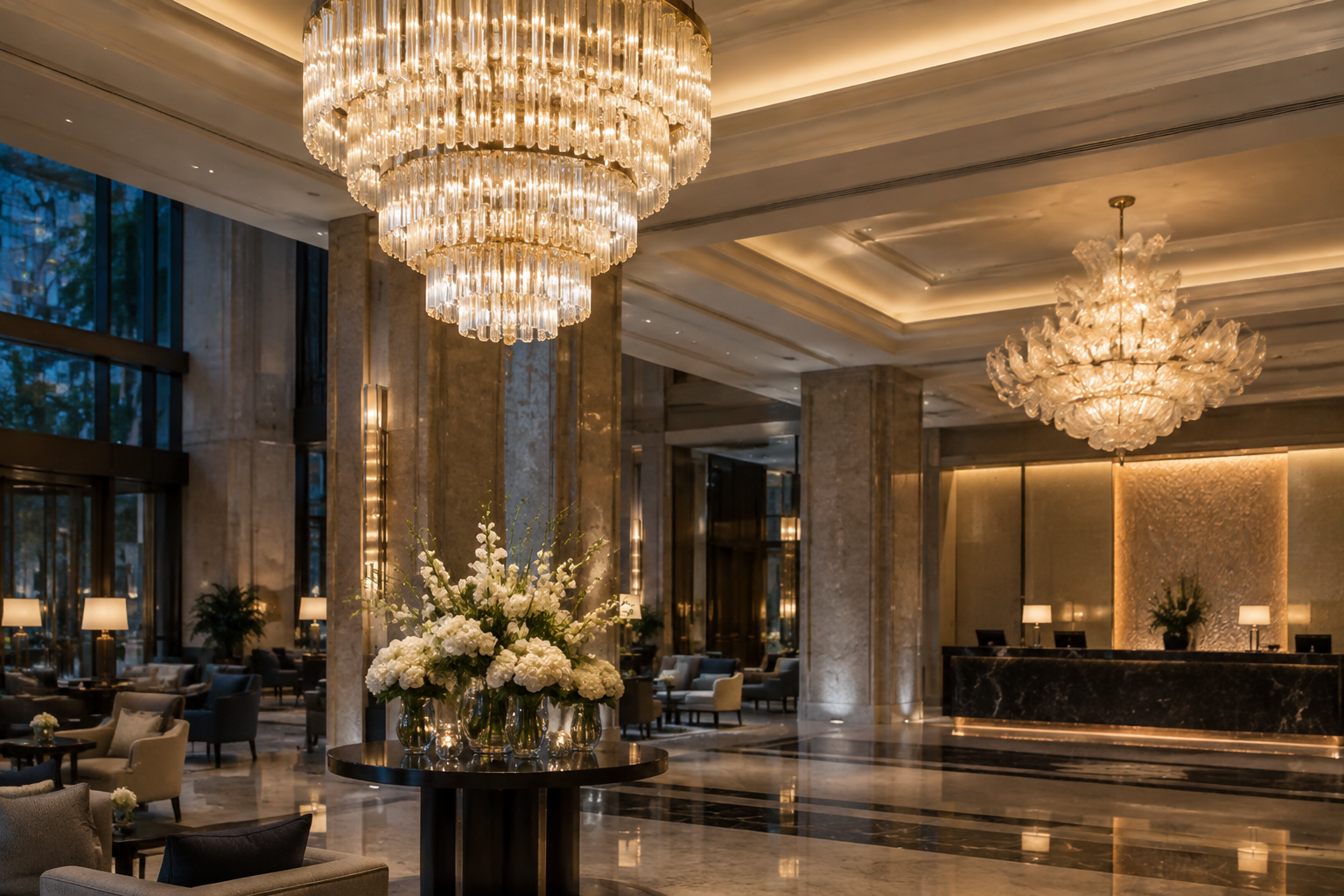 Crystal vs Hand-Blown Glass Hotel Chandeliers: Cost & Lead Time: Photometric files & compliance — what evidence should the consultant receive?
Frequently Asked Questions
Q: Are Crystal Hotel Lobby Chandeliers Always Cheaper Than Hand-blown Glass?
No. Catalogue crystal drops can reduce development work, but unusual cuts, dense assemblies, and premium finishes can exceed the cost of simpler hand-blown forms. A recommended specification is to obtain 2 quotations using the same dimensions, lighting performance, controls, installation scope, and spare-parts requirements. Compare installed acquisition cost rather than decorative-piece pricing alone.
Q: What Lead Time Should a Hotel Allow for a Bespoke Chandelier?
Start with a supplier-confirmed programme rather than a material-based promise. An early production design target might be 6–10 weeks for standard-component crystal after approval and material readiness; bespoke hand-blown glass may need longer. Drawings, sampling, shipping, customs, and site installation require separate allowances. These are planning targets, not confirmed XHLWX delivery dates.
Q: Can Both Chandelier Types Use DALI-2 or Wireless Dimming?
Yes, provided the light engine, driver, control interface, and installation architecture are compatible. Decorative material does not determine protocol compatibility. A recommended specification is a witnessed sample test at 1% output where supported, checking stability, flicker, noise, and restart behaviour. Confirm whether Casambi communicates directly with the driver or through an approved interface.
Q: How Should a Hotel Plan Replacement Crystal or Glass Components?
Agree a project-specific spare-parts schedule before production, considering fragility, cleaning access, component uniqueness, and replenishment risk. A recommended specification is to retain 1 signed reference set with indexed drawings and batch records. For bespoke glass, confirm mould retention, replacement minimums, colour-matching limitations, and packaging. No universal spare percentage suits every chandelier design.
Sources and Technical References — Documents for the Project Compliance Review
Authoritative references should support the specification, while project-specific evidence must come from the proposed assembly and its documentation.
- EN 12464-1 and EN 60598: obtain applicable editions and national adoptions through CEN-CENELEC or the relevant national standards body.
- IES: consult the Illuminating Engineering Society for lighting guidance, measurement standards, and photometric data conventions.
- WELL v2: review applicable lighting features through the WELL standard.
- DALI-2: verify certification scope and listed products through the DALI Alliance.
- CE marking: consult European Commission guidance; identify the legislation applicable to the actual product.
- UL evidence: check the relevant product and certification scope through UL Product iQ, rather than relying on a logo in a quotation.
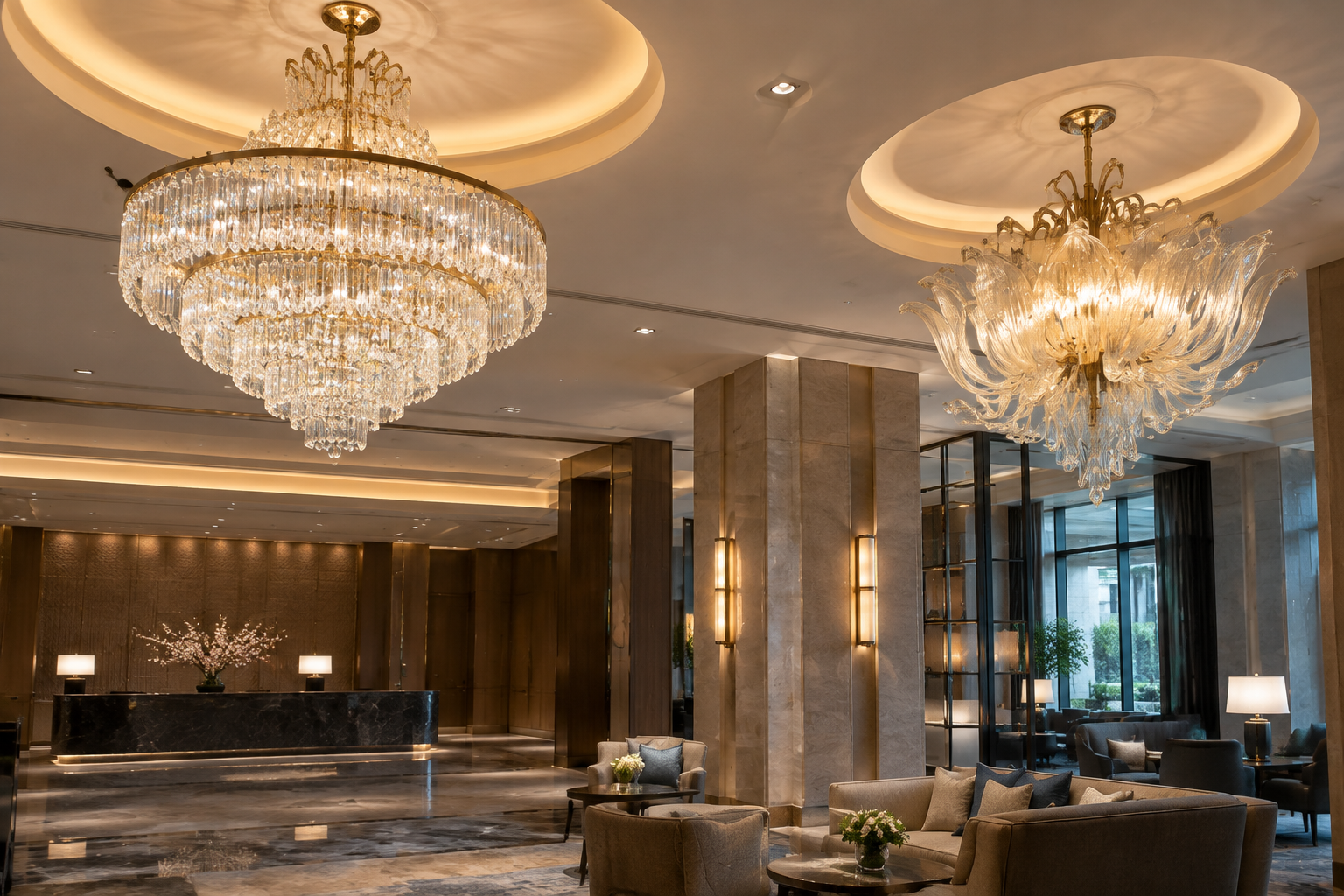 Crystal vs Hand-Blown Glass Hotel Chandeliers: Cost & Lead Time: Q: Can both chandelier types use DALI-2 or wireless dimming?
Request a Custom Quote — What Should the Hotel Project Team Send?
A comparable quotation requires a defined lobby brief and a clear division of procurement responsibilities.
Send reflected ceiling plans, lobby sections, chandelier dimensions, suspension height, destination country, electrical supply, control preference, finish references, budget basis, and required site date. Include access constraints, structural coordination requirements, and the desired balance between decorative impact and usable illumination.
At XHLWX (led-project-light.com), a Custom Indoor LED Lighting Manufacturer based in China, ... the quote brief should define evidence, not just appearance. Request crystal and hand-blown glass alternatives against the same approved scope, with itemised pricing, sampling gates, proposed lead times, replacement arrangements, and explicitly documented compliance responsibilities.
Need a tailored lighting plan for your project?
Our senior lighting designers reply within 48 hours with a free design proposal & quotation.