
Hotel Brass Wall Sconces: Plating, PVD or Aged Finishes?
Quick answer
Compare plating, PVD and aged brass for hotel wall sconces, with practical guidance on substrates, cleaning, lighting specifications and finish approval.

Introduction: Which Brass Sconce Finish Suits Hotel Interiors?
At XHLWX (led-project-light.com), a Custom Indoor LED Lighting Manufacturer based in China, ... choose PVD for durability, plating for economy, aged brass for character. Recommended specifications are 2700–3000 K and CRI ≥90; actual finish durability depends on substrate preparation, cleaning chemistry, coating integrity, and maintenance.
These are selection starting points, not guaranteed performance rankings. PVD describes a deposition process, electroplating describes another, and aged brass describes an appearance that different processes can produce.
A brass-colored hotel wall light may contain little or no solid brass. Buyers should specify the substrate, decorative treatment, protective layer, and approved cleaning method separately.
For EU, US, Middle East, and Southeast Asian hotel interiors, the best specification connects appearance with exposure: bedside handling, corridor trolley contact, bathroom humidity, or lobby cleaning. Geography alone does not establish the operating conditions.
Design Criteria and Standards: What Should a Brass Hotel Wall Light Specification Include?
A complete sconce specification defines lighting performance, finish construction, electrical safety, and maintenance access before production approval.
Set requirements by task and viewing position. Bedside reading needs controlled light without exposing a bright LED to the adjacent guest.
Corridor sconces need coordination with ambient lighting and emergency systems. Decorative bathroom sconces need location-appropriate electrical protection, not simply a moisture-resistant finish.
EN 12464-1 addresses indoor workplace lighting; use it where its scope applies to hotel staff tasks and relevant spaces. It is not a universal guest-bedroom illuminance schedule. WELL v2 can inform an owner’s visual comfort and lighting strategy, but a suitable sconce alone does not establish building certification.
The following values are recommended specifications or design targets, not claims about an existing XHLWX product.
| Parameter | Spec | Standard | Notes |
|---|---|---|---|
| CCT and color rendering | Recommended specification: 2700–3000 K; CRI ≥90 | Relevant IES guidance; project lighting brief | Approve brass appearance under the selected LED spectrum and surrounding light. |
| Glare and beam | Design target where relevant: UGR ≤19; recommended reading optic starting point: 30–60° | EN 12464-1 where applicable | UGR depends on the installation; verify shielding from bed and corridor viewpoints. |
| Control interface | Project-selected DALI-2, Casambi, KNX integration, or 0-10V | IEC 62386 for relevant DALI equipment; interface documentation | Match drivers, gateways, dimmers, and the hotel room-management system. |
| Housing, material and IP | Identify solid brass, steel, stainless steel, or aluminum; recommended dry-interior starting point: IP20 | EN 60598; IEC 60529 | Bathroom locations require separate assessment; IP does not rate finish corrosion resistance. |
| LED and driver brands | Candidate LED sources: Osram, Bridgelux, Samsung; candidate drivers: Tridonic, Mean Well | Component datasheets and applicable equipment requirements | Brands are selection options, not a confirmed bill of materials or performance guarantee. |
| Market compliance and quality system | Request applicable CE/RoHS evidence, US UL documentation, any specified SAA approval, and supplier ISO9001 evidence | EN 60598; RoHS legislation; UL 1598 as applicable; ISO 9001 | These have different scopes; no certification is claimed here. SAA concerns Australia, not a general export approval. |
| Finish construction | Record substrate, preparation, decorative layer, protective coating, and cleaning restrictions | Approved finish specification; relevant ISO test methods | Set test methods and acceptance criteria before sampling. |
Do not accept a standalone “UGR compliant” statement without installation assumptions. An opal shade can still appear uncomfortable close to a pillow, even when a broader room calculation seems acceptable.
Customisation Options and Materials: Selecting Finishes for Guestrooms, Corridors and Bathrooms
Finish performance follows the complete substrate-and-coating system, not the label “brass,” “PVD,” or “antique.”
Solid brass supports machining, forming, polishing, and deliberate patination, but it can tarnish when unprotected. Stainless steel can provide a robust substrate for a brass-tone PVD system. Steel and aluminum may suit other constructions, provided pretreatment, intermediate layers, joints, and exposed edges receive suitable engineering attention.
| Finish route | Appearance and construction | Principal limitation | Verdict |
|---|---|---|---|
| Electroplated brass tone with clear coat | Decorative metallic layer over a prepared substrate | Poor adhesion, porous deposits, or damaged clear coat can expose underlying metal | Good budget-controlled option when the complete coating stack is validated. |
| Brass-tone PVD system | Thin deposited coating over a suitably prepared, compatible surface | Substrate defects remain visible; edges and complex recesses require process review | Strong candidate for frequent-touch interiors, subject to system testing. |
| Chemically aged brass with sealer | Controlled patina on brass, followed by an approved protective layer | Tonal variation and sealer sensitivity need acceptance limits | Best for character-led schemes that accept controlled variation. |
| Unsealed solid brass | A living finish that changes through handling and oxidation | Fingerprints and uneven patination are expected | Use only when the owner explicitly accepts evolving appearance. |
| Brushed brass with clear lacquer | Directional texture protected by a transparent coating | Scratches or cleaner damage can interrupt the protective film | Practical for lower-contact decorative applications with defined cleaning. |
Which Plating Details Prevent Brass-tone Sconces from Becoming a Purchasing Risk?
Plated brass-tone sconces need an agreed substrate, pretreatment sequence, coating stack, and inspection standard.
“Brass plating” does not establish the composition or thickness of every layer. Ask the manufacturer to identify the decorative deposit, intermediate layers, and topcoat. Thickness acceptance should follow the proposed process and validation evidence rather than an arbitrary universal value.
Inspect mounting plates, folded returns, screw recesses, welded joints, and shade supports. These areas can reveal inconsistent preparation or coating coverage. A flat swatch establishes color direction, but only a finished fixture shows how polishing, geometry, and assembly affect the result.
When Does PVD Justify Its Premium on Hotel Wall Lights?
PVD deserves consideration where frequent handling makes surface wear more important than the lowest initial price.
Physical vapor deposition can produce hard decorative coatings, but “PVD” alone does not guarantee scratch resistance, corrosion resistance, or immunity to fingerprints. Performance depends on coating chemistry, substrate hardness, preparation, adhesion, and any protective top layer.
Review the manufacturing sequence: coating separate parts may improve access, while later assembly can introduce scratches. Ask how rejects are refinished and whether future replacement batches can match. PVD should be approved as a specific finish system, not purchased as a generic durability promise.
How Can Aged Brass Remain Consistent Without Looking Artificially Uniform?
Aged brass needs an approved variation range rather than an expectation of identical color across every surface.
Approve lighter and darker boundary samples alongside the preferred finish. Define brushing direction, recess darkness, edge highlights, and whether handling should continue to change the surface. Sealed and unsealed aged brass require different housekeeping expectations.
View samples vertically under the intended guestroom lighting. Warm LEDs can emphasize amber tones; adjacent daylight can reveal green or brown undertones. Require photographs for batch tracking, but use retained physical samples as the primary appearance reference.
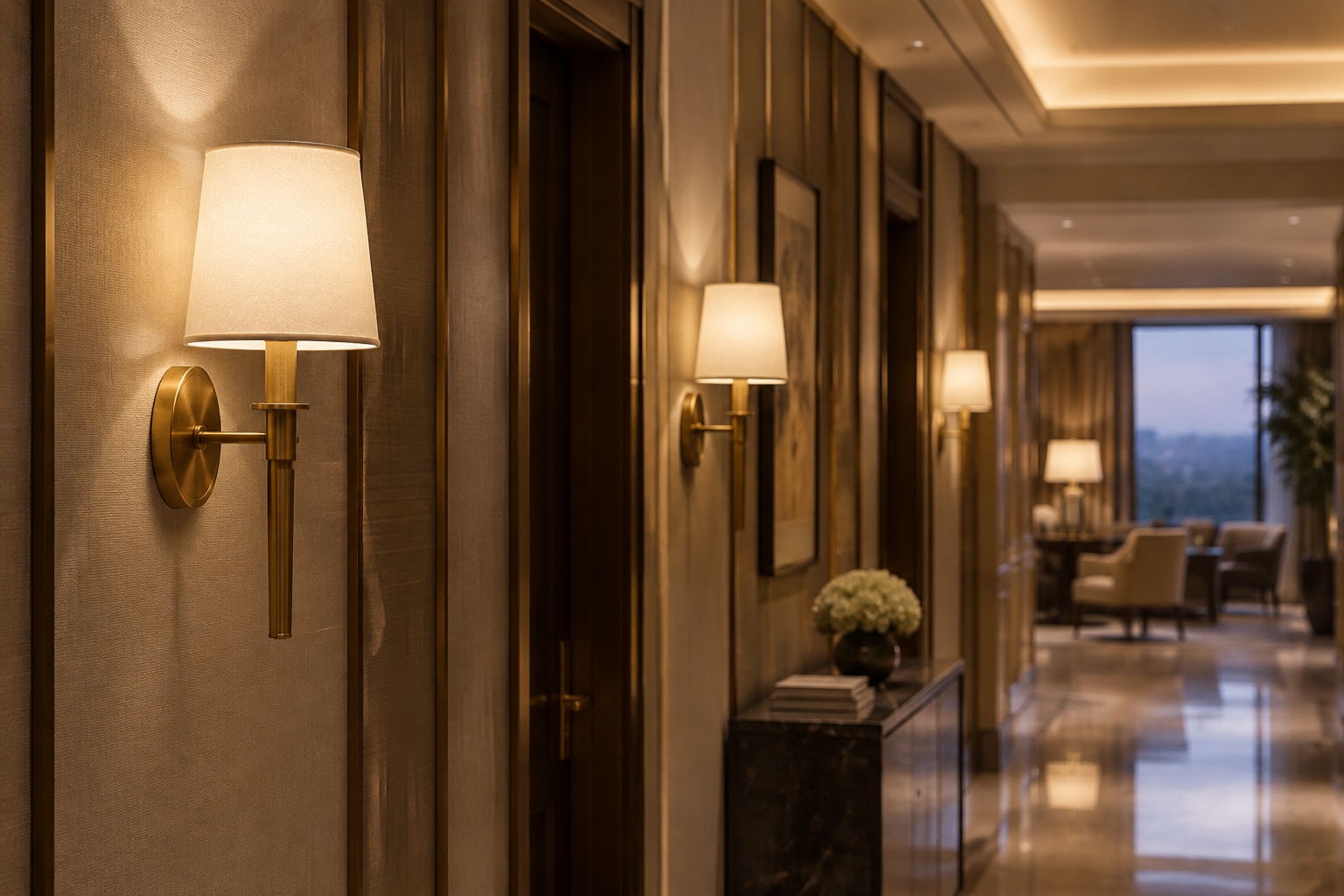 Hotel Brass Wall Sconces: Plating, PVD or Aged Finishes?: When does PVD justify its premium on hotel wall lights?
Controls and Commissioning: Preventing Flicker and Finish Damage During Handover
Commission the selected driver and control interface with the complete sconce before approving room-wide procurement.
DALI-2 can support addressable control when compatible equipment is selected. Casambi provides a wireless control route subject to network and integration design.
KNX generally requires an appropriate actuator, gateway, or compatible driver arrangement. With 0-10V, confirm wiring, dimming behavior, and how full switch-off is achieved.
A recommended specification for a premium bedside installation is stable dimming to 1% where the selected system supports it. Validate startup, fade transitions, low-end flicker, audible noise, and behavior after power restoration. Do not infer dimming quality from a protocol name.
Coordinate reading switches, decorative-light scenes, and guest access from bed. Locate drivers where replacement does not require damaging finished wall panels. During installation, protect brass surfaces from plaster dust, adhesive residue, and inappropriate solvents; remove protective films according to the finish supplier’s instructions.
Sampling, MOQ, Lead Time and Quality Control: Approving a Repeatable Production Finish
A useful approval package combines a finish reference, a functioning fixture, documented tests, and written production assumptions.
As a recommended sampling specification, request 2 physical finish references: one retained by the buyer and one retained for factory comparison. For aged finishes, add agreed boundary samples. A functioning first article should confirm weight, backplate alignment, shade fit, cable entry, driver access, and installed appearance.
MOQ and lead time are quotation-specific. They depend on tooling, metalwork complexity, coating-batch economics, component availability, testing, and packaging. Do not treat an early estimate as a production commitment before drawings, samples, and compliance responsibilities are approved.
Define finish acceptance before testing. ISO 2409 may be relevant to certain paint or lacquer adhesion assessments; its suitability depends on the coating system. ISO 9227 salt-spray testing can support comparative evaluation when appropriate, but exposure duration cannot be translated directly into hotel service life.
Include cleaner-compatibility testing with the actual housekeeping products and use conditions. Require batch traceability, agreed inspection sampling, and packaging that prevents metal-on-metal abrasion. Replacement parts should have a documented finish-matching process rather than an unsupported promise of perfect future color identity.
Photometric Files & Compliance: Verifying the Finished Luminaire for Each Destination
Photometric verification and electrical compliance must address the selected luminaire configuration, not an unrelated catalog model.
Request IES and LDT photometric files for the relevant LED, optic, shade, and output combination. Confirm whether data are measured or provisional.
In DIALux, assess reading coverage, wall illumination, reflected brightness, and interaction with other room luminaires. Calculations do not replace a physical glare review at the bed.
For EU supply, establish applicable legislation, technical documentation, the EU Declaration of Conformity, and CE marking responsibilities. RoHS concerns restricted substances; CE is not a generic third-party quality certificate. EN 60598 covers luminaire safety through the relevant general and particular requirements.
For US installations, confirm the required listing route with the authority having jurisdiction and procurement team. A recognized driver does not establish a listed complete luminaire. Across the Middle East and Southeast Asia, destination-country requirements, importer duties, mains characteristics, and project specifications must be checked individually.
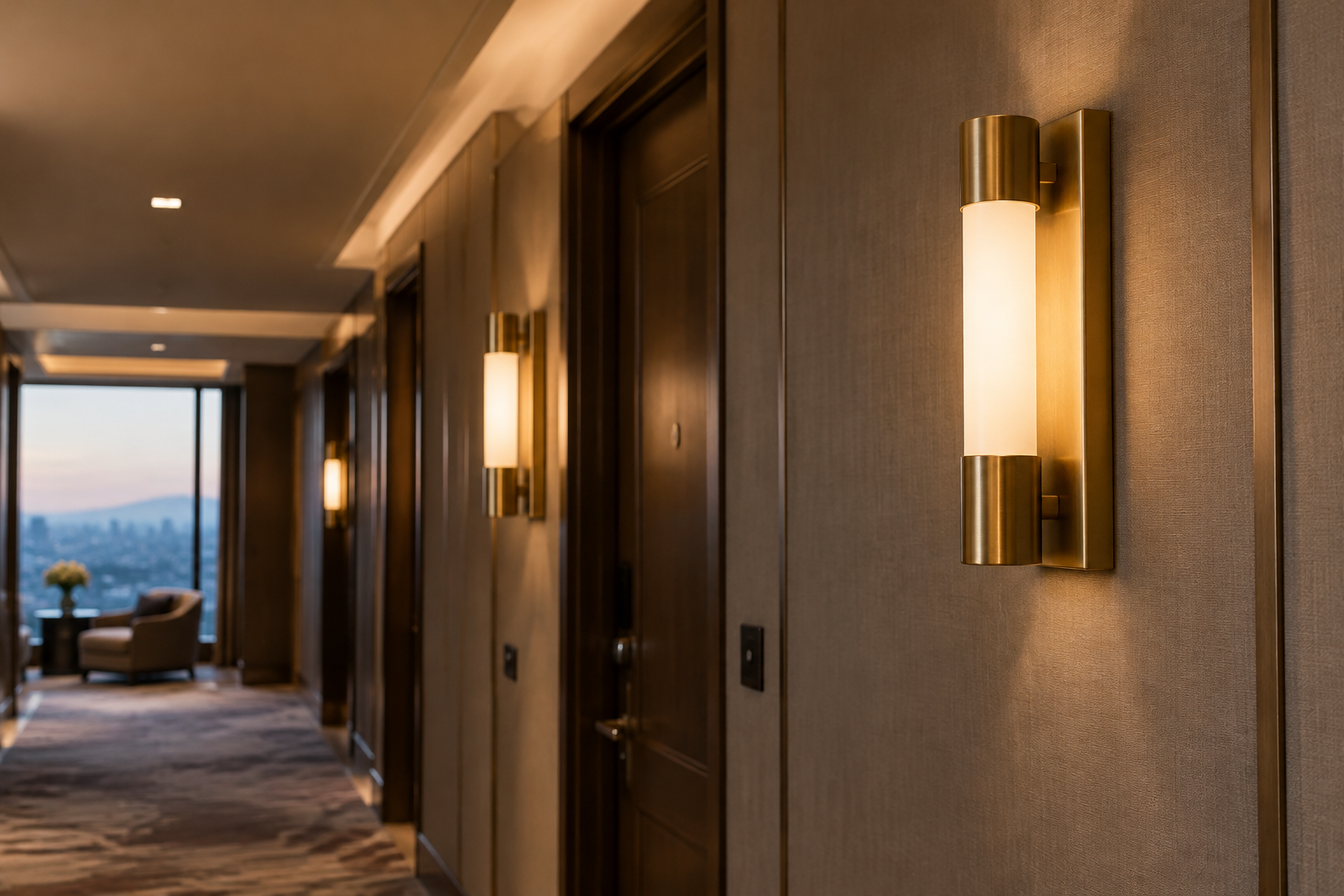 Hotel Brass Wall Sconces: Plating, PVD or Aged Finishes?: Photometric files & compliance: verifying the finished luminaire for each destination
Frequently Asked Questions
Q: Is PVD Always More Durable Than Electroplated Brass on Hotel Sconces?
PVD is not automatically more durable than every plated finish. Its performance depends on the substrate, surface preparation, deposited coating, and any protective top layer. As a recommended comparison specification, evaluate 2 finished samples under the same cleaning and handling protocol. Compare adhesion, visible marking, edge coverage, and repair options rather than accepting a process label as proof.
Q: What Light Color Works Best with Aged Brass Hotel Wall Lights?
Warm white is a useful starting point for aged brass, but approval should consider the entire room palette. Recommended specifications are 2700–3000 K and CRI ≥90 for a warm, color-conscious guestroom scheme. Review the actual finish with bedding, timber, stone, and adjacent lighting because nominal CCT alone does not determine perceived brass color.
Q: Can Brass Wall Sconces Be Specified for Hotel Bathrooms?
Brass wall sconces can suit hotel bathrooms when the complete fitting meets the installation location’s electrical and environmental requirements. IP44 may be a recommended specification for some assessed locations, but it is not a universal bathroom rule. Confirm local zoning, splash exposure, ventilation, coating suitability, and cleaning restrictions. An IP rating does not establish corrosion resistance.
Q: How Should Housekeeping Clean Plated, PVD or Aged Brass Sconces?
Housekeeping should follow the approved finish-specific cleaning instructions rather than use a general metal-polishing routine. As a recommended procedure, trial each proposed cleaner on 1 retained finish sample before use in guestrooms. Avoid abrasives and unapproved acidic or alkaline chemicals. Unsealed brass may intentionally change appearance, while polishing a sealed patina can permanently damage the intended finish.
Sources and Technical References: Which Documents Support Specification Decisions?
Use current editions and destination-specific requirements, checking each document’s scope against the actual product and installation.
- EN 12464-1 — Light and lighting — Lighting of work places — Part 1: Indoor work places: consult the applicable edition through a national standards body; see CEN-CENELEC.
- EN 60598 — Luminaires: identify the applicable general and particular safety requirements through the relevant standards catalogue.
- IES: use applicable lighting guidance and photometric data conventions from the Illuminating Engineering Society.
- WELL v2: review the project-relevant Light requirements in the official WELL standard.
- DALI-2: check equipment certification and interoperability resources through the DALI Alliance.
- ISO 2409, ISO 9227, and ISO 9001: consult the ISO catalogue for coating-test scopes and quality-management requirements; none proves a specific sconce’s service life.
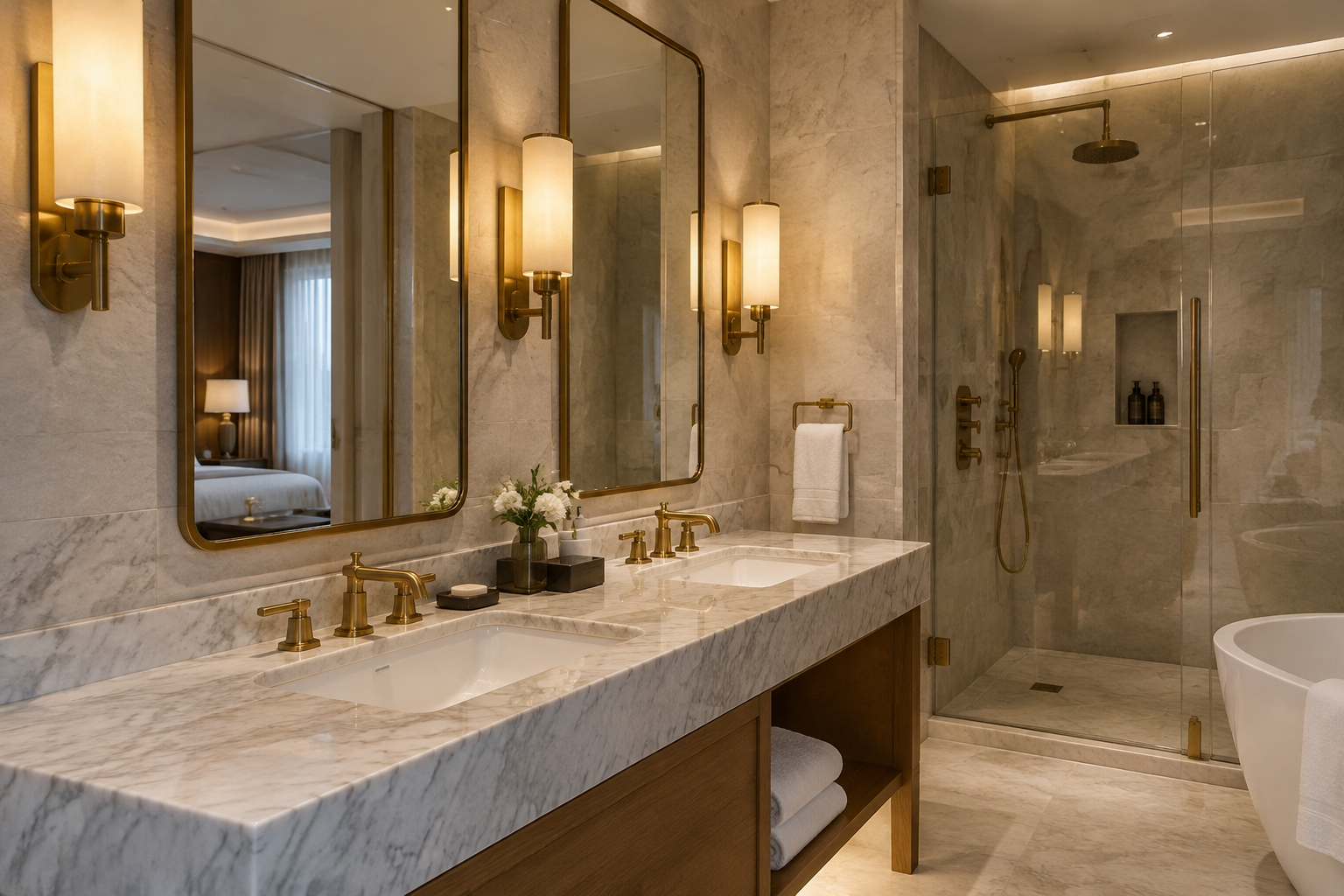 Hotel Brass Wall Sconces: Plating, PVD or Aged Finishes?: Q: Can brass wall sconces be specified for hotel bathrooms?
Request a Custom Quote: What Should the Hotel Purchasing Team Submit?
A quote-ready brief connects the desired brass appearance with installation conditions, lighting performance, quantities, and required compliance evidence.
Send interior drawings, mounting details, room quantities, finish references, preferred substrate, control protocol, destination country, and housekeeping products. State whether aged brass should remain visually stable or develop patina. Request separate confirmation of sampling costs, tooling, MOQ, lead time, testing, spares, and finish acceptance criteria.
your project brief should anchor the custom quotation. Ask for the proposed substrate-and-finish system, component schedule, photometric evidence, and market-specific documentation before approval. This makes plating, PVD, and aged brass comparable as engineered specifications rather than color names.
Need a tailored lighting plan for your project?
Our senior lighting designers reply within 48 hours with a free design proposal & quotation.