
Custom Hotel Bedside Wall Lights 2026: How to Reach 300–500 Lux?
Quick answer
Specify custom hotel bedside wall lights for a 300–500 lux reading target, with practical guidance on glare, USB charging, controls and compliance.
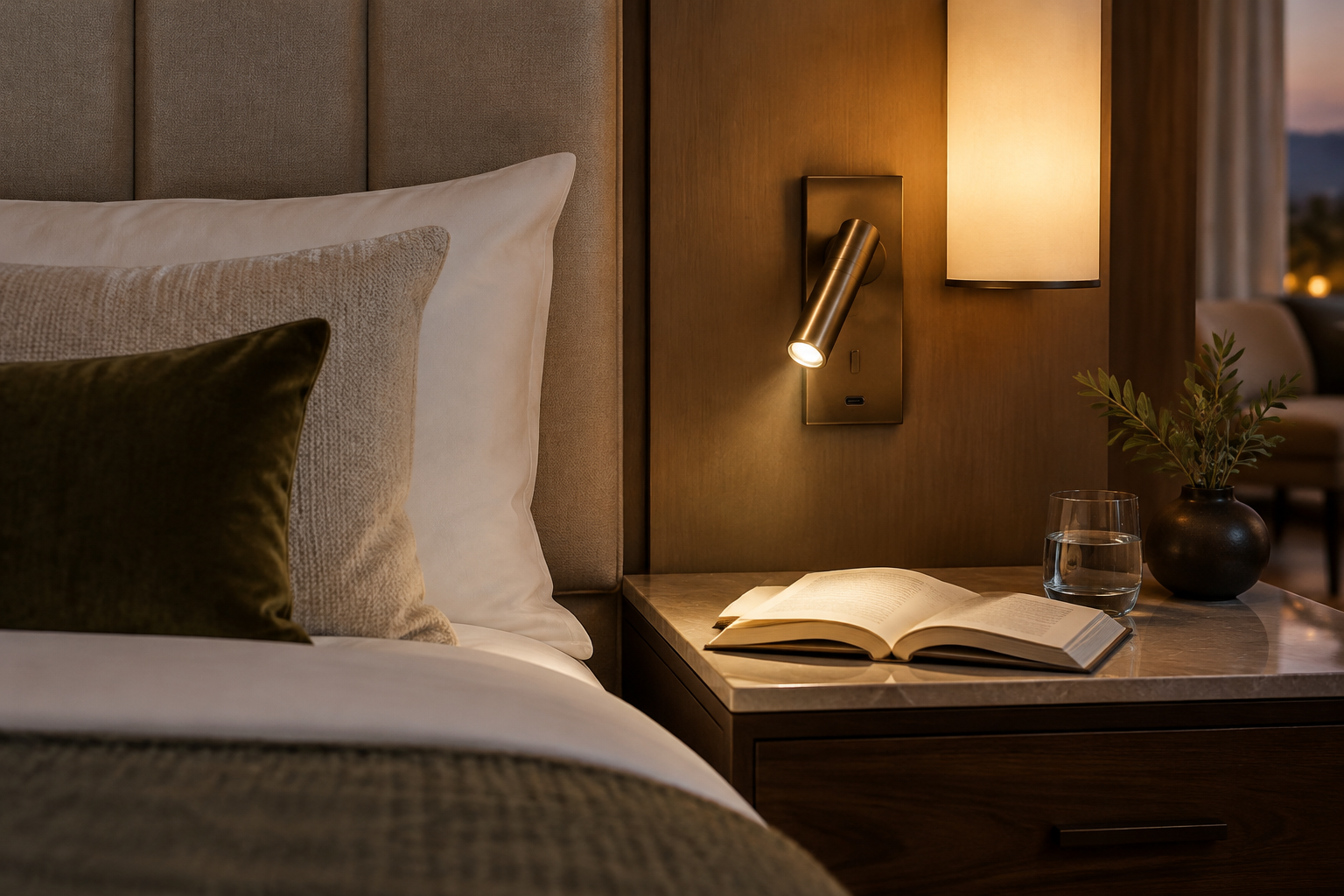
Introduction: How Should Bedside Wall Lights Reach 300–500 Lux?
At XHLWX (led-project-light.com), a Custom Indoor LED Lighting Manufacturer based in China, ... specify a 300–500 lux design target on the reading page. For 2026 hotel guestrooms, combine a shielded, adjustable reading light with independently controlled ambient lighting, then verify illuminance, glare and USB charging performance in a representative bedside mock-up.
This is a recommended specification, not a universal legal requirement for hotel bedsides. Successful lighting lets guests read without seeing an exposed LED, disturbing a sleeping partner or searching behind the headboard for controls. The correct fixture therefore depends on the bed, pillow position, book angle and headboard construction—not just its catalogue wattage.
For owners, designers and FF&E buyers across the EU, US, Middle East and Southeast Asia, the procurement priority is a coordinated bedside assembly. Treat the sconce, reading head, driver, switches, charging module and mounting interface as one engineered package.
Design Criteria and Standards: What Should Buyers Specify?
Specify maintained illuminance on the reading task, with separate acceptance criteria for visual comfort, electrical safety and charging performance.
A 300–500 lux design target should apply to the intended reading area, not the mattress, floor or wall. Record the book-plane position and inclination so photometric calculations and mock-up measurements describe the same task. Agree whether acceptance concerns average illuminance, minimum illuminance or both; a bright central spot alone does not establish comfortable coverage.
EN 12464-1 addresses lighting of indoor workplaces. It can inform task-lighting reasoning, but it should not be presented as a blanket bedside illuminance requirement for private hotel guestrooms. WELL v2 provides a broader framework for lighting quality and occupant experience; project-specific requirements must be checked separately.
The following values are recommended specifications or design targets, not verified product performance or existing XHLWX certifications.
| Parameter | Spec | Standard | Notes |
|---|---|---|---|
| Reading illuminance | Design target: 300–500 lux on the agreed reading plane | EN 12464-1 as a contextual reference | Define measurement area, inclination and maintenance assumptions |
| CCT | Recommended specification: 2700–3000 K | WELL v2 project criteria, where applicable | Coordinate with guestroom ambient lighting and finishes |
| Colour rendering | Recommended specification: CRI Ra ≥90; R9 ≥50 | IES technical guidance; project criteria | Request supporting spectral or test information |
| Glare / UGR | Design target: concealed source from agreed reclining sightlines | EN 12464-1 for contextual glare guidance | UGR is installation-dependent; no universal bedside UGR claim |
| Beam distribution | Recommended starting specification: 20–40° beam | IES photometric data conventions | Adjust to actual distance and reading-area size |
| Control interface | Recommended specification: select DALI-2, Casambi, KNX integration or 0–10 V | DALI Alliance requirements where applicable | These are alternatives, not automatically interchangeable interfaces |
| Housing / material / IP | Recommended specification: aluminium thermal body, optional brass trim, IP20 for suitable dry interiors | EN 60598; IEC 60529 | Confirm location suitability, anchorage and surface temperatures |
| LED / driver brands | Recommended specification: documented Osram, Bridgelux or Samsung LEDs; suitable Tridonic or Mean Well driver | Component documentation; EN 60598 assembly evaluation | Brand names are sourcing options, not proof of suitability or availability |
| USB charging | Recommended specification: USB-C PD, 30 W available per active port | Applicable electrical safety and USB-IF requirements | Verify supported profiles, shared-power behaviour and thermal loading |
| Certification / declarations | Confirm required CE documentation, RoHS evidence, UL listing where specified, SAA approval where relevant, and ISO9001 evidence if requested | Applicable destination requirements | These are different compliance categories; none is claimed here |
Choose wattage only after evaluating optical efficiency, output and mounting geometry. More power can increase heat and glare without improving usable reading coverage.
Customisation Options and Materials: Which Bedside Format Suits the Room?
The best bedside format separates comfortable reading from decorative ambience while matching the headboard construction and maintenance strategy.
| Configuration | Reading performance | Installation and maintenance | Verdict |
|---|---|---|---|
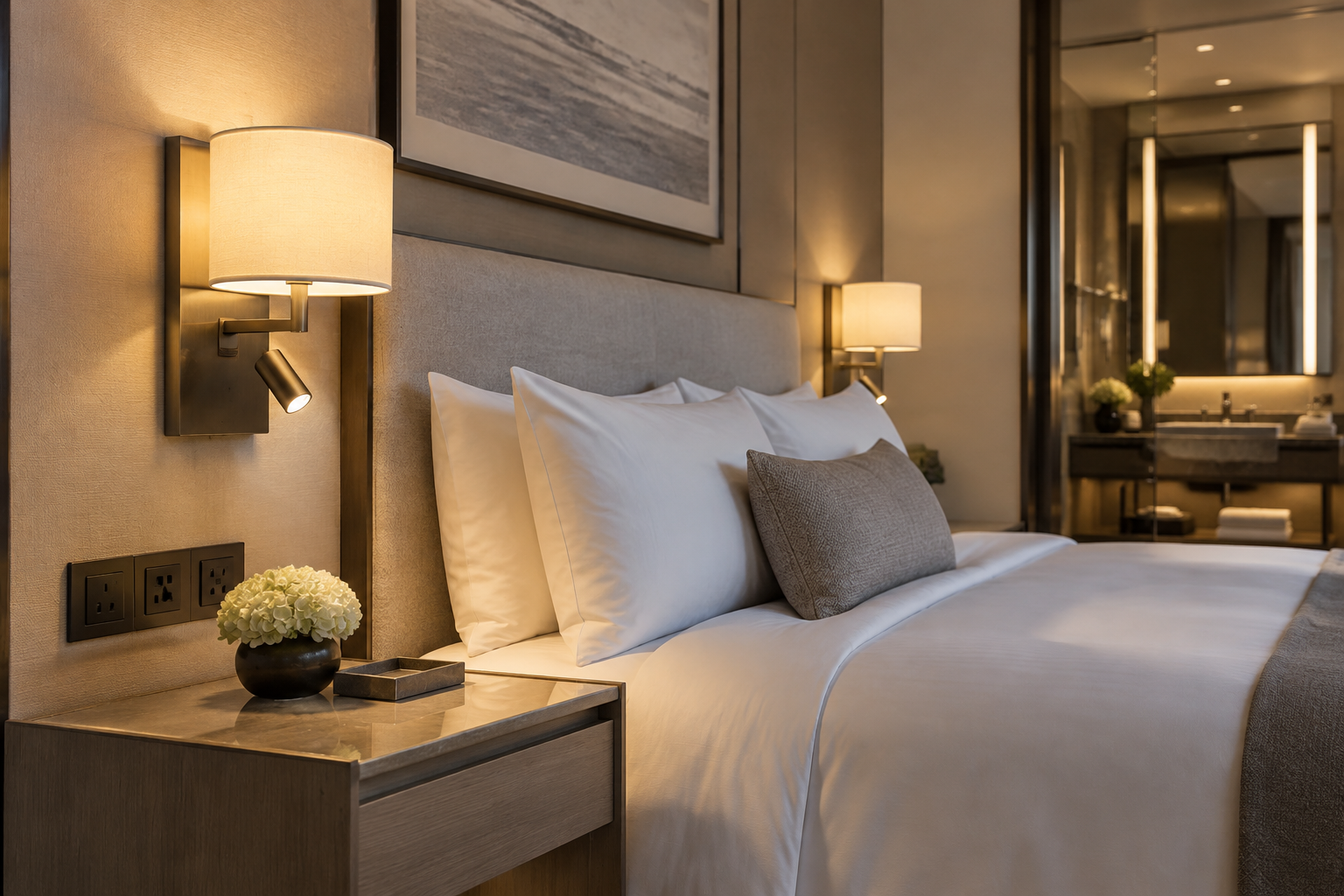
| Adjustable shielded reading head | Directs light towards different book positions | Requires durable joints and accessible wiring | Best starting option for flexible reading |
| Decorative shade with separate reading head | Provides ambient light and directional task light independently | More components and switching connections | Strong choice for full-service guestrooms |
| Fixed recessed headboard light | Can control spill when geometry is established | Requires coordinated cut-outs and rear access | Choose after a representative mock-up |
| Diffuse decorative sconce alone | Creates ambience but may spill onto pillows | Visually simple, with performance dependent on placement | Do not assume it meets the reading target |
| Sconce with replaceable USB module | Combines lighting and convenient charging | Needs module access and thermal separation | Useful when charging can be serviced independently |
How Should Mounting Position and Beam Angle Follow the Bed Layout?
Determine the mounting position from guest posture and reading geometry, rather than copying a generic height above the floor.
Request the finished mattress height, headboard thickness, pillow position and expected reading posture. Mark the reading plane and check both sides of the bed independently. A fixture that works with an upright headboard may expose its LED when installed beside a deeply reclined pillow position.
A 20–40° beam is a recommended starting specification, not a guaranteed solution. Check coverage at realistic aim angles: a narrow spot can produce an uncomfortable hotspot, while a wide beam can illuminate the neighbouring pillow. Include adjustment limits so guests cannot easily aim the source into another occupant’s eyes.
Which Materials and Finishes Survive Guestroom Cleaning?
Use structural and thermal materials for engineering performance, then select decorative finishes against the hotel’s actual cleaning procedure.
Aluminium can provide a practical thermal path; brass or stainless-steel elements can provide the desired appearance and tactile quality. Painted, plated and PVD finishes require different preparation and inspection methods. No finish should be described as scratch-proof or chemically resistant without relevant evidence.
Approve physical samples under the intended room lighting. Check colour consistency, fingerprints, cleaning compatibility, sharp edges and visible fasteners. Mechanical arms should retain their position without excessive adjustment force, and decorative sleeves should not obstruct heat dissipation.
How Should Integrated USB Charging Avoid Premature Obsolescence?
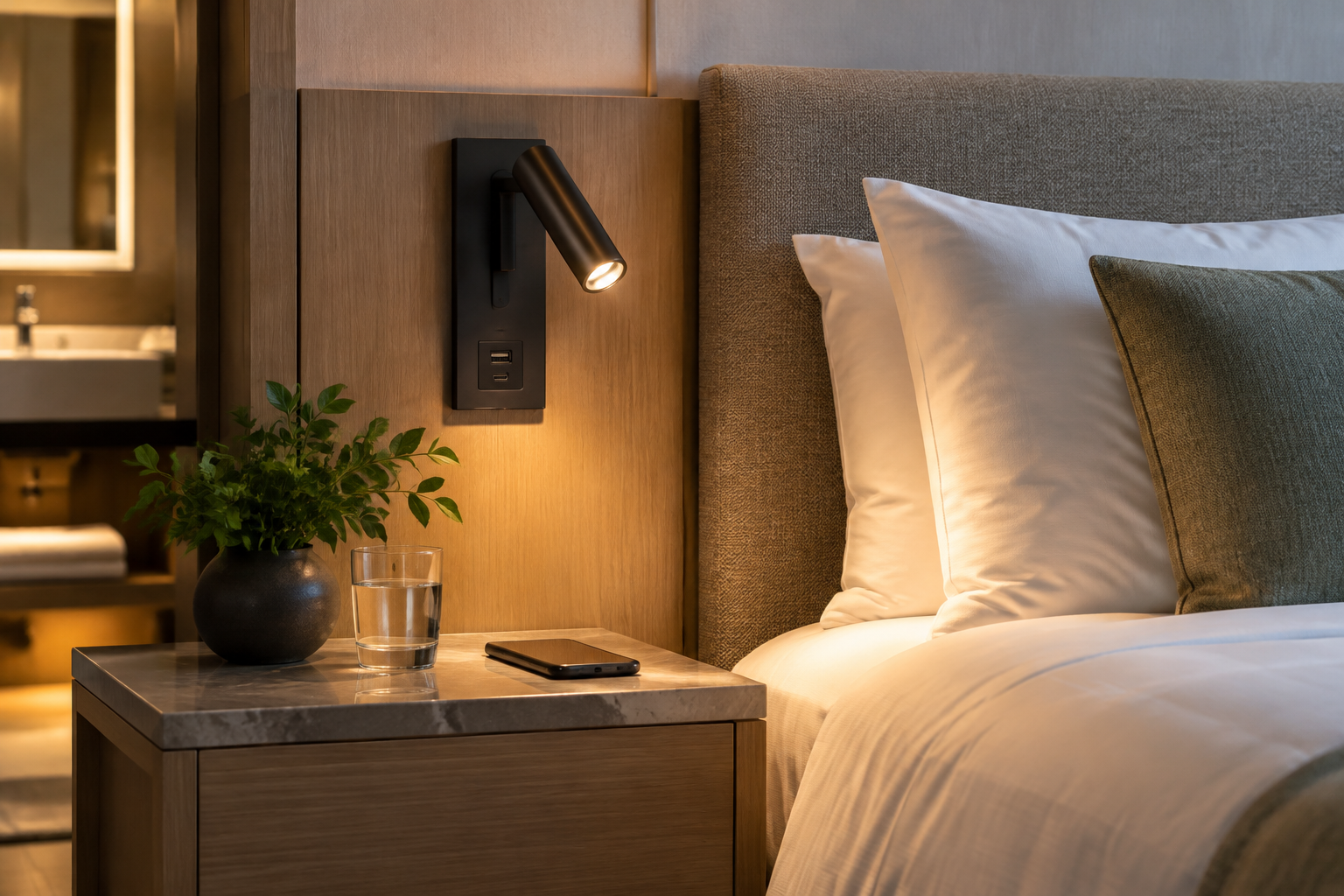
Specify a replaceable charging module with documented power delivery, rather than permanently embedding an unspecified USB socket inside the sconce.
USB-C describes the connector, not the available charging performance. A 30 W per-port output is a recommended specification for evaluation; supported voltage profiles, cable requirements and simultaneous-use limits must also be stated. A shared supply may reduce output when neighbouring ports are occupied.
Keep charging available when the reading light is switched off unless the hotel’s energy strategy explicitly requires otherwise. Coordinate isolation, earthing or double insulation, strain relief and module access. Test charging and lighting together because combined heat can affect driver life, dimming stability and touch temperatures.
 Custom Hotel Bedside Wall Lights 2026: How to Reach 300–500 Lux?: Which materials and finishes survive guestroom cleaning?
Controls and Commissioning: How Should Guests Operate Reading and Charging?
Provide an obvious local reading control, and integrate room automation only where it improves rather than complicates guest operation.
A decorative bedside sconce and its reading head should be independently operable. Guests should not need to activate room-wide ambient lighting to read. Clearly distinguish the reading control from the master-off button and charging outlet.
DALI-2 can support addressable control when the driver, input devices and room architecture are compatible. Casambi can support wireless control, subject to commissioning, access ownership and system support.
KNX commonly requires an appropriate actuator, driver interface or gateway. A 0–10 V installation needs coordinated wiring, dimming behaviour and switching arrangements.
Check the actual driver-and-dimmer combination at low output. Look for flicker, audible noise, delayed starts and abrupt extinction. Catalogue labels such as “dimmable” do not establish compatibility.
Commission normal operation, master-off, power restoration and any housekeeping scene. Confirm that controls remain understandable without an app, that charging follows the approved sequence and that staff receive the configuration backup and replacement instructions.
Sampling, MOQ, Lead Time and Quality Control: What Must Buyers Approve?
Approve a working bedside sample before freezing production, because drawings alone cannot establish glare comfort, adjustment quality or simultaneous charging performance.
MOQ and lead time should be quoted against the actual design. Tooling, finish development, charging-module selection, driver availability and destination testing can materially change both. Do not treat a generic delivery estimate as a committed schedule.
Use a documented approval sequence:
- Engineering review: confirm dimensions, mounting loads, wiring access, supply requirements, controls and service clearances.
- Finish sample: approve material, colour, texture and cleaning compatibility.
- Working mock-up: assess reading coverage, source visibility, adjustment, switching and charging at the intended headboard.
- Pre-production approval: freeze the bill of materials, drawings, labels, packaging and acceptance checklist.
Quality control should cover electrical safety checks appropriate to the product construction, wiring security, mechanical function, finish consistency and functional operation. Agree sampling rules and defect classifications before ordering rather than substituting vague promises of “strict inspection.”
Request traceability for LEDs, drivers and charging modules. Define spare-part availability and replacement access, especially where the driver is concealed behind upholstered joinery. An inexpensive module becomes costly if replacing it requires dismantling the headboard.
Photometric Files & Compliance: What Evidence Should Accompany Approval?
Require photometric data for the proposed optical configuration and compliance evidence that matches the final luminaire, not merely its components.
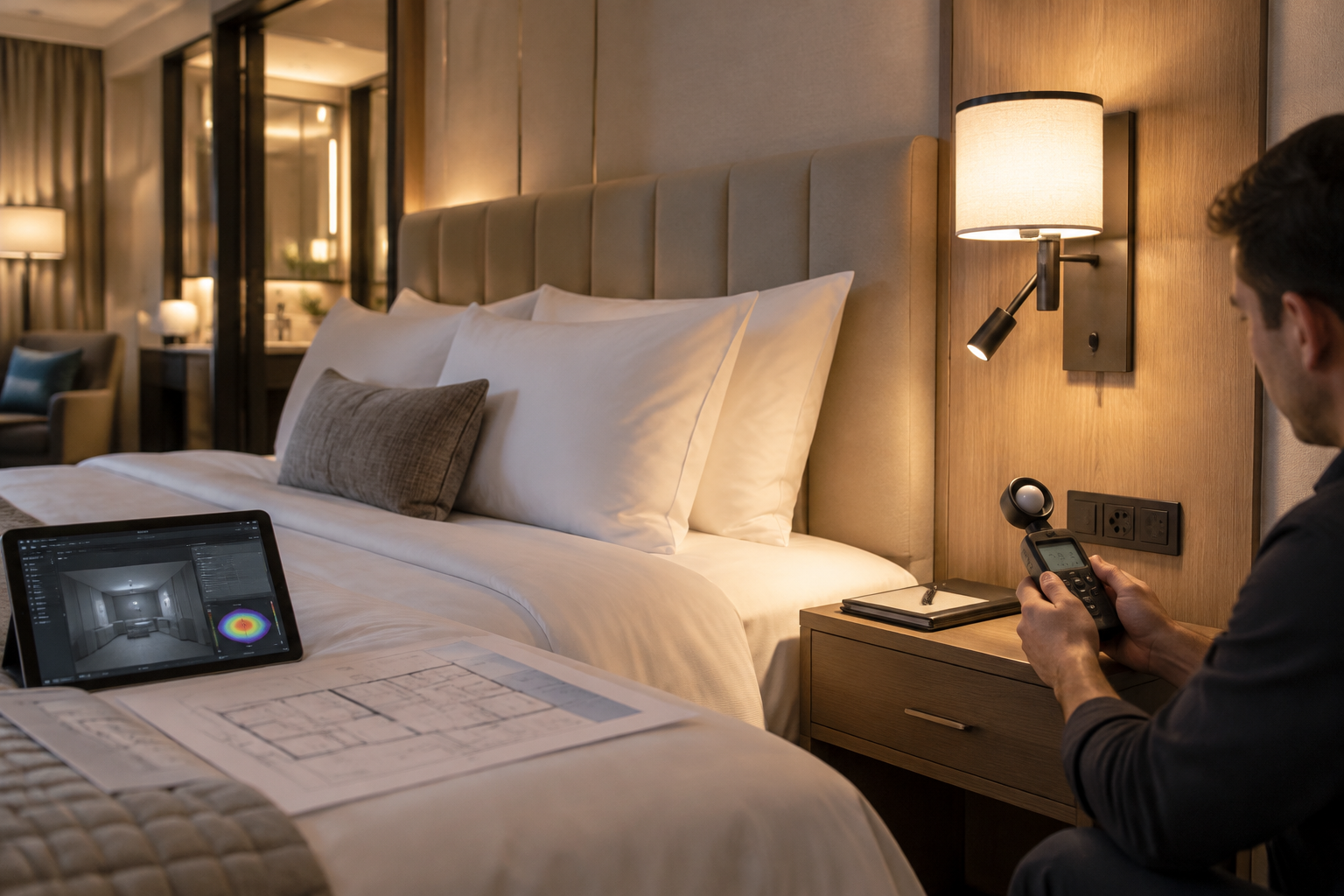
Request IES and LDT photometric files for the relevant LED, optic, shield and output configuration. Use them in DIALux with actual mounting coordinates, reading-plane geometry and representative room reflectances. Record any scaling, maintenance factor or assumed aiming position.
Small reading heads used at close distances deserve particular care: conventional far-field photometric calculations may not fully predict near-field page illumination. Confirm critical results with the working mock-up and a suitable lux meter. Photometric output alone also cannot prove comfort; inspect exposed-source visibility from realistic reclining positions.
Use EN 60598 as the luminaire-safety reference family and identify the applicable product-specific requirements with the test laboratory. For EU supply, establish the applicable legislation and supporting declaration documentation, including relevant RoHS evidence. CE is not a universal third-party quality certificate.
For US projects, confirm electrical ratings, installation requirements and any required UL listing or other accepted certification with the project authority. Middle Eastern and Southeast Asian approvals vary by country; neither region should be treated as one compliance market.
SAA approval is not a substitute for those checks. ISO9001 concerns an organisation’s quality-management system, not individual luminaire safety.
 Custom Hotel Bedside Wall Lights 2026: How to Reach 300–500 Lux?: Photometric files & compliance: what evidence should accompany approval?
Frequently Asked Questions
These answers distinguish recommended bedside design targets from performance and compliance that must be verified for the actual product.
Q: Is 300–500 Lux Mandatory for Every Hotel Bedside Reading Light?
No. A 300–500 lux reading-plane level is a design target in this guide, not a universal hotel regulation. Applicable requirements depend on the destination, project brief and any certification scheme. Define the task area and reading position, then check the proposed luminaire using calculation and a representative mock-up rather than equating a catalogue wattage with compliance.
Q: Can a Decorative Bedside Wall Sconce Provide Enough Reading Light?
It can, but a decorative shade alone may deliver uneven page illumination or excessive pillow spill. Test it against the 300–500 lux design target at the agreed reading position. Where ambience and reading conflict, use a separately controlled, shielded reading head so guests can illuminate the page without switching on the decorative light.
Q: What USB Specification Should a Custom Hotel Bedside Light Include?
Consider USB-C PD with a 30 W per-port recommended specification, while confirming the charging profiles your guest devices require. Ask whether output is shared, whether charging stays active after light-off and whether the module is replaceable. Verify lighting and charging under simultaneous operation; a connector label alone does not establish power delivery, safety or thermal performance.
Q: Should Bedside Reading Lights Use DALI-2 or a Local Switch?
A local control should remain the guest-facing priority; DALI-2 is useful when addressability or integration forms part of the room strategy. Set a 300–500 lux design target for the reading task regardless of control protocol. Select the interface around actual operational needs, and verify dimming, master-off behaviour and charging continuity in the approved sample.
Sources and Technical References: Which Documents Support Review?
Use primary standards and official technical resources, checking the current applicable editions and destination requirements before issuing the purchase specification.
- EN 12464-1 — Light and lighting — Lighting of work places — Part 1: Indoor work places. Consult an authorised national standards body for scope and applicability.
- EN 60598 — Luminaires. Confirm the applicable general and particular safety requirements through an authorised standards source and qualified laboratory.
- IES. Consult Illuminating Engineering Society standards and guidance for lighting practice and photometric data; IES is not a product safety certification.
- WELL v2. Review the official Light concept and the requirements selected for the project; no WELL compliance is asserted here.
- DALI Alliance. Check DALI-2 technical information and certification records for the proposed components.
- DIALux. Use the official calculation software resources with configuration-matched photometric data.
- USB-IF. Check official USB Power Delivery information and relevant programme requirements.
 Custom Hotel Bedside Wall Lights 2026: How to Reach 300–500 Lux?: Q: What USB specification should a custom hotel bedside light include?
Request a Custom Quote: What Should Your Bedside Brief Include?
A useful quotation brief defines the bedside geometry, visual intent, electrical architecture, compliance destination and evidence required for approval.
Send headboard drawings, mattress height, room quantities, finish references, reading-plane geometry, control requirements and USB expectations. Include the destination country, required documentation, spare-parts strategy and project programme. Request a proposed optical arrangement, component schedule, sample scope and itemised commercial assumptions.
At XHLWX (led-project-light.com), a Custom Indoor LED Lighting Manufacturer based in China, ... begin your enquiry with a 300–500 lux reading-plane design target. Ask for configuration-specific photometry, a representative bedside sample and destination-appropriate compliance documentation before approving production.
Need a tailored lighting plan for your project?
Our senior lighting designers reply within 48 hours with a free design proposal & quotation.