
Hotel Guestroom Lighting Control 2026: DALI-2, KNX or Casambi?
Quick answer
Compare DALI-2, KNX and Casambi for hotel guestrooms, with scene keypad guidance, driver specifications, commissioning checks and procurement requirements.
Introduction
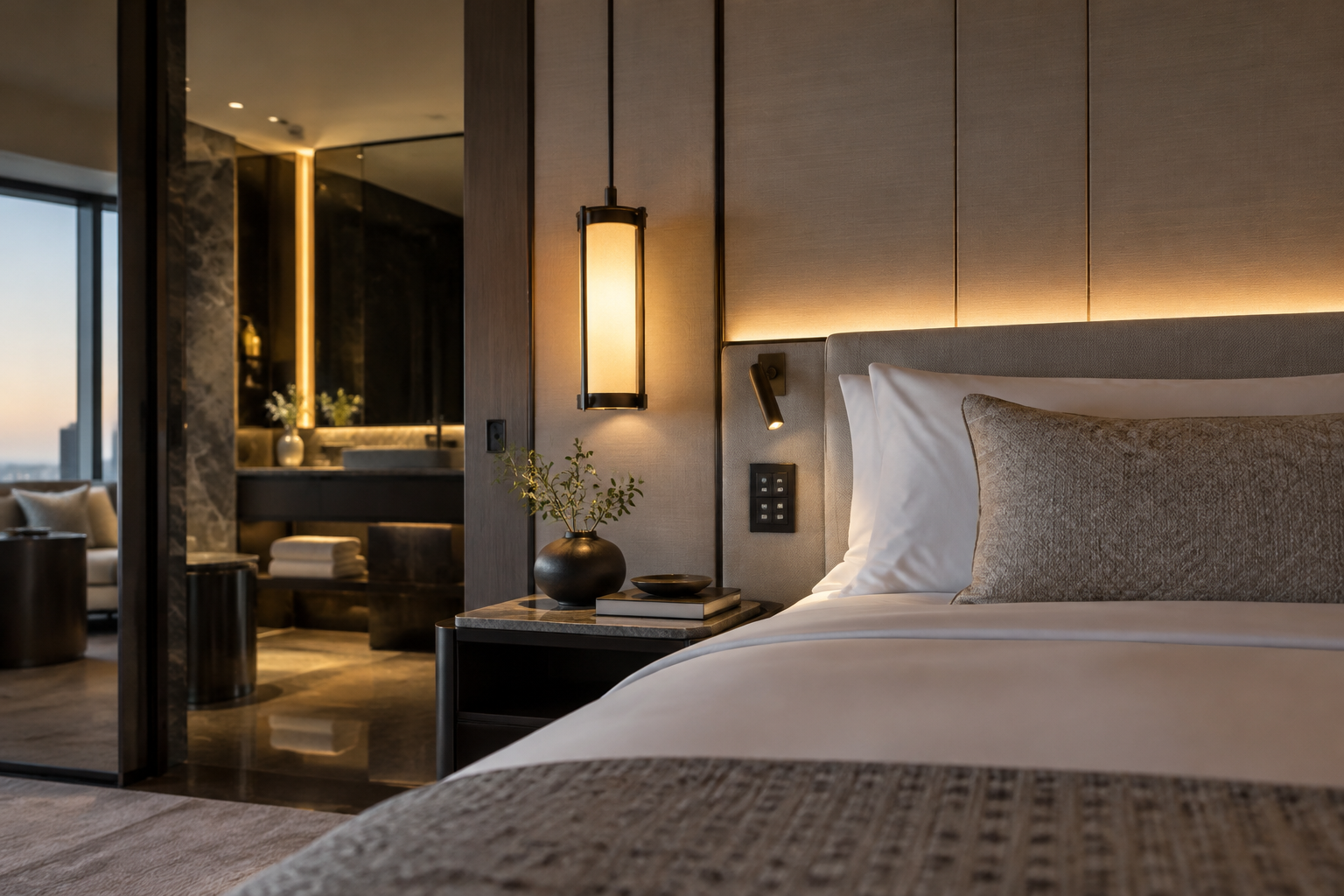
At XHLWX (led-project-light.com), a Custom Indoor LED Lighting Manufacturer based in China, ... our 2026 recommendation is DALI-2 for wired dimming, KNX for integrated room automation, or Casambi for retrofit flexibility. Specify 4 guest scenes and 1 bedside all-off command as design targets; select the system by integration, wiring access and maintenance capability.
These technologies are not always direct substitutes. DALI-2 addresses lighting control and device interoperability; KNX can coordinate lighting with other room services; Casambi provides a wireless lighting-control ecosystem. A KNX room controller can also command DALI lighting through a gateway.
For hotel owners, interior designers and FF&E buyers, the practical question is which architecture delivers intuitive bedside operation, dependable dimming and maintainable replacement parts. The decision must cover bespoke luminaires, drivers, keypads, gateways and handover documentation—not merely the protocol printed on a quotation.
Design Criteria and Standards
Select the control architecture around guest behaviour, verified driver compatibility and the hotel's maintenance model.
Start with a room-by-room load schedule. Separate entrance lighting, ambient coves, decorative pendants, bedside reading lights, bathroom lighting and any night-path circuit. Identify which loads need dimming, switching, tunable white or independent bedside operation.
The following values are recommended specifications or design targets, not measured XHLWX product performance or certification claims.
| Parameter | Spec | Standard | Notes |
|---|---|---|---|
| CCT | Recommended specification: 2700–3000 K for fixed-white guestroom lighting | Project colour schedule; WELL v2 where applicable | Approve the actual shade, diffuser and finish together |
| Colour rendering | Recommended specification: CRI Ra ≥90 | Project colour-quality specification | Review skin tones, timber and fabrics in a sample room |
| Glare | Design target: calculated UGR ≤19 for relevant desk-task layouts | EN 12464-1 where applicable | UGR depends on the installation; it is not a universal luminaire rating |
| Beam distribution | Recommended specification: 24–36° for selected reading or accent optics | IES photometric reporting conventions | Final selection depends on mounting position and target area |
| Control interface | Recommended specification: DALI-2 drivers, KNX integration, Casambi-compatible control or explicitly specified 0-10V | DALI-2 certification framework; KNX specifications; manufacturer interface documentation | These interfaces are not automatically interchangeable |
| Housing and materials | Recommended specification: aluminium or steel body; project-approved glass, fabric or diffuser | EN 60598 | Validate heat management, access and finish durability |
| Ingress protection | Recommended specification: IP20 in dry locations; IP44 only where location rules permit | EN 60598; IEC 60529; local electrical rules | Bathroom zones can require different protection and installation measures |
| LED and driver brands | Recommended specification: evaluate Osram, Bridgelux or Samsung LEDs; Tridonic or Mean Well drivers | Exact component datasheets and applicable certification records | Brand names alone do not establish dimming or system compatibility |
| Market compliance | Required procurement review: CE/RoHS for applicable EU supply; appropriate UL-listed product pathway for US projects | Applicable EU legislation; UL 1598 or UL 153 as relevant | SAA is relevant to Australian requirements, not a substitute for target-market approval |
| Factory management | Recommended procurement requirement: verify any claimed ISO9001 certificate and its scope | ISO 9001 | A management-system certificate does not certify a luminaire |
EN 12464-1 concerns indoor workplaces; it should not be presented as a universal bedroom illuminance schedule. Apply it to relevant work tasks alongside local requirements. WELL v2 is a voluntary building framework, not proof that a particular driver or lamp creates a healthy guestroom.
Customisation Options and Materials
Choose the system before freezing bespoke luminaire construction, because driver access, wiring and radio placement affect the design.
| Guestroom scenario | Preferred approach | Main limitation | Verdict |
|---|---|---|---|
| New-build room with accessible control wiring | DALI-2 lighting with suitable application controller | Requires addressing, programming and documented topology | Strong choice for maintainable wired lighting |
| Lighting coordinated with HVAC, blinds and room status | KNX room automation with a DALI gateway where appropriate | Integration and gateway behaviour need specialist commissioning | Strong choice for broader room automation |
| Refurbishment with restricted rewiring | Casambi-compatible lighting and physical keypads | Radio conditions, compatible hardware and ownership settings need validation | Strong retrofit candidate after a room mock-up |
| Simple dimming circuit with limited automation | Documented 0-10V control arrangement | Group wiring, off behaviour and dimming curves vary by equipment | Suitable when simplicity outweighs individual addressing |
| Mixed decorative and architectural loads | Coordinated architecture with tested interfaces | Each added interface increases troubleshooting responsibility | Use only with a clear integration owner |
How Should Bespoke Guestroom Luminaires Accommodate the Selected Driver?
Custom luminaires should provide a serviceable driver location without compromising thermal performance or appearance.
A decorative bedside pendant may need a remote driver because its canopy cannot safely accommodate the selected electronics. Confirm cable limits, accessible mounting positions and ventilation with the driver manufacturer. For wireless control, metal enclosures can reduce radio performance; assess the actual housing and antenna arrangement rather than an exposed module on a workbench.
Specify replacement access from the occupied room where feasible. Avoid designs that require removing fixed joinery simply to replace a control component.
Which Scene Keypad Layout Is Easiest for Hotel Guests to Understand?
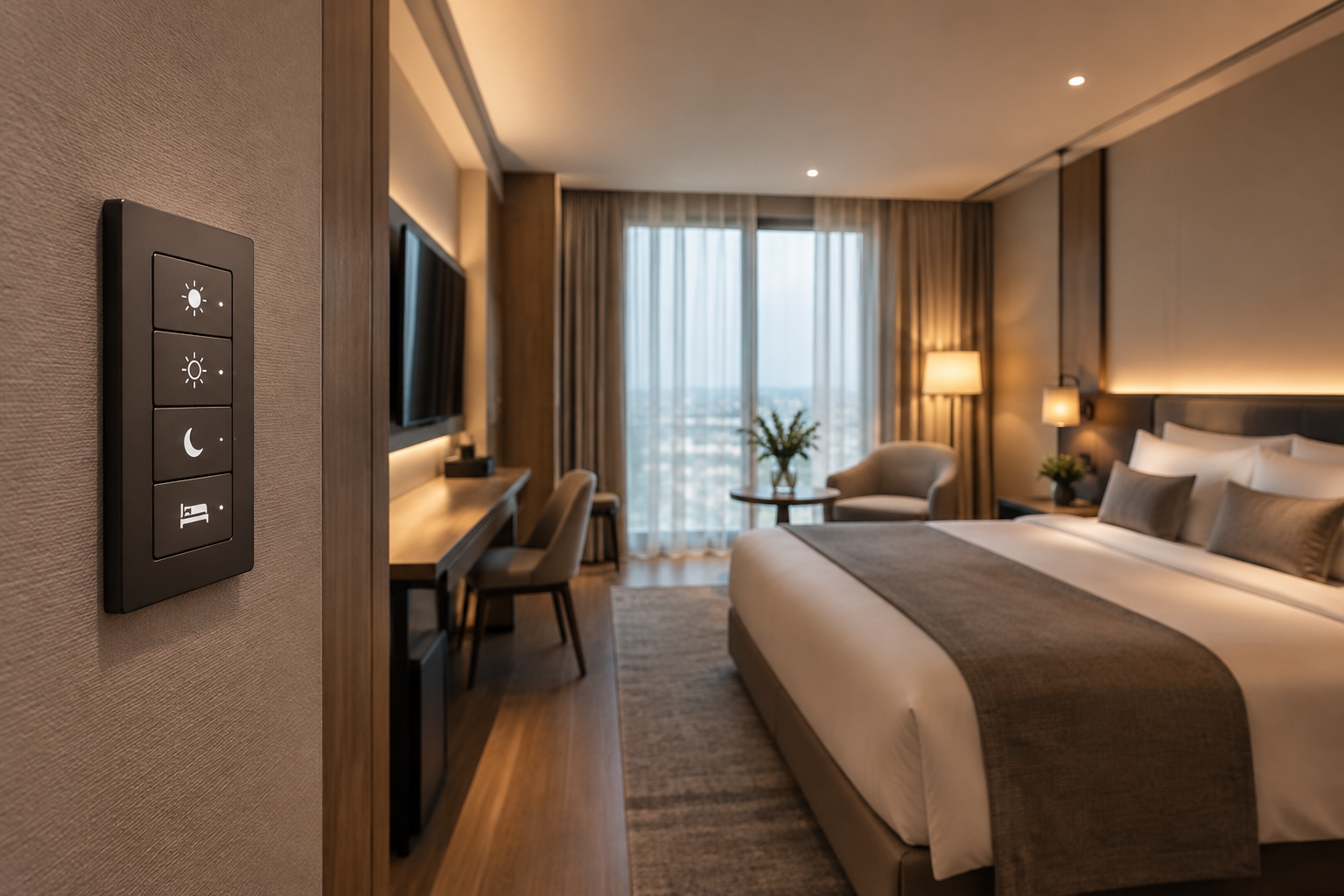
Physical keypads should make arrival, reading and sleep functions understandable without an app or verbal instructions.
A recommended specification is 4 named scenes: Welcome, Relax, Read and Sleep. This is a design target, not an industry requirement. Use plain-language labels or tested symbols, tactile feedback and restrained indicator brightness.
Provide independent reading-light control at each bedside. A bedside all-off command should address the agreed room-lighting scope without unintentionally switching convenience outlets, accessibility equipment or other essential services. Guest-facing controls should remain consistent across room types even when the underlying load schedule differs.
Which Materials and Finishes Create the Fewest Control-related Problems?
Materials should be approved for optical quality, electrical safety, cleanability and access to control components.
Fabric shades can change perceived warmth and output; opal diffusers can conceal LED images but reduce delivered light. Brushed metal finishes require agreed appearance limits and cleaning guidance.
Keep the approved LED, optic, driver and diffuser combination on the bill of materials. Substituting a visually similar diffuser or a nominally equivalent driver can alter brightness, low-end dimming or thermal conditions.
 Hotel Guestroom Lighting Control 2026: DALI-2, KNX or Casambi?: Which scene keypad layout is easiest for hotel guests to understand?
Controls and Commissioning
A guestroom control system is complete only when scenes, failure behaviour and manual operation have been tested together.
For DALI-2, specify the exact driver and control-device models and check relevant certification records. DALI-2 certification improves component interoperability, but it does not certify the finished guestroom experience. Tunable-white functions also require compatible device features and controller support.
For KNX, define the gateway mapping, group addresses and ownership of the engineering project. Confirm which party resolves faults spanning lighting, room automation and any property-management interface. Integration requires an agreed interface; it is not an automatic property of KNX.
For Casambi, validate mesh communication with completed partitions, closed doors, installed furniture and the intended luminaire housings. Physical controls and local scenes should be tested with internet access unavailable. Remote monitoring or integrations may require additional hardware and services.
Use this recommended commissioning sequence:
- Verify every load against the room schedule and keypad labels.
- Test minimum dimming, fade transitions, visible flicker, buzzing and off-state glow.
- Check Welcome, Read, Sleep and housekeeping operation from every relevant station.
- Simulate power restoration, controller loss and unavailable network services.
- Confirm occupancy timeouts do not leave a resting guest unexpectedly in darkness.
- Record addresses, firmware, backups, administrator permissions and replacement procedures.
A design target of 1–100% dimming should be accepted only after the complete LED-driver-control combination passes testing. Agree separate fade and minimum-level targets for each luminaire family.
Sampling, MOQ, Lead Time and Quality Control
Approve a representative room mock-up before releasing production quantities or fixing the installation programme.
A recommended procurement sequence is engineering review, functional sample, finish approval, room mock-up and production release. MOQ and lead time require a project-specific quotation because custom metalwork, special finishes, certified components and keypad engraving affect both.
The sample request should identify supply voltage, frequency, installation method, driver interface and the intended market. US, EU, Middle East and Southeast Asia projects cannot be treated as sharing a single approval regime.
Recommended quality records include incoming component verification, electrical safety testing appropriate to the product, functional dimming checks, finish inspection and carton identification. Define acceptance criteria before purchase rather than requesting an unspecified “hotel-grade” result.
Require written approval for substitutions. Keep an approved control sample and a traceable bill of materials so that later replacement orders can match the installed system.
Photometric Files & Compliance
Photometry supports lighting calculations, while safety documentation and controls testing address separate approval questions.
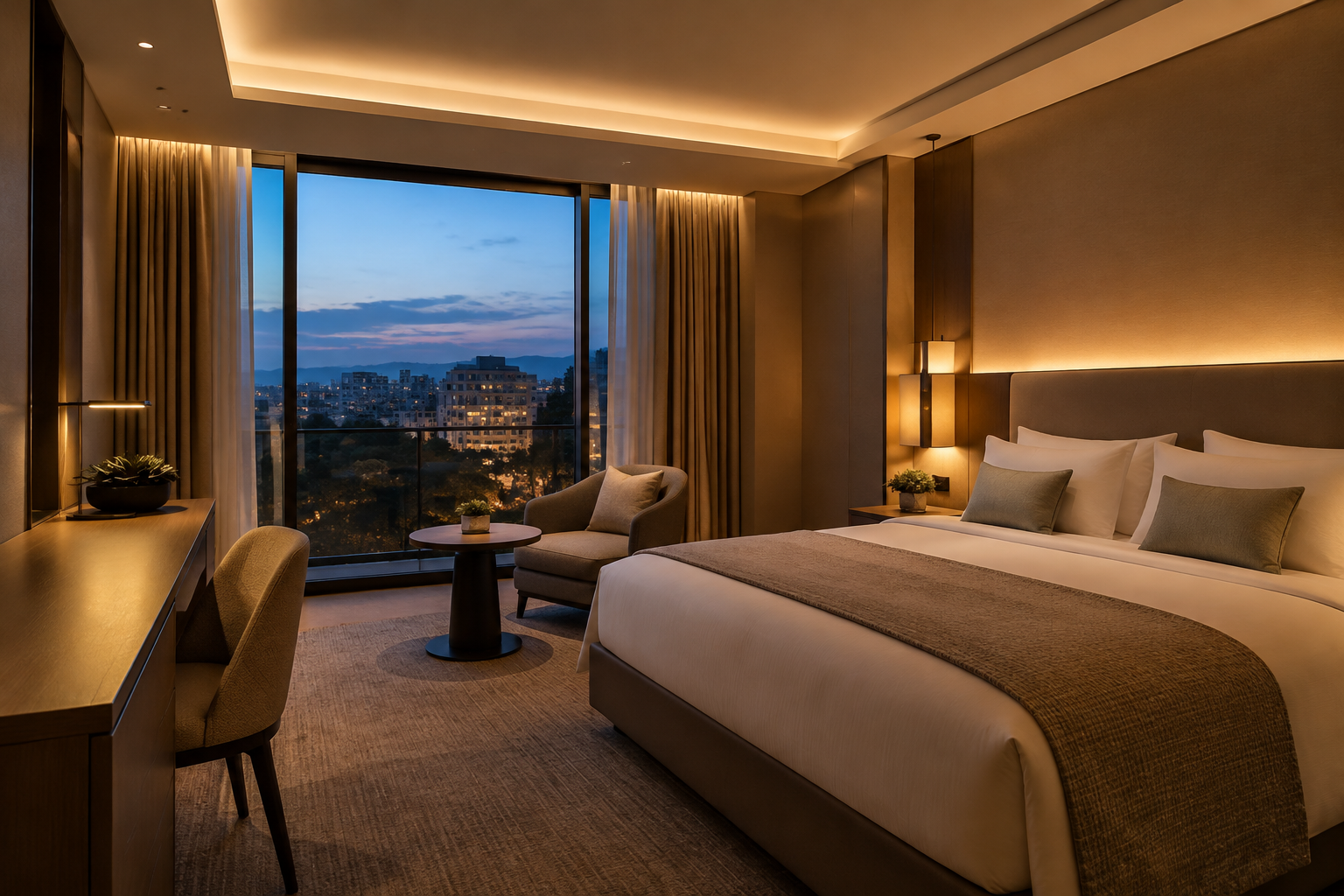
Request IES and LDT photometric files for the relevant luminaire configuration and use DIALux to assess illumination, distribution and glare. A file for a different optic, diffuser or output package should not be treated as exact evidence for a bespoke variant. Where representative data is used, identify the limitation and obtain appropriate validation.
DIALux does not prove gateway interoperability, dimming quality or reliable wireless coverage. Those require component verification and physical commissioning.
For EU procurement, request the applicable declaration of conformity and supporting technical documentation, including relevant EN 60598 assessments. CE marking is not a generic third-party quality certificate, and RoHS addresses restricted substances rather than all safety risks.
For US projects, establish the appropriate listing and acceptance route with the project team and authority having jurisdiction. For Middle East and Southeast Asia destinations, confirm country-specific registration, electrical and import requirements before production. Do not assume CE, UL or SAA evidence is universally interchangeable.
 Hotel Guestroom Lighting Control 2026: DALI-2, KNX or Casambi?: Photometric files & compliance
Frequently Asked Questions
Q: Is DALI-2 Better Than KNX for Hotel Guestroom Lighting?
DALI-2 and KNX serve different roles, so neither is universally better. DALI-2 is useful for addressable lighting, while KNX can coordinate broader room functions. A recommended specification is 1 clearly assigned integration owner when a KNX controller operates DALI drivers through a gateway. Verify scene mapping, fault handling and handover documentation before approving the architecture.
Q: Can Casambi Work Reliably Without Hotel Wi-Fi?
Casambi lighting control can operate locally without hotel Wi-Fi, but the supplied architecture determines which functions remain available. Use 1 completed guestroom as a recommended validation target, with doors closed and the internet disconnected. Test physical keypads, scene recall and power recovery. Confirm separately whether remote access, monitoring or third-party integration needs a gateway or internet service.
Q: How Many Lighting Scenes Should a Hotel Guestroom Have?
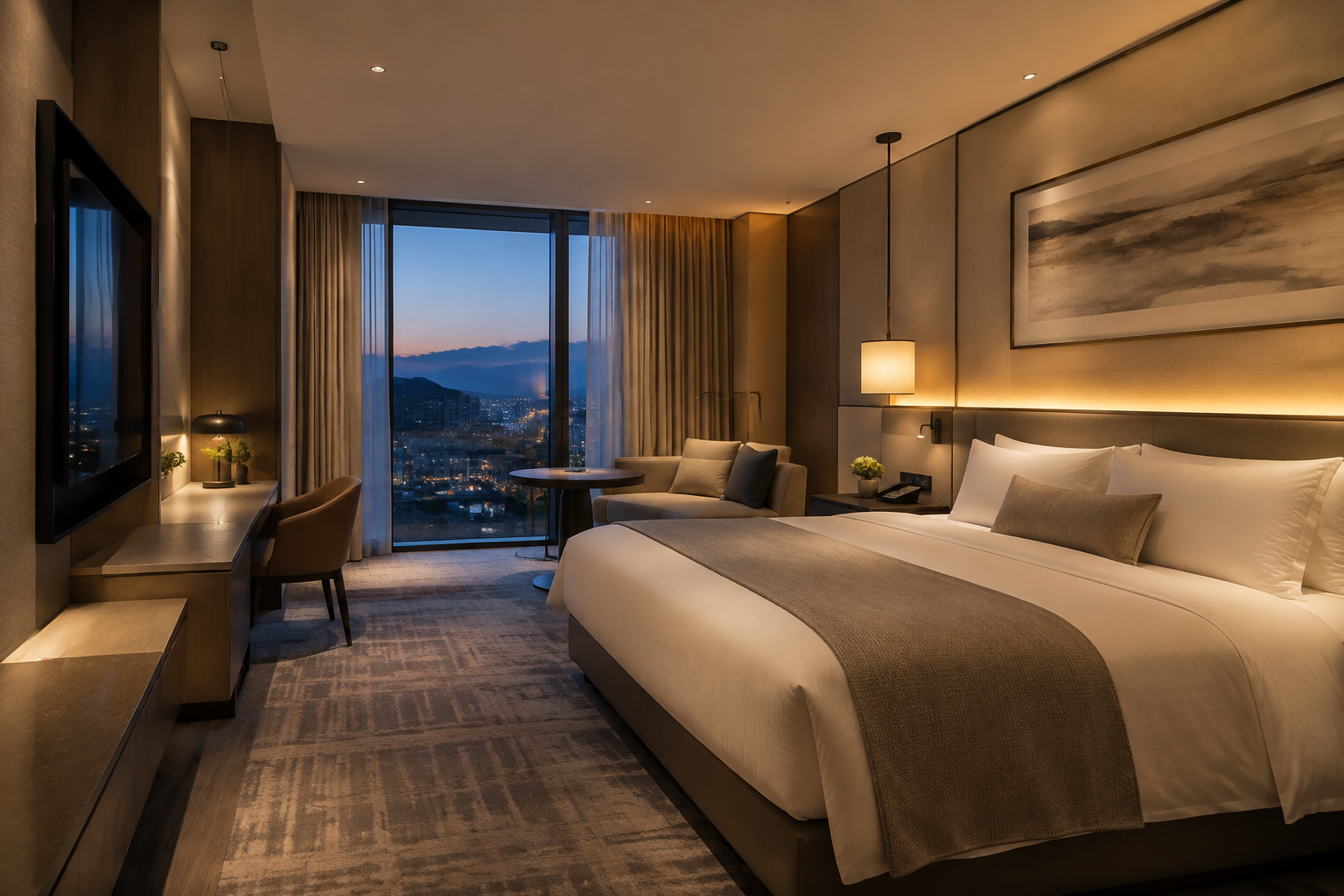
A recommended starting specification is 4 scenes: Welcome, Relax, Read and Sleep. These should complement independent bedside reading controls rather than replace them. More scenes are justified only when guests can understand them immediately. Test labels and indicator brightness in the mock-up, and give housekeeping any necessary service function without crowding the guest-facing keypad.
Q: What Should Buyers Request Before Ordering Custom Controlled Luminaires?
Buyers should request the exact driver model, control interface, component schedule, compliance pathway and representative photometric data. Add 1 working sample per electrically distinct luminaire family as a recommended procurement target. Confirm dimming behaviour with the intended controller, not a substitute test dimmer. The quotation should also define MOQ, lead time, approved substitutions, warranty responsibilities and programming handover.
Sources and Technical References
Use primary technical references and project-specific documentation rather than treating a protocol logo as evidence of complete system performance.
- DALI Alliance: DALI-2 explanations, certification information and the product database.
- KNX Association: system guidance, product certification and professional training resources.
- Casambi: ecosystem documentation and installation guidance for the proposed devices.
- BSI Knowledge: current national publications of EN 12464-1 and the applicable EN 60598 standards.
- Illuminating Engineering Society: IES lighting guidance and photometric technical references.
- WELL v2: current Light concept requirements and verification context.
- DIALux: lighting calculation software and workflow documentation.
Confirm applicable editions, national adoptions and contractual requirements with the project's electrical and compliance consultants.
 Hotel Guestroom Lighting Control 2026: DALI-2, KNX or Casambi?: Q: How many lighting scenes should a hotel guestroom have?
Request a Custom Quote
a useful custom quote starts with the guestroom plan and control intent. Send the reflected ceiling plan, luminaire schedule, scene keypad sketch, quantities, finishes, destination market and preferred architecture.
Request a proposed driver schedule, photometric documentation, sample plan and compliance evidence list. Use 1 representative room as a recommended mock-up target before approving repeat production, and ask the quotation to identify responsibility for programming, gateways, testing and handover.
Need a tailored lighting plan for your project?
Our senior lighting designers reply within 48 hours with a free design proposal & quotation.