
Indoor Pool Lighting 2026: IP65 & EN 12193 Guide
Quick answer
Master indoor swimming pool lighting design with our 2026 guide. Learn about EN 12193 standards, IP65/IP68 ratings, glare control, and anti-corrosion luminair
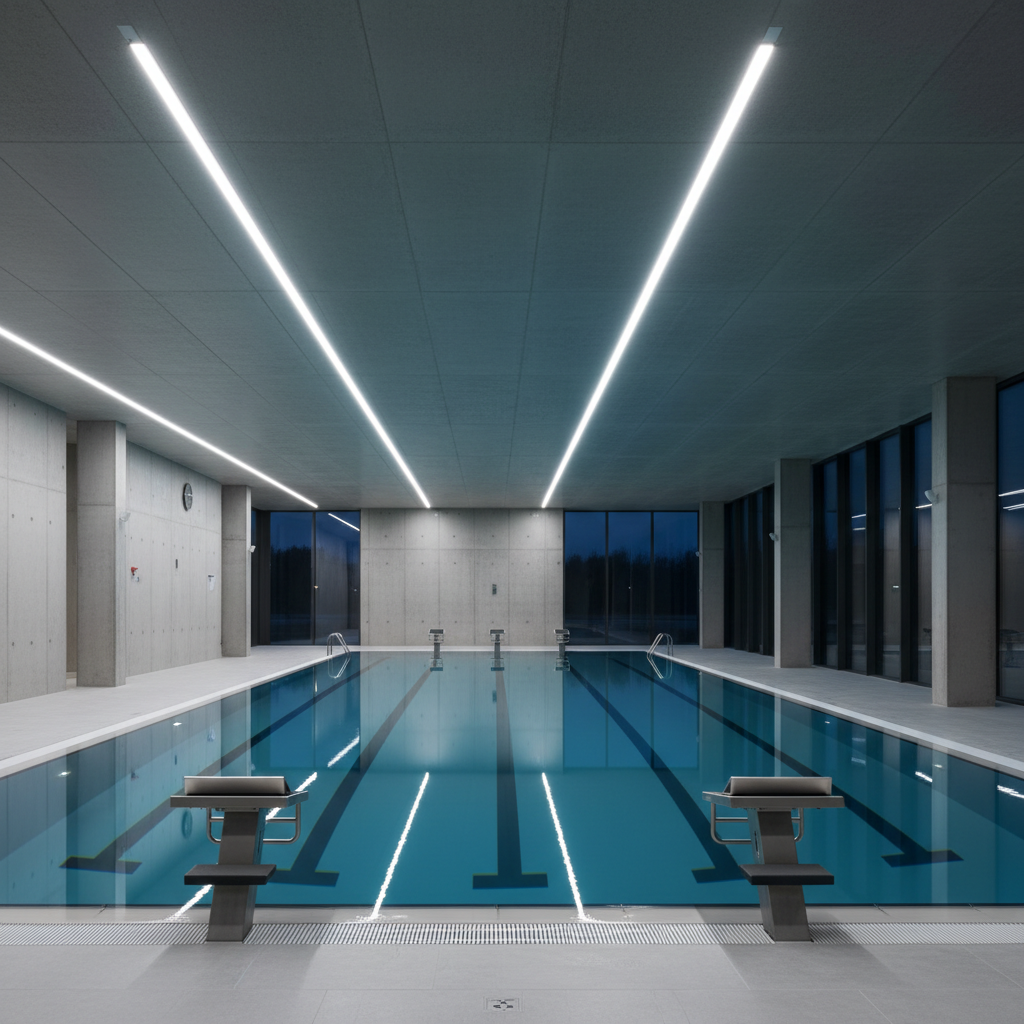
Introduction — the Design Problem in Natatoriums
com), a Custom Indoor LED Lighting Manufacturer based in China, we recognize that illuminating indoor swimming pools, or natatoriums, presents a uniquely hostile environment for electrical equipment. The design challenge extends far beyond simply providing light; it involves ensuring swimmer and staff safety through excellent visibility, managing debilitating glare off the water's surface, and specifying luminaires that can survive long-term exposure to a warm, humid, and chemically corrosive atmosphere laden with chloramines.
A successful lighting scheme delivers on performance, safety, and longevity, safeguarding both patrons and the facility's investment.
Lighting Criteria and Standards for This Application
Properly specifying pool lighting requires strict adherence to established international and regional standards for safety and performance. For sports and competition pools in Europe, EN 12193:2018 (Light and lighting - Sports lighting) is the primary governing document, superseding the more general EN 12464-1.
This standard defines lighting classes based on the level of competition, setting clear targets for horizontal illuminance (Ēm), uniformity (Uo), and, crucially, Glare Rating (GR). For general recreational pools, the principles of EN 12464-1 can apply, while North American projects often reference IES RP-6-15.
The WELL v2 standard also provides guidance, focusing on visual comfort and occupant well-being.
Achieving compliance demands careful selection of luminaires that meet stringent technical benchmarks. Below is a table outlining recommended specifications for a typical Class II (e.g., regional competition, training) natatorium project.
| Parameter | Recommended Specification | Standard Reference | Notes |
|---|---|---|---|
| Maintained Illuminance (Ēm) | 300 lx | EN 12193 (Class II) | Measured on the water surface. Class I requires 500 lx; Class III requires 200 lx. |
| Illuminance Uniformity (Uo) | ≥ 0.7 (min/avg) | EN 12193 (Class II) | Essential for lifeguards to clearly see all parts of the pool, including the bottom. |
| Glare Rating (GR) | < 22 | EN 12193 | Calculated for typical observer positions (e.g., lifeguard chair, starting blocks). |
| CCT / CRI / TM-30 | 4000K / Ra > 80 / Rf≥80, Rg≥95 | EN 12464-1 | Neutral white light renders colors accurately and promotes alertness. TM-30 ensures good color fidelity. |
| Housing Protection | IP65 Minimum (General Area) | IEC 60529 | Protects against water jets from cleaning and high humidity. Submersible lights must be IP68. |
| Impact Resistance | ≥ IK08 | EN 62262 | Ensures durability against accidental impacts from maintenance equipment or sports activities. |
| Control Interface | DALI-2 | IEC 62386 | Allows for individual addressing, energy monitoring, and integration with Building Management Systems (BMS). |
| LED Chip / Driver | Osram / Samsung / Bridgelux Chip; Tridonic / Mean Well Driver | Manufacturer Spec | Named brands provide reliability, verifiable performance data, and longer warranties. |
| Core Certifications | CE, RoHS, ErP, ISO9001 | EU Directives / ISO | Mandatory for EU market access (CE/RoHS/ErP). ISO9001 indicates quality management. |
Luminaire Selection and Optics
Choosing the right luminaire is the single most critical decision in a swimming pool lighting project. The combination of high humidity and chlorine disinfection creates airborne chloramines, which are exceptionally corrosive to standard-grade aluminum fixtures, leading to catastrophic failure through stress corrosion cracking.
Therefore, material science is just as important as photometric performance. Fixtures must be constructed from inherently corrosion-resistant materials or receive specialized, multi-layer surface treatments to ensure a viable service life.
Optical design is the next priority. The goal is to illuminate the pool tank and deck evenly while preventing direct and reflected glare.
Asymmetric beam distributions are highly effective, allowing fixtures to be mounted at the sides of the pool and aimed across, directing light downwards without shining into the eyes of people on the opposite deck. For high ceilings, specialized high bay optics with low-glare lenses or reflectors are essential.
| Luminaire Type | Corrosion Resistance | IP Rating | Optical Control | Verdict |
|---|---|---|---|---|
| Standard Aluminum High Bay | Poor | IP65 | Moderate | Unsuitable. Fails prematurely due to chloramine corrosion, posing a safety risk. |
| Polycarbonate Linear Fixture | Excellent | IP66 / IP67 | Good | Very Good. Ideal for low-to-medium ceiling heights. Inherently corrosion-proof housing. |
| 316L Stainless Steel Projector | Excellent | IP66 / IP68 | Excellent | Excellent. The premium choice for high-end competition venues; maximum durability and precise optics. |
| Polymer-Coated Aluminum High Bay | Good | IP65 / IP66 | Very Good | Good. A viable option if the coating process is robust (e.g., multi-stage, >100μm thickness). Requires vetting. |
How Do You Light a Swimming Pool Without Glare?
Effective glare control is achieved by layering multiple design strategies to manage light distribution carefully. The primary technique is to use luminaires with asymmetric optics, which direct light downwards onto the water and deck without sending significant intensity at high angles towards observers.
Secondly, consider indirect lighting, where fixtures are aimed upwards to bounce light off a high, diffuse, light-colored ceiling. This creates exceptionally soft, uniform illumination but requires a suitable ceiling structure and higher lumen output.
Finally, placing fixtures strategically along the sides of the pool, rather than directly over the water, helps keep them out of the primary field of view for swimmers doing backstroke and for spectators.
What IP Rating Is Required for Swimming Pool Lighting?
The required Ingress Protection (IP) rating for pool lighting is dictated by its proximity to the water. According to international standards (like IEC 60364-7-702), luminaires are placed in zones.
Zone 0 is inside the pool itself, requiring submersible, low-voltage (12V) IP68 fixtures. Zone 1 is the area immediately surrounding the pool, where fixtures must be at least IP65.
Zone 2 is the wider area beyond Zone 1. However, due to constant high humidity, condensation, and high-pressure cleaning protocols in the entire hall, it is best practice to specify a minimum of IP65 for all luminaires, including those on the ceiling far from the water's edge.
Why Is Special Anti-corrosion Treatment Necessary for Pool Luminaires?
Specialized anti-corrosion materials are non-negotiable because of a chemical agent called trichloramine (NCl₃). This gas is formed when chlorine disinfectant reacts with organic compounds (like sweat and skin cells) from swimmers.
It rises and accumulates in the warm, humid air of the natatorium, aggressively attacking metals. For standard aluminum heat sinks, this leads to a phenomenon called Stress Corrosion Cracking (SCC), where microscopic cracks form and propagate, causing the luminaire's structural integrity to fail completely, potentially allowing it to fall.
A proper anti-corrosion luminaire uses materials immune to this attack, such as polymer, 316L stainless steel, or aluminum with a multi-layer, seawater-resistant coating.
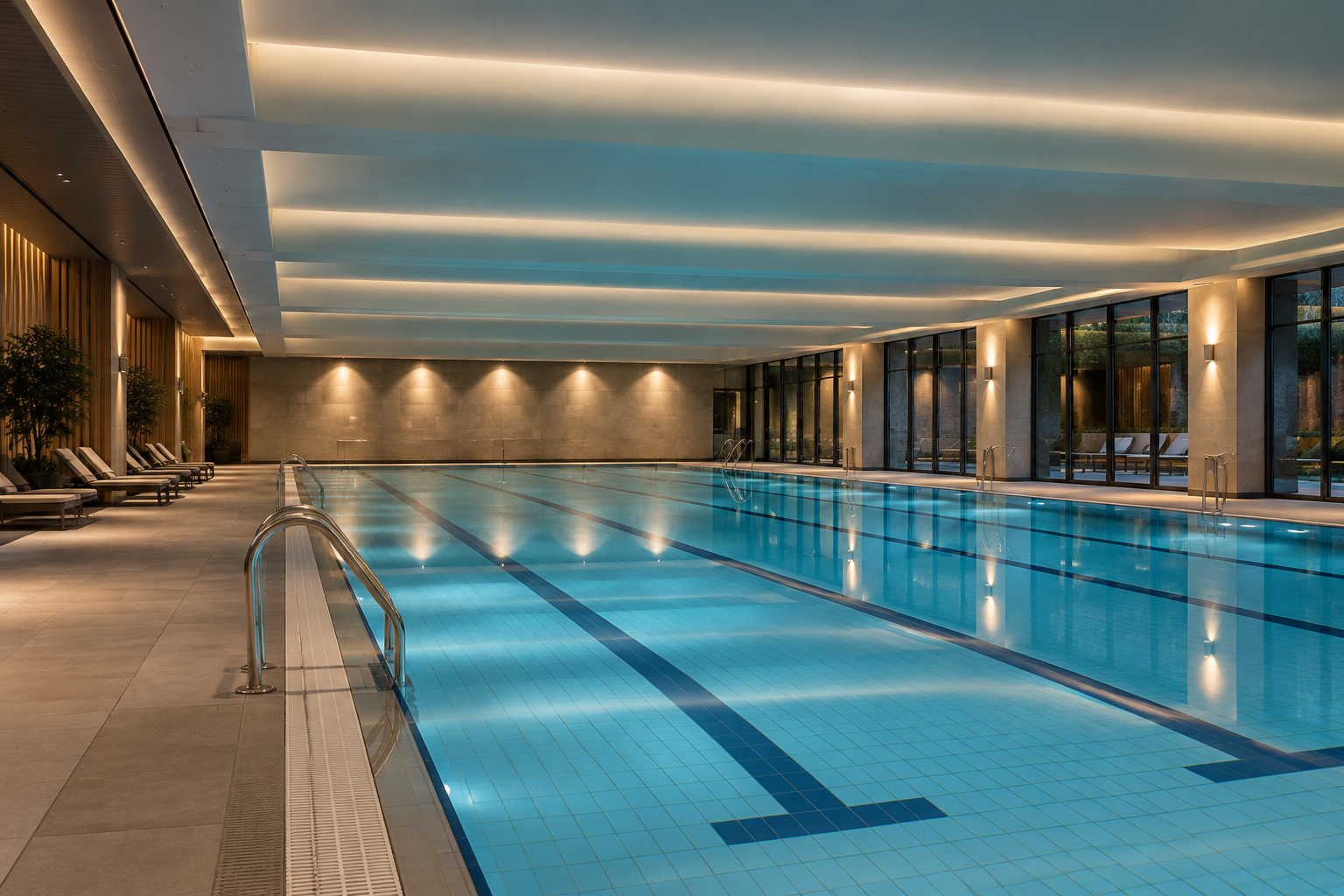 Indoor Pool Lighting 2026: IP65 & EN 12193 Guide: How do you light a swimming pool without glare?
Controls, Energy, and Commissioning
Modern lighting controls are essential for maximizing energy efficiency and operational flexibility in a natatorium. A DALI-2 (Digital Addressable Lighting Interface) system is the preferred solution for new builds and major renovations.
It allows each luminaire to be individually addressed, controlled, and monitored. This enables scene-setting for different uses—such as full-power for competitions, 50% for training, 25% for cleaning, and integration with emergency lighting.
For retrofits where new wiring is impractical, wireless systems like Casambi (Bluetooth Mesh) offer a powerful alternative. Integrating daylight harvesting sensors near large windows can automatically dim the lights, saving significant energy—often 20-40% annually depending on building orientation.
Occupancy sensors can also switch off or dim lighting during unoccupied hours for further savings.
Photometric Files & Compliance
Verifying a design's compliance with standards like EN 12193 is a mandatory, data-driven process. At XHLWX, we provide standardized IES and LDT photometric files for every custom luminaire.
These files are the digital DNA of a light fixture, containing precise data on its light distribution. Lighting designers import these files into simulation software like DIALux or Relux.
Inside the software, a 3D model of the swimming pool is built, and the virtual luminaires are placed. The simulation then calculates key metrics like illuminance, uniformity, and Glare Rating (GR) at every point in the space.
This allows for iterative design adjustments and provides documented proof of compliance before a single fixture is ordered. Furthermore, all products for the European market must bear the CE mark, confirming they meet EU safety, health, and environmental protection requirements, backed by RoHS (Restriction of Hazardous Substances) and ErP (Energy-related Products) directive compliance.
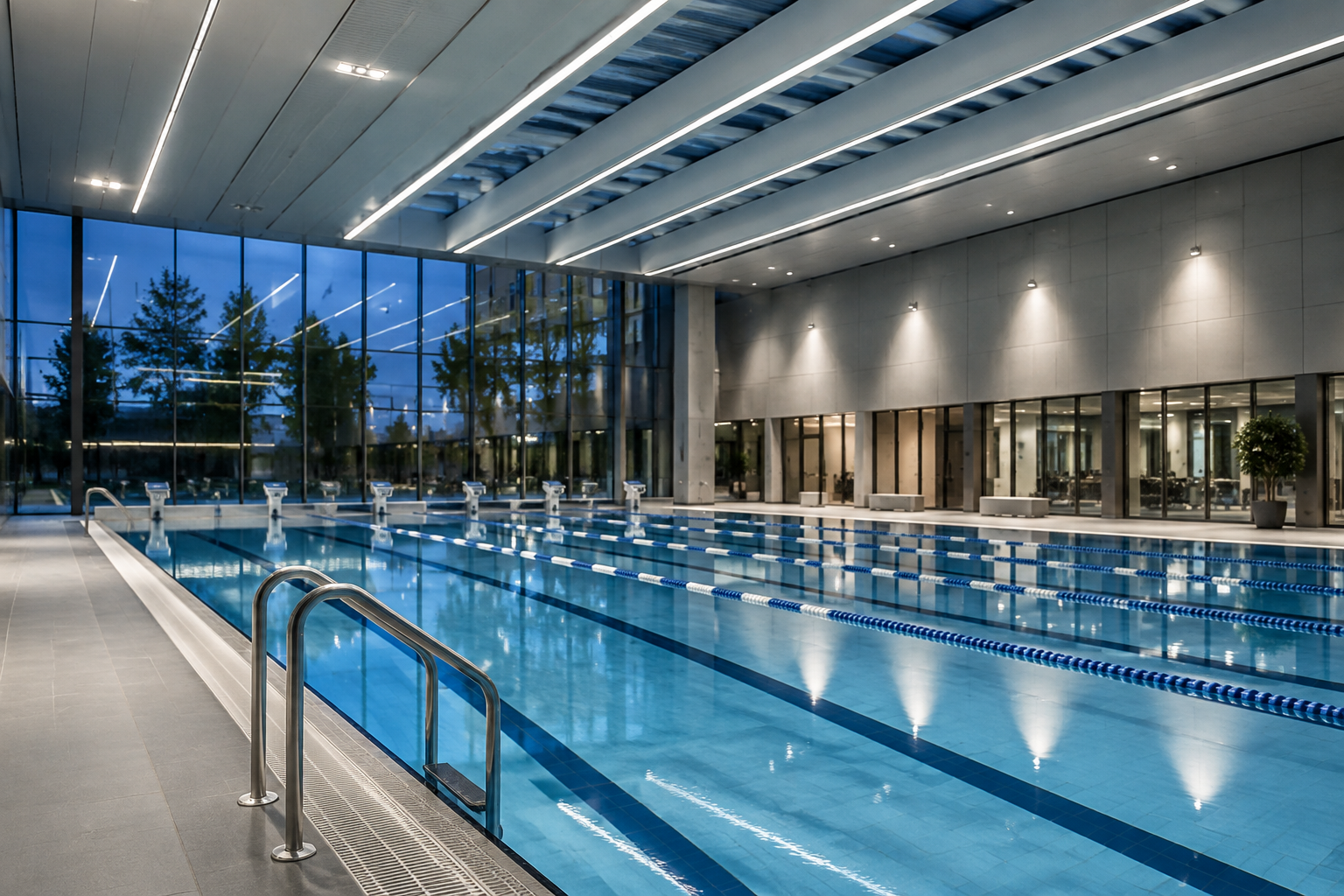 Indoor Pool Lighting 2026: IP65 & EN 12193 Guide: Photometric Files & Compliance
Frequently Asked Questions
Q: What Is the Best CCT for an Indoor Swimming Pool?
A Correlated Color Temperature (CCT) of 4000K is the most common and recommended choice for indoor pools. It provides a clean, neutral white light that enhances water clarity and promotes alertness for lifeguards and swimmers. While 3000K can create a warmer, more relaxed feel for leisure pools, 4000K strikes an ideal balance for both recreational and competitive environments. A CRI above 80 is essential for good color rendering.
Q: How Many Lux Are Needed for a Competition Swimming Pool?
For top-tier international and national competitions (Class I), the EN 12193 standard specifies a maintained average illuminance (Ēm) of 500 lux on the water surface. For regional competitions and training (Class II), the requirement is 300 lux. Importantly, the uniformity (Uo) must be very high, at ≥0.7, to ensure there are no dark spots where a swimmer in distress might be missed.
Q: Can I Use DMX for Swimming Pool Lighting?
Yes, DMX control is an excellent choice, particularly for leisure pools or spas where dynamic color-changing (RGBW) effects are desired. It allows for sophisticated light shows and mood-setting. However, for the primary functional white lighting in a competition or training pool, DALI-2 is often more practical. DALI-2 provides robust two-way communication for status monitoring and fault detection on each luminaire, which is a key advantage for facility maintenance.
Q: What Is the Typical Lifespan of a Corrosion-resistant LED Pool Light?
A high-quality, purpose-built LED luminaire for corrosive pool environments should have a minimum rated lifespan of L80B10 at 50,000 hours. This industry metric means that after 50,000 hours of operation, 90% of the installed luminaires will still produce at least 80% of their initial light output. Fixtures without proper corrosion resistance may fail structurally in less than 5,000 hours.
Sources and Technical References
- EN 12193:2018: Light and lighting - Sports lighting
- EN 12464-1:2021: Light and lighting - Lighting of work places - Part 1: Indoor work places
- IES RP-6-15: Recommended Practice for Sports and Recreational Area Lighting
- IEC 60364-7-702: Low-voltage electrical installations - Part 7-702: Requirements for special installations or locations - Swimming pools and fountains
- WELL Building Standard v2: Light Concept - L03, L04
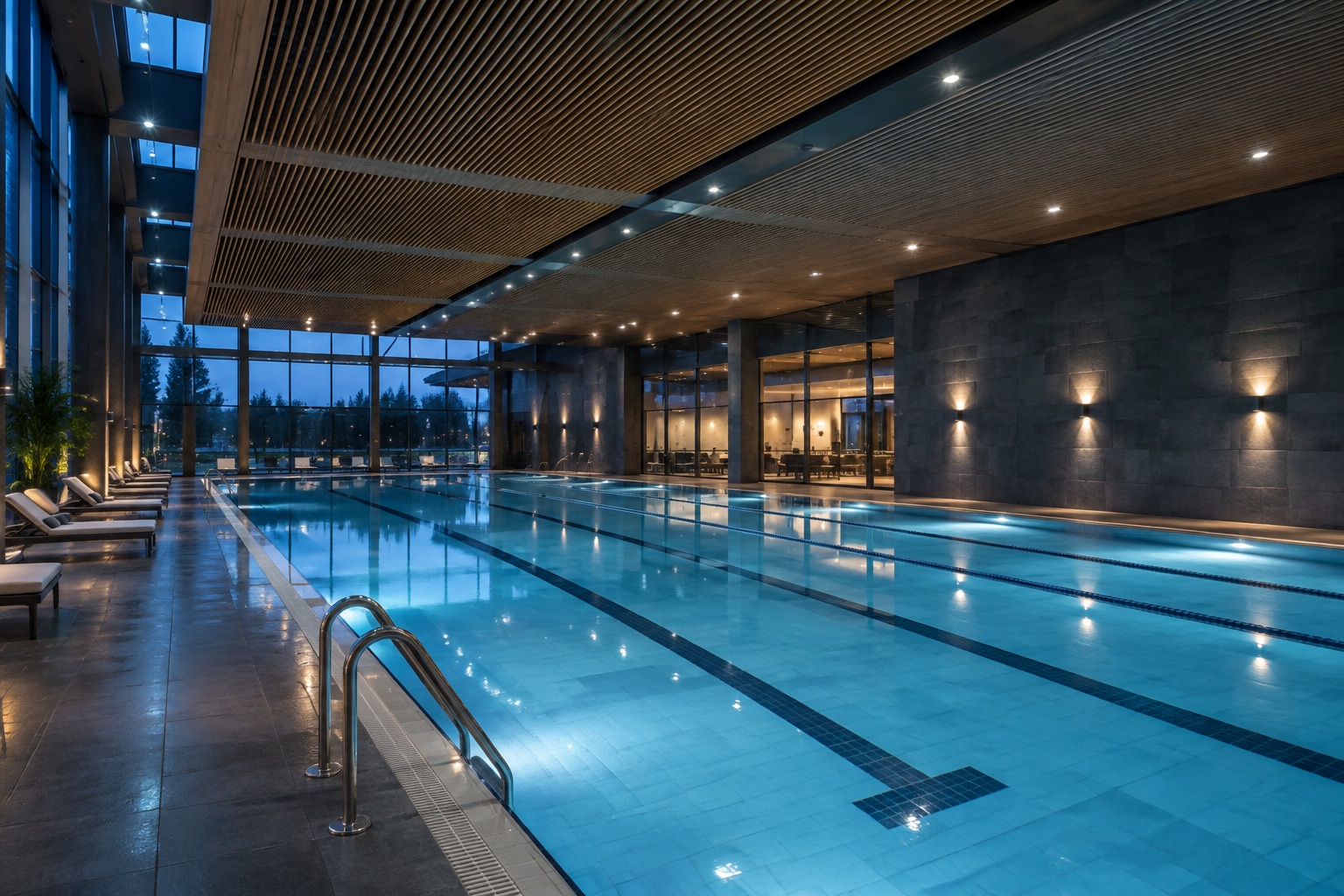 Indoor Pool Lighting 2026: IP65 & EN 12193 Guide: Q: Can I use DMX for swimming pool lighting?
Request a Custom Quote
com), a Custom Indoor LED Lighting Manufacturer based in China, our engineering team specializes in developing robust, high-performance LED lighting solutions for the most challenging indoor environments, including natatoriums. We work directly with architects, lighting designers, and facility managers across the EU, US, and Middle East to engineer fixtures that meet precise photometric targets, integrate seamlessly with control systems like DALI-2, and provide decades of reliable service in corrosive atmospheres.
Contact us to discuss your project and request a custom quote or a DIALux lighting design proposal.
Need a tailored lighting plan for your project?
Our senior lighting designers reply within 48 hours with a free design proposal & quotation.