
Kindergarten Lighting Design 2026: Glare-Free Safety Guide
Quick answer
Discover how to design safe, glare-free kindergarten lighting. Our 2026 guide covers EN 12464-1 standards, UGR<19, IK ratings, and circadian-friendly LED solu
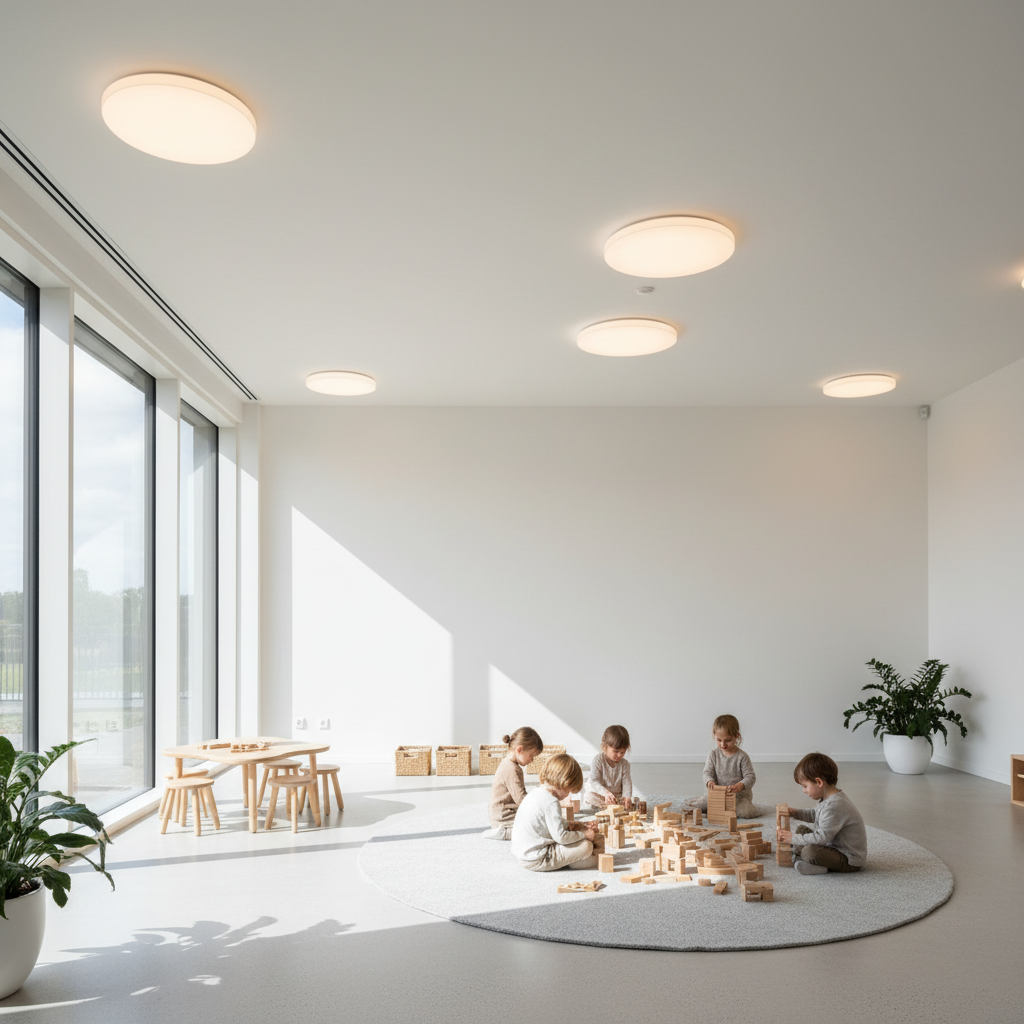
Introduction — the Design Problem in Kindergartens
com), a Custom Indoor LED Lighting Manufacturer based in China, we recognize that lighting for kindergartens and nurseries is a specialized discipline demanding more than just illumination. The design must prioritize the safety, well-being, and developmental needs of young children.
This involves creating a visually comfortable, glare-free environment that is also physically robust and adaptable to a wide range of activities, from energetic play and focused learning to quiet story time and restorative naps. The challenge lies in integrating these human-centric principles with stringent safety standards and energy efficiency, creating a space that nurtures and protects its young occupants.
Lighting Criteria and Standards for Kindergartens
Standards define the minimum quality for safety and visual comfort in educational spaces. For projects in the EU, EN 12464-1:2021 is the primary reference, setting clear targets for illuminance, glare, and color rendering.
In the US, IES RP-3 provides similar guidance, while the WELL v2 Standard introduces advanced criteria for circadian lighting. For a typical playroom, standards mandate an average illuminance (Ēm) of at least 300 lux on the task area.
Critically, the Unified Glare Rating (UGR) must be kept below 19 to protect children's sensitive eyes, as they often have a higher line of sight towards the ceiling. A Color Rendering Index (CRI) of Ra > 80 is a minimum, but for accurate color perception in an educational setting, Ra > 90 is the recommended specification.
Furthermore, physical safety is paramount, with impact resistance (IK rating) and ingress protection (IP rating) being key considerations for luminaire durability.
| Parameter | Recommended Specification | Governing Standard | Notes |
|---|---|---|---|
| Illuminance (Ēm) | 300 lux (Play/Classroom), 500 lux (Crafts) | EN 12464-1, IES RP-3 | Maintained illuminance on the primary task plane (floor/tables). |
| Glare Control (UGR) | < 19 | EN 12464-1 | Essential for visual comfort. Achieved with microprismatic or high-quality opal diffusers. |
| Color Quality | CRI: Ra > 90; TM-30: Rf > 90, Rg > 98 | WELL v2, IES TM-30 | High-fidelity color rendering is vital for developmental learning and art activities. |
| CCT & Circadian | Tunable White: 2700K - 5000K | WELL v2 Light Concept | Allows scenes to be adapted: cooler CCT for focus, warmer CCT for relaxation and naps. |
| Housing Safety | IP44 / IK08 | IEC 60529 / EN 62262 | IP44 protects against splashes. IK08 ensures the luminaire withstands a 5-joule impact. |
| Control Protocol | DALI-2 (D4i) or Casambi | IEC 62386 | Enables scene setting, daylight harvesting, and individual luminaire addressability. |
| Core Components | Osram Duris E 2835 LEDs / Tridonic an DALI Driver | Manufacturer Data | Specifies high-quality, reliable components ensuring long life (e.g., L90B10 > 50,000 hours). |
| Certifications | CE, RoHS, ErP, ISO9001:2015 | EU Directives / ISO | Mandatory for EU market access and verification of quality management systems. |
Luminaire Selection and Optics
The right luminaire choice balances performance, safety, and aesthetics for a child-centric environment. While standard office lighting might meet basic lux requirements, it often fails on the critical metrics of glare control and impact resistance.
For kindergarten applications, luminaires must be selected with optics and materials specifically designed for safety and visual comfort. Microprismatic diffusers are excellent for controlling glare in recessed or surface-mounted panels, while robust polycarbonate (PC) covers are essential for impact-prone areas.
Indirect lighting, which bounces light off the ceiling, is another effective strategy for creating soft, diffuse, and exceptionally low-glare ambient illumination.
| Luminaire Type | Optics & Material | Glare Control (UGR) | Verdict |
|---|---|---|---|
| Standard Edge-Lit LED Panel | Polystyrene (PS) Diffuser | Typically 22-25 | Not Recommended. The PS diffuser is brittle, prone to yellowing, and offers poor glare control, making it unsuitable and unsafe for a child's environment. |
| Back-Lit Microprismatic Panel | PMMA Microprismatic Sheet | Design target < 19 | Highly Recommended. Provides excellent, compliant glare control. The back-lit design avoids the LGP, improving longevity and efficiency. Choose a robust frame. |
| Surface-Mounted PC Drum Light | Opal Polycarbonate (PC) Diffuser | Typically 20-24 | Recommended for Durability. Best choice for areas where impact is likely. The IK08-IK10 rated PC cover is virtually unbreakable. Glare is higher than microprismatic options. |
| Indirect Linear LED Pendant | N/A (Upward Light) | Design target < 16 | Excellent for Ambient Light. Creates the most comfortable, shadow-free environment by using the ceiling as a reflector. Best used with high ceilings and supplemental task lights. |
How Do You Light a Multi-purpose Playroom Effectively?
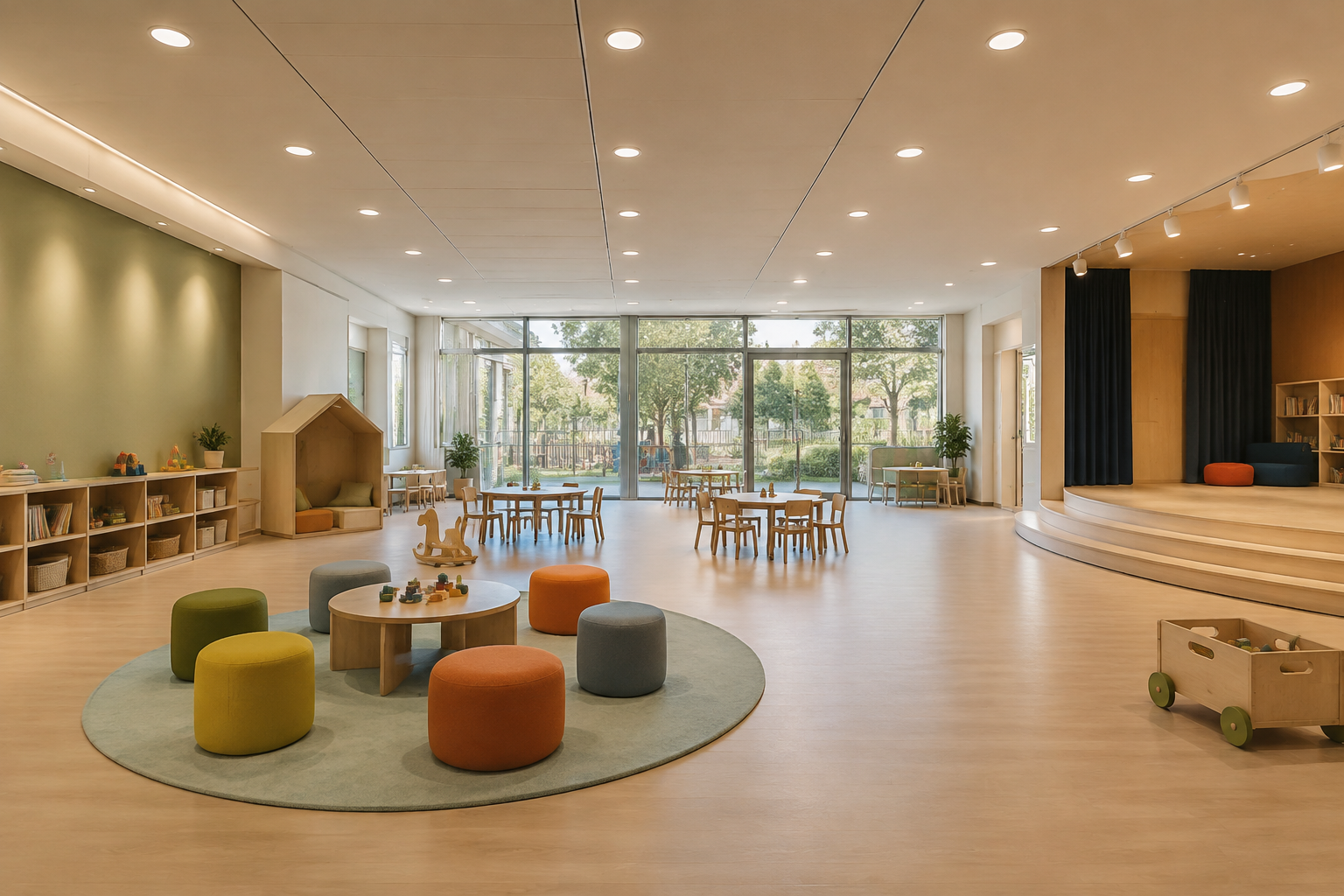
Zoning and dynamic control are essential for adapting a single room to diverse activities. A multi-purpose playroom requires a flexible lighting scheme that can transition seamlessly between different functions.
This is best achieved by creating lighting 'zones' using an addressable control system like DALI-2. For instance, a craft area can be lit to a higher level of 500 lux with a neutral 4000K CCT for focus.
Simultaneously, a reading nook in the same room can be set to a cozier 300 lux at a warm 3000K CCT. Using tunable white luminaires allows a single fixture to provide activating, cool light for morning play and calming, warm light for afternoon story time, supporting the children's natural circadian rhythm.
What Is the Best Lighting for a Kindergarten Nap Room?
Nap room lighting must promote rest by using warm, low-level, indirect illumination. The primary goal is to signal the body to wind down.
This requires a CCT of 2700K or warmer; dim-to-warm technology, which mimics incandescent dimming down to 2200K or 1800K, is an ideal solution. Illuminance levels should be low, in the range of 50-100 lux, and controlled via a smooth, flicker-free dimmer.
The light source should be indirect, such as from LED strips in a cove or low-output wall washers, to prevent any direct light from shining on children's faces. All luminaires must be fully dimmable to near-zero output to create a truly restful state.
Why Is Impact Resistance (IK Rating) Critical in Childcare Settings?
A high IK rating ensures luminaires can withstand accidental impacts from toys, preventing breakage and injury. Standard EN 62262 classifies the level of protection against mechanical impact, measured in joules of energy.
An office-grade luminaire may only have an IK02 rating, meaning it can shatter from a minor impact. In a kindergarten, where balls and toys are frequently thrown, a minimum recommended specification is IK08.
7 kg mass dropped from 300mm) without breaking, ensuring no sharp fragments can fall and cause harm.
 Kindergarten Lighting Design 2026: Glare-Free Safety Guide: How do you light a multi-purpose playroom effectively?
Controls, Energy, and Commissioning
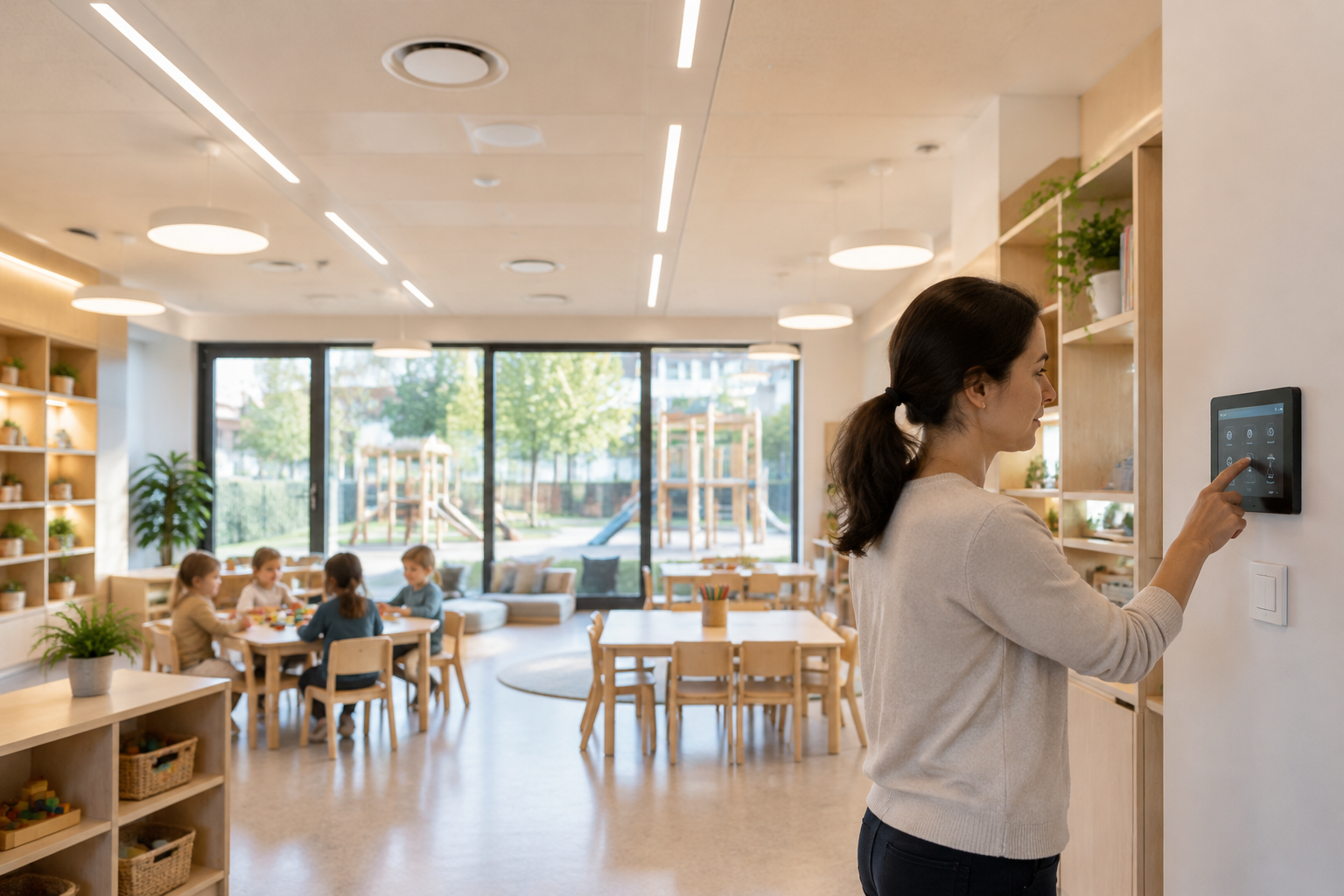
Smart controls like DALI-2 and Casambi maximize energy savings and enable human-centric lighting scenes. Modern LED lighting's efficiency is only fully realized when paired with an intelligent control system.
For new-build projects, a wired DALI-2 (Digital Addressable Lighting Interface) system offers robust, standardized control. It allows for individual and group addressing of luminaires, enabling scene-setting for 'Play', 'Learn', and 'Nap' modes at the touch of a button.
Integrating D4i-certified sensors for presence detection (automatically turning lights off in empty rooms) and daylight harvesting (dimming lights near windows) can yield energy savings exceeding 70% compared to uncontrolled lighting. For retrofits, wireless systems like Casambi (Bluetooth Mesh) provide similar functionality with greater installation flexibility.
Proper commissioning is the final, crucial step where a technician programs scenes, sensor thresholds, and schedules to align with the facility's operational needs and the original design intent.
 Kindergarten Lighting Design 2026: Glare-Free Safety Guide: Controls, Energy, and Commissioning
Photometric Files & Compliance
Verified photometric files and compliance certificates are non-negotiable for project approval and safety assurance. Before committing to a specification, lighting designers must verify performance using photometric data files.
These files, provided in IES (for North America) or LDT (for Europe) format, contain a digital measurement of the luminaire's light distribution. This data is imported into simulation software like DIALux or Relux.
A designer can then build a 3D model of the kindergarten and accurately predict the lighting performance, generating reports that prove compliance with EN 12464-1 criteria for illuminance, uniformity, and UGR. Beyond performance, compliance documentation is essential.
CE marking declares conformity with EU health, safety, and environmental standards. RoHS restricts hazardous substances, and the new ErP (Ecodesign) regulation sets strict efficiency requirements.
As a manufacturer, our ISO9001:2015 certification ensures our processes meet global quality management standards.
Frequently Asked Questions
Q: What Is the Ideal CCT (color Temperature) for a Kindergarten?
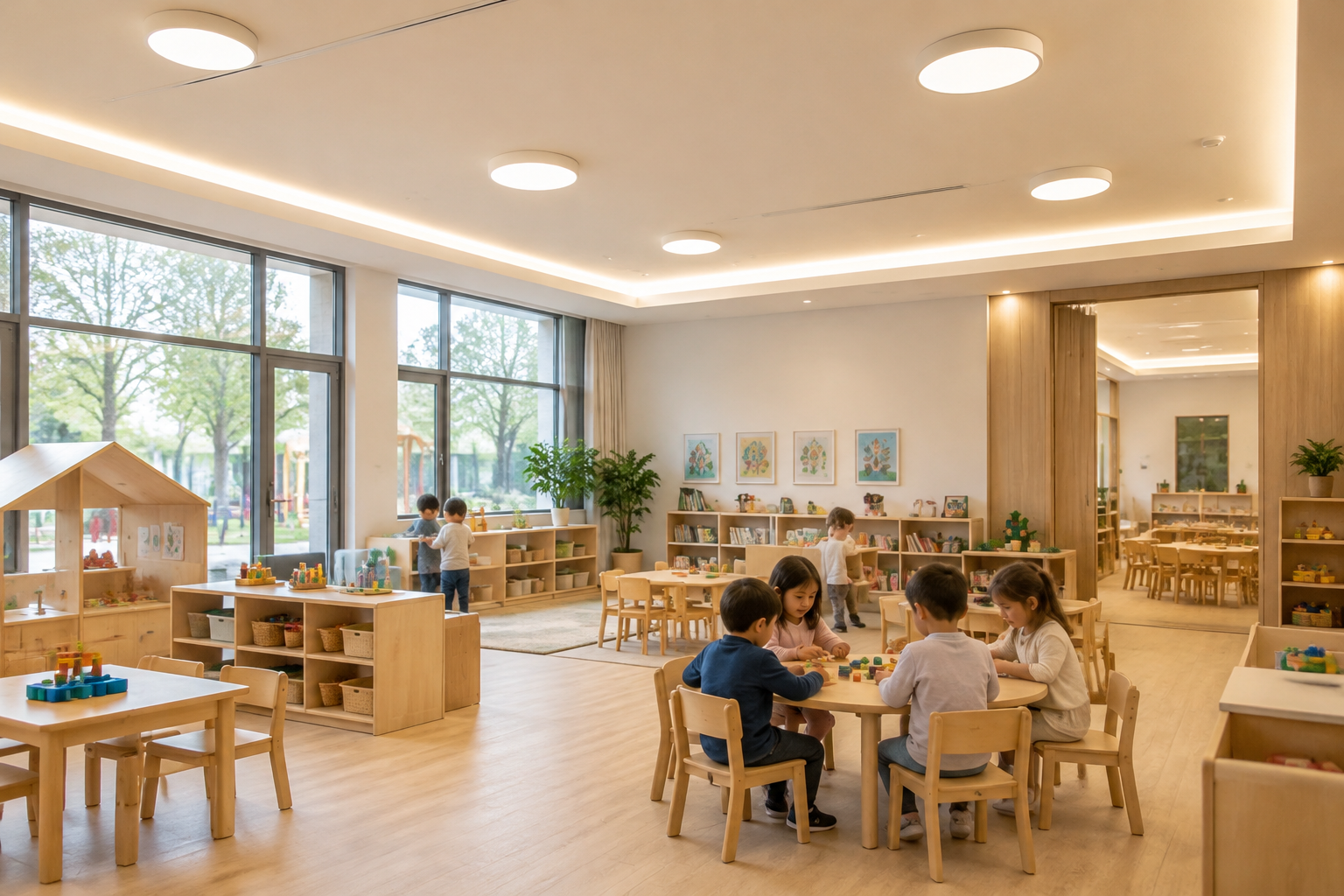
For multi-purpose rooms, a tunable white system from 3000K to 5000K is ideal. It allows for activating cool light (~4000K) for focused tasks and warm light (~3000K) for relaxation, supporting the children's natural circadian rhythms as recommended by WELL v2 building standards. For nap rooms, a fixed warm CCT of 2700K or a dim-to-warm solution is best.
Q: Is a CRI of 80 Enough for a Playroom?
While a CRI of 80 is the minimum standard per EN 12464-1, a CRI of 90 or higher is strongly recommended for educational settings. High CRI (and a high TM-30 Rf value > 90) renders colors more vividly and accurately, which is crucial for early childhood development, art activities, and helping children identify and learn colors correctly.
Q: What Does a UGR<19 Rating Actually Mean for Children?
UGR<19 means "Unified Glare Rating less than 19," indicating a low probability of causing discomfort glare. This is critical for children, who often play on the floor and look up at the ceiling. A low UGR value prevents visual discomfort, eye strain, and distraction, creating a more comfortable and effective learning environment as mandated by EN 12464-1.
Q: How Much Energy Can LED Lighting with DALI-2 Controls Save?
Compared to outdated fluorescent lighting without controls, a modern DALI-2 controlled LED system can achieve significant energy savings, often in the range of 60-80%. This substantial reduction comes from the combination of high-efficacy LEDs, scheduled dimming for different activities, presence detection in unoccupied rooms, and daylight harvesting that automatically dims lights when sufficient natural light is present.
 Kindergarten Lighting Design 2026: Glare-Free Safety Guide: Q: What is the ideal CCT (color temperature) for a kindergarten?
Sources and Technical References
- EN 12464-1:2021: Light and lighting — Lighting of work places — Part 1: Indoor work places.
- IES RP-3-20: Recommended Practice: Lighting for Educational Facilities.
- WELL Building Standard v2: Light Concept.
- EN 62262: Degrees of protection provided by enclosures for electrical equipment against external mechanical impacts (IK code).
- IEC 62386: Digital Addressable Lighting Interface (DALI).
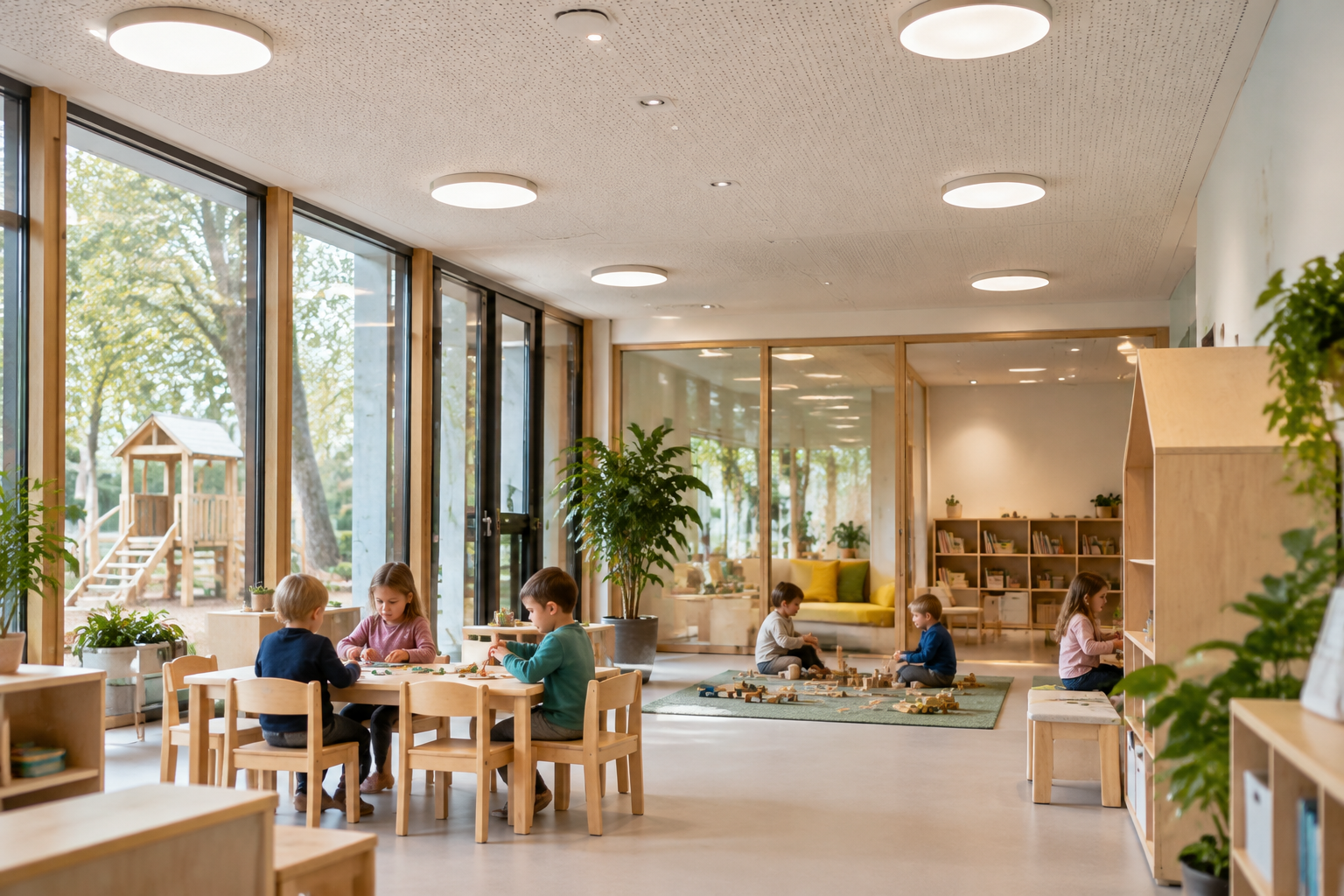 Kindergarten Lighting Design 2026: Glare-Free Safety Guide: Q: How much energy can LED lighting with DALI-2 controls save?
Request a Custom Quote
At XHLWX (led-project-light.com), a Custom Indoor LED Lighting Manufacturer based in China, we specialize in developing and producing lighting solutions that meet the precise safety, performance, and budgetary needs of educational projects across the EU, US, and Middle East. Our engineering team can provide full support, from selecting the right IK-rated, low-glare luminaires to providing complete DIALux simulation reports and integrating DALI-2 or Casambi controls. Contact us today to discuss your kindergarten or school project and request a custom quote.
Need a tailored lighting plan for your project?
Our senior lighting designers reply within 48 hours with a free design proposal & quotation.