
Pharma GMP Lighting Design 2026: IP65 Cleanroom Guide
Quick answer
Explore our 2026 guide to pharmaceutical GMP lighting design. Learn key criteria for IP65/IP66 cleanroom luminaires, EN 12464-1 compliance, and validation sup
Introduction — the Design Problem in This Space
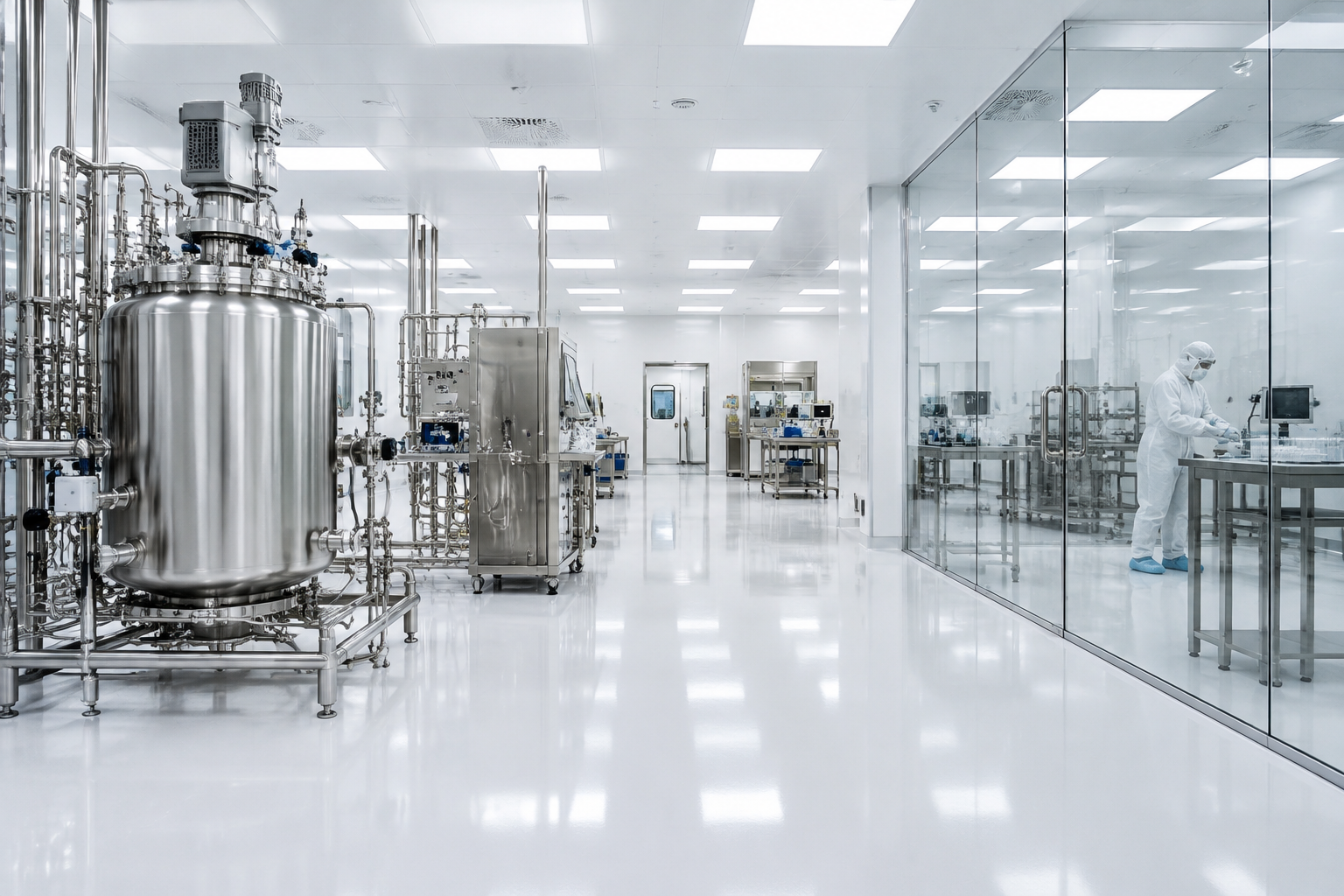
At XHLWX (led-project-light.com), a Custom Indoor LED Lighting Manufacturer based in China, we understand that designing for pharmaceutical GMP (Good Manufacturing Practice) suites presents unique challenges that transcend typical commercial lighting. The core problem is ensuring that the lighting system actively contributes to the facility's state of control, guaranteeing product safety, process integrity, and personnel efficiency. This involves specifying luminaires that are not merely bright, but are hermetically sealed against contamination, resistant to aggressive chemical washdowns, constructed from non-shedding materials, and supported by meticulous validation documentation required by regulatory bodies like the FDA and EMA. The lighting solution must integrate seamlessly into the cleanroom's controlled environment, managing factors like air pressure differentials and stringent cleaning protocols without compromising performance or compliance.
Lighting Criteria and Standards for This Application
Specifying lighting for GMP environments demands a rigorous, standards-based approach to meet safety and quality mandates. Adherence to established criteria for illuminance, glare, color rendering, and ingress protection is not optional; it is fundamental to operational qualification. These parameters, governed by standards like EN 12464-1 in Europe and IES RP-7 in the US, form the basis of a compliant and effective lighting design. Key considerations include ensuring sufficient light for detailed visual inspection tasks (typically 500-1000 lux), maintaining low glare (UGR < 19) to prevent operator error, and utilizing high color rendering (CRI > 90) to accurately identify materials and product variations. Furthermore, the luminaire's physical construction must meet stringent requirements for cleanability and resistance to chemicals and dust ingress.
| Parameter | Recommended Specification | Standard | Notes |
|---|---|---|---|
| Illuminance (Ē) | 500 - 1000 lux (Design Target) | EN 12464-1 / IES RP-7 | Task-dependent; higher levels are critical for visual inspection zones and quality control labs. |
| Color Rendering (CRI/Rf) | Ra > 90, Rf > 85 (Recommended) | IES TM-30 / CIE S 026 | Essential for accurate quality control, safety signage visibility, and distinguishing subtle color variations in products. |
| Unified Glare Rating (UGR) | < 19 (Design Target) | EN 12464-1 | Critical for preventing visual discomfort and reducing the risk of errors during prolonged, detailed tasks. |
| Control Protocol | DALI-2 (Digital Addressable Lighting Interface) | IEC 62386 | Enables individual addressing, status monitoring (vital for maintenance), and integration with Building Management Systems (BMS). |
| Housing Protection | IP65 / IK08 | EN 60529 / EN 62262 | Ensures the luminaire is dust-tight, protected against low-pressure water jets, and possesses robust impact resistance. |
| LED Chip / Driver | Samsung / Tridonic (Example Brands) | CE / RoHS / ErP | Guarantees long-term reliability, high efficacy (>140 lm/W), and verified compliance for EU/US/ME markets. |
| Certification | ISO 9001, CE, RoHS | EU Directives / ISO | Verifies manufacturer's quality management system and confirms product compliance with health, safety, and environmental standards. |
Luminaire Selection and Optics
A compliant GMP facility's integrity depends heavily on the physical form and material of its luminaires. The primary goal is to select a luminaire that presents no risk of contamination to the cleanroom environment. This means opting for fixtures with smooth, non-porous, crevice-free surfaces that are easy to clean and do not harbor microorganisms or particulates. The choice between a fully recessed panel, a tear-drop profile for laminar flow ceilings, or a surface-mounted gasketed fixture depends on the cleanroom's classification, ceiling type, and airflow design. The optic material is equally important; while polycarbonate is impact-resistant, PMMA (acrylic) or glass often provide superior resistance to harsh cleaning chemicals like vaporized hydrogen peroxide (VHP).
| Luminaire Type | Key Feature | Weakness | Verdict |
|---|---|---|---|
| Recessed Flat Panel (IP65) | Creates a perfectly flush, monolithic ceiling plane that is exceptionally easy to wipe down. | Installation requires a precise ceiling cutout and can be challenging to seal perfectly in non-grid ceilings. | Best for new builds with walkable grid or plasterboard ceilings (e.g., Grade C/D, ISO 7/8) for a seamless, modern aesthetic. |
| Recessed Tear-Drop Profile | Aerodynamic shape minimizes air turbulence, making it suitable for unidirectional (laminar) airflow. | The profile protrudes slightly into the room, creating a minor ledge compared to a flat panel. | Ideal for high-grade cleanrooms (Grade A/B, ISO 5-6) where maintaining strict laminar airflow over critical process areas is paramount. |
| Surface-Mounted Gasketed Batten (IP66) | Simple to install on solid or existing ceilings without major structural work; often achieves a higher IP rating. | Creates more external surfaces and potential ledges for dust accumulation if not designed carefully. | Suitable for retrofits or in areas with concrete ceilings where recessing is impractical, such as ancillary or utility zones. |
| Integrated Panel/Ceiling System | The luminaire is a factory-sealed component of a modular ceiling tile, guaranteeing a perfect seal. | Highest initial cost and vendor lock-in; less flexibility for future modifications. | The ultimate solution for high-spec facilities demanding total system integration and the highest assurance of environmental control. |
How to Ensure Luminaires Withstand Aggressive Cleaning Protocols?
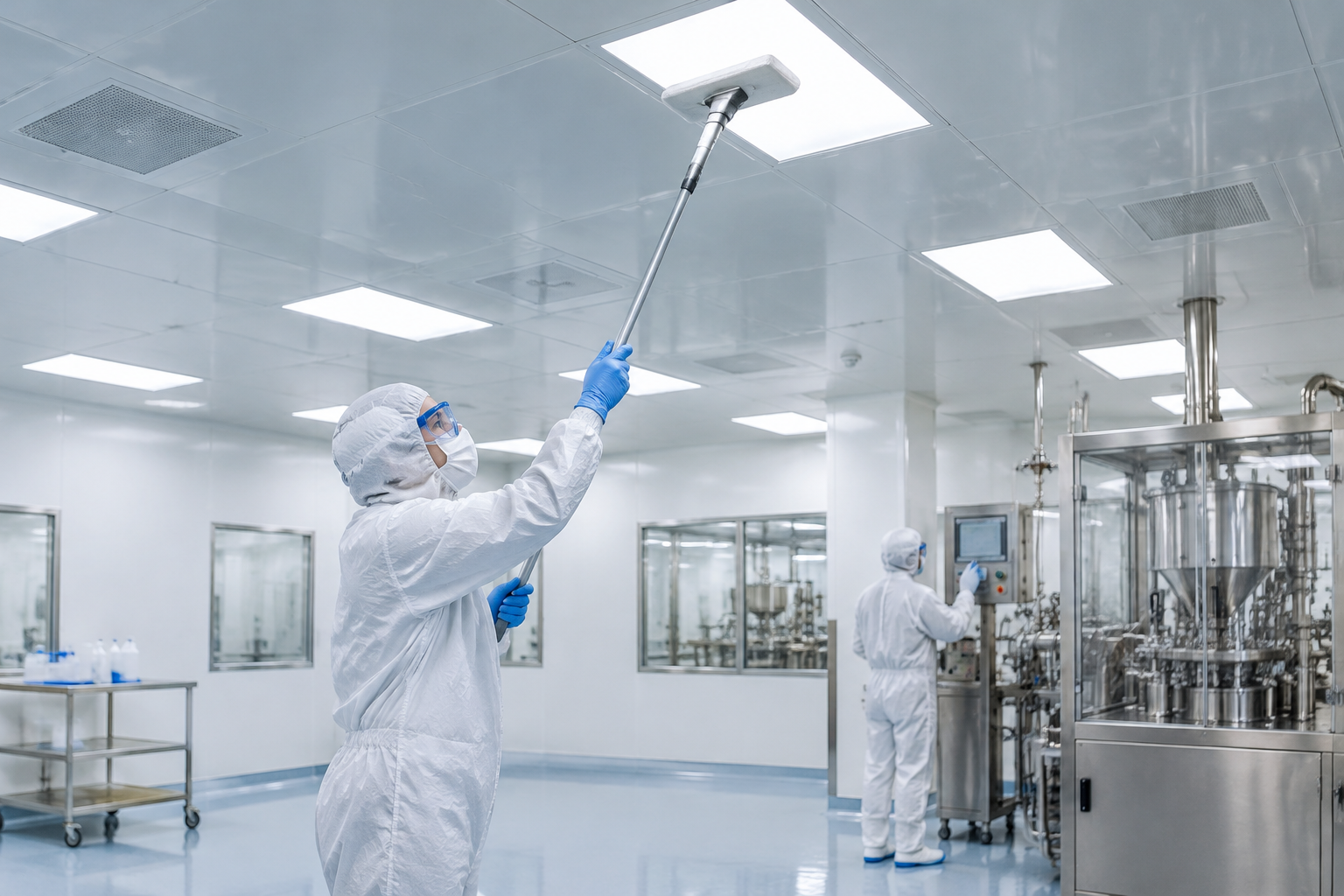
Selecting luminaires with superior material science and construction is the only way to guarantee longevity against harsh cleaning. This requires specifying fixtures with chemically resistant finishes, such as a high-quality epoxy-polyester powder coat, which can withstand common sanitizing agents including alcohols, peroxides, and quaternary ammonium compounds. The exposed lens material should be PMMA or toughened glass instead of standard polycarbonate, which can degrade with chemical exposure. All fasteners should be high-grade stainless steel (e.g., 304 or 316), and gaskets must be made from durable, closed-cell materials like silicone that will not compress or degrade over time, maintaining the IP65 or IP66 seal.
What Makes a Luminaire "GMP Compliant"?
A luminaire is considered "GMP compliant" by its design attributes, not a specific certification. These attributes ensure it supports a controlled environment and includes several key features. The housing must be fully sealed (minimum IP65) and free of any cracks, joints, or crevices where contaminants could accumulate. All materials must be non-shedding, non-toxic, and non-porous. Furthermore, the design must prevent the risk of contamination, which often means avoiding glass components or using shatterproof-rated materials in sensitive areas. Compliance is ultimately demonstrated through documentation showing material specifications, IP/IK test reports, and a design that facilitates validated cleaning procedures.
Why Is Luminaire Placement Critical in Laminar Flow Cleanrooms?
Incorrect luminaire placement can severely compromise the effectiveness of a laminar airflow system. In cleanrooms designed for unidirectional airflow (typically top-to-bottom), any object protruding from the ceiling can create turbulence, disrupting the uniform "piston" of clean air meant to sweep particles away from the critical zone. Tear-drop shaped luminaires are specifically designed to be more aerodynamic, minimizing this turbulence. A comprehensive lighting design, often modeled using DIALux software with specific luminaire IES and LDT photometric files, is essential to strategically place fixtures between HEPA filter outlets, ensuring that the lighting system works in harmony with the HVAC system, not against it.
 Pharma GMP Lighting Design 2026: IP65 Cleanroom Guide: How to ensure luminaires withstand aggressive cleaning protocols?
Controls, Energy and Commissioning (DALI-2 / Casambi / Sensors)
An advanced lighting control system is a powerful tool for enhancing GMP compliance and operational efficiency. DALI-2 is the preeminent choice for new pharmaceutical facilities due to its robust, two-way communication protocol. It allows for individual and group control of luminaires, enabling precise light levels for different tasks or zones. Crucially for validation, DALI-2 provides real-time feedback on luminaire and driver status, automatically logging failures as required for Operational Qualification (OQ) and simplifying maintenance records. While wireless systems like Casambi offer flexibility for retrofits, their signal integrity must be rigorously tested within the steel and concrete structure of a typical production facility. Sensor integration for occupancy or daylight harvesting must be applied judiciously; in many GMP areas, lights are mandated to be on 100% of the time during operation for safety and quality assurance, limiting energy-saving strategies to non-operational hours or non-critical zones like corridors and gowning rooms.
Photometric Files & Compliance (IES / LDT / DIALux / CE / RoHS / ErP)
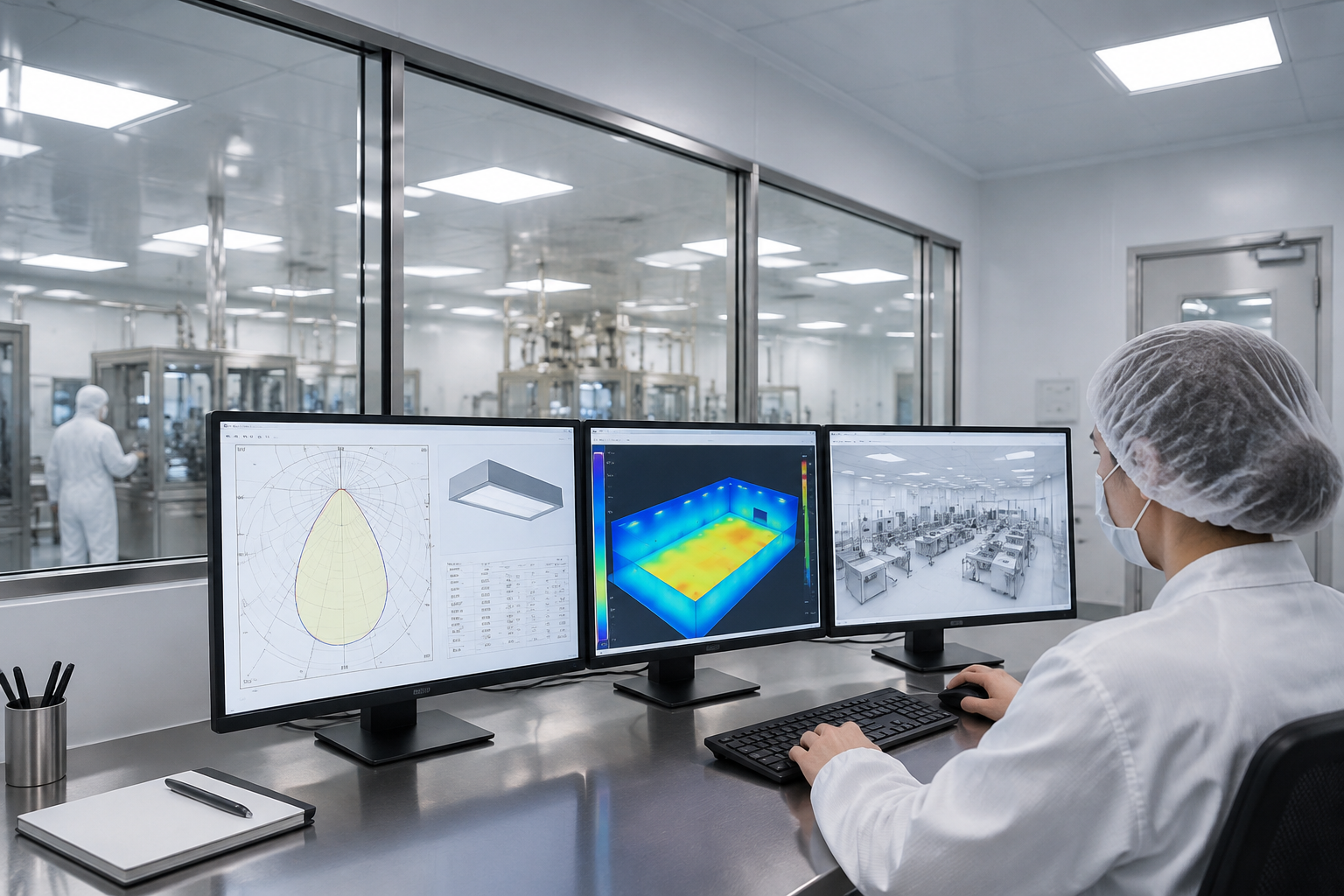
Verifiable compliance is achieved through a combination of digital simulation and certified hardware. Reputable manufacturers provide standardized IES and LDT photometric files for each luminaire, which contain precise data on its light distribution. These files are imported into lighting design software like DIALux to create a detailed 3D model of the pharmaceutical suite. This simulation acts as a critical piece of Design Qualification (DQ) documentation, providing predictive calculations for illuminance levels, uniformity, and UGR. The report proves, before installation, that the design will meet the stringent targets of EN 12464-1 and the recommendations of the WELL v2 standard for visual comfort. The physical luminaires must then be backed by non-negotiable compliance certificates, including CE marking for market access in the EU, RoHS to restrict hazardous materials, and ErP to meet ecodesign energy efficiency targets.
 Pharma GMP Lighting Design 2026: IP65 Cleanroom Guide: Photometric files & compliance (IES / LDT / DIALux / CE / RoHS / ErP)
Frequently Asked Questions
Q: What Is the Minimum IP Rating for a Pharmaceutical Washdown Area?
The minimum recommended rating is IP65. This ensures the luminaire is completely dust-tight (the '6') and can withstand low-pressure water jets from any direction (the '5'), which is typical for standard washdown procedures. For areas with more aggressive, higher-pressure cleaning protocols, an IP66 rating is often specified for enhanced protection. Always verify the required IP rating against your facility's specific cleaning SOPs.
Q: Why Is a CRI of 90+ Recommended for Pharma Inspection Areas?
A Color Rendering Index (CRI) above 90 is crucial for tasks requiring accurate color discernment. In pharmaceutical quality control, inspectors must be able to detect subtle shifts in product color, check the accuracy of printed labels, and identify potential contaminants. A high-CRI light source, with a TM-30 Rf value above 85, renders colors more faithfully, reducing the risk of errors and improving the reliability of visual inspection processes.
Q: Can Standard Office LED Panels Be Used in a GMP Cleanroom?
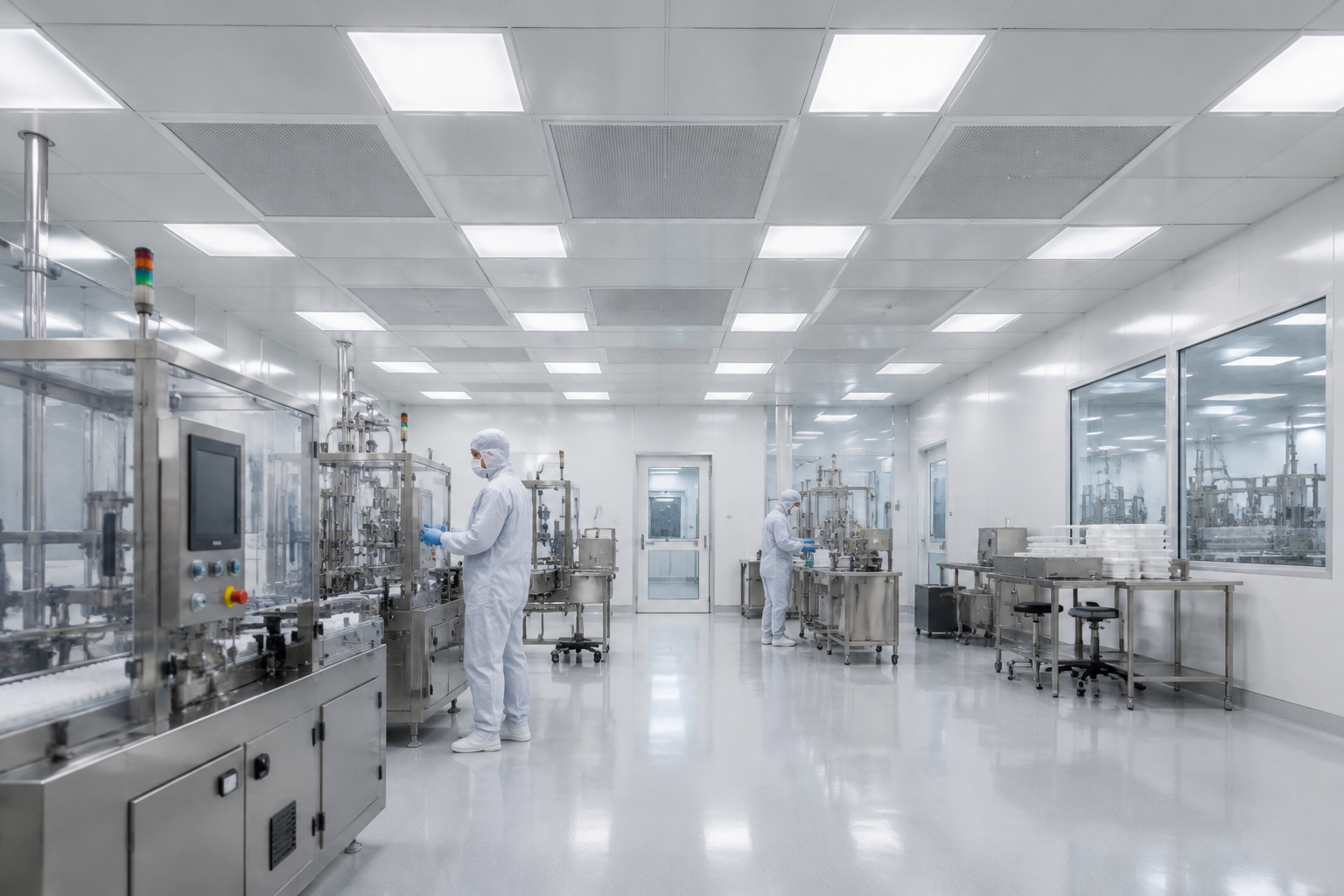
No, standard office LED panels are entirely unsuitable for GMP environments. They are not sealed against dust and moisture ingress (typically only IP20 or IP40), are made with materials that may shed particles or outgas, and feature crevices that can harbor microbial growth. Using non-compliant fixtures presents a significant contamination risk, leading to batch failure and regulatory non-compliance. Only purpose-built, IP65+ rated cleanroom luminaires should be used.
Q: How Does DALI-2 Lighting Control Support GMP Validation?
DALI-2 directly supports validation by providing automated monitoring and data logging. The system can be programmed to automatically test emergency lighting and report the status of every single luminaire and driver. This automates parts of the Operational Qualification (OQ) and simplifies ongoing maintenance records. Any failure is immediately flagged in the Building Management System (BMS), ensuring prompt repair and maintaining the validated state of the facility with a complete, auditable data trail.
Sources and Technical References
- ISO 14644-1:2015: Cleanrooms and associated controlled environments — Part 1: Classification of air cleanliness by particle concentration
- EN 12464-1:2021: Light and lighting - Lighting of work places - Part 1: Indoor work places
- IES RP-7-17: Recommended Practice: Lighting for Health Care Facilities
- EudraLex - Volume 4 - EU Guidelines for Good Manufacturing Practice for Medicinal Products for Human and Veterinary Use, Annex 1: Manufacture of Sterile Medicinal Products
- WELL Building Standard v2: Light Concept (Feature L03 & L04)
 Pharma GMP Lighting Design 2026: IP65 Cleanroom Guide: Q: Can standard office LED panels be used in a GMP cleanroom?
Request a Custom Quote
At XHLWX (led-project-light.com), a Custom Indoor LED Lighting Manufacturer based in China, we specialize in developing and producing lighting solutions tailored for the demanding requirements of pharmaceutical and biotech facilities. Our engineering team can collaborate with you to specify IP65/IP66 luminaires that meet your exact material, optical, and control needs. We provide comprehensive support for your validation process, including all necessary technical documentation, test reports, and photometric files for DIALux simulation. Contact us to discuss your GMP project and receive a custom proposal that ensures compliance, performance, and long-term reliability for your critical environment.
Need a tailored lighting plan for your project?
Our senior lighting designers reply within 48 hours with a free design proposal & quotation.