
Print & Textile Inspection Lighting 2026: D65 CRI98 Guide
Quick answer
Discover how to design ISO 3664 compliant lighting for print and textile colour inspection. This guide covers D50/D65 illuminants, CRI/TM-30, and luminaire se

Introduction — the Design Problem in Print & Textile Colour Inspection
com), a Custom Indoor LED Lighting Manufacturer based in China, we understand that precise colour evaluation is non-negotiable in the print and textile industries. The primary design problem is overcoming metamerism—where two colours match under one light source but differ under another—which leads to costly rejects, reprints, and brand damage.
Inconsistent viewing conditions between designers, production facilities, and client showrooms create a chain of uncertainty. The solution lies in creating a standardized viewing environment using luminaires engineered to replicate specific daylight illuminants, such as D50 and D65, with exceptionally high fidelity.
This ensures that a Pantone swatch in a German design studio appears identical on a finished garment in a US retail store, eliminating subjectivity and securing supply chain integrity.
Lighting Criteria and Standards for Colour-critical Applications
Effective colour inspection lighting is defined by stringent international standards, not subjective preference. The foundational standard for the graphic arts and printing industry is ISO 3664:2009, which specifies viewing conditions, particularly the D50 illuminant.
For general colour matching, including textiles, ISO 23603 and CIE standards recommend the D65 illuminant, which simulates average noon daylight. Achieving compliance requires luminaires that not only hit a target Correlated Colour Temperature (CCT) but also possess a high Colour Rendering Index (CRI), especially a high R9 value for saturated reds, and a favourable TM-30-18 report for fidelity (Rf) and gamut (Rg).
The recommended illuminance on the task area is typically high, often 1000 to 2000 lux, with exceptional uniformity to prevent misleading shadows or hot spots. According to EN 12464-1, tasks requiring exact colour inspection demand a CRI of Ra ≥ 90 and a low Unified Glare Rating (UGR) to ensure visual comfort and accuracy during prolonged use.
| Parameter | Recommended Specification | Standard Reference | Notes |
|---|---|---|---|
| Optics | |||
| Illuminant / CCT | D50 (5003K) or D65 (6504K) | ISO 3664:2009 / CIE S 012 | Selectable via tunable white system for versatility. |
| Colour Rendering | CRI Ra ≥ 98, R9 > 90 | CIE 13.3 / EN 12464-1 | Critical for rendering the full colour spectrum accurately. |
| Fidelity & Gamut | TM-30-18: Rf ≥ 95, Rg ≈ 100 | IES TM-30-18 | Provides a more complete picture of colour rendition than CRI alone. |
| Unified Glare Rating | UGR < 16 | EN 12464-1 | Essential for visual comfort in high-illuminance inspection tasks. |
| Beam Control | Asymmetric / Batwing | Manufacturer Data | Ensures high vertical and horizontal uniformity within a booth. |
| Control | |||
| Dimming / Tuning | DALI-2 (DT8) / Casambi | IEC 62386 | DALI-2 DT8 provides the most precise, standardized control for tunable white. |
| Housing | |||
| Ingress Protection | IP40 (minimum) | IEC 60529 | Suitable for clean, dry indoor inspection environments. |
| Impact Resistance | IK04 | EN 62262 | Provides sufficient durability for a controlled commercial setting. |
| Compliance | |||
| Key Certifications | CE, RoHS, ErP, ISO9001:2015 | EU/International Directives | Guarantees safety, environmental compliance, and quality management. |
| Core Components | Bridgelux Thrive™ Vesta® Series chips; Tridonic premium drivers | Component Datasheets | Using high-spec components is essential for achieving the required SPD. |
Luminaire Selection and Optics
Selecting the right luminaire is crucial for meeting the demanding specifications of colour matching. While standard LED panels are inadequate due to poor spectral quality, specialized luminaires are engineered for this purpose.
The ideal solution combines a high-quality light engine with precision optics to deliver uniform, high-fidelity illumination. Custom-extruded linear LED profiles offer the most control, allowing for specific lengths, outputs, and optical distributions tailored to the geometry of an inspection booth or table.
This customization ensures that demanding uniformity and illuminance targets are met precisely where needed. For multi-purpose rooms, tunable white troffers or pendants can provide flexibility, but may not achieve the same level of beam control as a dedicated linear profile.
| Luminaire Type | Spectral Accuracy (SPD Match) | Uniformity Control | Versatility | Verdict |
|---|---|---|---|---|
| Custom Linear Profile | Excellent | Excellent | Good (fixed or tunable) | Recommended. Offers the best performance and customization for dedicated inspection booths by matching length and optics to the task area. |
| Specialized Tunable Panel | Very Good | Good | Excellent | A strong choice for multi-use spaces where D50/D65 and general office lighting are needed from the same fixture. Less beam control than linear. |
| High-CRI Fluorescent | Fair to Good | Fair | Poor (fixed CCT) | Legacy technology. Fails to provide the spectral stability, longevity, and control of modern LED systems. Not recommended for new installations. |
| Standard Office LED Troffer | Poor | Fair | Poor (fixed CCT) | Unsuitable. Standard CRI 80/90 LEDs lack the specific spectral power distribution (SPD) needed to accurately simulate D50/D65 illuminants. |
How Do You Achieve Uniform Illumination on the Viewing Surface?
Achieving perfect uniformity requires careful consideration of optics and fixture placement. To light both a horizontal viewing table and a vertical back wall, luminaires with asymmetric or double asymmetric beam profiles are the superior choice.
These optics direct light sideways and forwards, "washing" surfaces evenly and eliminating the harsh central hotspot seen with standard downward-firing lights.7, as recommended by IES standards.
Precise positioning can be validated using DIALux simulations to guarantee compliance before a single fixture is installed, ensuring no shadowing or glare compromises the evaluation.
What Is the Role of Spectral Power Distribution (SPD) Beyond CRI?
Spectral Power Distribution (SPD) provides a far more detailed and crucial metric of light quality than CRI alone., 98) indicates excellent average colour rendering, the SPD curve reveals how it achieves that score.
For D50/D65 compliance, the LED's SPD must closely mimic the smooth, continuous curve of natural daylight, without significant peaks or valleys. A light source with a spiky SPD can still achieve a high CRI but may fail to render certain critical tones accurately—a phenomenon known as spectral mismatch.
Premium LED chips, such as the Bridgelux Thrive series, are engineered to deliver a full, continuous spectrum that minimizes the gaps found in standard phosphor-coated LEDs, guaranteeing a more faithful and reliable representation of colour.
Can One Lighting System Handle Both D50 and D65 Requirements?
Yes, a single advanced lighting system can adeptly manage both D50 and D65 requirements through tunable white technology. Modern DALI Type 8 (DT8) or multi-channel wireless (Casambi) controlled luminaires use two or more LED channels with different CCTs and phosphors.
By precisely mixing the output of these channels, the luminaire can be calibrated to accurately reproduce the exact spectral power distribution of multiple standard illuminants, including D50 for print, D65 for textiles, and even Illuminant A (2856K) for detecting metamerism. This provides ultimate flexibility for quality control departments that must evaluate products for different industries and supply chains, consolidating multiple viewing booths into one dynamic, highly functional station.
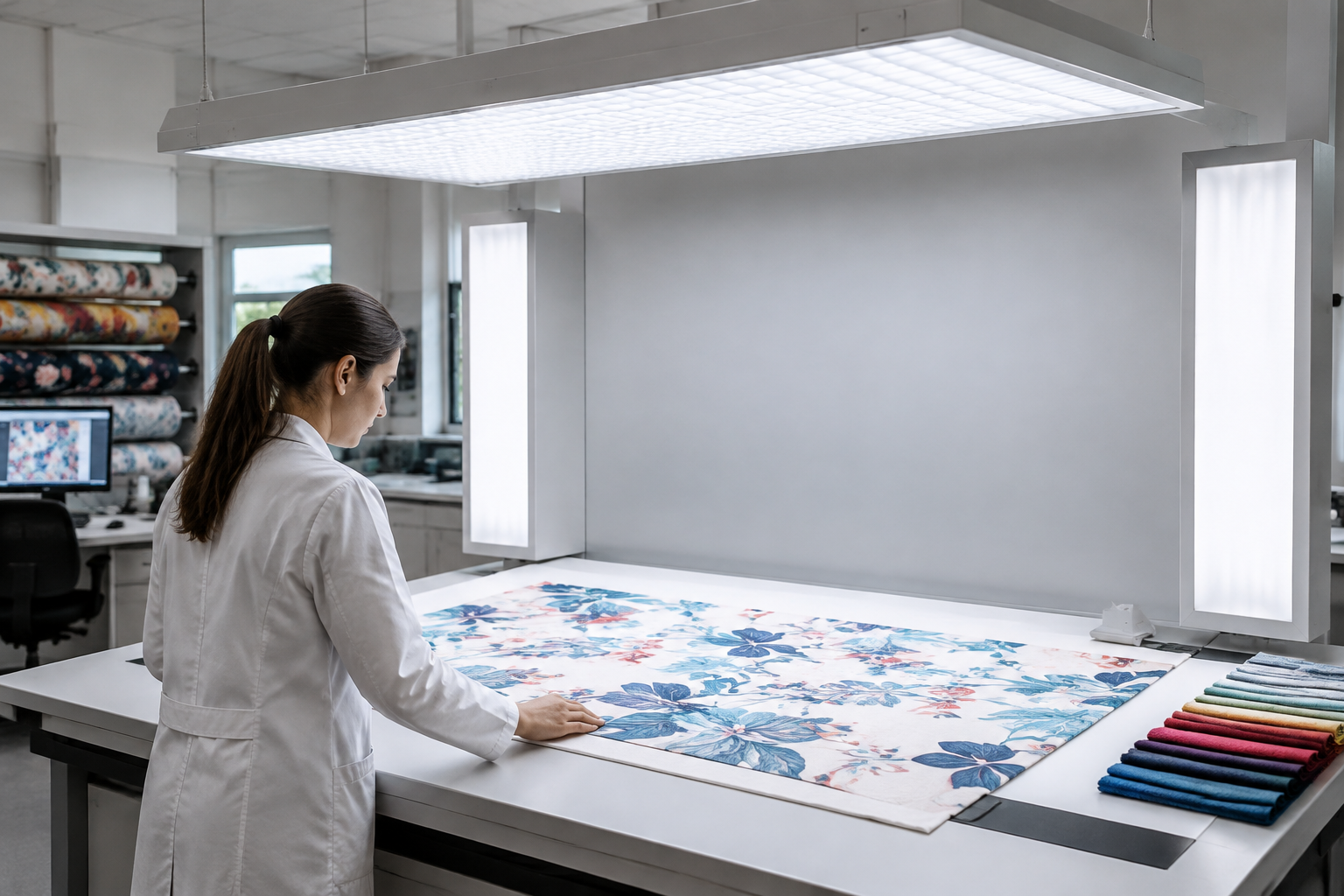 Print & Textile Inspection Lighting 2026: D65 CRI98 Guide: How do you achieve uniform illumination on the viewing surface?
Controls, Energy and Commissioning
Precise control is fundamental to the integrity of a colour inspection lighting system. DALI-2 digital control, particularly the DT8 standard for tunable white, is the premier choice for professional installations.
It allows for exact, repeatable setting of both intensity and CCT, ensuring that the calibrated D50 or D65 illuminant can be recalled perfectly with the press of a button. For retrofits or installations where new wiring is challenging, a wireless mesh system like Casambi offers comparable functionality with excellent reliability and a user-friendly app interface.
While occupancy sensors can switch lights off to save energy when the booth is vacant, the lighting must operate at 100% of its commissioned output during active inspection. Dimming is not used during evaluation, as ISO 3664 specifies a fixed illuminance level (2000 lux ±500 lux).
Photometric Files & Compliance
Verifiable performance is the cornerstone of a compliant lighting installation. At XHLWX, we provide comprehensive technical documentation for every custom luminaire, including IES and LDT photometric files.
These data files are essential for lighting designers and specifiers, enabling them to import the exact luminaire data into simulation software like DIALux or AGi32., >1500 lux), uniformity on the task plane, and UGR ratings (<16)—will be met.
This simulation process, guided by standards such as EN 12464-1 (and its widely used German counterpart, DIN EN 12464-1) or IES Recommended Practices (RP), de-risks the project. Furthermore, all our products carry CE, RoHS, and ErP certifications, ensuring they meet the stringent safety, material, and efficiency requirements for deployment across the EU, US, and Middle Eastern markets.
 Print & Textile Inspection Lighting 2026: D65 CRI98 Guide: Photometric files & compliance
Frequently Asked Questions
Q: Why Is a CRI of 98 Needed Instead of a Standard CRI 80?
A standard CRI 80 light source is inadequate because it omits critical portions of the colour spectrum, distorting the appearance of saturated colours. For colour matching, a CRI of 98, combined with a high R9 value (>90), ensures that the light source renders the fullest possible range of colours, just like natural daylight. This is crucial for avoiding costly colour mismatches between design, production, and final product, especially with deep reds, blues, and complex tones.
Q: What Is the Ideal Lux Level for a Colour Inspection Table?
The standard ISO 3664:2009 specifies a target illuminance of 2000 lux (± 500 lux) on the viewing surface for critical print evaluation. For less stringent textile comparison, levels around 1000-1500 lux are often sufficient, as recommended by IES RP-1. The key is to have a high level of uniform light across the entire surface to reveal any imperfections or colour variations without casting shadows.
Q: Does TM-30 Matter More Than CRI for Colour Matching?
TM-30 provides a more complete, two-part analysis of colour rendition than the single CRI score. The Fidelity Index (Rf) is similar to CRI, while the Gamut Index (Rg) describes colour saturation. For colour matching, an Rf score over 95 and an Rg score near 100 are ideal. While a high CRI (95+) is a good starting point, the TM-30 metrics give a more nuanced and reliable confirmation that the light source will not distort colour appearance.
Q: Can Existing Fluorescent Fixtures Be Retrofitted with D65 LEDs?
While technically possible, retrofitting fluorescent fixtures with LED tubes is not recommended for critical colour inspection. The optics of the old fixture were not designed for the directional nature of LEDs, leading to poor uniformity. More importantly, most retrofit tubes lack the specific spectral power distribution and calibration required to truly replicate the D65 illuminant. A purpose-built, integrated LED luminaire is the only way to guarantee ISO-compliant performance and reliability.
Sources and Technical References
- ISO 3664:2009: Viewing conditions — Graphic technology and photography
- CIE S 012/E:2004: Standard Illuminants for Colorimetry
- EN 12464-1:2021: Light and lighting — Lighting of work places — Part 1: Indoor work places.
- IES TM-30-18: IES Method for Evaluating Light Source Color Rendition.
- WELL Building Standard v2: Light Concept, Feature L07.
 Print & Textile Inspection Lighting 2026: D65 CRI98 Guide: Q: Does TM-30 matter more than CRI for colour matching?
Request a Custom Quote
Achieving perfect, repeatable colour fidelity in your quality control process begins with a lighting system designed for the task. Generic lighting is a liability; a specialized solution is an asset.
com), a Custom Indoor LED Lighting Manufacturer based in China, we engineer and build luminaires that meet the exacting demands of ISO 3664 and other international colour viewing standards. Contact our solutions team today to discuss your print or textile inspection project and receive a no-obligation proposal for a custom-calibrated D50/D65 lighting system.
Need a tailored lighting plan for your project?
Our senior lighting designers reply within 48 hours with a free design proposal & quotation.