
Residential Lighting Design 2026: A Warm-Dim & CRI90 Guide
Quick answer
Elevate high-end residential spaces with our 2026 guide. Learn to layer light, specify Warm-Dim and CRI90+ LEDs, and meet EN 12464-1 and WELL v2 standards.
Introduction — the Design Problem in High-End Residences
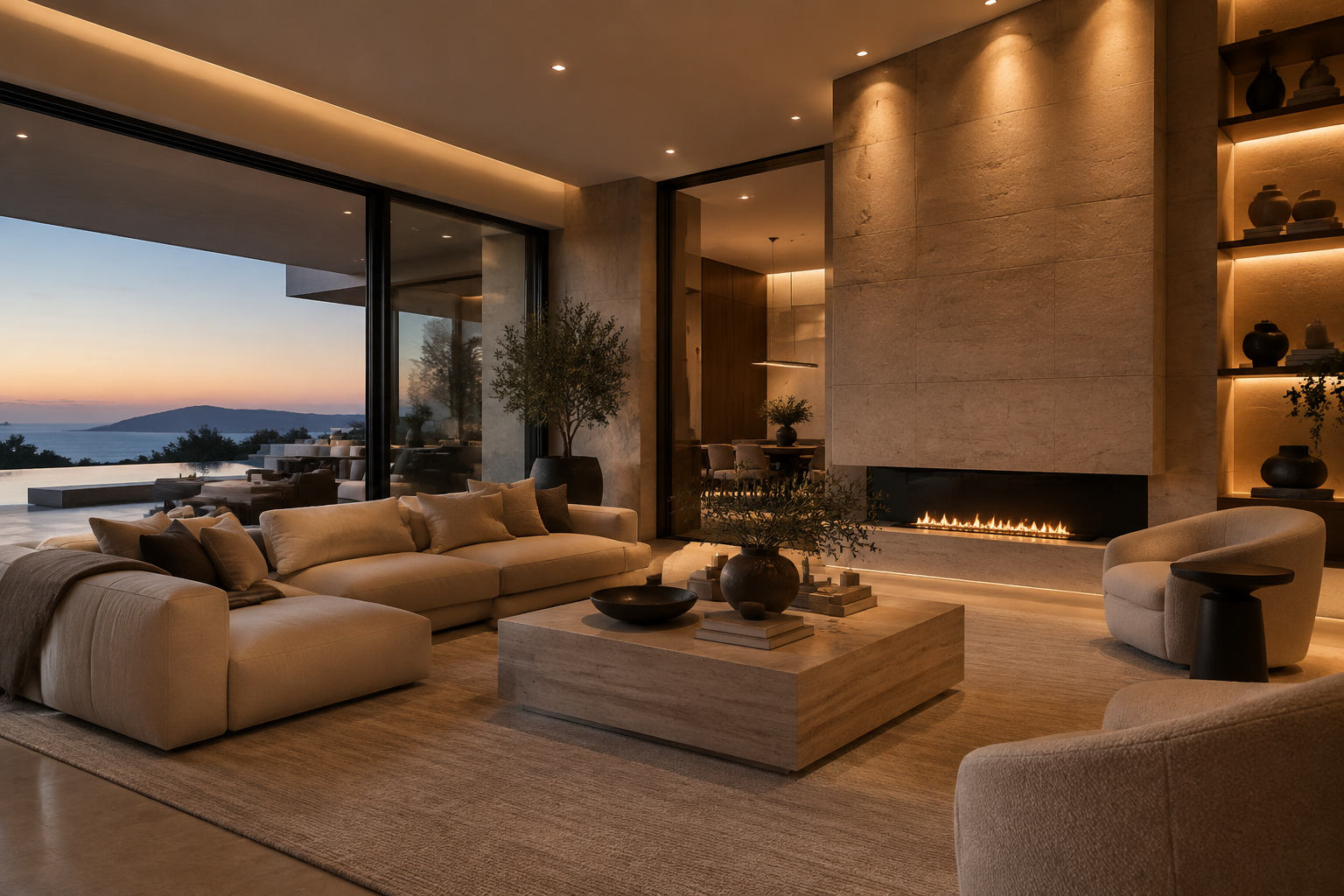
com), a Custom Indoor LED Lighting Manufacturer based in China, we observe a definitive evolution in high-end residential lighting, moving beyond mere illumination towards creating immersive, human-centric experiences. The design challenge is no longer just about providing light to see, but about using light as an architectural material to enhance mood, improve well-being, and accentuate the premium finishes of modern apartments and villas.
Homeowners and designers now demand dynamic, high-quality lighting that can adapt from a bright, functional environment for cooking or working from home to a warm, intimate atmosphere for relaxation and entertainment. This requires a sophisticated, layered approach that combines ambient, task, and accent lighting with superior color quality and intuitive control, a challenge that standard off-the-shelf solutions often fail to meet.
Lighting Criteria and Standards for This Application
Achieving exceptional residential lighting requires adherence to key performance metrics and international standards. While residential spaces are not as strictly regulated as commercial ones, best practices from standards like EN 12464-1 for task areas and the WELL v2 standard for health and well-being provide an excellent framework.
For task-intensive zones like kitchen islands or home offices, targeting an illuminance of 500 lux and a Unified Glare Rating (UGR) of <19, as recommended by EN 12464-1, ensures visual comfort and performance. The WELL v2 standard, particularly feature L07 (Electric Light Quality), emphasizes high color rendering, requiring a CRI Ra > 90.
, PstLM < 1) is critical for visual comfort. Integrating these technical targets into the design ensures the final installation is not only beautiful but also promotes a healthy living environment.
| Parameter | Recommended Specification | Standard / Best Practice | Notes |
|---|---|---|---|
| CCT / Color Shift | 3000K-1800K Warm-Dim | WELL v2 (L03) | Mimics natural daylight arc and incandescent dimming for circadian support and mood setting. |
| Color Rendering | CRI Ra > 95, R9 > 90; TM-30 Rf > 90, Rg ≈ 100 | WELL v2 (L07) | Ensures textiles, food, skin tones, and artwork are rendered vibrantly and accurately. |
| Glare Control | UGR < 19 (for task areas) | EN 12464-1 | Critical for visual comfort over kitchen counters and desks. Achieved via deep-recessed, low-glare optics. |
| Beam Angles | 15°, 24°, 36°, 60° | Designer Specification | A range of optics is needed: narrow for accent, medium for task, and wide for ambient fill. |
| Control Protocol | DALI-2 (DT8) / Casambi | N/A | DALI-2 offers robust wired control for new builds; Casambi provides flexible wireless control for retrofits. |
| Housing Protection | IP44 (min. for wet areas) / IK03 | IEC 60529 / EN 62262 | IP44 is required for downlights in bathrooms (Zone 2) and kitchens. IK rating indicates impact resistance. |
| Certifications | CE / RoHS / ErP / ISO9001 | EU/International Law | Essential for market access, safety, environmental compliance, and quality management. |
| LED Chip / Driver | Bridgelux Vesta® Series / Tridonic | Manufacturer's Choice | Using premium components ensures long-term performance, color stability, and system reliability. |
Luminaire Selection and Optics
Selecting the right luminaires and optics is crucial for executing a layered lighting design successfully. A well-designed residential space seamlessly integrates three distinct layers of light, each served by specific fixture types.
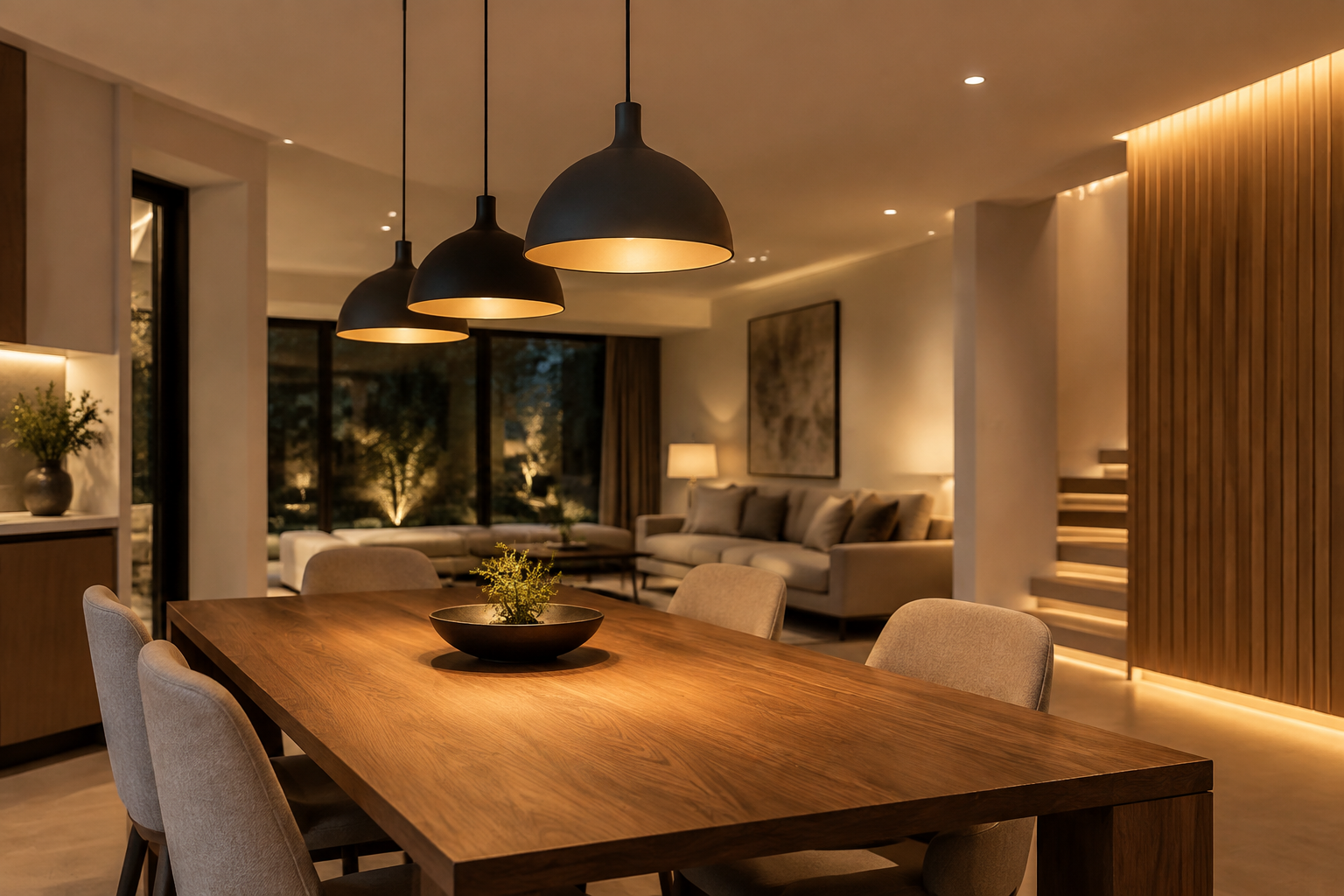
The ambient layer provides general, diffuse illumination using wide-beam downlights or indirect linear profiles in coves. The task layer delivers focused, higher-intensity light for specific activities, using adjustable downlights or under-cabinet fixtures.
Finally, the accent layer creates visual interest and highlights architectural details or artwork with narrow-beam, high-CRI spotlights. The key is using luminaires with high-quality optics, such as deep-set COBs with black baffles, to control glare and ensure light is delivered precisely where it's needed.
| Luminaire Type | Primary Application | Key Optical Feature | Verdict & Best Use Case |
|---|---|---|---|
| Deep Recessed Downlight | Ambient / General | Low-glare reflector (UGR<19) | Excellent. The workhorse for modern residential spaces. Use wide beams (36°-60°) for ambient fill and medium beams (24°) for circulation paths. |
| Adjustable Gimbal/Spotlight | Accent / Task | Narrow beam (10°-24°), high CRI | Essential. Perfect for highlighting artwork, architectural features, or providing flexible task lighting over a reading chair or kitchen counter. |
| Linear LED Profile | Ambient / Task | Diffuse or asymmetric lens | Highly Versatile. Use in coves for soft, indirect ambient light, or with a lens under cabinets for shadow-free task illumination on countertops. |
| Low-Level Wall Washer | Accent / Wayfinding | Asymmetric optic | Sophisticated. Creates a beautiful scalloped effect on textured walls and provides safe, low-level illumination for hallways and stairs at night. |
How Does Warm-Dim Technology Enhance Residential Living?
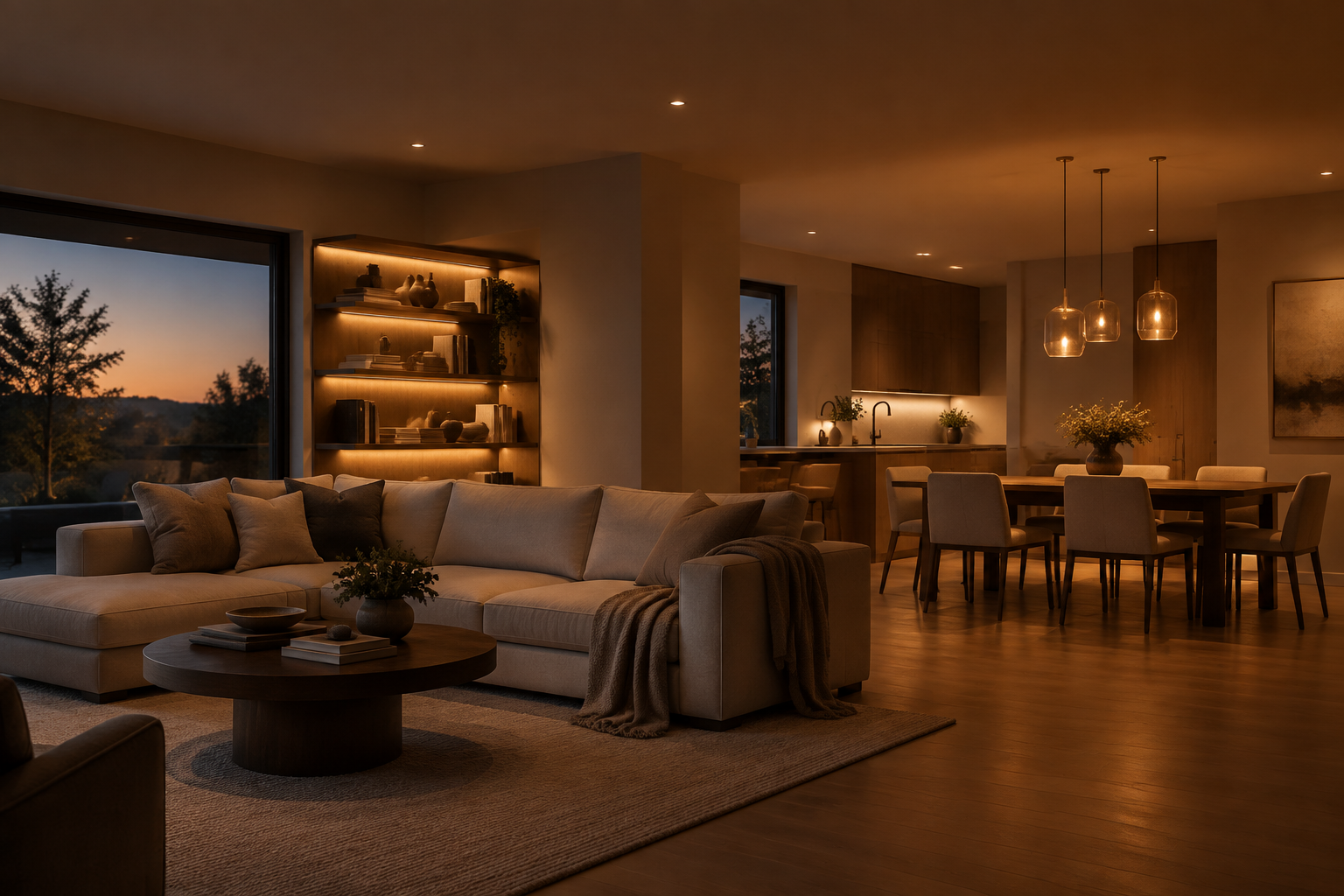
Warm-Dim technology emulates the intimate, cozy feeling of incandescent dimming for modern LED sources., 1800K) at its lowest level.
This dual function is transformative for multi-use spaces like living rooms and bedrooms. It allows a single lighting circuit to provide bright, clean light for daytime activities and then transition smoothly into a relaxing, atmospheric setting in the evening, aligning with our natural circadian rhythms and promoting rest.
What Is the Ideal CRI and TM-30 for Luxury Homes?
For luxury residences, a Color Rendering Index (CRI) above 90 is the minimum acceptable standard. However, for truly exceptional results that honor high-end materials and finishes, specifying CRI Ra > 95 and, critically, R9 > 90 is recommended.
The R9 value measures the accurate rendering of deep reds, which are prevalent in skin tones, natural wood, and food. For an even more comprehensive assessment, designers should look at TM-30-18 metrics.
A fidelity index (Rf) above 90 and a gamut index (Rg) between 98-102 ensure that colors are not only rendered faithfully but also appear vibrant and saturated, making interiors feel rich and alive.
How Do You Layer Light in a Master Bedroom?
Layering light in a master bedroom creates a versatile sanctuary for rest, reading, and dressing. The ambient layer should be indirect and fully dimmable, using cove lighting or a few wide-beam, Warm-Dim downlights set to a low level to avoid visual clutter.
The task layer is critical and requires dedicated circuits: a pair of adjustable, narrow-beam reading lights (wall-mounted or recessed) providing 300-500 lux on the reading plane, and high-CRI linear lighting inside wardrobes for clear visibility. An accent layer, such as a single low-wattage spotlight on a piece of art, adds a final touch of sophistication and creates a focal point.
 Residential Lighting Design 2026: A Warm-Dim & CRI90 Guide: How Does Warm-Dim Technology Enhance Residential Living?
Controls, Energy, and Commissioning (DALI-2 / Casambi / Sensors)
Advanced lighting controls transform a static installation into a dynamic, responsive, and energy-efficient system. For new builds, DALI-2 (Digital Addressable Lighting Interface) is the gold standard, offering individual luminaire control, precise scene-setting, and robust integration capabilities.
The DALI-2 DT8 standard is particularly relevant as it allows for simple control of Warm-Dim and tunable white luminaires with a single DALI address. For retrofits or projects where new wiring is challenging, Casambi's wireless Bluetooth Mesh technology provides a powerful and flexible alternative, controllable from a smartphone app or wireless wall switches.
Incorporating sensors, such as occupancy sensors in walk-in closets and bathrooms, adds convenience and energy savings., 'Cook', 'Dine', 'Relax'), set dimming curves, and ensure the entire system functions intuitively for the homeowner.
Photometric Files & Compliance (IES / LDT / DIALux / CE / RoHS / ErP)
Verifiable performance data and compliance documentation are non-negotiable for professional lighting projects. At XHLWX, we provide comprehensive photometric data for all our custom luminaires.
These are available as IES and LDT photometric files, which are essential digital tools for lighting designers. Designers import these files into simulation software like DIALux to accurately model and predict the lighting outcome in a virtual environment.
This process allows them to verify illuminance levels, uniformity, and UGR values against project requirements and standards like EN 12464-1 before a single fixture is ordered. Furthermore, all products for the European market must be fully compliant with regional regulations.
This includes CE marking for safety, RoHS for the restriction of hazardous substances, and ErP (Ecodesign) for energy efficiency, ensuring the project is not only well-lit but also compliant and sustainable.
 Residential Lighting Design 2026: A Warm-Dim & CRI90 Guide: Photometric Files & Compliance (IES / LDT / DIALux / CE / RoHS / ErP)
Frequently Asked Questions
Q: What Is a Good Lux Level for a Kitchen Island?
For a kitchen island used for food preparation and other tasks, a recommended illuminance target is 500 lux on the workplane, as suggested by the standard EN 12464-1. This ensures excellent visibility and safety. For the dining or seating area of an island, 200-300 lux is often sufficient, so using a separate, dimmable circuit is ideal to create different zones and moods.
Q: Why Is a High R9 Value Important for Residential Lighting?
A high R9 value, typically R9 > 90 for premium applications, is crucial because it measures how accurately a light source renders deep red colors. These colors are abundant in natural wood grains, fruits and vegetables, and human skin tones. Lighting with a poor R9 value can make these objects appear dull, flat, and unsaturated, detracting from the richness and quality of a high-end interior.
Q: Can I Mix Different CCTs in the Same Open-plan Room?
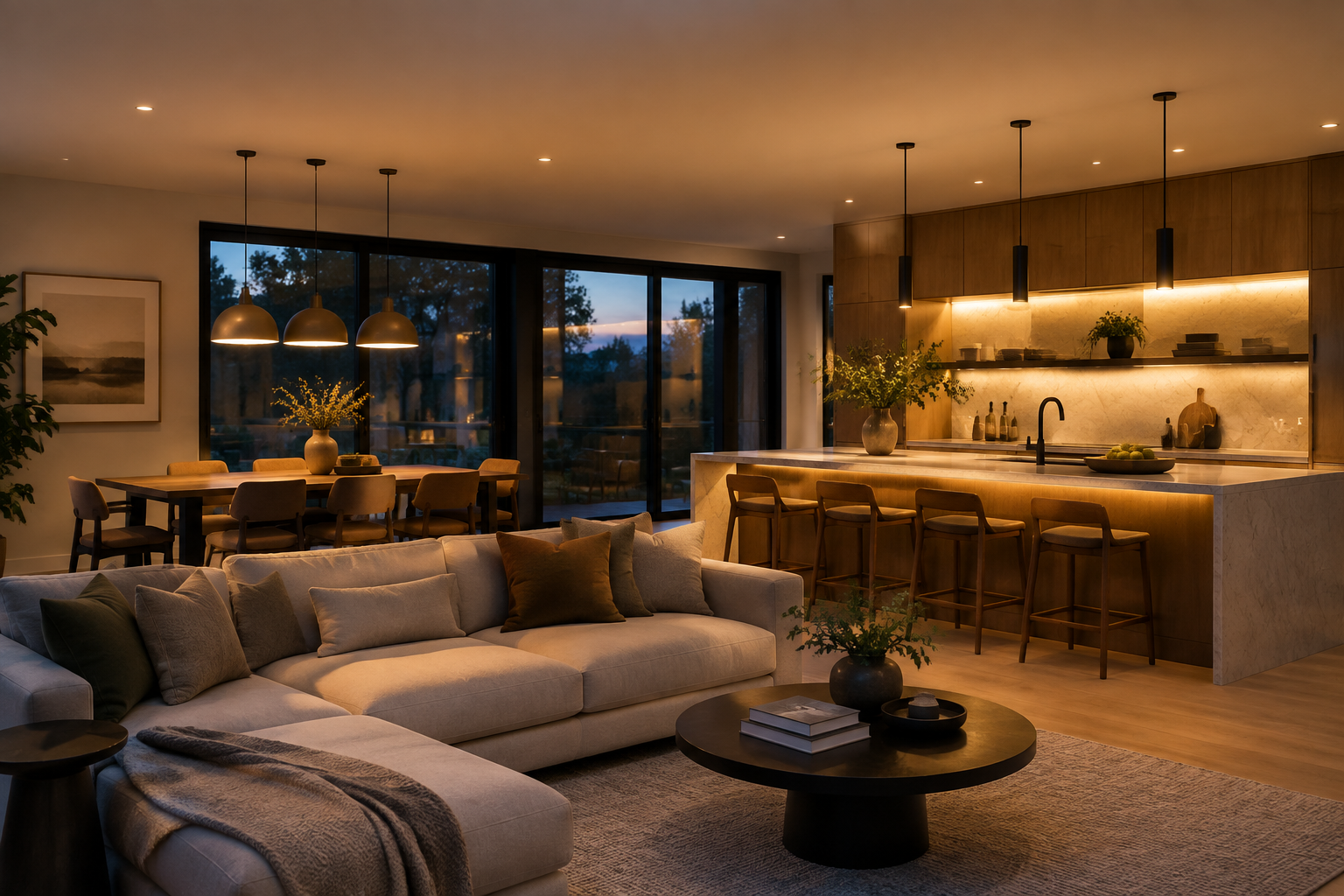
Yes, but it should be done with clear intent and control. The best practice is to keep the general ambient lighting at a consistent CCT (e.g., 3000K) while using different CCTs for specific tasks or effects, such as a cooler 4000K light concealed under cabinets for task-intensive food prep. Using tunable white or Warm-Dim technology provides the ultimate flexibility, allowing the entire room to shift CCT together.
Q: What IP Rating Do I Need for a Bathroom Downlight?
The required Ingress Protection (IP) rating depends on the luminaire's location within the bathroom zones. For a downlight installed directly above a shower or bath (Zone 1), a rating of IP65 is mandatory. For areas outside the immediate vicinity of the bath or shower but still subject to moisture, such as the general ceiling area (Zone 2), a rating of at least IP44 is required.
Sources and Technical References
- EN 12464-1:2021 Light and lighting - Lighting of work places - Part 1: Indoor work places.
- International WELL Building Institute: The WELL Building Standard v2 (features L03, L07).
- Illuminating Engineering Society (IES): ANSI/IES RP-16-10, Nomenclature and Definitions for Illuminating Engineering.
- TM-30-18 IES Method for Evaluating Light Source Color Rendition.
- IEC 60529: Degrees of protection provided by enclosures (IP Code).
 Residential Lighting Design 2026: A Warm-Dim & CRI90 Guide: Q: Can I mix different CCTs in the same open-plan room?
Request a Custom Quote
com), a Custom Indoor LED Lighting Manufacturer based in China, we specialize in creating luminaires that meet these exact specifications for projects across the EU, USA, and Middle East. Our engineering team can develop custom downlights, linear profiles, and spotlights featuring Warm-Dim technology, CRI 95+ color quality, and seamless DALI-2 or Casambi integration. Contact our engineering team to discuss your high-end residential project and receive a custom quote and photometric data to ensure your design vision is realized with precision.
Need a tailored lighting plan for your project?
Our senior lighting designers reply within 48 hours with a free design proposal & quotation.