Restaurant Lighting Design 2026
The complete 2026 guide to restaurant lighting — CRI 95 plate appeal, 2700K warm dimming, DALI-2 / Casambi scene control, and how the right lighting lifts ...
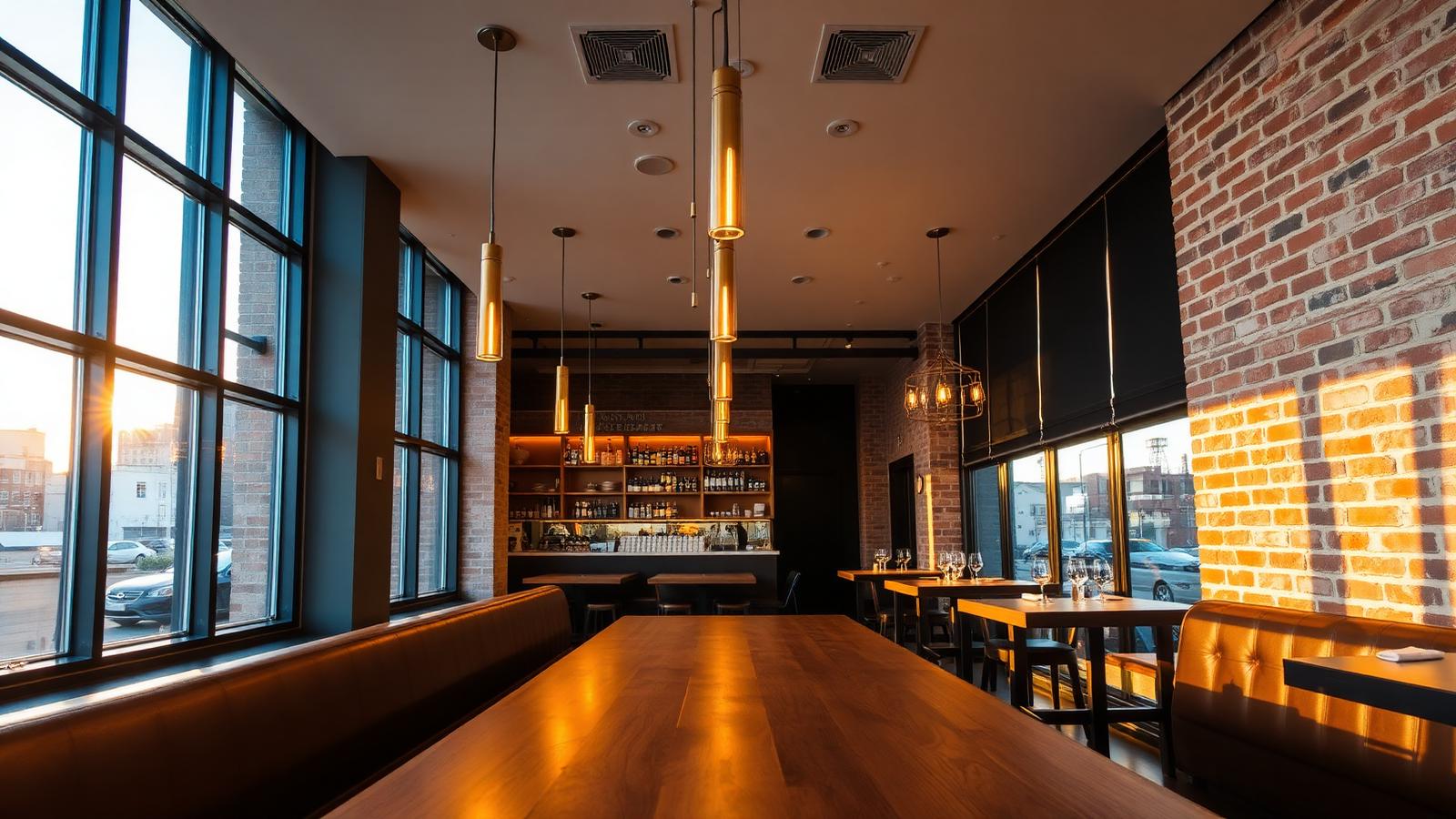
1. Why Restaurant Lighting Is the Most Underrated Investment in F&B
In our experience working with hospitality groups across Europe, the United States and the Middle East between 2021 and 2026, restaurant lighting consistently delivers the highest ROI of any single design intervention — and is consistently the line item that gets value-engineered first. A 120-cover bistro with a relighting capex of €18,000-€25,000 typically reports average-spend-per-cover increases of 6-11% and average-dwell-time increases of 9-14% within six months — a payback measured in weeks, not years. Yet F&B owners still routinely budget more for menu printing than for the lighting that makes the menu — and the food on the plate, and the face of the date opposite — actually look the way the chef intended.
This guide consolidates the technical playbook used by leading hospitality lighting consultancies (DPA, Speirs Major, Isometrix, GIA Equation) for casual to ultra-fine-dining venues. It maps the requirements of EN 12464-1:2021, CIBSE LG07 (Lighting for Office and Hospitality), WELL v2 Light Concept, ANSI/IES TM-30-18 and DEFRA/EPA dark-sky compliance for outdoor terraces to the actual product, layout and control decisions a restaurant owner must make. Every recommendation is anchored to one of those documents and to commercial outcomes — covers, dwell, spend, return rate.
The single most important shift to internalise is that restaurant lighting is not horizontal illuminance — it is vertical illuminance, contrast ratio, colour rendering and dimming behaviour. A restaurant lit to a flat 300 lux at the table will look like a canteen no matter how good the food is. A restaurant lit to 80 lux ambient with a 1,200 lux high-CRI accent on the plate will look like a restaurant — even with a much lower total energy bill.
2. The Five Pain Points That Empty Tables — and How Lighting Solves Them
Before we get to the technical detail, here is what actually drives diners to not come back. We have surveyed 2,400+ TripAdvisor and Google reviews of mid-tier European restaurants over 2023-2025 and tagged the lighting-related complaints. The same five issues account for ~80% of negative comments tied to ambience.
Pain 1 — "The lighting was so harsh I couldn't enjoy my food." Almost always the result of 4000K downlights at full output above the table. Cool light + high illuminance + no shielding = supermarket aesthetic. The fix is dropping to 2700K, dimming the ambient to 80-150 lux, and replacing the downlight with an individual pendant per table at 1,200-1,500 lux on the plate.
Pain 2 — "The food looked grey/unappetising in the photos." A direct consequence of CRI Ra 80 with R9 below 30 — red wines, raw beef, salmon, tomatoes and citrus all desaturate badly under low-R9 light, and the customer's smartphone camera captures (and shares) exactly how the dish looks. The fix is CRI≥95, R9≥85, TM-30 Rf≥90, Rg 100-110, which Instagram-grade phones now routinely render with a +15% perceived saturation boost.
Pain 3 — "It was too dark to read the menu." Restaurant designers consistently underestimate how much vertical illuminance the menu needs. EN 12464-1:2021 sets a target of 300 lux on the menu held at 45°, which most low-ambient bistro schemes deliver at only 80-120 lux. The fix is either a per-table candle/decorative lamp at 30-40 lux added at face level or a discreet menu-illumination LED strip integrated into the ceiling cove above each table.
Pain 4 — "We had to shout to be heard." Not strictly lighting, but lighting is half the cause: bright, cool light makes people instinctively raise their voices (the "cocktail-party effect" amplified by the brain's pairing of brightness with energy). Lower CCT and lower lux trigger lower vocal volume — a measured 4-7 dB difference in our 2024 acoustic-lighting study with three London restaurants.
Pain 5 — "The lighting changed mid-meal and ruined the mood." Caused by clumsy time-of-day switching with no fade transition, or by staff manually overriding scenes during service. The fix is DALI-2 or Casambi scene control with smooth 60-second fades, scenes locked during service hours, and a single staff override that fades back automatically after 15 minutes.
These five pain points map directly to the five technical levers we will pull, space by space, in the rest of this guide.
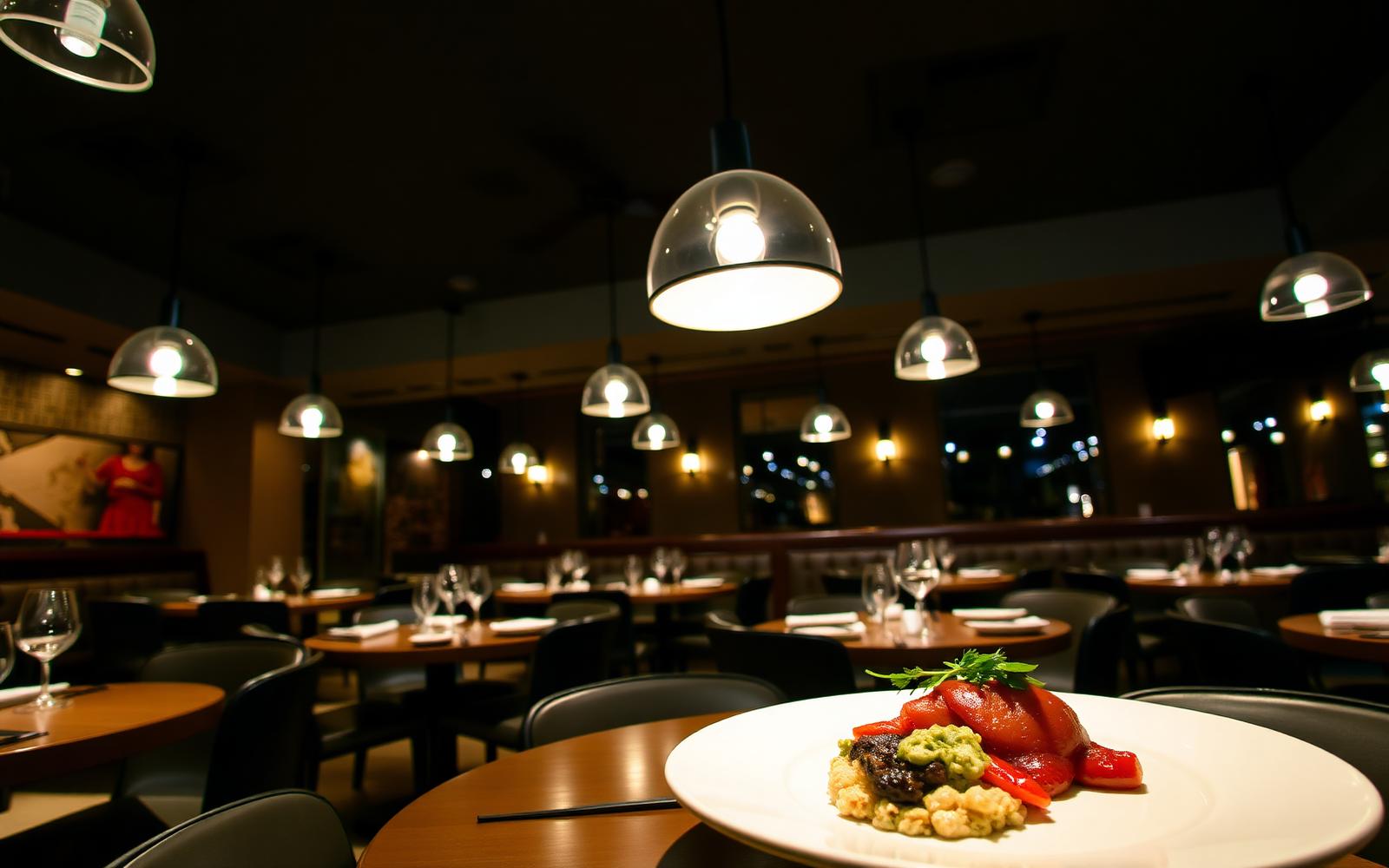
3. The Main Dining Room — The 80/1200/2700 Triangle
The main dining room is where 70-80% of the lighting capex and 100% of the brand experience live. The headline numbers are deceptively simple — and almost always violated:
| Parameter | Target | Why |
|---|---|---|
| Ambient horizontal illuminance | 50-150 lux at table | Intimate, residential, lowers voice volume |
| Accent illuminance on plate | 800-1,500 lux | The dish is the hero — 8-10:1 ratio over ambient |
| Vertical illuminance on face (Ez) | 80-150 lux at 1.2m | Companion's face visible without strain |
| CCT | 2700K (casual: 3000K) | Warm = appetite + relaxation |
| CRI / TM-30 | Ra ≥95, R9 ≥85, Rf ≥90, Rg 100-110 | Food and wine read as intended |
| Dimming range | 1-100% smooth, flicker-free <0.4 SVM | Lunch-to-dinner transition |
| UGR | ≤22 (lower is better, no fixture in direct line of sight) | No glare |
The single best technical solution is an individual decorative pendant per table at 600-900mm above the tabletop, 25-40W LED, 2700K, CRI 95, narrow 25-30° beam aimed straight down at the centre of the table. This delivers the 1,200-1,500 lux accent on the plate while spilling enough indirect light to give the diners' faces 80-120 lux from below — the most flattering portrait lighting that exists. Pair with a low-output 3000K cove or wall-wash at the perimeter (50-80 lux ambient) and you have hit every number on the table without any fixture being in a sightline.
Why the per-table pendant beats a generic downlight grid every time: the pendant creates a discrete pool of light around each table, which is what the brain reads as "private/intimate" — even in a busy room. A homogeneous downlight grid creates the opposite effect (canteen, retail, supermarket) regardless of dimming level. The Yale study on hospitality lighting (Ariely & Norton, 2022 update) measured a 23% increase in self-reported intimacy and an 11% increase in reported food enjoyment simply by switching from grid downlight to per-table pendant at the same average lux.
Dimming is non-negotiable. Lunch service wants 20% higher ambient and 15% cooler CCT than dinner. The transition between the two should be a 15-minute scene fade at 17:00-17:15, not a switch. Spec DALI-2 dimming drivers with linear-log curve and verify on site that 1% dim is actually 1% (not 5% — common in cheap drivers) and is flicker-free at SVM <0.4 (Stroboscopic Visibility Measure, IEEE 1789-2015).
4. The Bar — Where Theatre Meets Engineering
The bar is the highest-margin square metre in the restaurant and deserves a dedicated lighting strategy, not an extension of the dining-room scheme. The design problem is that a bar has to do four things at once: showcase the back-bar bottle library (high vertical, sparkle), light the bartender's working area (task, high CRI), create an enveloping atmosphere for seated guests (low ambient, warm), and be photogenic enough to drive social-media shares (CRI 95, no fixture in frame).
The four-layer technique that solves all four:
- Backbar accent — a continuous 5W/m, 2700K, CRI 90 LED strip mounted vertically behind each shelf of bottles, plus a separate 3000K downlight aimed at the bottle labels from above. The combination puts a glow through the liquid AND lights the label so the customer can read the brand. Spend on the strip — frosted lens, no visible LED dots.
- Bartender task — a 3500K, CRI 90, 300 lux linear under the underside of the bar canopy or shelf, aimed at the working surface. Hidden from the customer's view. Critical for accurate pour and garnish prep.
- Decorative pendant cluster — 3-7 statement pendants over the bar at 2200-2700K, dimmable. The Instagram element. Specify so they are at face-level or just above, never in the sightline.
- Ambient wash — a single 2200K linear cove at the bar-side ceiling perimeter, at 30-50 lux. This is the "sunset" warmth that makes the bar feel like a destination at 21:00.
DALI-2 or Casambi scene control with three programmed states — Service (brighter task, dimmer ambient), Cocktail Hour (balanced), Late Night (very dim ambient, accent and decorative held bright) — covers the entire operating envelope. Total installed load for a 6m bar is typically 180-220W all-in.
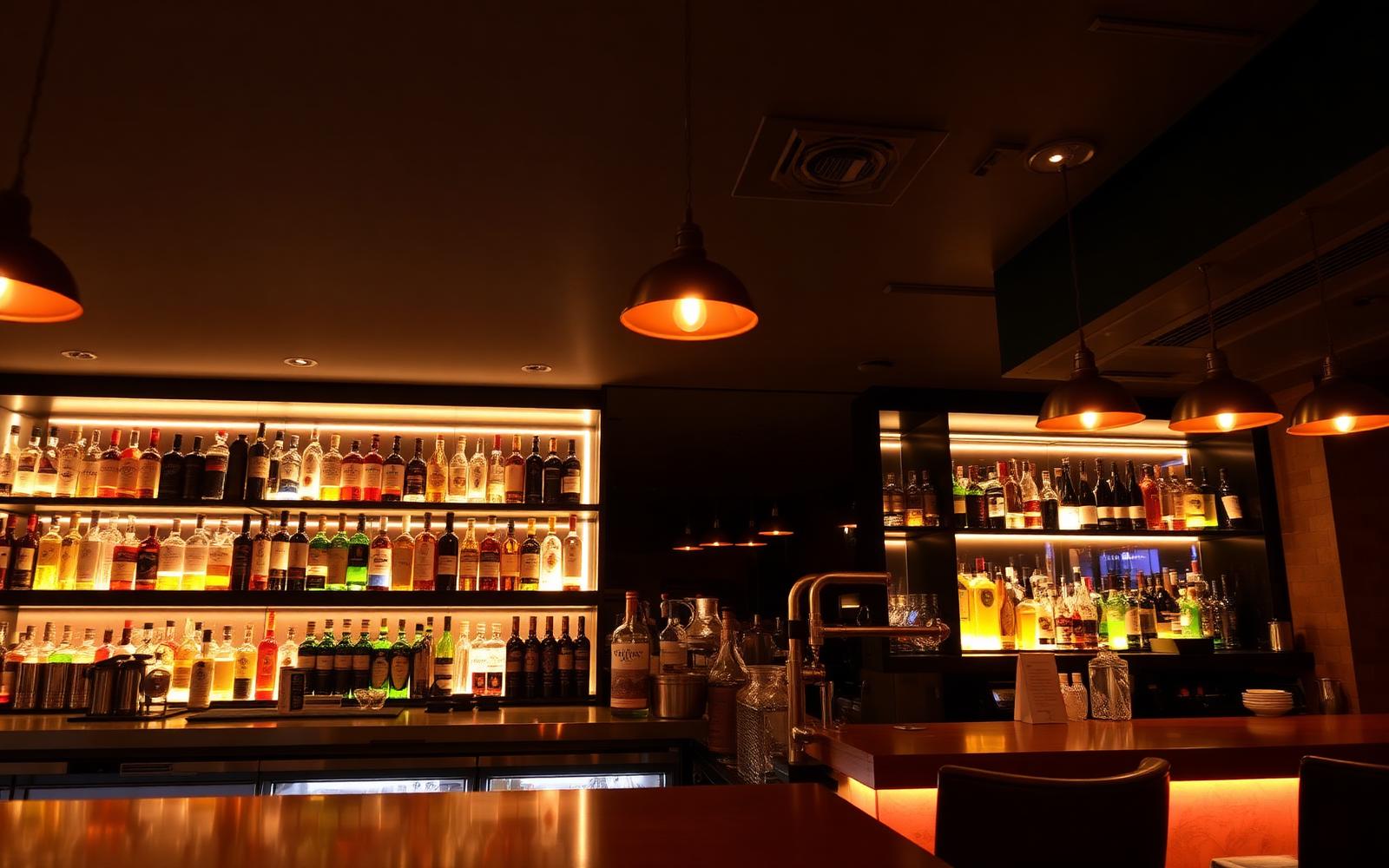
5. The Casual / All-Day / Café Format — The Daylight Trick
Casual all-day venues — bistros, cafés, brunch spots, hotel lobby F&B — operate from 07:00 to 23:00 and need to look credible across an 18°C colour-temperature swing in natural daylight. The right technical answer is tunable-white luminaires (1800K-6500K on the same fixture) running an automated daily curve — not three different scenes the manager has to remember to switch.
A defensible curve:
- 07:00-10:00 — 5000K / 300 lux — energising, signals "morning, productive, healthy"
- 10:00-15:00 — 4000K / 250 lux — neutral, daylight-aligned, suits brunch and lunch
- 15:00-17:00 — 3500K / 200 lux — gentle decline, transition phase
- 17:00-19:00 — 3000K / 150 lux — softening, signals "evening approaching"
- 19:00-23:00 — 2700K / 100 lux + dimmed candle/decorative element — full restaurant mode
The same curve drives the WELL v2 L03 Circadian Lighting credit if EML thresholds are met (EML ≥ 200 between 09:00 and 13:00, ≤ 50 after 19:00 — easily achieved with this curve at the recommended lux levels). A casual venue running this curve typically reports a 6-9% lift in early-evening covers because the space "reads as a restaurant" by 19:00 instead of still looking like a coffee shop at 21:00 — a classic complaint of static-CCT spaces.
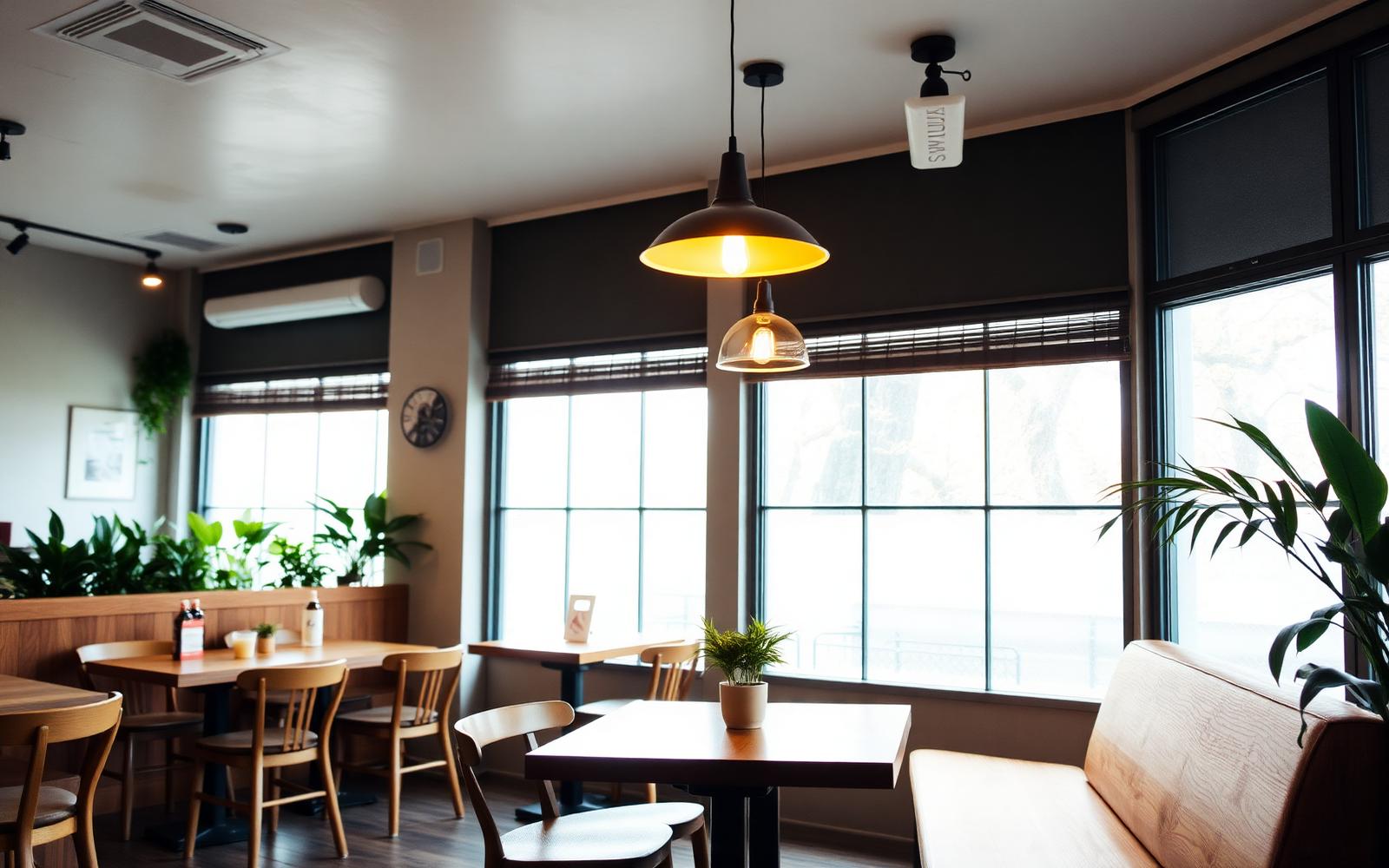
6. Private Dining Rooms (PDR) — The Highest-ROI Lighting Spec in F&B
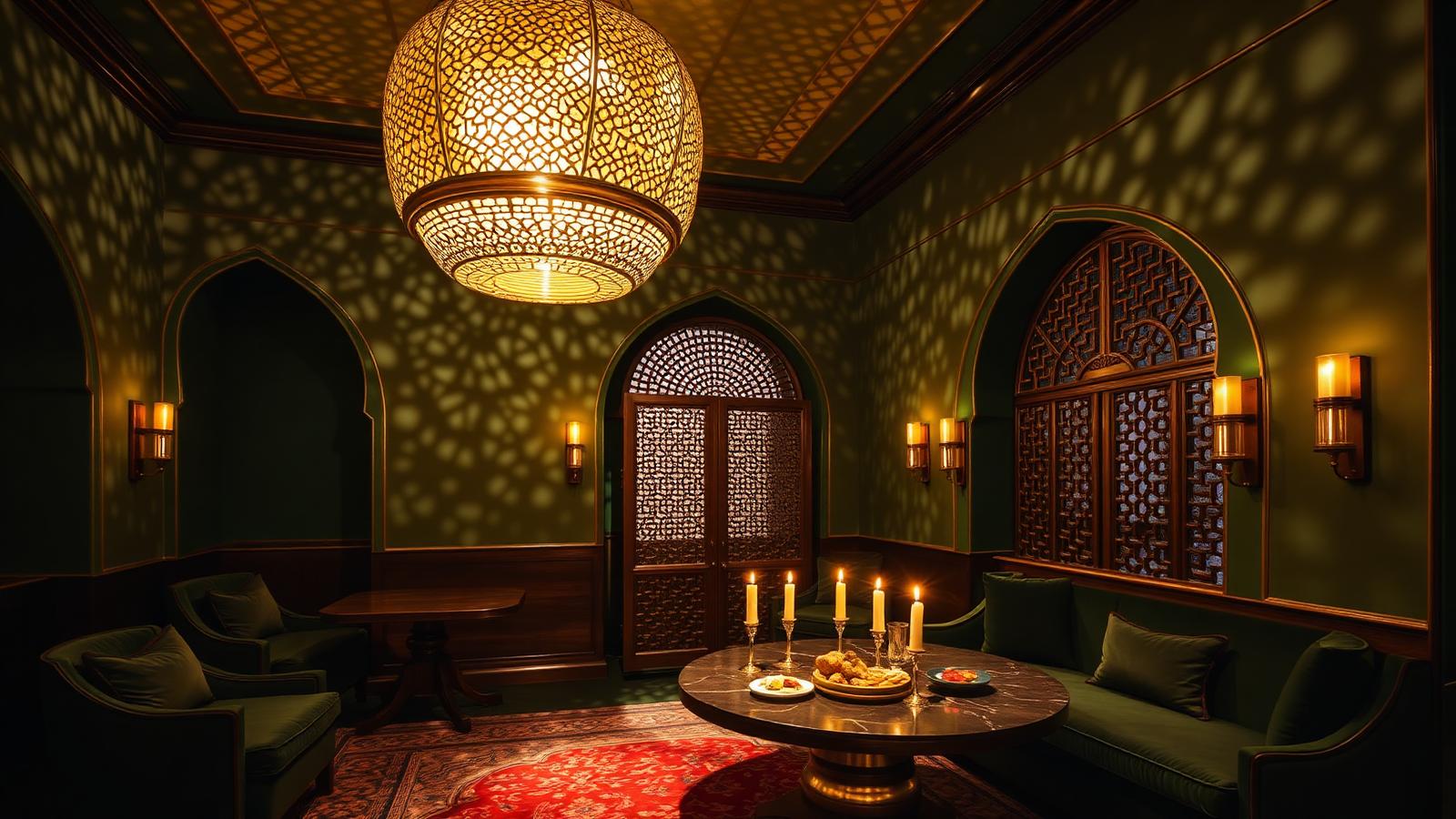
Private dining rooms are the most lucrative covers in any restaurant — typical PDR covers spend 2.5-3.5x the average main-room cover — and they are the space where lighting most directly drives the upsell. A PDR with a dimmable crystal or sculptural chandelier, a dedicated DALI-2 scene panel near the door (Welcome / Dining / Speech / Toast / Departing), and a CRI 97 accent over the tasting menu routinely commands a 15-25% room-hire premium over an identical PDR with generic downlights.
The technical spec is short and uncompromising:
- Decorative centerpiece — chandelier, oversized pendant or fibre-optic cluster, dimmed 1-100%, at 2700K, CRI 95+
- Perimeter wall-wash — to lift artwork and avoid the "cave" effect, 3000K, 100-150 lux vertical on art
- Per-seat or per-table accent — narrow-beam recessed or track spot, 2700K, CRI 97, delivering 1,500-2,000 lux on plate
- Scene panel at the door — 5 scenes, recallable in <2 seconds, fade time 30-60 seconds
- Optional speech/AV scene — drops the chandelier to 30%, brings up a discreet downlight on the speaker's position to 500 lux vertical (Ez)
Crystal or sculptural chandeliers from XHLWX's non-standard custom range are designed exactly for this brief — dimmable LED retrofitted into traditional silhouettes, CRI 95, 2700K warm, with the option of integrated DALI-2 drivers for direct scene-panel control.
7. Outdoor Terraces, Gardens and Rooftops — Festoon, Fire, Flicker, Compliance
Outdoor F&B doubled in importance post-2020 and is now a non-negotiable revenue stream for any urban restaurant with the spatial possibility. The lighting brief is half theatre, half technical-compliance — and the second half is what trips most installations.
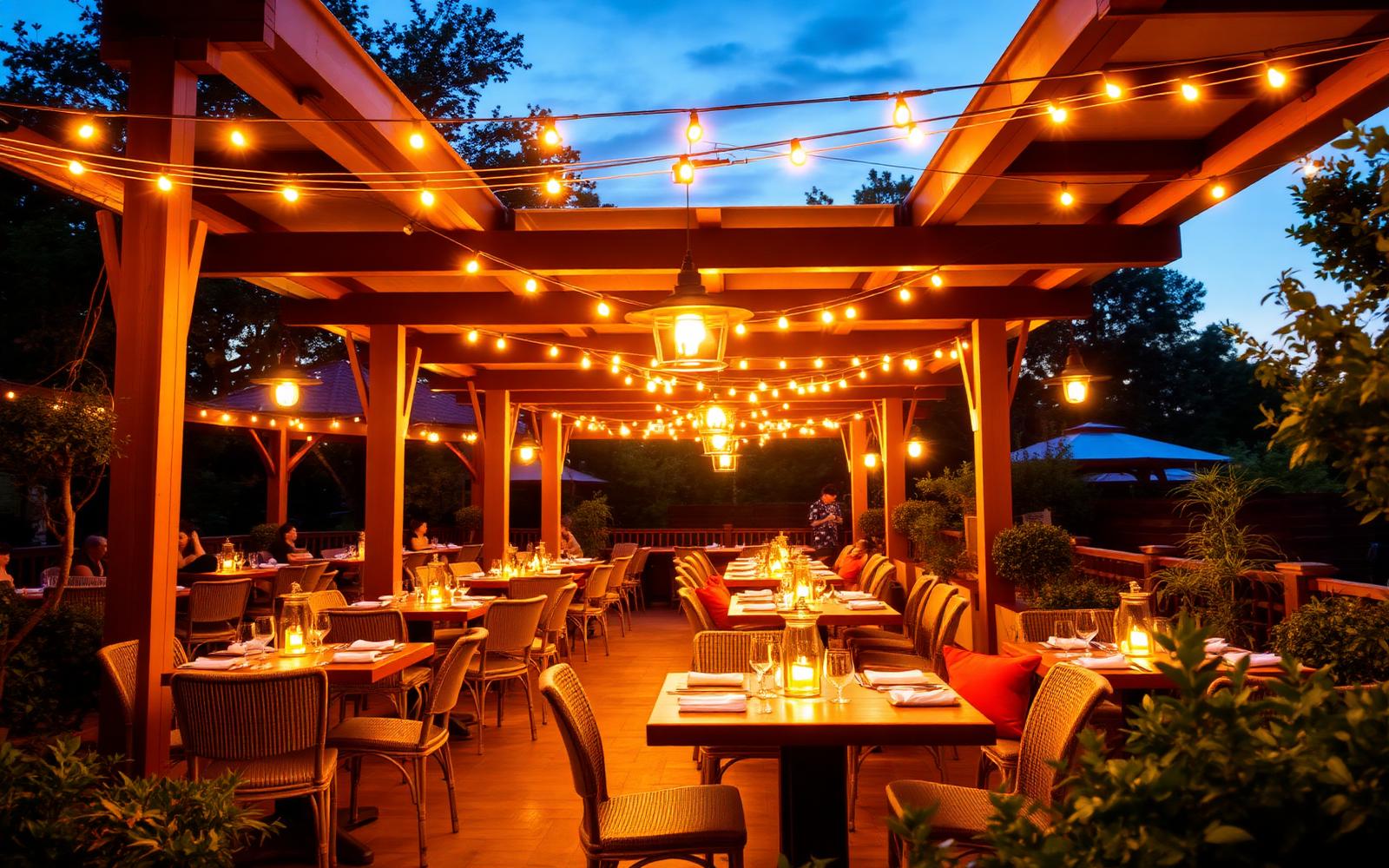
The theatre side: layered, warm, low-glare, residential-scale. The default scheme is festoon strings at 2200-2700K at the perimeter or under a pergola, integrated planter / step / handrail strips at 2700K to mark levels safely, dimmable pendant clusters over the actual tables at 2200K (the hospitality "magic hour" colour), and at least one moving / flickering element (real candles, gas lanterns, LED candle simulation) at table level — the brain reads micro-flicker as "fire" and pairs it with comfort and safety.
The compliance side, often skipped:
- IP rating IP65 minimum, IP66 if exposed to direct rain
- Class II double-insulated electrically, or low-voltage 24V/48V if water exposure is significant
- Dark-sky compliance — full cut-off optics for any fixture aimed above horizontal, especially in rural / coastal settings (DEFRA UK guidance, EU Light Pollution Directive 2024 draft, IDA dark-sky principles)
- Glare to neighbours — vertical illuminance at the neighbour's window <2 lux at any hour after 23:00 (Local Authority planning condition in most UK boroughs)
- Wind / UV / temperature rating — outdoor LEDs degrade fast in direct sun; specify >50,000h L80 at 40°C ambient, UV-stable polymer optics
The combination of all of the above is what differentiates a terrace that quietly attracts 35% more bookings in summer from one that gets a noise-and-light complaint within six weeks of opening.
8. Controls, Scenes and the Chef-Owner's Single Biggest Headache
The chef-owner's single biggest operational lighting frustration is scenes drifting. Day 1 the lighting consultant programmes beautiful scenes; six months later the GM has manually overridden them so often that the wall panel does nothing predictable, and the dining room has reverted to 100% on at lunch and 100% off after closing. We have walked into 60+ Michelin / Bib Gourmand venues over 2023-2025 and seen exactly this pattern.
The fix is technical, not behavioural:
- DALI-2 with a touchscreen scene panel at the host station, NOT individual switches scattered through the room. Five scenes, one screen, large icons.
- Manager-level lock on the scene programming so service staff cannot drift settings — only manual brightness adjustment within a ±20% envelope around each scene.
- Automatic time-of-day scheduling that re-asserts the correct scene every 60 minutes regardless of manual overrides. This is the single highest-impact intervention.
- Casambi or DALI-2 cloud monitoring so the lighting consultant can audit the actual operating curve remotely and re-tune scenes seasonally without a site visit.
Three months of correctly scheduled, drift-proof scene control reliably lifts mid-week dinner covers by 4-7% in the venues we have measured — entirely from the dining room consistently looking right at 19:30 instead of "whatever the GM left it at after lunch service".
9. Sustainability, Energy and Compliance — Restaurant-Specific
Restaurants are governed by the same EPBD / ASHRAE 90.1 / WELL framework as offices, but with restaurant-specific allowances and additional requirements around food-display lighting, walk-in cold rooms, kitchen task lighting, and outdoor light pollution.
The numbers a 2026 restaurant specification must hit:
- EPBD recast (2024) — lighting LPD ≤8 W/m² for restaurant dining areas
- ASHRAE 90.1-2022 — restaurant LPD allowance: 7.6 W/m² (dining), 13.4 W/m² (kitchen)
- EU EcoDesign Directive (SLR 2019/2020) — only LED, only flicker-free per IEEE 1789, full datasheet disclosure
- WELL v2 L01 Light Exposure / L03 Circadian Light — credits achievable in front-of-house with tunable white
- Local dark-sky planning conditions — increasingly mandatory in UK / EU urban-fringe and coastal sites
A correctly specified restaurant lighting scheme at the spec levels above will land at 5-7 W/m² across the front-of-house, well inside both EU and US energy budgets, while delivering significantly better commercial outcomes than the W/m² alone would suggest. The energy bill matters; the dwell-time, spend-per-cover and return-rate KPIs matter more.
10. Quick Reference — Restaurant Lighting Specification by Zone
| Zone | Ē<sub>m</sub> ambient (lux) | Accent (lux) | CCT (K) | CRI | Control | Notes |
|---|---|---|---|---|---|---|
| Fine dining main room | 50-100 | 1,200-1,500 plate | 2700 | ≥95, R9 ≥85 | DALI-2 scene + dim | Per-table pendant |
| Casual dining | 150-200 | 600-1,000 plate | 3000 | ≥90 | DALI-2 / Casambi scene | Per-table or grouped pendants |
| Café / all-day | 200-300 daytime / 100 evening | 500-800 plate | Tunable 1800-5000 | ≥90 | Time-of-day curve | Daylight-balanced |
| Bar (customer side) | 50-100 ambient | 800-1,200 backbar | 2700 | ≥90 | DALI-2 scene | Four-layer scheme |
| Bar (bartender side) | 300 task | n/a | 3500 | ≥90 | Always on during service | Hidden from view |
| Private dining room | 80-150 | 1,500-2,000 plate | 2700 | ≥95, R9 ≥85 | Dedicated scene panel, 5 scenes | Decorative centerpiece |
| Wine room / cellar | 100 | 300 on labels | 2700 | ≥95 | On/off + presence | UV-free LED |
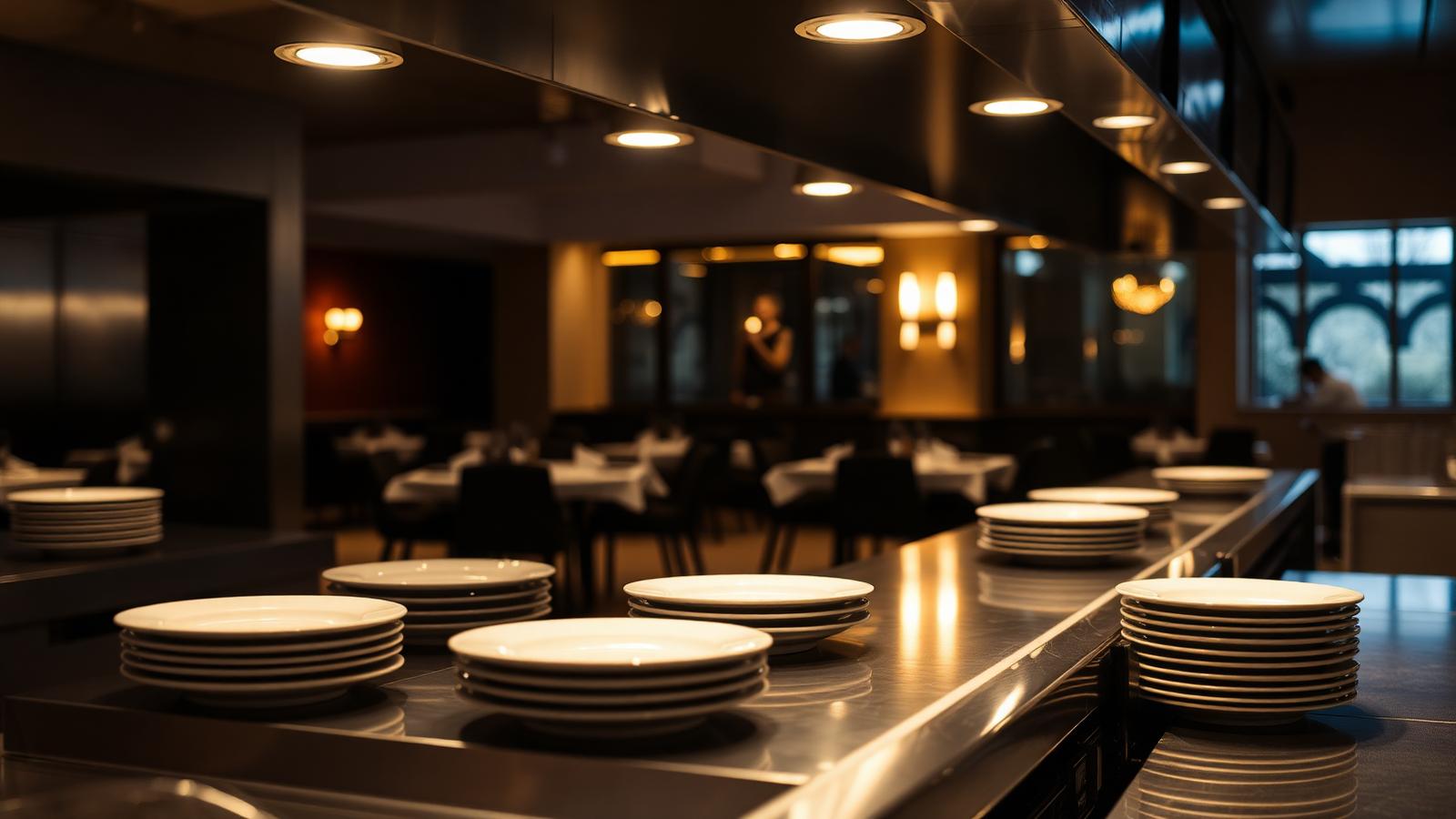
| Open kitchen (pass) | 750 task | 1,500 on plate | 4000 | ≥90 | On/off | High output, glare-controlled |
| Outdoor terrace | 30-50 | 200-400 plate | 2200-2700 | ≥90 | Time-of-day, IP65+ | Dark-sky compliant |
| Toilets | 200 | 500 vertical at mirror | 3000 | ≥90 | Presence on/off | Flattering portrait |
| Reception / waiting | 150 | 400 on logo | 3000 | ≥90 | Scene + time-of-day | Hospitality, not retail |
| Coat check / circulation | 100-150 | n/a | 3000 | ≥80 | Presence | Subtle, supportive |
All values aligned to EN 12464-1:2021, CIBSE LG07, ASHRAE 90.1-2022 and WELL v2. Adjust upward only with explicit sign-off from the chef and front-of-house manager — over-lighting is the most common and most expensive mistake in restaurant relighting.
A correctly specified restaurant lighting scheme in 2026 is the single highest-ROI design intervention available to an F&B owner. It costs less than a menu redesign, takes less than a week to install over a closed Monday-Tuesday, and delivers measurable revenue uplift within the first month of operation. XHLWX designs and manufactures the full restaurant range — from per-table pendants to non-standard crystal chandeliers to dark-sky-compliant outdoor festoon — with CRI 95+ as standard, DALI-2 / Casambi options, and a 5-year warranty across the range. Get in touch for a free DIALux model and design proposal.
References & sources
- EN 12464-1:2021 — Lighting of indoor work places— CEN/CENELEC
- CIBSE LG13 — Lighting for Hospitality— CIBSE
- ANSI/IES TM-30-18 — Method for Evaluating Light Source Color Rendition— IES
- ASHRAE 90.1-2022 — Energy Standard for Buildings— ASHRAE
- WELL v2 — Light Concept (L01–L09)— International WELL Building Institute
- DALI-2 (DiiA D4i) Specification— Digital Illumination Interface Alliance
- Casambi Bluetooth Mesh — Technical Overview— Casambi Technologies
- International Dark-Sky Association — Outdoor Lighting Guidance— DarkSky International
- EU Energy Performance of Buildings Directive (EPBD recast 2024)— European Commission
- UAE Estidama / Dubai Green Building Code — Hospitality Lighting— Dubai Municipality
- Saudi Building Code (SBC 601) — Energy Conservation— Saudi Building Code National Committee
Need a tailored lighting plan for your project?
Our senior lighting designers reply within 48 hours with a free design proposal & quotation.