
Sports Hall Lighting Design 2026: EN 12193 & IK10 Guide
Quick answer
Sports hall and badminton court lighting to EN 12193: 500–750 lux, uniformity ≥0.7, UGR<19, flicker-free drivers for cameras and IK10 ball-proof high bays.
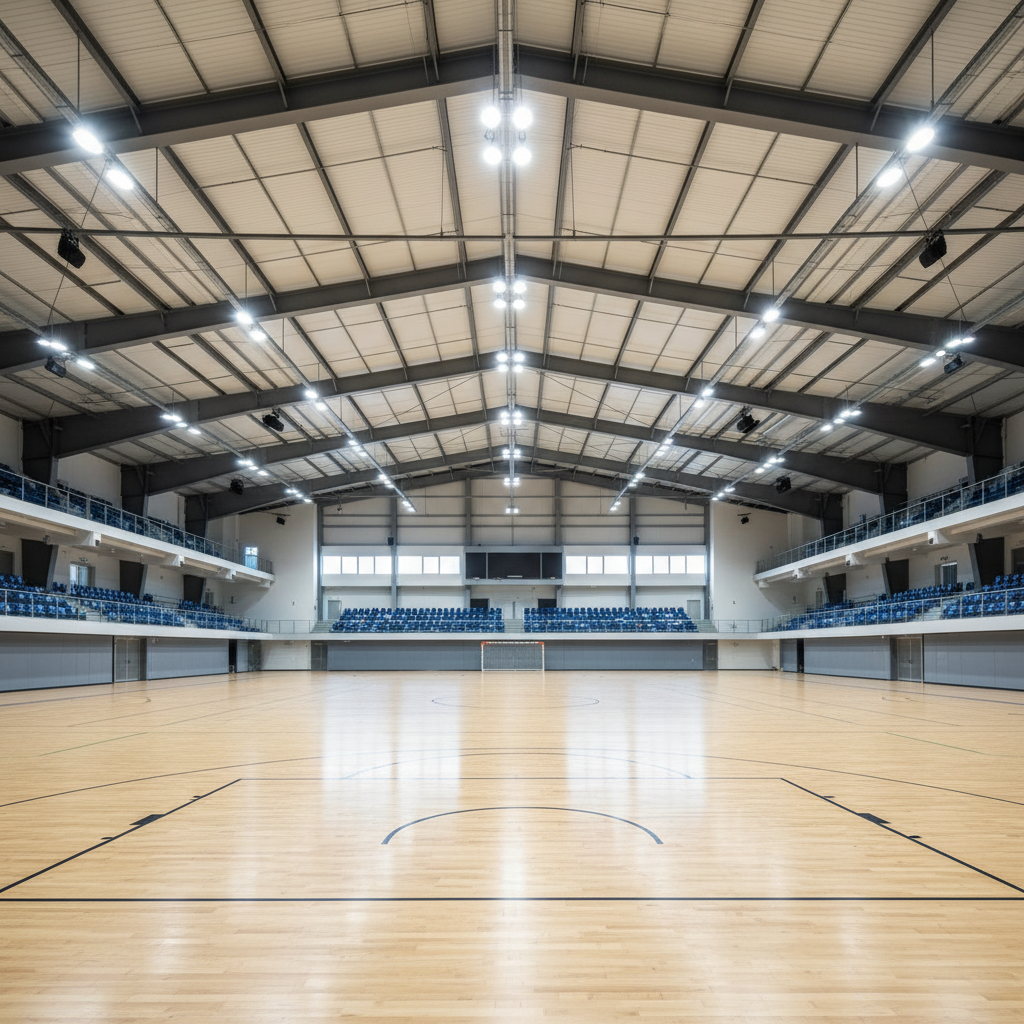
Introduction — the Design Problem in Multi-Purpose Sports Halls
Designing effective lighting for a multi-purpose sports hall presents a complex challenge, balancing the diverse needs of various sports, spectator comfort, and broadcast-quality visuals.com), a Custom Indoor LED Lighting Manufacturer based in China, we understand that a successful solution must deliver exceptional durability, precise optical control, and intelligent energy management.
The core problem lies in creating a single lighting system that can be adapted for fast-paced activities like basketball, slower-paced events like community gatherings, and the stringent demands of television coverage, all while ensuring player safety and minimising operational costs.
Modern sports facilities are no longer single-use venues. They host a range of activities, from school-level badminton training to national-level volleyball competitions.
This versatility demands a lighting system that is equally adaptable. Key considerations include providing sufficient horizontal and vertical illuminance, maintaining high uniformity, controlling glare to prevent disabling vision for players looking upwards, and ensuring the physical robustness to withstand direct ball impacts.
Furthermore, with the rise of streaming and broadcasting, flicker-free operation and high colour fidelity have become non-negotiable requirements.
This guide outlines the critical standards, luminaire specifications, and design methodologies required to deliver a high-performance, future-proof lighting installation for multi-purpose sports halls.
Lighting Criteria and Standards for This Application
Compliance with established lighting standards is the foundation of any successful sports hall project. The primary European standard governing sports lighting is EN 12193:2018, "Light and lighting - Sports lighting".
This standard defines three lighting classes based on the level of competition: Class I (top-level international/national), Class II (regional/mid-level), and Class III (local/school/training). Each class specifies minimum requirements for illuminance (lux levels), uniformity, glare, and colour rendering.
For ancillary areas like changing rooms and corridors, EN 12464-1:2021 applies.
For projects in North America, the Illuminating Engineering Society's IES RP-6-20 provides similar guidance. Critically, for any modern facility considering occupant wellbeing, the WELL v2 Building Standard also includes specific criteria for visual lighting design and circadian lighting. A key physical requirement for sports halls is impact resistance, defined by the EN 62262 standard, where an IK10 rating signifies the highest level of protection against mechanical impacts (20 Joules), making it essential for luminaires installed within the field of play.
Below is a table of recommended specifications for a high-performance, multi-purpose sports hall targeting EN 12193 Class I or II competition levels.
| Parameter | Recommended Specification | Standard / Method | Notes |
|---|---|---|---|
| Maintained Illuminance (Eh, avg) | 500 - 750 lx | EN 12193 (Class II / I) | Level depends on the primary sport and competition level. Design must account for Light Loss Factor (LLF). |
| Illuminance Uniformity (Uo = Emin/Eavg) | ≥ 0.7 | EN 12193 (Class I / II) | Critical for consistent visibility across the entire principal playing area (PPA). |
| Glare Rating (UGR) | < 19 | EN 12193 | A lower UGR is essential to prevent discomfort and disability glare for players looking up (e.g., volleyball, badminton). |
| Colour Rendering Index (CRI/Ra) | ≥ 80 (non-televised) / ≥ 90 (televised) | EN 12193 / EBU Tech 3320 | For broadcast, TLCI is a more relevant metric. A target TLCI of >90 is recommended. |
| Colour Temperature (CCT) | 4000K or 5000K | Design Target | 5000K is often preferred for its crisp, daylight feel, enhancing alertness and on-camera appearance. |
| Impact Protection | IK10 | EN 62262 | Essential for durability. Indicates luminaire can withstand a 20 Joule impact, equivalent to a 5 kg mass dropped from 400 mm. |
| Ingress Protection | IP54 or higher | EN 60529 | Protects against dust and water splashes, ensuring long-term reliability and easy maintenance. |
| Control System | DALI-2 | IEC 62386 | Enables individual addressing, scene setting (e.g., training, competition, maintenance), and energy monitoring. Casambi (Bluetooth Mesh) is a viable wireless alternative. |
| LED Chip / Driver | Osram / Bridgelux / Samsung; Tridonic / Mean Well | Manufacturer Specification | Using recognised brands ensures high efficacy (lm/W), long lifetime (L80B10 > 50,000 hrs), and driver compatibility. |
| Certifications | CE, RoHS, ErP | EU Directives | Mandatory for the EU market. Proves conformity with health, safety, and environmental standards. ISO9001 for manufacturing quality. |
Luminaire Selection and Optics
Selecting the right luminaire is crucial for meeting the stringent performance criteria of a modern sports hall. The choice typically comes down to specialised LED high bay fixtures, which are designed for high-ceiling applications and offer the required robustness and optical control.
These luminaires must not only deliver the quantity of light but also the quality, ensuring visual comfort for athletes and excellent clarity for spectators and cameras. Key factors in selection include efficacy (lumens per watt), thermal management to ensure long life, and the variety of available beam angles to optimise uniformity.
The optical system is paramount. A combination of lenses and reflectors is used to shape the light distribution, directing it precisely onto the playing surface while minimising light spill and upward glare.
For multi-purpose halls, using luminaires with interchangeable lenses allows for fine-tuning the lighting design to suit different court layouts within the same space. The physical construction must meet the IK10 rating, typically involving a robust die-cast aluminum housing and a tough polycarbonate diffuser or a protective steel wire guard.
Here is a comparison of common luminaire approaches for this application:
| Luminaire Type | Pros | Cons | Verdict |
|---|---|---|---|
| IK10-Rated Round LED High Bay | Excellent efficacy (150-190 lm/W). Wide range of beam angles (e.g., 60°, 90°, 120°). Cost-effective. Simple installation. | Can create scalloping on walls if not spaced correctly. Symmetrical distribution may be less efficient for rectangular courts. | Best for General Purpose. The go-to solution for most multi-sport halls, offering a superb balance of performance, durability, and cost. Proper DIALux planning is key. |
| IK10-Rated Linear LED High Bay | Provides a more uniform, linear distribution ideal for illuminating long, rectangular areas like multiple badminton courts or bowling alleys. Reduces scalloping effects. | Often slightly lower efficacy than top-tier round high bays. Can be more expensive per kilolumen. Fewer beam angle options. | Excellent for Specific Layouts. Ideal for venues with clearly defined parallel playing zones. Creates very even coverage for sports like tennis or volleyball. |
| Asymmetric LED Floodlight/Projector | Precision optics can be aimed to illuminate the surface from the sides, keeping ceilings dark and minimising glare for players. Excellent for televised events. | Higher initial cost. More complex installation and commissioning to ensure correct aiming. Potential for harsh shadowing if not designed carefully. | Specialist Choice for Broadcast. Reserved for high-level competition venues (EN 12193 Class I) where broadcast quality and minimal player glare are the absolute top priorities. |
How Do You Achieve True IK10 Ball-Impact Resistance?
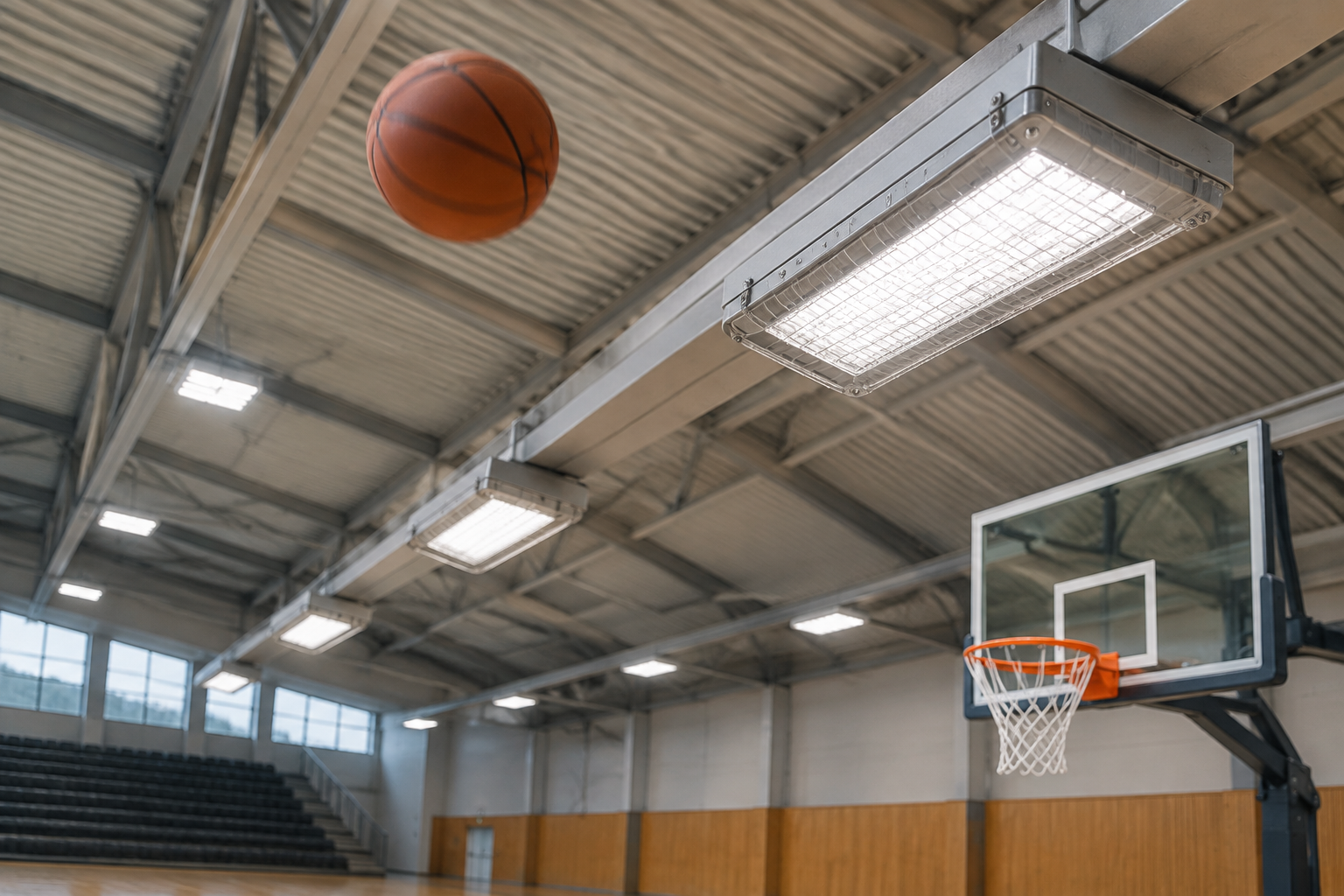
Achieving an IK10 rating requires a purpose-built luminaire designed and tested for extreme durability. The IK rating, defined by standard EN 62262, measures the resistance of an enclosure to mechanical impacts.
An IK10 rating signifies protection against 20 joules of impact energy. This is achieved through a combination of robust materials and smart structural design, such as using thick, die-cast aluminum (ADC12) for the housing and a high-strength, UV-stabilised polycarbonate (PC) for the lens or cover.
In some designs, a reinforced steel wire guard is added over the optical face for an extra layer of protection against direct hits from hard balls like hockey pucks or lacrosse balls. During testing, the luminaire is subjected to impacts at multiple points to ensure there are no weak spots.
For a specifier, it is crucial to request the official IK10 test report for the luminaire to verify its compliance.
What Makes Sports Lighting "Broadcast-Ready"?
Broadcast-ready lighting goes beyond simple brightness, focusing on metrics that matter to a camera sensor. The most important parameter is the Television Lighting Consistency Index (TLCI), which has superseded CRI as the definitive metric for broadcast.
While a CRI of 90 is good, a TLCI of 90+ is the professional standard, ensuring that colours appear true-to-life on screen without extensive colour correction in post-production. Another critical factor is flicker.
The LED driver must be flicker-free, especially for slow-motion replays., >2000 Hz) or a flicker-free driver is essential to avoid banding or strobing effects on camera.
, 5000K or 5600K) across all luminaires and high uniformity on both horizontal and vertical planes are also mandatory to provide a seamless, professional-looking broadcast.
Why Is Glare Control (UGR < 19) Critical for Athletes?
Glare control is a matter of both performance and safety in a sports environment. A Unified Glare Rating (UGR) of less than 19, as recommended by EN 12193 for top-level competition, is vital to prevent discomfort and disability glare.
In sports like badminton, volleyball, or basketball, athletes frequently look upwards to track the ball. A luminaire with poor glare control will create a blinding effect, momentarily impairing vision and increasing the risk of misjudgment or injury.
This is controlled through advanced luminaire optics. High-quality fixtures use precisely molded lenses or deep-set reflectors that shield the bright LED source from direct view at typical viewing angles.
This directs light down onto the playing surface where it is needed, not into the players' eyes. Simulating UGR in DIALux is a standard part of the design process to guarantee compliance before installation.
 Sports Hall Lighting Design 2026: EN 12193 & IK10 Guide: How Do You Achieve True IK10 Ball-Impact Resistance?
Controls, Energy, and Commissioning
An intelligent control system transforms a static lighting installation into a dynamic, energy-efficient asset. For multi-purpose halls, a DALI-2 (Digital Addressable Lighting Interface) system is the industry standard for new builds.
DALI-2 allows each luminaire to be individually addressed, grouped, and controlled, enabling pre-programmed lighting scenes at the touch of a button., 200 lx) scenes, optimising light levels and saving significant energy.
DALI-2 also provides valuable feedback on energy consumption and luminaire status for proactive maintenance.
For retrofit projects or where wiring is a challenge, wireless systems like Casambi (Bluetooth Low Energy mesh) offer incredible flexibility. Luminaires can be controlled via a smartphone app or wireless switches, making complex scene setting simple without the need for control cabling.
To maximize energy savings, as outlined in standards like EN 15193, these control systems should be integrated with occupancy and daylight sensors. Occupancy sensors can dim or turn off lights in unused zones, while daylight sensors can automatically dim luminaires near windows or skylights, harvesting natural light and reducing electricity consumption by a potential 30-60% depending on the building's architecture and usage patterns.
Photometric Files & Compliance
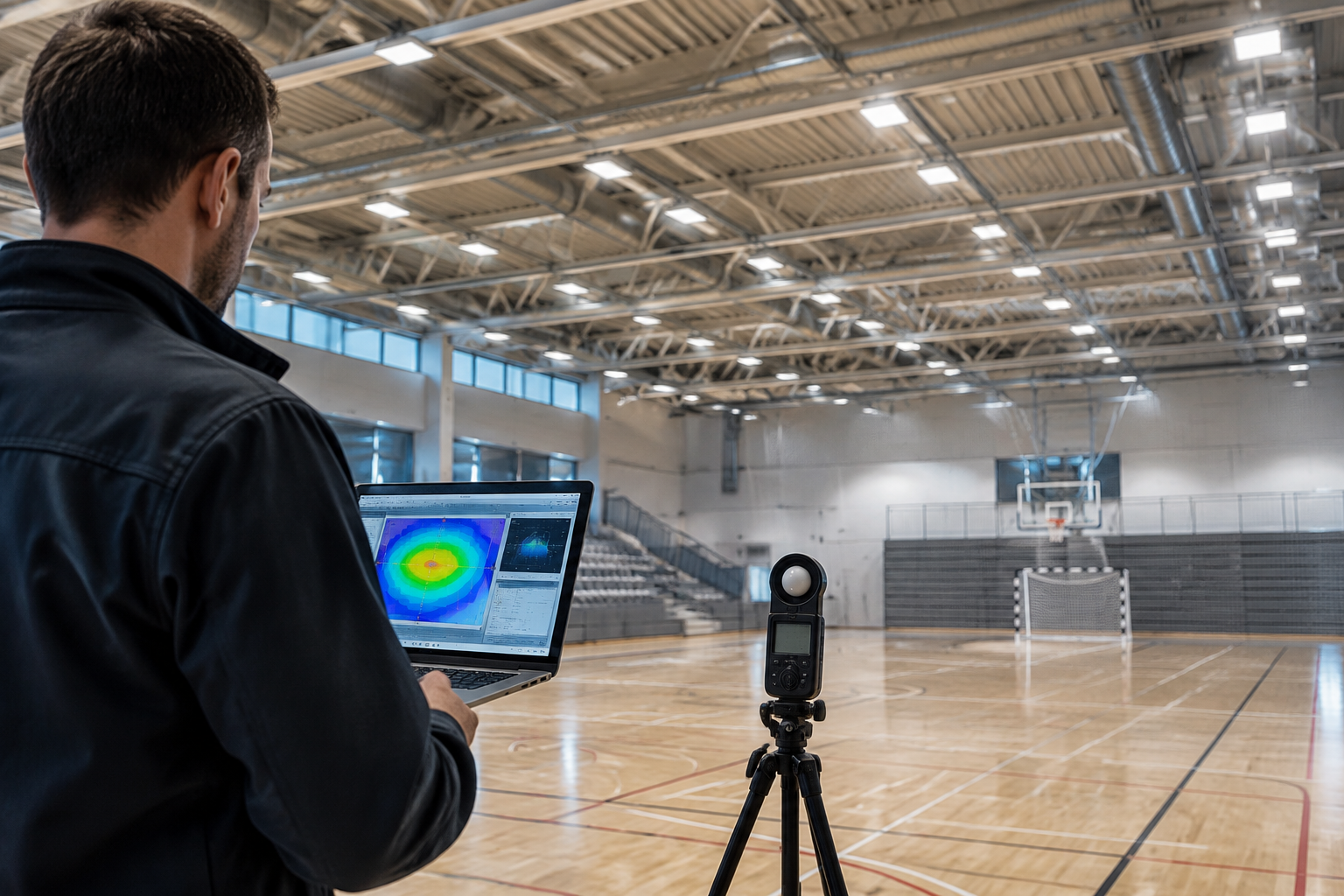
Verifying a lighting design's compliance before a single luminaire is ordered is a non-negotiable step. This is accomplished through photometric simulation using software like DIALux or AGi32.
At the heart of this process are the IES and LDT photometric files, which are unique digital fingerprints for each luminaire. These standardized files, provided by the manufacturer, contain detailed data on the luminaire's light distribution, intensity, and power consumption.
An lighting engineer imports these files into DIALux to build a 3D model of the sports hall. They can then place luminaires, aim them, and run a simulation to generate precise predictions of the final lighting performance.
The software produces reports showing calculated illuminance levels, uniformity ratios (Uo), and UGR values across the entire playing area. This simulation serves as digital proof that the proposed design meets all requirements of EN 12193 or other relevant standards.
It allows for optimization of luminaire placement and beam selection to achieve the desired outcome with the minimum number of fixtures, saving on both initial investment and long-term energy costs.
Furthermore, all luminaires supplied to the European Union must bear the CE mark, indicating conformity with health, safety, and environmental protection standards. RoHS compliance restricts the use of hazardous substances, while the ErP directive sets minimum energy performance requirements. Reputable manufacturers will provide declaration of conformity documents for all these standards.
 Sports Hall Lighting Design 2026: EN 12193 & IK10 Guide: Photometric Files & Compliance
Frequently Asked Questions
Q: What Is the Best CCT for a Multi-purpose Sports Hall?
A Cool White CCT of 5000K is highly recommended for most multi-purpose sports halls. This color temperature creates a crisp, energizing atmosphere that mimics natural daylight, enhancing player alertness and visual acuity. For televised events, 5000K or 5600K provides an excellent baseline for camera white balance, ensuring vibrant and accurate color representation. While 4000K is also a viable option, 5000K generally offers superior performance for fast-paced sports.
Q: What Is the Difference Between EN 12193 and EN 12464-1?
EN 12193 is the specific European standard for sports lighting, covering all aspects of illuminating playing areas for training and competition. It details requirements for illuminance, uniformity, glare (UGR), and colour rendering based on the class of play. In contrast, EN 12464-1 is the standard for lighting indoor workplaces, which applies to the non-playing, ancillary areas of a sports facility, such as changing rooms, spectator seating, corridors, and offices.
Q: Can We Use the Same Lighting for Basketball and Badminton?
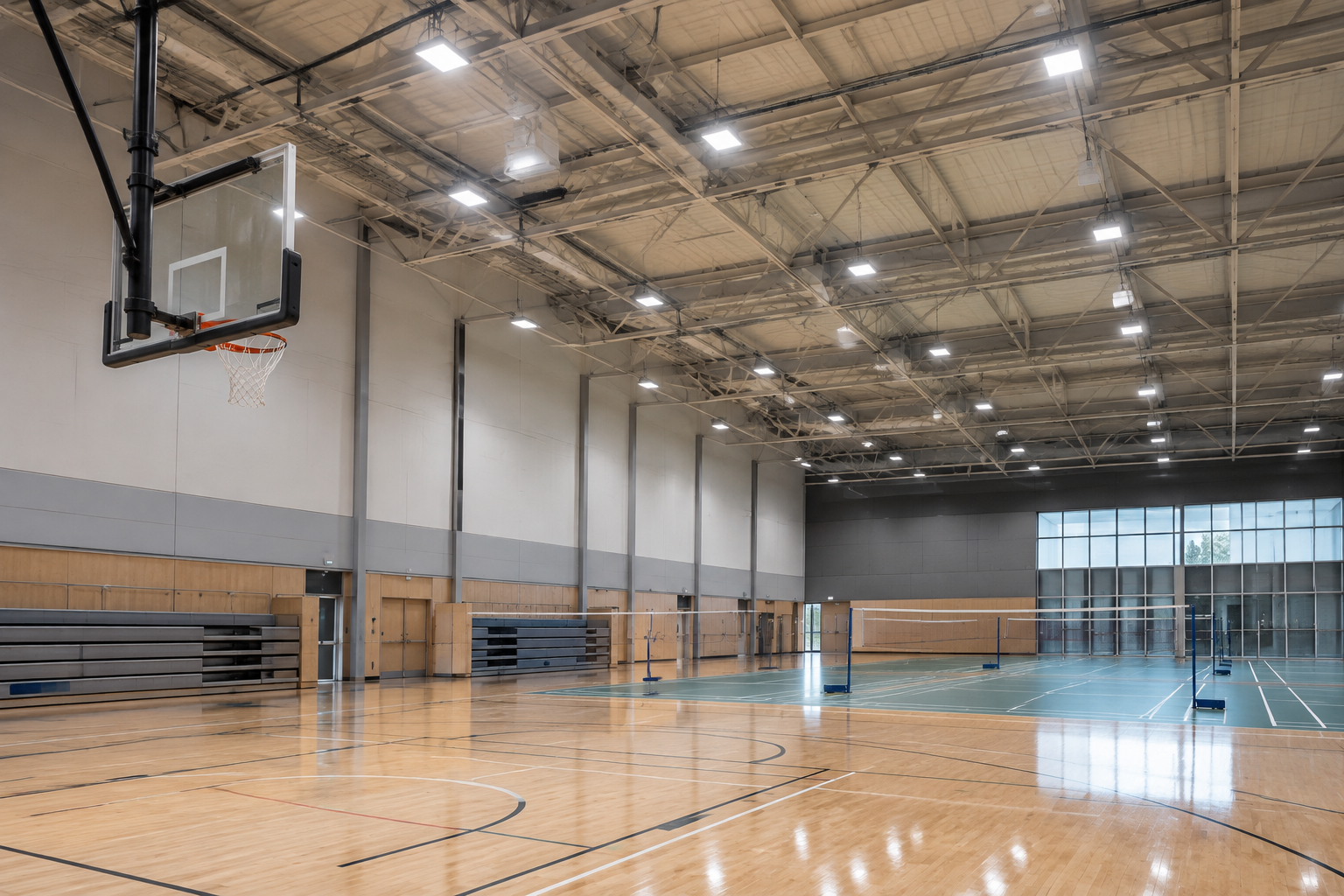
Yes, a well-designed, flexible lighting system can cater to both. The key is using a DALI-2 or similar control system to create different lighting scenes. Basketball, a ground-level sport, may have a primary requirement for 500 lx horizontal illuminance. Badminton requires excellent vertical illuminance and extremely low glare (UGR < 19) as players look up. A dimmable system allows you to set the appropriate light level for each activity, ensuring compliance and saving energy.
Q: How Much Energy Can Be Saved by Upgrading to IK10 LED Lighting with Controls?
Upgrading from traditional 400W metal halide fixtures to modern IK10 LED luminaires can yield energy savings of 60-75% based on luminaire efficacy alone. When combined with a DALI-2 control system that incorporates occupancy sensing, daylight harvesting, and scene setting for different activities, the total energy savings can reach a design target of 80-90%. This significantly reduces operational expenditure and improves the facility's carbon footprint.
Sources and Technical References
- EN 12193:2018: Light and lighting - Sports lighting
- EN 12464-1:2021: Light and lighting - Lighting of work places - Part 1: Indoor work places
- EN 62262: Degrees of protection provided by enclosures for electrical equipment against external mechanical impacts (IK code)
- EN 60529: Degrees of protection provided by enclosures (IP Code)
- IEC 62386: Digital Addressable Lighting Interface (DALI)
- IES RP-6-20: Recommended Practice for Sports and Recreational Area Lighting
- WELL Building Standard v2: (Light Concept)
- EBU (European Broadcasting Union) Tech 3320: User requirements for lighting in television production
 Sports Hall Lighting Design 2026: EN 12193 & IK10 Guide: Q: Can we use the same lighting for basketball and badminton?
Request a Custom Quote
Achieving a compliant, high-performance, and durable lighting solution for a multi-purpose sports hall requires expert planning and access to specialized luminaires.com), a Custom Indoor LED Lighting Manufacturer based in China, we partner with clients across the EU, US, and Middle East to engineer and manufacture luminaires that meet the exact demands of your project.
We provide full design support, including DIALux simulations and all necessary compliance documentation. Contact our technical sales team today to discuss your project requirements and receive a no-obligation quote.
Need a tailored lighting plan for your project?
Our senior lighting designers reply within 48 hours with a free design proposal & quotation.