Hypermarket LED Lighting Inside Auchan, Carrefour & Kau
How leading European hypermarkets — Auchan, Carrefour, Kaufland — light their floors: 140 lm/W linear high-bays, CRI 95 / R9>90 fresh-produce track, 2700K ...
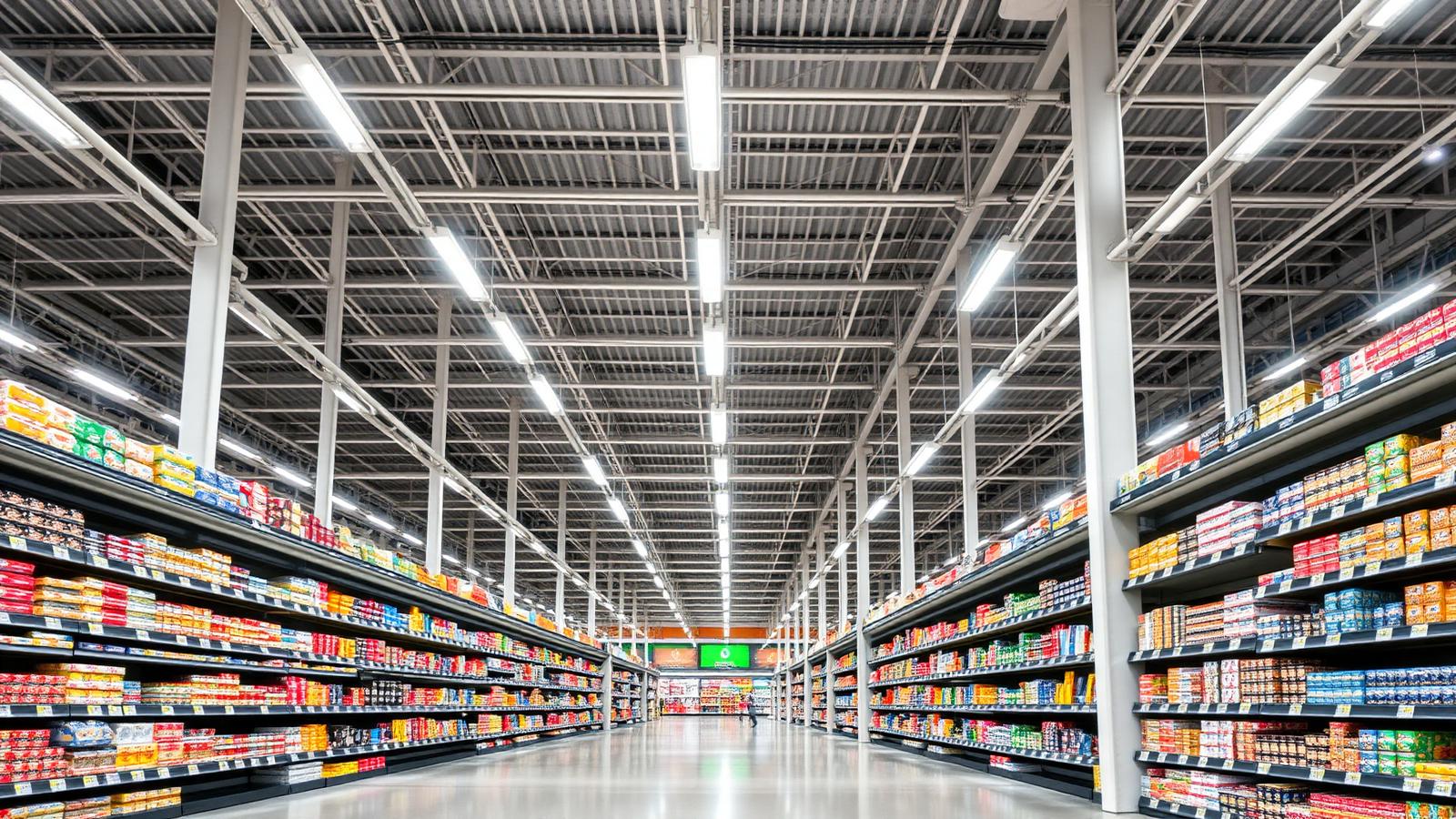
For retail giants like Auchan, Carrefour, Kaufland, and Lidl, lighting is not an expense; it's a sales tool, a safety feature, and a significant operational cost. A strategic hypermarket LED retrofit is one of the highest-ROI facility upgrades available, directly boosting product appeal, reducing energy consumption by up to 70%, and future-proofing stores against rising energy costs and stricter EU regulations.
Understanding the Language of Light: Your Hypermarket's Optical Baseline
Before specifying a single luminaire for a hypermarket spanning 10,000 square metres, a facility manager or lighting designer must speak the language of photometry. These metrics are not abstract; they are the technical specifications that translate directly into a better shopping experience, lower electricity bills, and a safer working environment. They form the non-negotiable baseline for any serious lighting project in the European retail sector.
The Foundation: EN 12464-1 for Retail Spaces
The European standard EN 12464-1:2021 ("Light and lighting - Lighting of work places - Part 1: Indoor work places") is the cornerstone of professional lighting design in the EU. While it primarily focuses on workplaces, its principles are directly applicable and often mandatory for retail environments, especially in areas where staff work for extended periods, such as checkouts, bakeries, and stock rooms.
For large retail areas, EN 12464-1 provides minimum requirements for:
- Illuminance (Ēm): The amount of light falling on a surface.
- Uniformity (U0): The evenness of light across an area.
- Unified Glare Rating (UGR): The level of discomfort glare for occupants.
- Colour Rendering Index (Ra): The ability of a light source to reveal the true colours of objects.
Adhering to EN 12464-1 is not just about compliance; it's about ensuring a minimum standard of quality that prevents visual fatigue in employees and provides a comfortable, visually legible environment for customers. Any lighting plan for an Auchan or Tesco that ignores this standard is fundamentally flawed.
Illuminance (lx) and Uniformity (U0): Banish the Shadows
Illuminance, measured in lux (lx), is the measure of luminous flux per unit area. It's the "brightness" on a surface. A common mistake is to over-light everything, wasting energy, or to under-light, creating a gloomy atmosphere that can make a store feel poorly stocked or unclean.
- General Aisles: Typically require an average of 300-500 lx on the vertical plane (on the products) and on the floor.
- Promotional/Feature Areas: May be boosted to 750-1000 lx to draw attention.
- Checkout Areas: Require a higher level of 500-750 lx on the task area (counter, keypad) for accuracy and to reduce cashier eye strain.
Uniformity (U₀) is just as critical. It's the ratio of minimum illuminance to average illuminance (Emin/Ēm) over a specified area. A low uniformity ratio (e.g., 0.4) means there are noticeable dark spots and bright pools of light, creating a "scalloping" effect that is visually jarring. For main aisles and open sales areas, EN 12464-1 requires a U₀ of at least 0.6, ensuring smooth, even illumination. This gives the space a clean, high-quality feel and prevents products from being lost in shadow. Achieving high uniformity requires careful planning of luminaire placement and beam optics, a core competency of professional lighting design.
Glare Control (UGR): Protecting Staff and Shopper Comfort
Unified Glare Rating (UGR) is a dimensionless value that quantifies the degree of discomfort glare from luminaires in an indoor environment. It's calculated based on the luminance of the fixtures, their position relative to the observer, and the background luminance. Lower UGR values mean less discomfort.
- UGR > 28: Unacceptable glare.
- UGR 22-25: Typical for industrial/circulation areas.
- UGR < 19: Required for tasks requiring concentration (offices, and critically, checkout counters).
- UGR < 16: Required for highly detailed technical work.
In a hypermarket setting, high-bay lights in the main aisles can be a major source of glare for shoppers looking up at signage. More importantly, poorly specified downlights or panel lights at the checkout can cause significant eye strain and headaches for cashiers over an 8-hour shift. Specifying luminaires with a UGR of less than 19 for these critical task areas is a non-negotiable aspect of responsible lighting design and employee welfare. This is achieved through advanced optics such as deep-set reflectors, micro-prismatic diffusers, and louvres.
Colour Fidelity (CRI Ra/R9) & TM-30: Making Products Pop
Colour Rendering Index (CRI) measures how accurately a light source reproduces the colours of the object it illuminates, compared to a natural light source. It's measured on a scale of 0-100, where 100 is perfect.
- CRI Ra: This is the average value derived from 8 standard test colours (R1-R8). A CRI Ra of 80 is considered the minimum for general retail, but it's an outdated and incomplete metric.
- CRI R9: This metric specifically measures the rendering of strong red. It is crucial for retail because many products—meats, fresh produce (tomatoes, peppers), and even warm-toned packaging—rely on rich red tones to appear fresh and appealing. An Ra 80 light source can have a very low or even negative R9, making reds look brownish and dull.
For a modern hypermarket, the standard should be CRI Ra > 90, with a specific requirement for R9 > 50. For premium fresh food sections, CRI 95 R9 > 90 is the gold standard for making produce look irresistible.
IES TM-30-20 is a newer, more comprehensive system for evaluating colour rendition. It uses 99 colour samples instead of 8 and provides two key metrics:
- Fidelity Index (Rf): Similar to CRI Ra, it measures colour accuracy.
- Gamut Index (Rg): Measures the saturation of colours. An Rg over 100 indicates that colours will appear more saturated or "vivid" than under natural light.
While not yet as ubiquitous as CRI, specifying luminaires with good TM-30 reports (e.g., Rf > 90, Rg 95-105) provides a much more nuanced and accurate prediction of how products will look on the shelf.
Colour Temperature (CCT): Setting the Mood
Correlated Colour Temperature (CCT), measured in Kelvin (K), describes the perceived colour of the light—from warm to cool. This is a powerful psychological tool in retail.
- 2700K (Warm White): Creates a cozy, inviting, golden atmosphere. Ideal for bakeries, high-end wine sections, and cheese counters.
- 3000K (Warm/Neutral White): The "sweet spot" for fresh produce and meat. It's clean and vibrant without feeling cold or clinical, and it has excellent red rendering capabilities. The best choice for a meat counter LED 3000K setup.
- 4000K (Neutral White): The workhorse for general aisles in a hypermarket LED retrofit. It provides a clean, alert, and modern feel, excellent for showcasing packaged goods and general merchandise efficiently.
- 5000K+ (Cool White): Generally too cold and clinical for most European hypermarket interiors, though sometimes used in back-of-house or pharmacy sections for a high-clarity environment.
A successful lighting scheme will often use a mix of CCTs to define different zones within the store, guiding the customer journey and enhancing the specific products in each department.
Luminous Efficacy (lm/W): The Engine of Energy Savings
Luminous Efficacy, measured in lumens per watt (lm/W), is the single most important metric for operational cost savings. It indicates how efficiently a luminaire converts electrical power (Watts) into light (lumens).
A decade ago, fluorescent tubes offered 60-80 lm/W. Early LEDs hit 90-100 lm/W. Today, a high-quality commercial LED luminaire for hypermarket applications should deliver at least 130 lm/W at the system level (including driver losses). The pinnacle of efficiency is reaching for high bay linear 140 lm/W or even 160 lm/W.
This metric is paramount when assessing a proposal. A 10% increase in efficacy across a 15,000 m² Carrefour can translate into tens of thousands of Euros in saved electricity costs annually. However, be wary of efficacy claims made at the expense of other metrics. Some manufacturers achieve high lm/W by sacrificing CRI (e.g., dropping to CRI 70) or using poor optics that create excessive glare. A reputable supplier provides high efficacy in combination with high CRI, low UGR, and a long lifespan.
Durability & Safety (IP/IK): Built for the Retail Grind
Hypermarkets are harsh environments with cleaning crews, stocking carts, and high foot traffic. Luminaires must be built to last.
- IP Rating (Ingress Protection): A two-digit code that rates a fixture's protection against solids (first digit) and liquids (second digit).
- IP20: Standard for dry, clean indoor areas (most aisles).
- IP44/IP54: Protected against splashes of water. Necessary for fresh produce areas with misters, fish counters, or areas subject to wet cleaning.
- IP65: Dust-tight and protected against water jets. Required for butchery/deli wash-down areas.
- IK Rating (Impact Protection): Rates a fixture's resistance to mechanical impact, measured in joules (J).
- IK03-IK05: Standard for areas with no risk of impact.
- IK08: Essential for luminaires in low-to-medium-height areas like lower aisles, stock rooms, or car parks where they might be hit by carts or pallet jacks. IK08 means the fixture can withstand a 5-joule impact.
Specifying the correct IP and IK ratings prevents premature failure, ensures safety, and reduces maintenance costs associated with damaged fixtures. It's a critical detail in any professional Auchan Carrefour Kaufland lighting specification.
5 Hypermarket Lighting Recipes for Sales, Safety & Efficiency
Applying the baseline optical principles, we can create specific "lighting recipes" for the five most critical zones in a hypermarket. Each recipe is a balance of illuminance, colour quality, and efficiency, tailored to the function of the space and the products within it.
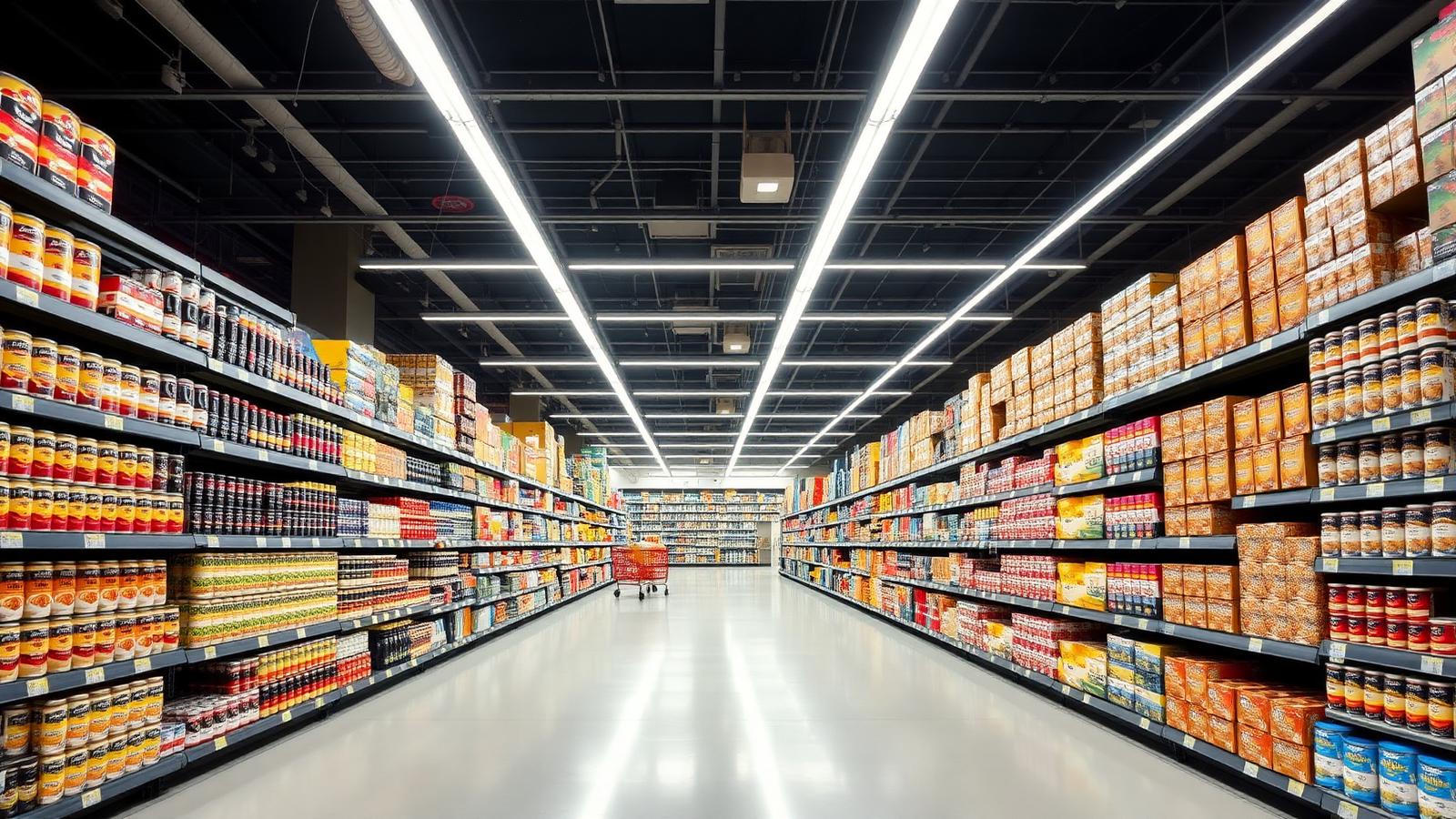
H3: Main Aisles: The Grand Corridors of Commerce
"Our main grocery aisles feel so patchy. Customers complain they can't read labels on the bottom shelf, and some corners look really dim, like we're trying to hide old stock. It just looks cheap compared to the new Lidl down the road."
This is a classic uniformity problem. The goal here is efficiency, visual comfort, and perfect legibility of packaging from top to bottom shelf. The lighting should guide customers effortlessly through the store's primary arteries.
- Metrics: 500 lx average on the vertical surface of the shelving; U₀ > 0.6; UGR < 22; CRI Ra > 80 (Ra > 90 preferred); CCT 4000 K.
- Fixture Type: High-efficacy linear high-bay or trunking systems. These systems allow for continuous runs of light, eliminating shadows between fixtures and ensuring exceptional uniformity.
- Beam Angle: Aisle-specific asymmetric or double-asymmetric optics are crucial. These lenses direct light sideways and downwards onto the vertical faces of the shelving, not just onto the floor in the middle of the aisle. A typical beam angle might be 30°x90° or a batwing distribution.
- Mounting Height: Typically 6-10 metres. This height necessitates luminaires with high lumen output and precisely controlled optics to push light down effectively.
- Smart Control: DALI-2 controlled systems are ideal. They allow for daylight harvesting near skylights and scheduled dimming (e.g., to 70% during off-peak hours or 10% for night cleaning crews), unlocking an additional 20-30% in energy savings on top of the LED efficiency gains. PIR sensors can be integrated into the trunking for on-demand lighting in less-frequented aisles.
- Recommended XHLWX Product: The L1200/L1500/L3000 Optix Linear Light with a specialised aisle lens and DALI driver is purpose-built for this application, delivering up to 160 lm/W and outstanding uniformity.
H3: Fresh Produce: The Theatre of Freshness
"Our tomatoes and peppers look washed out, almost pale, under the old fluorescent lights. We're losing sales because the produce just doesn't look as fresh or vibrant as it really is. It's incredibly frustrating."
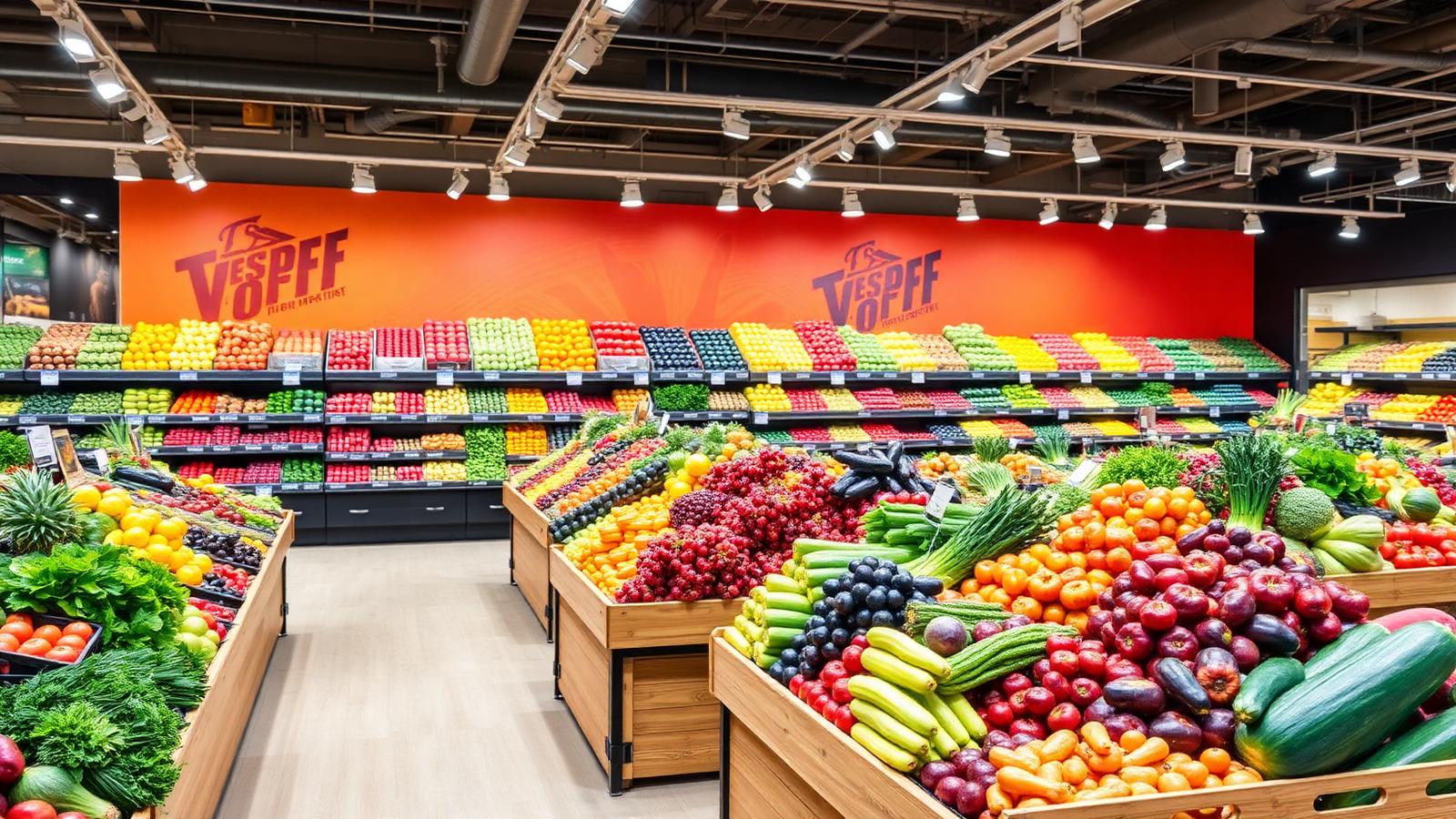
In the fresh produce section, light is not illumination; it is marketing. Colour is everything. The goal is to render the natural colours of fruits and vegetables with such vibrancy that they look like they were just picked. This is the domain of high-CRI and high-R9 lighting.
- Metrics: 750-1000 lx on the displays; U₀ > 0.7; UGR < 19; CRI Ra > 95, R9 > 90; CCT 3000 K.
- Fixture Type: Adjustable high-CRI track spotlights or gimbal downlights. Track lighting provides the flexibility to aim light precisely onto changing displays and create accent highlights.
- Beam Angle: A mix of medium (24°-36°) and narrow (15°) beam angles. Medium beams provide a general wash over the produce beds, while narrow beams create dramatic "punches" of light on hero products like pyramids of apples or exotic fruits.
- Mounting Height: 2.8-4 metres. At this lower height, control and flexibility are more important than raw power.
- Smart Control: A DALI-2 or Casambi-based system allows for the creation of "scenes." For example, a brighter, more dynamic scene during peak shopping hours on a Saturday afternoon, and a softer, energy-saving scene on a quiet Tuesday morning. Tunable white technology (e.g., 2700K to 4000K) can be used to experiment with which CCT best enhances specific seasonal produce.
- Recommended XHLWX Product: The C-D110 Retail Track Light 40W with a CRI 97+ "Fresh" LED chip is the perfect tool for creating this theatre of freshness.
H3: Meat & Deli: The Science of Appetite
"We have a problem at the butcher counter. The wrong light can make our best cuts of beef look brownish, or it can even accelerate discoloration over the day. We need lighting that proves freshness without damaging the product."
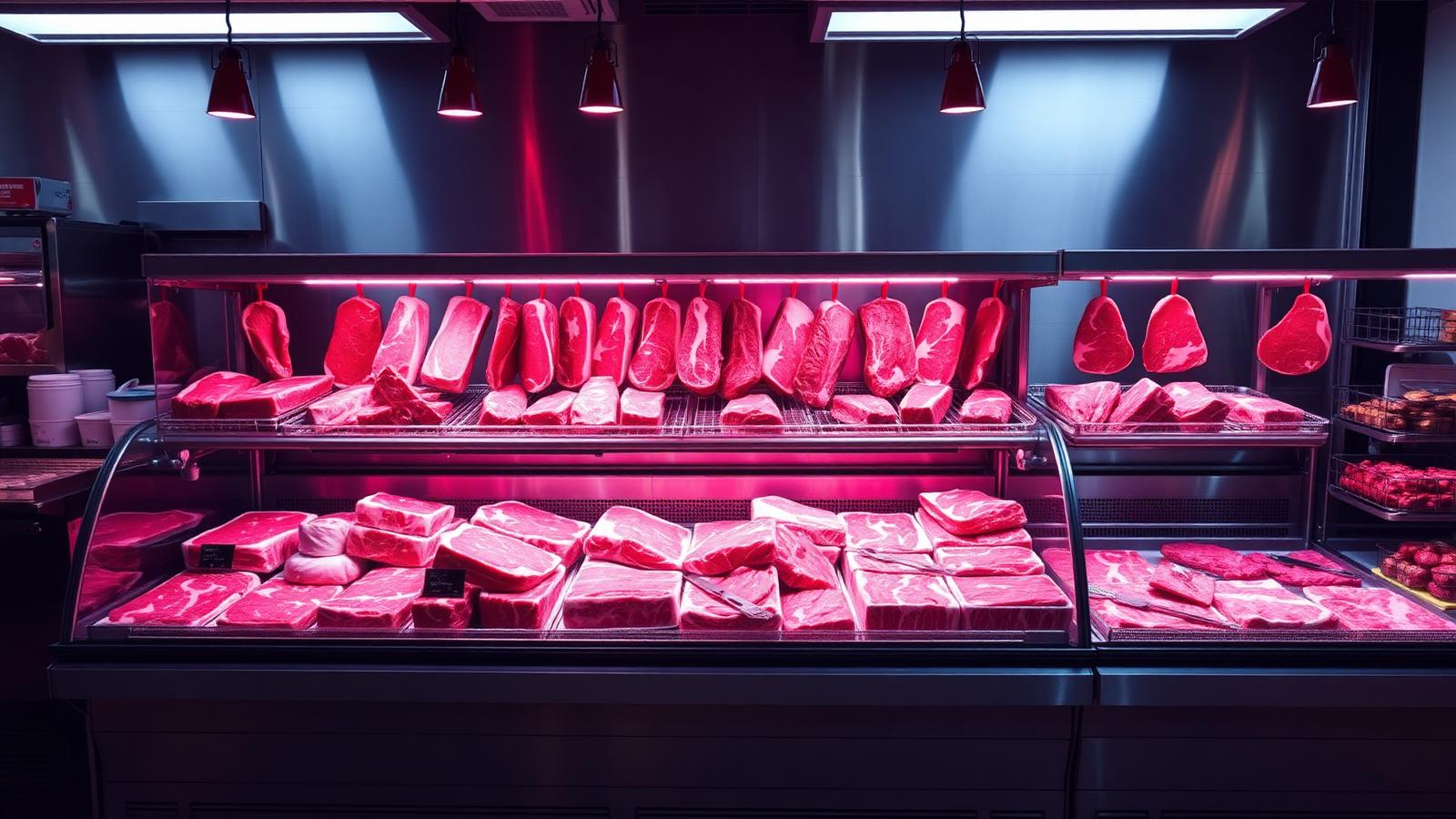
Lighting meat is a science. The primary goal is to accentuate the deep reds of marbled beef and the pinks of fresh pork and ham, which are key indicators of quality and freshness for the customer. This requires a spectrum specifically enhanced in the red wavelengths (high R9) at a specific CCT.
- Metrics: 750 lx on the product; UGR < 19; CRI Ra > 90, R9 > 90; CCT 3000 K (or a specialised spectrum around 3000K with enhanced red/pink peaks).
- Fixture Type: Linear LED profiles integrated into the refrigerated display case, or adjustable spotlights mounted just in front of it. The key is to get the light close to the product without causing heat or UV damage.
- Beam Angle: A wider, diffuse beam (60°-90°) for linear profiles within the case, or a 36° beam for spotlights to wash the entire counter evenly.
- Mounting Height: Can be less than 1 metre for integrated profiles, or 2.5-3 metres for external spotlights.
- Smart Control: DALI control is useful for programming timers. The lights can be set to 100% intensity during opening hours and automatically dim to 30% or turn off when the counter is closed and shuttered, saving energy and reducing unnecessary light exposure on the product.
- Recommended XHLWX Product: A custom version of the C-D90 Museum / High-CRI Track with a specialised "Fresh Meat" LED spectrum provides the ideal colour point and high R9 value to make meat look its absolute best and freshest.
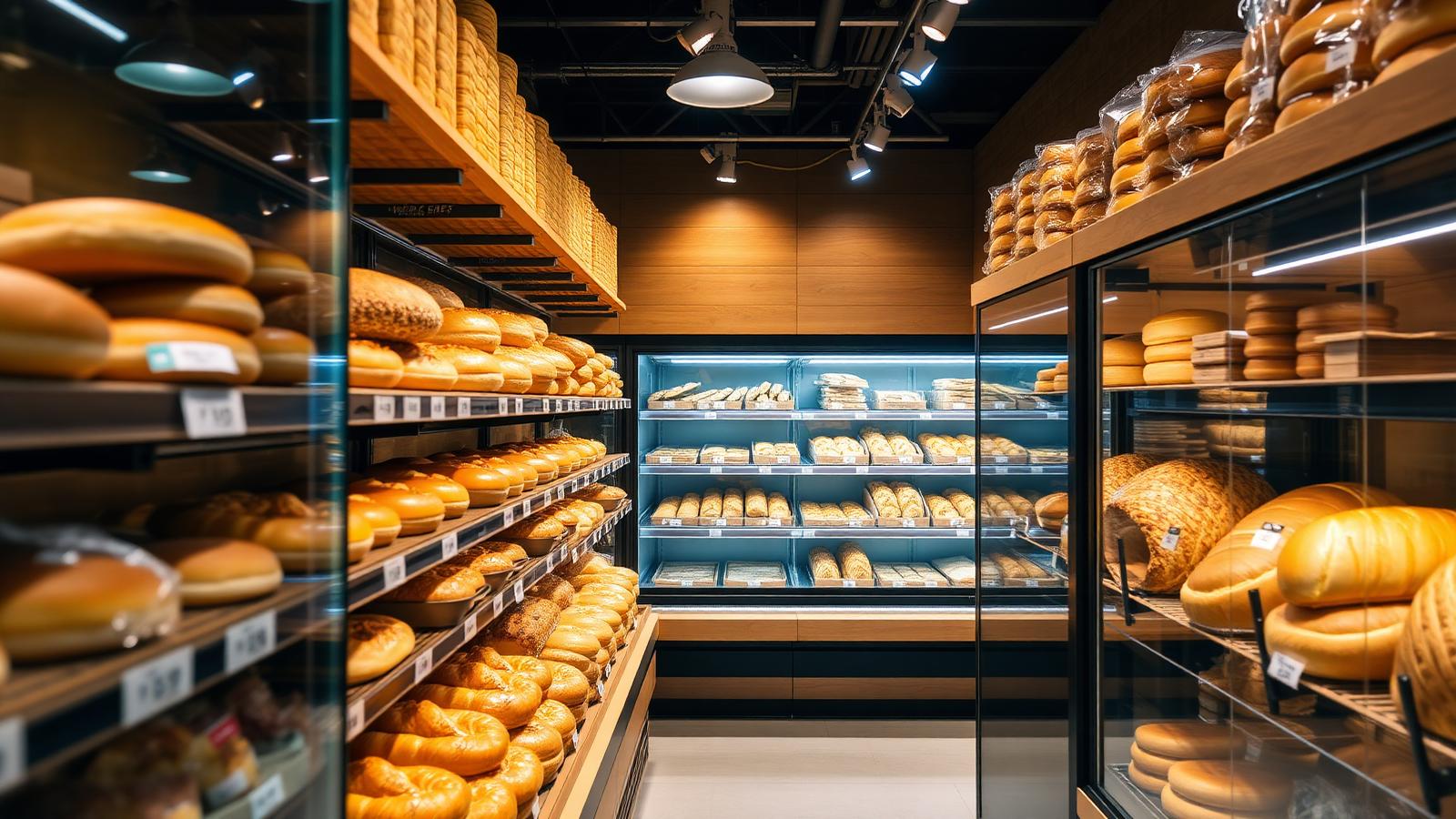
H3: Bakery: The Art of the Golden Crust
"Our artisan breads have a beautiful golden-brown crust, but under our current cool white lights, they just look pale and uninteresting. We need to create that warm, fresh-out-of-the-oven feeling."
The bakery section is about creating an emotional connection. The smell of fresh bread is a powerful sales driver, and the lighting must complement it. The goal is to use warm light to bring out the golden, caramelized tones of breads, pastries, and croissants, triggering an impulse purchase.
- Metrics: 500-750 lx on the displays; UGR < 22; CRI Ra > 95; CCT 2700 K.
- Fixture Type: A combination of wide-beam downlights for general ambience and narrow-beam track spotlights to accent specific items like cakes or specialty loaves.
- Beam Angle: 36°-60° downlights for the base layer of warm light, coupled with 15°-24° spotlights to create highlights and visual hierarchy.
- Mounting Height: 2.8-3.5 metres. This keeps the light sources relatively close to create a sense of intimacy in the space.
- Smart Control: Casambi (Bluetooth Mesh) is an excellent choice here. It allows for simple, app-based control of individual spotlights, so staff can easily re-aim and re-dim lights as displays change daily without needing a complex DALI commissioning process.
- Recommended XHLWX Product: The C1-D90 Business Track Light in a 2700K, CRI 95 version is perfect for providing the warm, high-quality accent lighting this department demands.
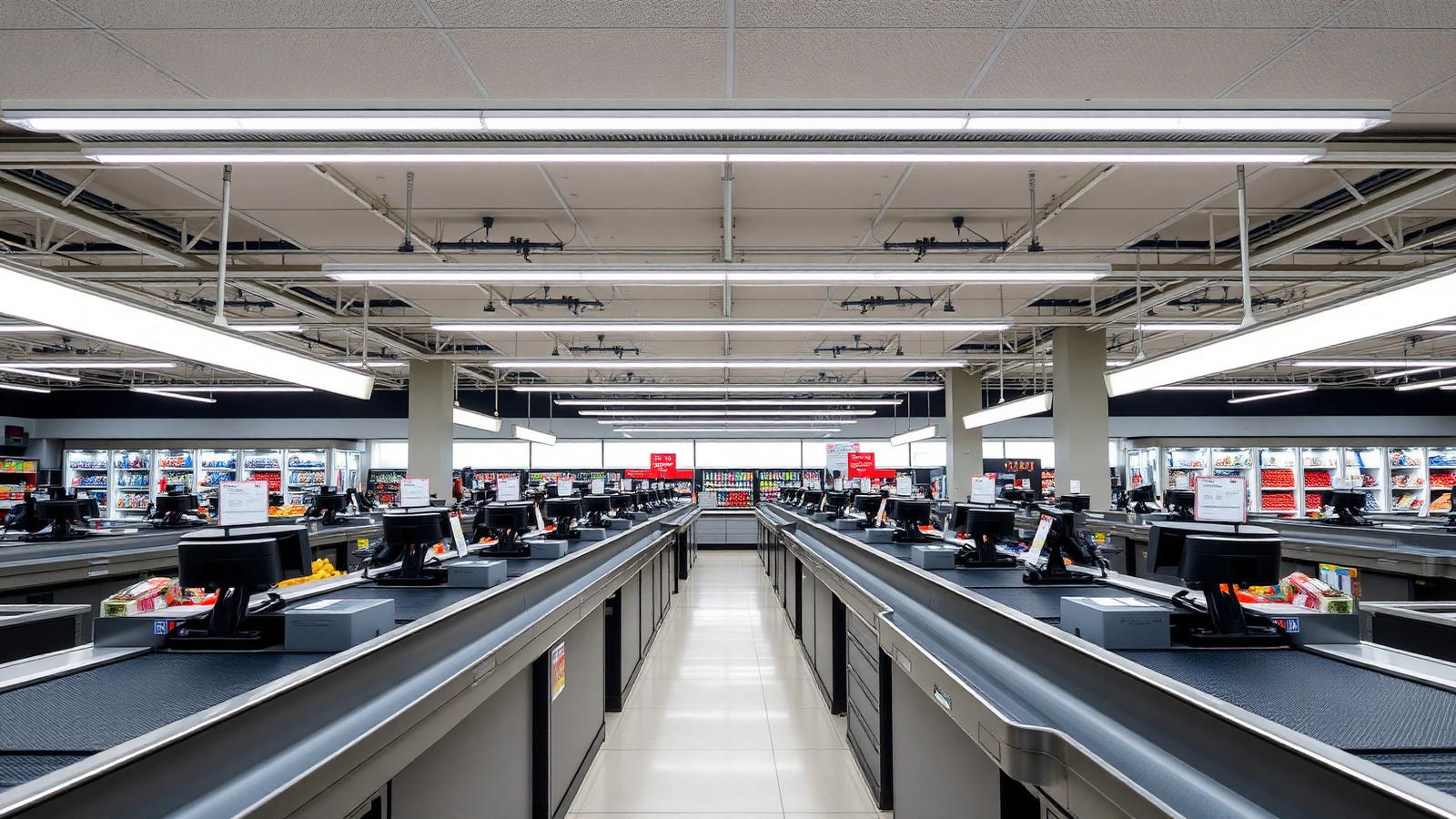
H3: Checkout: The Final, Flawless Impression
"By the end of my shift, I have a splitting headache. The light above my till is so bright and reflects off the scanner and keypad. It's a constant, piercing glare that makes it hard to focus."
This is a critical H&S and employee welfare issue. The checkout is the last point of interaction a customer has with the store, and it's a static, demanding workstation for staff. The priority here is not sales, but comfort, accuracy, and safety. Low-glare lighting is not a luxury; it's a requirement.
- Metrics: 500-750 lx on the task plane (counter, belt, keypad); U₀ > 0.7; UGR < 19; CRI Ra > 80; CCT 4000 K.
- Fixture Type: Low-glare UGR<19 LED panels or downlights with micro-prismatic diffusers. The optics are the most important feature of the luminaire.
- Beam Angle: Wide beam (90°-110°) to create a broad, even pool of comfortable light over the entire checkout station.
- Mounting Height: 2.6-3 metres. The luminaires are directly in the an employee's field of view, making low-glare optics absolutely essential.
- Smart Control: While less dynamic than other areas, DALI can be used to ensure consistent light levels are maintained over the luminaire's lifetime (Constant Light Output - CLO functionality). A dedicated "cleaning mode" scene can be programmed to bring lights to 100% for after-hours maintenance.
- Recommended XHLWX Product: The COB-D101 Anti-Glare Downlight is specifically engineered with a deep-set light source and black reflector to achieve a UGR < 19, providing optimal visual comfort for cashiers.
The Future is Now: Navigating Europe's 2026 Lighting Landscape
The pace of change in the lighting industry is accelerating, driven by EU regulations and technological advancements. A hypermarket LED retrofit planned today must account for the trends and rules that will define the market by 2026. Forward-thinking facility managers at Kaufland and Carrefour are already planning for these four key shifts.
Ecodesign (EU 2019/2020) Heads Toward 2026: Repairability and Sustainability
The current Ecodesign for light sources (SLR - (EU) 2019/2020) and separate control gear (ELR - (EU) 2019/2020) regulations have already pushed inefficient technologies off the market. The next phase, expected to be influential by 2026, will tighten the focus on circular economy principles.
This means:
- Repairability: Luminaires will be increasingly designed for disassembly. The ability to replace a faulty LED driver or light engine without discarding the entire fixture will become a key selling point. This reduces waste and long-term cost of ownership.
- Information Transparency: Manufacturers are required to provide detailed information on disassembly and repair. This empowers facility management teams to perform their own maintenance.
- Higher Efficacy Thresholds: The minimum energy efficiency requirements will continue to rise, making today's "high-end" luminaires the standard of tomorrow. Any Ecodesign 2026 supermarket project will likely require system efficacies well above 130 lm/W as a bare minimum.
Procuring luminaires that are modular and repairable, like XHLWX's F1M D85 Modular Track Light, is a way to future-proof an investment against these evolving regulations.
The New Normal: 130-160 lm/W Efficacy as a Non-Negotiable
Driven by both Ecodesign rules and soaring energy prices, luminous efficacy has become the headline metric for any large-scale lighting project. While 100 lm/W was acceptable a few years ago, the new baseline for a competitive hypermarket tender is now 130-160 lm/W.
For a facility manager, the calculation is simple. A hypermarket using 4,000 luminaires for 14 hours a day can see its annual electricity bill reduced by an additional €30,000-€50,000 by choosing 150 lm/W fixtures over 120 lm/W ones. This is a powerful argument.
The challenge is to achieve this high bay linear 140 lm/W performance without compromising on light quality. This requires top-tier LED chips (e.g., from Nichia or Cree), highly efficient drivers (efficiency > 90%), and excellent thermal management to maintain performance over a 50,000+ hour lifespan. Always demand third-party photometric reports (LM-79, ISTMT) to verify these claims.
UGR<19 Anti-Glare: From Office Standard to Retail Essential
What was once a strict requirement for office environments (as per EN 12464-1) is now becoming best practice in an increasing number of retail spaces. As luminaires become more powerful and compact, the risk of glare increases. The market is recognizing that visual comfort is not just for office workers; it impacts the well-being of retail staff and the shopping experience of customers.
By 2026, specifying UGR<19 fixtures will be standard procedure not just for checkout counters, but also for customer service desks, pharmacies within the hypermarket, and any area with reflective flooring or digital signage. This focus on "human-centric lighting" demonstrates a retailer's commitment to quality and employee welfare, which can be a competitive advantage.
Smart Controls: DALI-2 and Casambi Go Mainstream for Granular Savings
Simple on/off switching or 1-10V dimming is no longer sufficient. The future of retail lighting management is digital, and DALI-2 is the leading open protocol for robust, interoperable control in large-scale installations.
A DALI scene control retail strategy enables:
- Task-Tuning: Setting exact light levels for each specific zone to avoid over-lighting.
- Daylight Harvesting: Automatically dimming lights near windows and skylights to save energy.
- Scheduling: Pre-programming different light levels for opening hours, closing time, cleaning, and restocking.
- Real-time Monitoring: DALI-2 provides feedback on energy consumption and luminaire status, enabling predictive maintenance and energy reporting.
For smaller, more flexible areas like pop-up displays or concessions, wireless mesh systems like Casambi offer unparalleled ease of use, allowing staff to reconfigure lighting scenes from a smartphone or tablet. By 2026, a hypermarket without a digital lighting control system will be leaving significant operational savings on the table.
Why Top European Retailers Choose XHLWX for Their Lighting Retrofits
Choosing a lighting partner for a multi-store, multi-country rollout is a major strategic decision. It requires a supplier that delivers not just a product, but a complete solution encompassing performance, compliance, and long-term support. XHLWX is engineered to be that partner.
The XHLWX Advantage: Precision, Performance, Partnership
- European Standards, Guaranteed: All our key products are ENEC certified. This pan-European mark is a symbol of third-party-verified quality and safety, demonstrating full compliance with all relevant EN standards. It simplifies procurement across different EU countries and provides an undisputed assurance of quality.
- Uncompromising Performance: We specialise in combining high efficacy (130-160 lm/W) with superior light quality (CRI 90-98, R9 > 50, UGR < 19). We don't force you to choose between saving energy and making your products look amazing.
- Application-Specific Optics: We understand that a bakery needs a different light than a main aisle. Our extensive range of luminaires, from linear high bays with asymmetric lenses to track spots with specialised food-spectrum LEDs, ensures the right tool for every job.
- DALI-2 Native Integration: Our luminaires are designed to work seamlessly with DALI-2 control systems. We partner with leading control gear manufacturers like Tridonic and Osram to ensure robust, reliable, and intelligent lighting networks.
- Supply Chain Reliability: With a robust European supply chain and logistics network, we can deliver large-scale projects on time and on budget, minimizing disruption to store operations for clients like Auchan, Carrefour, and Kaufland.
Your 10-Point Hypermarket Lighting Procurement Checklist
Use this checklist when evaluating potential lighting suppliers:
- ENEC Certification: Is the proposed luminaire ENEC certified for guaranteed European compliance? Ask for the certificate.
- System Efficacy (lm/W): Is the claimed efficacy for the entire system (luminaire + driver), not just the LED chip? Is it ≥ 130 lm/W?
- Colour Quality (CRI/R9): Does the supplier offer options for CRI > 90 and R9 > 50 for critical food areas? Request TM-30 reports.
- Glare Control (UGR): Can the supplier provide UGR < 19 luminaires for checkout and other task areas? Ask for UGR tables from DIALux simulations.
- Warranty and Lifespan: Is there a minimum 5-year warranty? Is the L80B10 lifespan rated for at least 50,000 hours?
- Driver & Chip Manufacturer: Are the LEDs and drivers from reputable, tier-1 manufacturers (e.g., Nichia, Cree, Tridonic, Osram)?
- Control System Compatibility: Is the luminaire available with a DALI-2 driver from a major brand? Is the supplier experienced with DALI commissioning?
- IP/IK Ratings: Do the proposed fixtures meet the required IP and IK ratings for their specific locations (e.g., IP54 for produce, IK08 for stock rooms)?
- Repairability: Is the driver accessible and replaceable? Are spare parts available? This is key for future Ecodesign 2026 supermarket alignment.
- Project References: Can the supplier provide case studies of similar large-scale hypermarket projects in Europe?
Real-World Pains & Practical Answers: Your Hypermarket LED FAQ
Beyond the technical specifications, facility managers face daily operational pains. A lighting retrofit must solve these problems, not create new ones.
The Hidden Costs of Procrastination
Sticking with outdated fluorescent or HID lighting isn't a "no-cost" option. The hidden costs are substantial and grow every year.
"Our electricity bill is through the roof, and it feels like my maintenance team is just constantly on scissor lifts changing out dead T8 tubes. Every time a ballast fails in a refrigerated case, we have to call in an expensive specialist. The downtime is killing us."
This facility manager's pain is common. The costs of inaction include:
- Massive Energy Waste: A typical fluorescent system consumes 60-70% more energy than a modern LED equivalent. With current energy prices, this is a crippling operational expense.
- Constant Maintenance: Fluorescent tubes have a short lifespan (10,000-15,000 hours) compared to LEDs (50,000-100,000 hours). This means 4-5x more replacement cycles, labour costs, and disruption.
- Poor Light Quality and Sales Impact: As seen in the quotes throughout this article, poor lighting directly impacts product perception and sales. Old lamps also suffer from colour shift and lumen depreciation, making the store look progressively worse over time.
- Compliance Risk: As older lamp technologies are banned under Ecodesign, sourcing replacements will become difficult and expensive, creating a significant risk to store operations.
Your Top 8 Hypermarket Lighting Questions Answered
1. What is the realistic ROI for a full hypermarket LED retrofit? Typically, the payback period for a full-scale hypermarket LED retrofit is between 1.5 and 3 years, based on energy savings alone. When you factor in reduced maintenance costs and potential sales uplift from improved light quality, the ROI becomes even more compelling. With DALI controls, the payback can often be under 2 years.
2. Can we reuse our existing wiring? In many cases, yes. When retrofitting from fluorescent T8/T5 trunking systems, the main power infrastructure can often be reused for new LED trunking systems, significantly reducing installation costs and time. Track lighting systems can also be replaced on existing tracks in many cases. A detailed site audit is necessary to confirm.
3. How much more can DALI controls save us compared to simple LED dimming? While upgrading to dimmable LEDs saves energy, a DALI-2 system unlocks layered savings. We typically see an additional 20-40% savings on top of the LED efficiency gains. This comes from daylight harvesting (10-15%), scheduling (5-10%), and task-tuning/scene control (5-15%). The data monitoring also helps identify further efficiencies.
4. We operate 24/7. How can we manage a retrofit without shutting down the store? Experienced installers perform retrofits in sections, typically overnight during the quietest hours (e.g., 10 PM to 6 AM). They will cordon off one or two aisles at a time, complete the installation, clean the area, and have it ready for customers by morning. A well-planned project schedule minimizes any impact on sales.
5. Our refrigerated cases have integrated lighting. Can you replace that? Yes. Replacing lighting in refrigerated display cases is a specialised but common task. We offer specific linear LED profiles with appropriate IP ratings, CCTs, and CRI values (e.g., for meat or dairy) designed to replace inefficient fluorescent tubes within these units. This not only saves energy but also reduces the heat load on the refrigeration compressors, leading to secondary energy savings.
6. What is the biggest mistake you see retailers make in lighting projects? The biggest mistake is procuring based on the lowest initial fixture cost ("luminaire price"). This often leads to buying low-quality products with poor efficiency, high glare, bad colour rendering, and a short lifespan. The total cost of ownership (TCO)—including energy, maintenance, and replacement costs over 10 years—is a far more important metric. Choosing a high-quality, ENEC certified product from a reputable partner always results in a lower TCO.
7. Why is R9 so important if it's not part of the main CRI Ra score? Because Ra averages the first 8 test colours, which are mostly pastel shades. It completely ignores R9 (strong red). You can have two lamps, both "CRI 85," but one has an R9 of 10 and the other has an R9 of 60. Under the lamp with R9=60, reds in meat, fruit, and packaging will look rich and saturated. Under the lamp with R9=10, they will look flat and brownish. For retail, especially food, demanding a high R9 value is non-negotiable.
8. How do we start the process? What's the first step? The first step is a professional lighting audit and design consultation. A specialist will visit your site, measure current light levels, analyse your energy bills, and discuss your goals for each department. They will then create a comprehensive proposal including DIALux lighting simulations, product specifications, a detailed ROI calculation, and an installation plan.
Investing in a state-of-the-art LED lighting system from XHLWX is one of the most impactful decisions a hypermarket operator can make. It's an investment in your customers' experience, your employees' well-being, your brand image, and your long-term financial health.
Ready to see the difference high-quality lighting can make?
Contact our European retail lighting specialists today or explore our full range of professional LED luminaires.
Need a tailored lighting plan for your project?
Our senior lighting designers reply within 48 hours with a free design proposal & quotation.