Indoor Parking Lot LED Lighting
Complete 2026 spec for indoor & underground parking LED retrofits — IP65 tri-proof linears, DALI-2 motion-sensor scenes, EV charging zones, and BS 5489 / E...
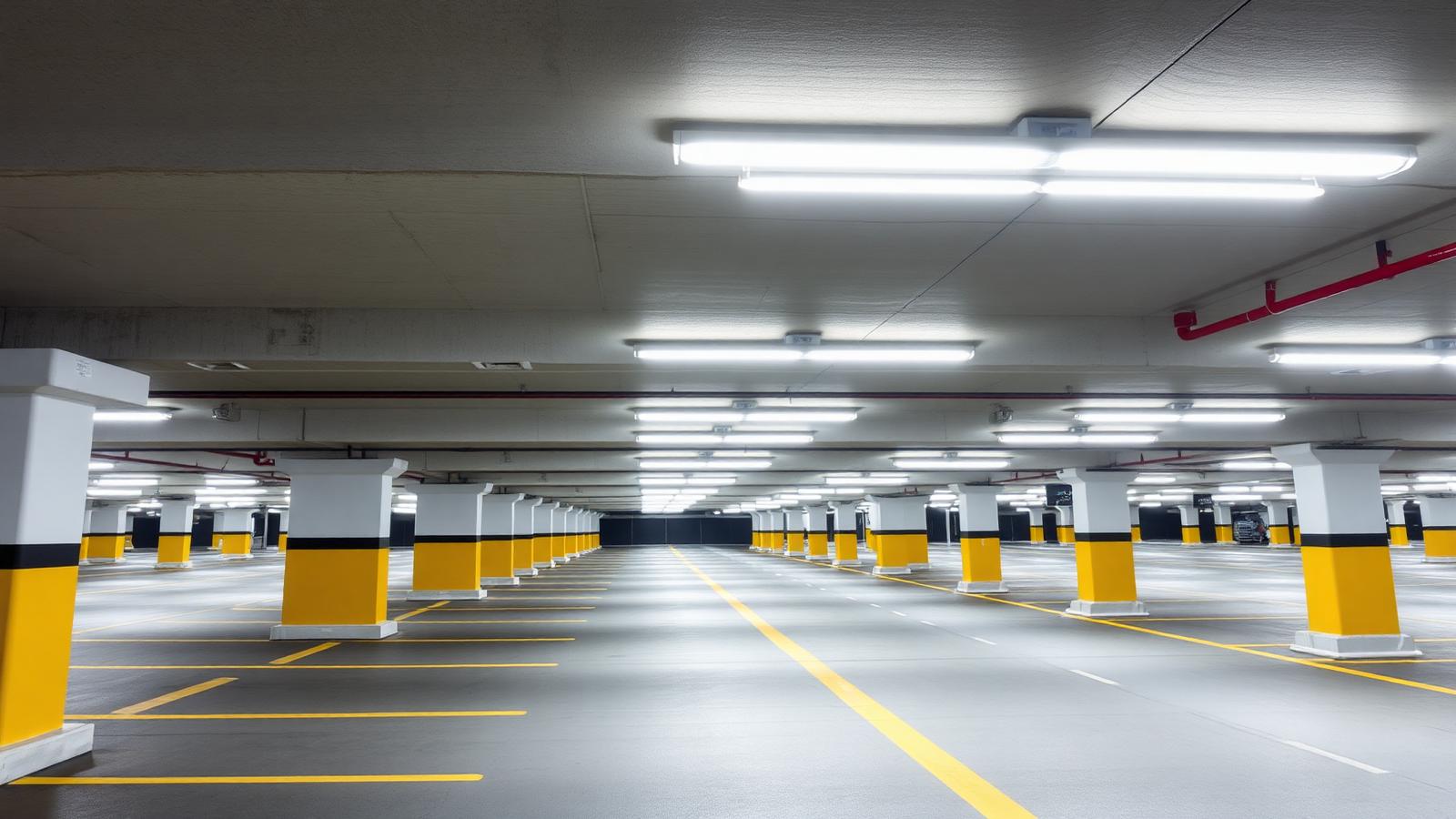
A modern indoor parking garage is more than a place to leave a car; it's the first and last impression of a commercial building. This comprehensive guide details how to execute a successful parking garage LED retrofit using IP65 tri-proof fixtures, intelligent motion sensors, and DALI-2 dimming, ensuring your facility is safe, energy-efficient, and ready for the EV-centric demands of 2026 and beyond.
Part 1: The Optical Baseline & Modern Lighting System Overview
Designing lighting for an indoor or underground parking garage is a unique engineering challenge. Unlike an office or retail space, it's a 24/7 transitional environment fraught with potential hazards: moving vehicles, pedestrians, low ceilings, and variable ambient light conditions at entrances and exits. The primary goals are uncompromising safety, perceived security, and radical energy efficiency.
Achieving this trifecta requires moving beyond simply replacing old fluorescent tubes with new LEDs. It demands a systems-based approach grounded in European lighting standards and a deep understanding of optical metrics. The foundational standard for indoor workplaces, EN 12464-1, provides the framework. While this standard is for "indoor workplaces," its principles of visual comfort and safety are directly applicable. For parking-specific guidance, we borrow principles from EN 12464-2 (outdoor work places) and national adaptations like the UK's BS 5489-1:2020, which provides excellent, detailed recommendations for indoor car parks.
A successful lighting design masterfully balances the following technical parameters:
1. Illuminance (Lux): Measured in lux (lx), this is the amount of light (lumens) falling on a given surface area (square meter). It's the most basic measure of "brightness." EN standards specify minimum average illuminance levels for different zones (e.g., driving lanes, parking bays, pedestrian walkways) to ensure tasks can be performed safely. Insufficient lux creates trip hazards and a sense of unease.
2. Uniformity (U₀): Perhaps more critical than average illuminance is uniformity. It's the ratio of the minimum illuminance to the average illuminance on a surface (U₀ = Emin / Eavg). A high uniformity (U₀ ≥ 0.4 is a common target for driving areas) ensures there are no "hot spots" of intense light directly under fixtures and dangerously dark zones between them. Poor uniformity creates a "zebra effect" that can disorient drivers and conceal potential hazards or threats between parked cars.
3. Glare (UGR): Unified Glare Rating (UGR) is a metric for quantifying discomfort glare. In a low-ceiling environment like a parking garage, glare from exposed light sources can be a significant issue for drivers, momentarily impairing vision. While the standard for circulation areas is often UGR<28, best practice aims for UGR<25 in driving lanes. Lowering glare enhances visual comfort and safety, transforming the user experience from stressful to seamless. This is what we call anti-glare parking.
4. Colour Rendering (CRI & R9): The Colour Rendering Index (CRI or Ra) measures how accurately a light source reveals the true colours of an object compared to a natural light source. A CRI of 80 is the commercial standard. A critical sub-metric is R9, which measures the rendering of saturated red. High R9 is vital in a parking garage for accurately rendering red brake lights, fire safety equipment, and warning signage.
5. Advanced Colour Science (IES TM-30): While CRI is the established metric, TM-30 is the future. It provides a more nuanced, two-part assessment of colour rendition:
- Rf (Fidelity Index): Similar to CRI, it measures colour accuracy on a scale of 0-100.
- Rg (Gamut Index): Measures the average increase or decrease in colour saturation. Specifying lighting with good TM-30 scores ensures a more vibrant, natural, and visually appealing environment, which contributes to a feeling of safety and quality.
6. Correlated Colour Temperature (CCT): Measured in Kelvin (K), CCT describes the perceived "warmth" or "coolness" of a light source. For parking facilities, a neutral white 4000K is the industry standard. It promotes alertness and excellent visibility without the harsh, sterile feel of cooler temperatures (5000K+).
7. Luminous Efficacy (lm/W): This is the ultimate metric for energy efficiency, showing how many lumens of light are produced for every watt of electrical power consumed. Old fluorescent tubes might operate at 60-80 lm/W. Modern, high-quality LEDs for parking applications should achieve 130 lm/W to over 160 lm/W. This single metric is the primary driver of ROI in a parking garage LED retrofit.
8. Ingress Protection (IP) & Impact Resistance (IK) Ratings:
- IP Rating: A two-digit code classifying the degree of protection against solids (first digit) and liquids (second digit). For a parking garage, IP65 is the non-negotiable standard. It means the fixture is completely dust-tight (6) and protected against low-pressure water jets from any direction (5). This ensures longevity in damp, dusty underground environments and allows for high-pressure hose cleaning. An
IP65 tri-prooflight is sealed against dust, water, and corrosion. - IK Rating: This indicates the level of protection against mechanical impact. A rating of IK08 or higher is recommended, ensuring the fixture can withstand accidental bumps from vehicles, equipment, or vandalism.
By mastering these eight parameters, a facility manager can specify a lighting system that is not just compliant, but exceptional—delivering a safe, comfortable, and highly efficient environment for decades.
Part 2: The 5-Space Garage Lighting Recipes Playbook
A parking garage is not a single, uniform space. It's a collection of distinct zones, each with unique lighting requirements. Applying a one-size-fits-all approach is a recipe for poor performance and wasted energy. Here, we present a "playbook" of lighting recipes for the five critical zones of any indoor parking facility.
H3: Entrance & Ramp
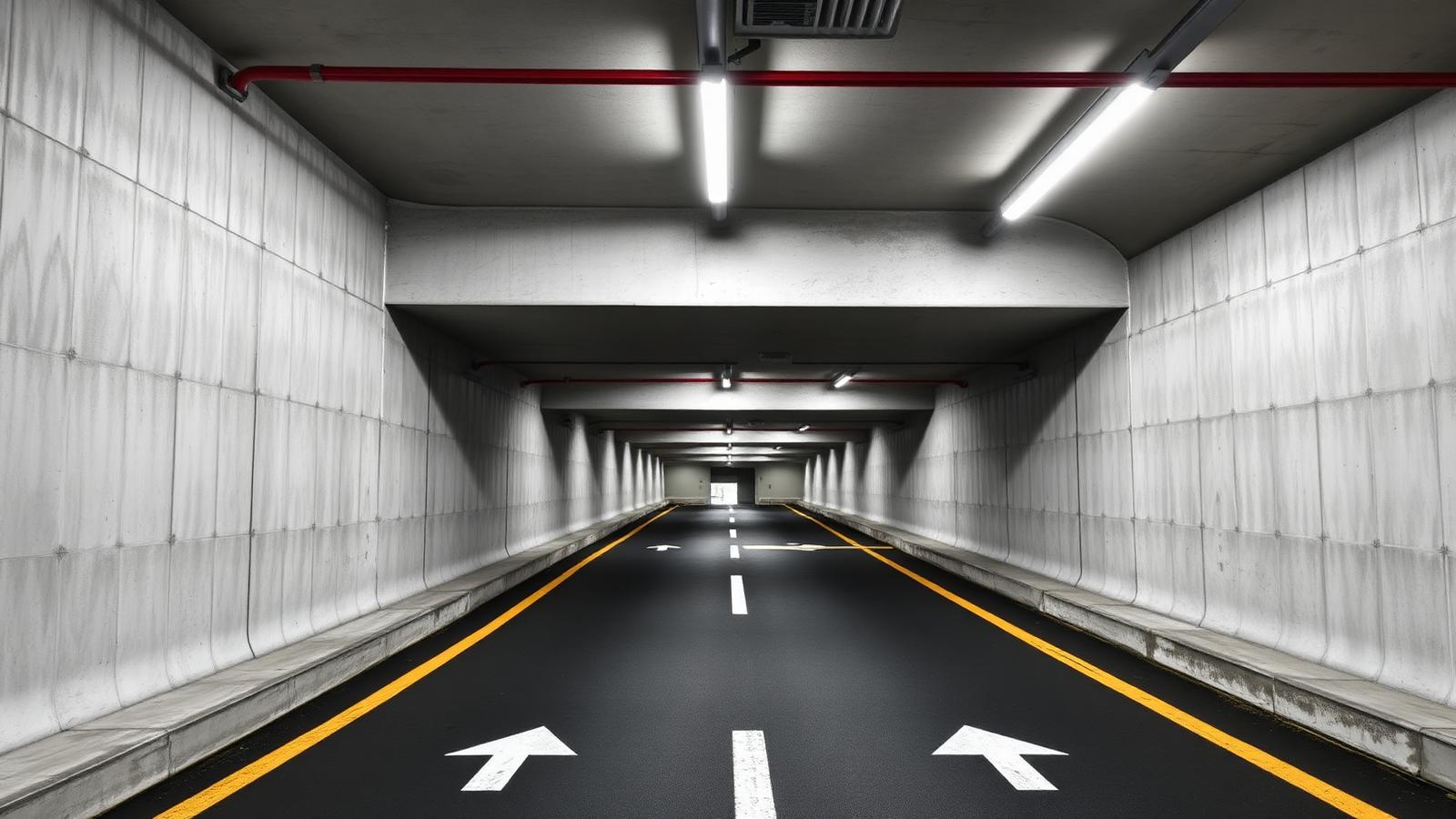
"Our biggest issue is the entrance during the day. Drivers come in from bright sunlight and it feels like driving into a black wall. We've had a few near-misses with the ticketing machine because they can't see properly for the first few seconds." (Paraphrased from a public facility management forum)
The entrance is the most critical and challenging zone. During the day, the human eye needs several seconds to adapt from bright sunlight (up to 100,000 lx) to a dimly lit interior. This delay can cause temporary blindness, known as the "black hole effect," creating a serious safety risk.
- Objective: To create a smooth visual transition that allows the driver's eyes to adapt safely.
- Recommended Illuminance:
- Daytime: A high-illuminance zone of 300–500 lx on the floor for the first 10-15 meters, gradually stepping down to the general circulation level.
- Nighttime: The same fixtures should be dimmed down to ~75 lx, matching the interior, to prevent a "wall of light" effect for drivers entering from dark streets.
- UGR: <25 (Glare control is critical for approaching drivers).
- CRI: >80 Ra.
- CCT: 4000K.
- IP Rating: IP65 / IK08.
- Fixture Type: High-output linear LED luminaires with robust drivers.
- Beam Angle: A wider beam angle (e.g., 120°) can work well here to create a large, even pool of light.
- Mounting Height: Typically 2.5m - 4m.
- Smart Control: Essential. DALI-2 dimming linked to an external photocell is the ideal solution. The system automatically ramps up light levels during daylight hours and dims them down at night, optimizing safety and energy use. Simple on/off motion sensors are insufficient for this application.
- XHLWX Recommendation: L1500 Optix Linear Light in its high-output configuration, paired with a DALI-2 driver for seamless daylight transition lighting.
H3: Parking Bay
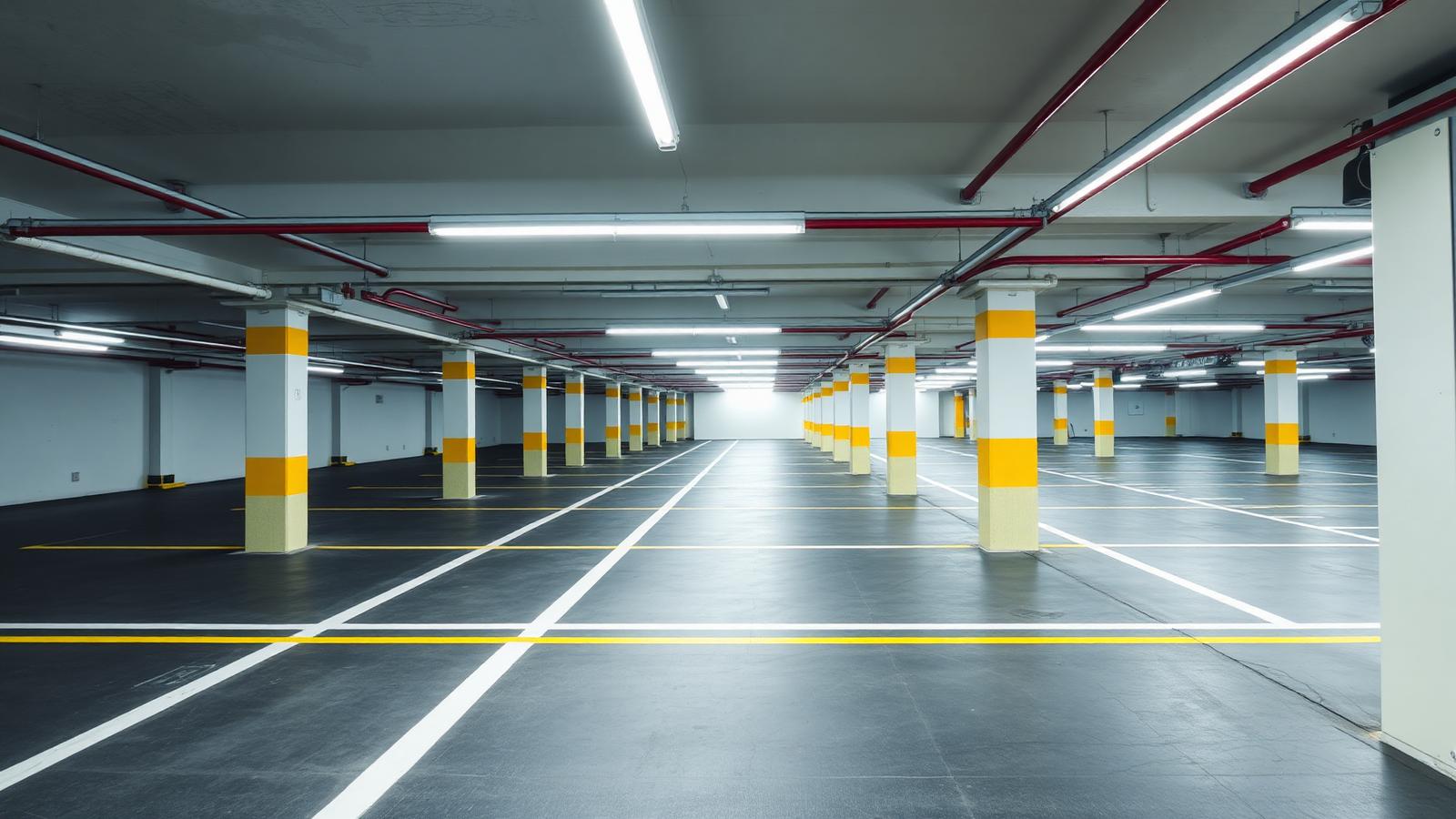
This is the main area of the car park. The lighting goals here shift from adaptation to general visibility, security, and maximum energy savings. The space is often unoccupied for long periods, making it a prime candidate for smart controls.
- Objective: To provide uniform, glare-free light that ensures drivers can navigate safely and pedestrians feel secure, while minimizing energy consumption.
- Recommended Illuminance:
- Occupied/Active: 75–100 lx (average on the floor).
- Unoccupied/Standby: Dims to 10–20% (approx. 10-20 lx). This provides enough light for general orientation and CCTV function without wasting energy.
- Uniformity (U₀): ≥ 0.4. This is crucial for eliminating dark shadows between vehicles where people or objects could be hidden.
- UGR: <25.
- CRI: >80 Ra.
- CCT: 4000K.
- IP Rating: IP65 / IK08.
- Fixture Type: IP65 LED Tri-Proof linear fixtures are the workhorse for this application.
- Beam Angle: A frosted diffuser or lens providing a 120° beam angle is standard for creating soft, uniform light in low-bay applications.
- Mounting Height: Typically 2.4m - 3.5m.
- Smart Control: Individual or grouped motion sensor parking lot lighting is the key. Integrated microwave sensors are superior to PIR as they can "see" through objects and are less prone to false triggers. When a car or person enters a zone, the lights in that and adjacent areas ramp up instantly, and then fade back to standby after a set hold-time. This provides light on demand, generating energy savings of 60-80%.
- XHLWX Recommendation: L1200 Optix Linear Light with an integrated microwave motion sensor and DALI-2 driver for group-based "follow-me" lighting.
H3: EV Charging Zone
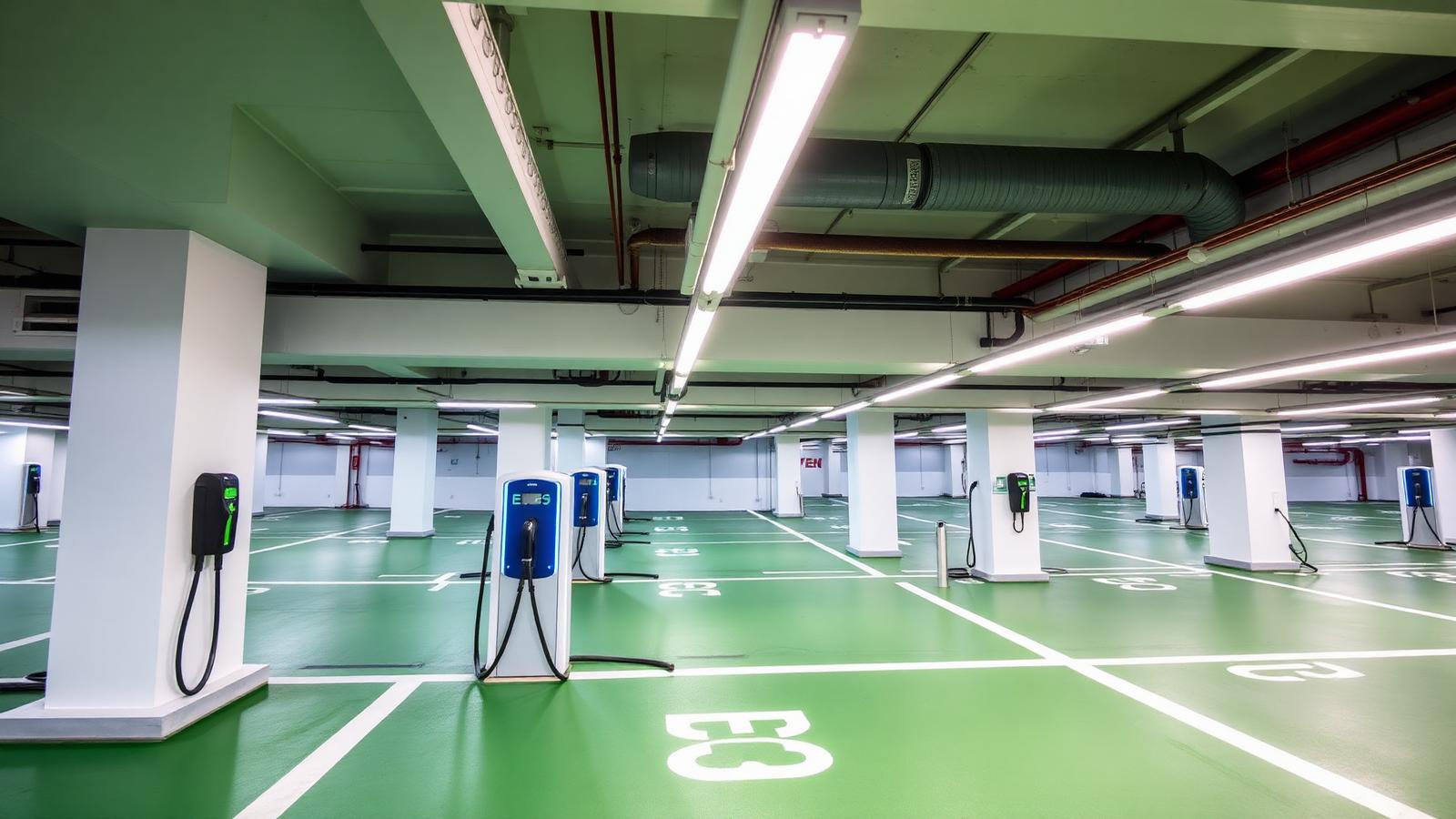
The rise of electric vehicles has introduced a new, critical zone within the parking garage. This isn't just a parking space; it's a "task area" where users interact with sophisticated equipment. They need to read screens, align connectors, and handle cables, often with one hand while holding a phone or bag. Lighting must support these tasks safely and efficiently.
- Objective: To provide higher vertical and horizontal illuminance for safe and easy operation of EV charging equipment. To visually demarcate the zone.
- Recommended Illuminance: 150 lx (average on the floor and on the vertical face of the charger). This is double the level of a standard parking bay.
- UGR: <22. Given the higher light levels, enhanced glare control is important.
- CRI: >90 Ra. High CRI is strongly recommended here. It enhances the visibility of coloured indicator lights on the charger, improves the clarity of on-screen instructions, and provides better facial recognition for security cameras.
- CCT: 4000K, or consider using a slightly different CCT (e.g., 3500K or 5000K) or even coloured linear light to visually brand and differentiate the EV charging area.
- IP Rating: IP65 / IK08.
- Fixture Type: High-CRI IP65 linear fixtures or dedicated adjustable spotlights.
- Beam Angle: A slightly more focused beam (e.g., 90°) can be used to punch light onto the charging station.
- Mounting Height: 2.5m - 4m.
- Smart Control: These zones are often in use for extended periods, so motion sensing for on/off is less critical. However, they should still be on a DALI-2 network to allow for scheduled dimming during off-peak hours (e.g., 2-5 AM) if the facility is not 24/7.
- XHLWX Recommendation: For premium EV zones requiring exceptional colour quality, the C-D90 Museum / High-CRI Track can be surface-mounted to provide targeted, high-CRI accent light on the chargers, supplemented by general lighting from the L1200 Optix series.
H3: Pedestrian / Exit
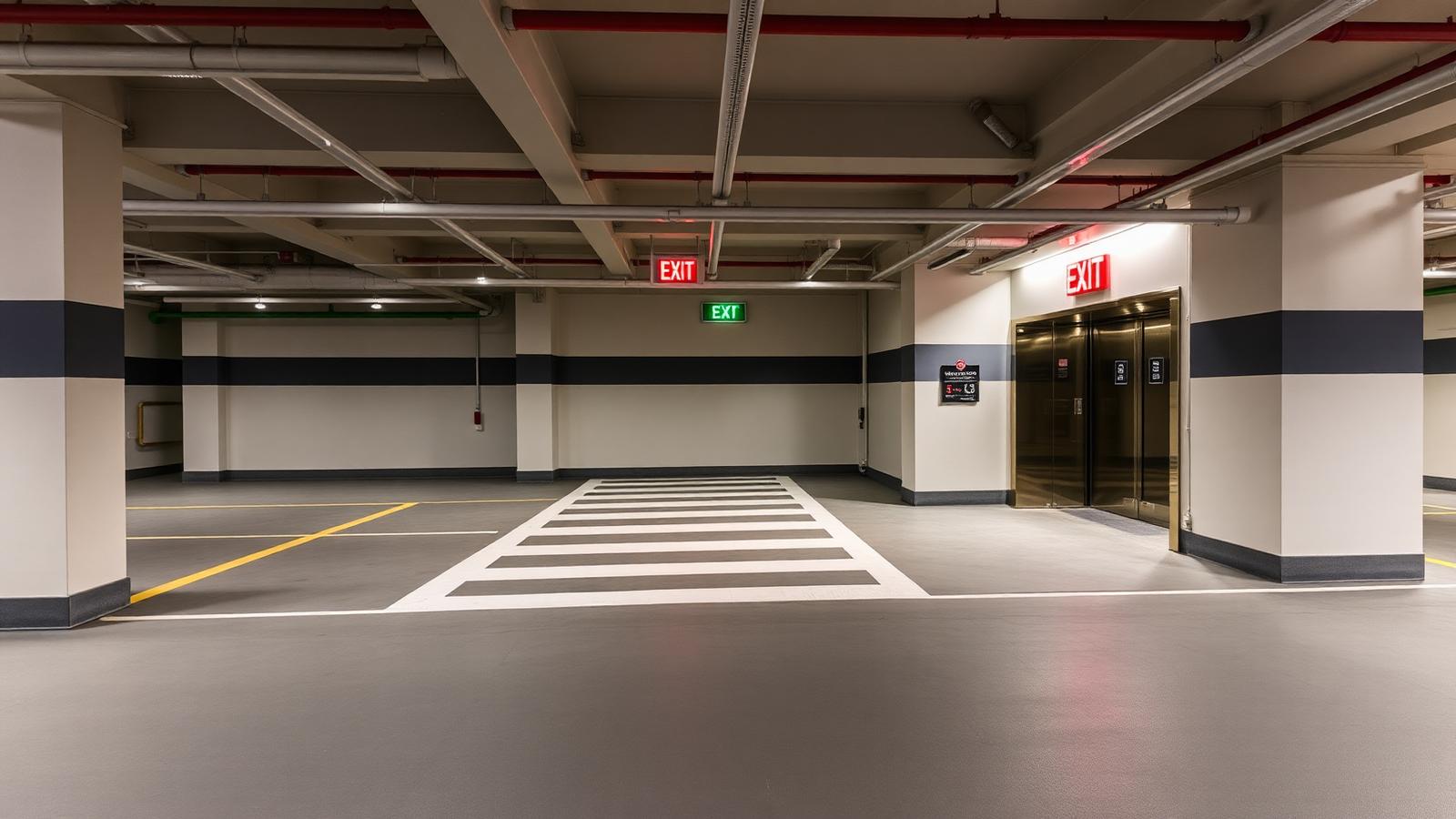
Pedestrians are the most vulnerable users of a parking garage. Lighting for walkways, stairwells, and elevator lobbies must prioritize their safety and sense of security. The goal is to create clear, well-lit paths of travel, free from ambiguity or fear.
- Objective: To ensure clear visibility on all pedestrian routes, highlight exits and level changes, and enhance facial recognition for CCTV security.
- Recommended Illuminance: 100 lx (average on the floor) for designated walkways, stairwells, and lobbies. Vertical illuminance on faces is also important.
- UGR: <22.
- CRI: >80 Ra (higher CRI improves security camera footage quality).
- CCT: 4000K.
- IP Rating: IP65 for open walkways, IP44 may be acceptable inside enclosed fire-rated stairwells or lobbies.
- Fixture Type: IP65 linear fixtures for general walkways. For lobbies and near elevators, consider using dedicated anti-glare downlights for a more architectural and welcoming feel. Emergency exit signs must be compliant with EN 1838.
- Beam Angle: Varied. 120° for general paths, 60° for downlights to create pools of light.
- Mounting Height: 2.4m - 3m.
- Smart Control: Walkways should be linked to the motion-sensing groups of adjacent parking bays. Elevator lobbies and main exit routes should often be programmed to a constant, non-dimmed level during operational hours to ensure they are always welcoming and clearly visible.
- XHLWX Recommendation: A combination of the L1200 Optix Linear Light for walkways and the COB-D101 Anti-Glare Downlight for lobbies and payment areas.
H3: Overview
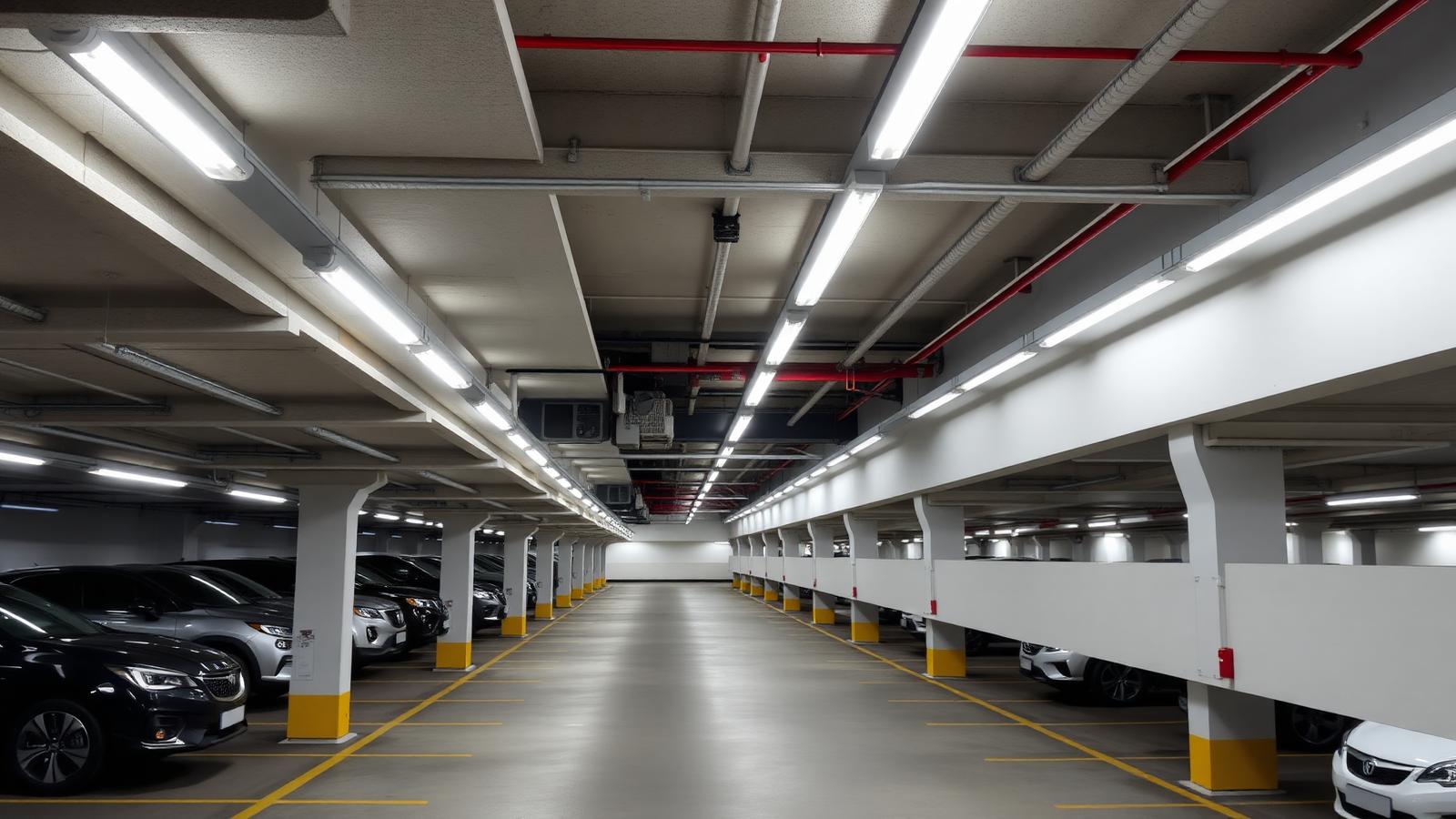
Bringing it all together, the modern, intelligent parking garage lighting system is a network. It's not just a collection of individual lights; it's a cohesive whole, orchestrated by a central brain like DALI-2.
- Objective: To create a fully integrated, automated, and supremely efficient lighting ecosystem that adapts in real-time to the usage patterns of the facility.
- System Architecture: Rows of IP65 linear fixtures are laid out to achieve high uniformity (U₀ ≥ 0.4) over the driving lanes and parking bays. Higher output fixtures are used at the entrance, and higher CRI fixtures are deployed in EV and pedestrian zones.
- The Smart Layer:
- DALI-2 (Digital Addressable Lighting Interface): This is the gold standard. Each fixture (or small group) has a unique address, allowing for individual control, dimming, and two-way communication. This enables zone-based motion sensing, daylight harvesting, energy monitoring, and automated fault reporting. It is an open protocol, ensuring interoperability between components from different manufacturers.
- Motion Sensors: Integrated microwave sensors are programmed with specific hold times (e.g., 5 minutes) and standby dim levels (e.g., 20%). They can be grouped so that movement in one aisle also activates adjacent aisles, creating a safe "corridor of light" for moving cars.
- The Result: A dynamic environment. As a car drives through, a wave of light travels with it, while unoccupied sections rest in a low-power state. Safety is enhanced, but energy use is slashed by 60-80% compared to a legacy, always-on fluorescent system. This is the essence of a successful parking garage LED retrofit.
Part 3: Mastering the 2026 EU Lighting Landscape: 4 Key Trends
The European lighting market is evolving rapidly, driven by regulations, technological advancements, and a growing demand for sustainability and human-centric design. For facility managers and developers planning a parking garage lighting project, understanding these trends is key to future-proofing the investment. Here are four hot topics that will define projects leading into 2026.
1. Green Energy-Saving & The Ecodesign Directive (2026)
The biggest pain point of any 24/7 facility is the electricity bill. Legacy parking garages lit by T8 fluorescent tubes are energy black holes, consuming vast amounts of power and requiring constant maintenance (tube and ballast replacements).
"My T8 fluorescent fixtures are a constant headache. I'm spending a fortune on electricity, and my maintenance team is on a never-ending cycle of replacing flickering tubes and dead ballasts. There has to be a better way." (Paraphrased from a property maintenance manager's LinkedIn post)
The Solution: The EU's Ecodesign Directive (SLR/ELR) is pushing the industry towards hyper-efficiency and a circular economy. The regulations are continuously tightening the minimum luminous efficacy requirements, effectively phasing out inefficient technologies. Looking towards 2026, the focus is not just on lm/W but also on repairability and replaceability of components.
- High Efficacy: A modern
IP65 tri-proofLED fixture with an efficacy of 130 lm/W to 160 lm/W can reduce lighting energy consumption by 60% on its own. When combined with motion sensors and DALI-2 dimming, the total savings can approach 80-90%. This translates into a project ROI that is often less than 2-3 years. - Circular Economy: The 2026 regulations will further emphasize the need for luminaires with replaceable light sources and control gear. This moves away from the "sealed-for-life" LED units of the past. Choosing a manufacturer like XHLWX, who offers modular designs and replaceable drivers, ensures your investment is sustainable and serviceable for years to come, reducing total cost of ownership and environmental impact.
2. The New Standard of Visual Comfort: Anti-Glare UGR<22
For years, parking garage lighting was purely functional, with little regard for visual comfort. The result was often a sea of harsh, glary lights that created driver anxiety and a poor user experience.
The Pain: Direct glare from low-mounted, unshielded light sources can be distracting and even disabling for drivers, especially older individuals or those with sensitive eyes. It cheapens the perception of a property and can be a source of persistent complaints.
The Solution: The concept of anti-glare parking is gaining significant traction. While a UGR<25 is the general standard for circulation spaces, forward-thinking projects are now specifying UGR<22 or even UGR<19 in critical zones. This is achieved through advanced optical design:
- Specialized Lenses: Instead of a simple opal diffuser, fixtures use precisely engineered prismatic or micro-structured lenses that shape the light output, cutting off the high-angle light that causes glare.
- Recessed LEDs: The LEDs are set back within the fixture housing, shielding them from direct view.
The difference is immediately noticeable. The space feels calmer, safer, and more premium. It demonstrates a commitment to user well-being that goes beyond minimum compliance. XHLWX's Optix Linear series, for example, can be configured with low-UGR optics to meet these exacting visual comfort standards.
3. The Brains of the Operation: DALI-2 & Interoperable Smart Controls
The first generation of "smart" lighting was often a mess of proprietary, incompatible systems. An electrician might install a sensor from one brand that wouldn't talk to a driver from another, leading to endless commissioning headaches.
"I'm an electrical contractor, and I'm tired of being the middleman between two 'smart' lighting suppliers whose products won't talk to each other. The client blames me when their fancy motion sensing system is buggy. I need a system based on an open standard that just works." (Paraphrased from r/electricians on Reddit)
The Solution: DALI-2 is the answer. As the latest version of the IEC 62386 standard, it's a rigorously tested and certified protocol for digital lighting control. Its key advantage is interoperability.
- Certified Interoperability: When you specify products bearing the DALI-2 logo (drivers, sensors, application controllers), you can be confident they will work together seamlessly, regardless of the manufacturer. This de-risks the project massively.
- Two-Way Communication: Unlike simple 0-10V dimming or standalone PIR sensors, DALI-2 allows for rich data feedback. The system can report energy consumption per fixture, lamp-on hours, and even pre-emptively signal a driver failure. This enables true preventative maintenance and asset management.
- Granular Control & Flexibility: DALI-2 allows for easy software-based regrouping of lights. If the layout of the parking garage changes (e.g., adding a new EV zone), the lighting groups can be reconfigured in minutes from a laptop, without any expensive rewiring. This is the essence of a future-proof installation.
4. High Efficacy as the Default: The Push for 130-160 lm/W
In the past, high efficacy was a premium feature. Today, it's the baseline expectation for any professional lighting project.
The Pain: Installing a new LED system with a sub-par efficacy (e.g., 100-110 lm/W) is a missed opportunity. While it's better than fluorescent, it leaves significant energy savings on the table and will appear outdated in just a few years as energy costs continue to rise.
The Solution: The technology for achieving 130 lm/W and beyond is mature and cost-effective. This is accomplished through a combination of:
- High-Performance LED Chips: Top-tier LED manufacturers are constantly improving the output and efficiency of their chips.
- Efficient Drivers: The power supply (driver) itself consumes energy. High-quality drivers can have efficiencies exceeding 90%.
- Thermal Management: LEDs lose efficacy as they get hotter. A well-designed fixture with a robust aluminum heatsink keeps the LEDs cool, ensuring high performance and a long lifespan (L80B10 > 50,000 hours).
When procuring for a project, specifying a minimum system efficacy of 130 lm/W is one of the easiest ways to guarantee a strong financial and environmental return on investment.
Part 4: Why XHLWX for Your Project + The Ultimate Procurement Checklist
Choosing the right manufacturing partner is as important as choosing the right technology. A successful, long-term lighting installation depends on product quality, documented performance, and post-sales support. XHLWX is an OEM/ODM expert specializing in commercial LED lighting for the European market, engineered for performance and reliability.
But don't just take our word for it. A professional procurement process relies on verification. Use this 10-point checklist to vet any potential lighting supplier and ensure you are making a secure, informed decision.
The 10-Point Procurement Checklist for Commercial Lighting
| Checklist Item | Why It's Critical | How XHLWX Delivers |
|---|---|---|
| 1. Product Samples | You cannot judge build quality, optical performance, or ease of installation from a datasheet. A physical sample is essential for evaluation and client sign-off. | We encourage sample requests. We provide fully functional samples for you to test and evaluate in your real-world environment. |
| 2. Photometric (.IES) Files | These data files are the digital DNA of a luminaire. They are essential for lighting design software (like DIALux or Relux) to accurately simulate a lighting scheme. | We provide certified IES files for our entire product range, enabling your engineers or our team to create precise, compliant lighting simulations. |
| 3. EU Certifications (CE, ENEC) | CE marking is mandatory but is a self-declaration. ENEC is a superior, third-party European certification mark that proves compliance with rigorous safety and performance standards. | Our key products carry ENEC and/or TÜV-CB certification, demonstrating third-party validation of our quality and safety claims. All products are CE marked. |
| 4. 5-Year Warranty | A comprehensive 5-year warranty is the industry standard for professional-grade LED lighting, covering both the fixture and the driver. It's a statement of quality. | XHLWX provides a standard 5-year warranty on our commercial project lighting, giving you peace of mind and protecting your investment. |
| 5. DALI-2 Driver Certification | If specifying a DALI-2 system, ensure the driver itself is DALI-2 certified. This guarantees interoperability and access to all advanced features of the protocol. | We use DALI-2 certified drivers from leading brands like Osram, Tridonic, and BOKE, ensuring seamless integration and reliable performance. |
| 6. LM-79 & LM-80 Reports | LM-79 is a certified report of a fixture's initial performance (lumens, wattage, CRI). LM-80 reports on the lumen maintenance of the LED chips over time. | We provide full LM-79 reports upon request. Our use of top-tier LED chips ensures we meet or exceed the LM-80 standards required for a long service life. |
| 7. OEM/ODM Capabilities | Can the supplier customize a product to meet specific project needs (e.g., custom CCT, bracket, cable length, or integration of a specific sensor)? | As an OEM/ODM specialist, this is our core strength. We can tailor products to your exact project requirements, from simple modifications to fully bespoke designs. |
| 8. Transparent Lead Time & MOQ | A professional supplier can give clear, reliable information on production lead times and Minimum Order Quantities (MOQs) to allow for effective project planning. | We provide clear communication on lead times from day one and work with clients to find solutions that meet their project timelines and scale. |
| 9. Project References & Case Studies | Seeing is believing. A reputable supplier should be able to share examples of similar successful projects, demonstrating their experience and capability in your sector. | We have a portfolio of successful commercial and industrial projects across Europe and are happy to share relevant case studies with prospective clients. |
| 10. Post-Sales Technical Support | What happens if there's an issue during installation or commissioning? Access to knowledgeable technical support is crucial for resolving problems quickly. | Our engineering team provides direct technical support to our partners to ensure a smooth process from design through to commissioning and beyond. |
By using this checklist, you transform the procurement process from a simple price comparison into a thorough risk assessment, ensuring you partner with a manufacturer who can deliver on their promises and support the success of your project for its entire lifecycle.
Part 5: Real-World Pains, Your Questions Answered & Next Steps
Theory and datasheets are one thing; the reality of managing a large facility is another. Below, we address some of the most common, real-world concerns we hear from facility managers, contractors, and developers, followed by a detailed FAQ.
Voices from the Field: Common Parking Garage Pains
These paraphrased comments from public forums and client conversations highlight the everyday challenges that a well-designed LED lighting system can solve.
On Energy Costs & Maintenance: "Our quarterly budget meeting is always a nightmare. The energy bill for our 3-level underground car park is astronomical, it's our single biggest utility expense after HVAC. The lights are on 24/7. On top of that, I have two guys spending half a day every week on a scissor lift just swapping out dead T8s. The cost of labor and tubes is killing my maintenance budget." — Facility Manager, Urban Shopping Centre
On Security & Liability: "We had an incident last month where a customer's car was broken into. When we reviewed the CCTV, the footage was useless. The area between the cars was a black pit because of our old, poorly spaced lighting, and the glare from an overhead light blew out the camera's view of the suspect's face. Our security team is demanding better, more uniform lighting." — Operations Director, Hospital Trust
On User Experience & Glare: "The feedback from our premium tenants is consistent: they hate our parking garage. They pay for a Class-A office experience, but the first thing they encounter is a glaring, dungeon-like car park. It feels unsafe and cheap. We need a solution that feels as premium as the rest of our building." — Property Developer, Commercial Real Estate
On Future-Proofing & EV: "We're in the planning phase for a new mixed-use development. We have a mandate to hit a BREEAM 'Excellent' rating, and we're planning for 25% of our parking bays to be EV-ready from day one, with infrastructure for more. Our lighting system needs to be hyper-efficient, smart, and designed specifically for the higher demands of EV charging zones. We can't afford to install a system that will be obsolete in five years." — Municipal Procurement Officer
On Control System Nightmares: "I'm project managing a major retrofit, and the so-called 'smart' lighting is giving me a migraine. The sensors are from one company, the drivers from another, the gateway from a third. Nothing is commissioning properly. We've wasted weeks on-site trying to get them to communicate. Never again. For the next phase, it's DALI-2 certified components only." — Electrical Contractor
On Durability: "I manage a car park at a coastal location. The salty, damp air is brutal. Our old metal halide fixtures corroded within a few years. I need something that's genuinely sealed and corrosion-proof. A proper IP65 tri-proof rating isn't a 'nice-to-have,' it's an absolute necessity for us." — Port Authority Manager
Frequently Asked Questions (FAQ)
1. What is the typical ROI for a parking garage LED retrofit?
For a simple one-for-one replacement of fluorescent tubes with efficient LED fixtures, the ROI is typically 2-4 years based on energy savings alone. When you add DALI-2 dimming and motion sensor parking lot lighting, which can increase energy savings from ~50% to 70-80% or more, the ROI can often be under 2 years. This calculation doesn't even include the significant savings from reduced maintenance.
2. Can I use motion sensors in all areas of the garage? Yes, but with a strategy. They are most effective in general parking bays and less-trafficked driving lanes. Main thoroughfares, entrances/exits, and pedestrian lobbies should often be kept at a constant, safe light level during operating hours. A DALI-2 system allows you to create these different zones and control strategies easily within a single installation.
3. How does an IP65 rating really help in a parking garage?
An IP65 tri-proof rating is crucial for two reasons. First, underground garages can be damp, and cars bring in water, snow, and salt, creating a corrosive environment. The IP65 seal protects the internal electronics from moisture and dust, ensuring a long life. Second, it allows for practical maintenance. The entire parking deck, including the light fixtures, can be safely pressure-washed without risk of damage.
4. What's the real difference between DALI-2 and a simpler 0-10V dimming system? 0-10V is an analog, one-way system: the controller sends a voltage signal to the driver to dim. It's simple, but that's all it does. DALI-2 is a digital, two-way protocol. It allows for individual addressing of fixtures, grouping in software, setting scenes, and receiving feedback on energy use and fixture status. It's far more flexible, powerful, and is the key to creating a truly intelligent, future-proof building.
5. Do I really need high CRI lighting in a car park?
For general driving lanes, a standard CRI >80 is sufficient. However, in specific zones, high CRI (>90) offers significant benefits that enhance safety and perceived quality. In pedestrian areas and near elevators, it dramatically improves the quality of security camera footage and facial recognition. In EV charging zone illuminance, it helps users read fine print and see colour-coded indicators on charging equipment correctly.
6. How do you light an EV charging station differently from a normal parking bay? You need to treat it as a task area. We recommend doubling the illuminance to at least 150 lx, using high-CRI (>90) sources for better visibility of details, and ensuring excellent vertical illuminance on the face of the charging unit. Using specific optics to control glare is also more important due to the higher light levels.
7. What warranty does XHLWX offer on its IP65 tri-proof lights? We offer a standard 5-year warranty on our professional-grade IP65 linear lights and other commercial fixtures. This warranty covers the complete luminaire, including the LED modules and the driver, providing you with long-term assurance of our product quality.
8. How do you handle glare in a low-ceiling parking garage?
Glare is managed through superior optical design. Instead of using a basic opal diffuser that emits light in all directions (including into the driver's eyes), we use specialized micro-prismatic or louvered optics. These lenses precisely control the light distribution, cutting off the high-angle light that causes discomfort, and directing it down to the floor and task surfaces where it's needed. This is the key to achieving UGR<25 or better.
Start Your Parking Garage Transformation Today
Upgrading your parking garage lighting is one of the highest-return investments you can make in a commercial property. It simultaneously enhances safety, cuts operational costs, reduces carbon footprint, and improves user perception of your entire facility.
Don't settle for an outdated, inefficient system. Let the experts at XHLWX help you design a state-of-the-art lighting solution that is compliant, intelligent, and ready for the future.
Ready to take the next step?
Need a tailored lighting plan for your project?
Our senior lighting designers reply within 48 hours with a free design proposal & quotation.